Catalogue entry
Herculaneum Scrolls: The Villa Library Was Mostly Philodemus
- By
- Where Tales Began
- Published
- Last substantive revision
How records are checked: Following the paper trail. Corrections: Fixes to the record. Questions: Contact us.
Fast facts
- Name
- Herculaneum papyri (Herculaneum scrolls), the carbonized rolls of the Villa of the Papyri, Herculaneum
- Classification
- Carbonized papyrus bookrolls; mostly Greek Epicurean philosophy, with a smaller group of Latin texts
- Earliest ink
- Earliest dated report of the rolls in the sources checked: Camillo Paderni's letter of November 18, 1752, printed in Philosophical Transactions in 1753
- Languages and regions
- Greek and Latin; dug up at Herculaneum near Naples between 1752 and 1754; most rolls are in the National Library of Naples, a few in Paris, Oxford and London
- Core motifs
- A library buried by Vesuvius; Philodemus of Gadara; reading rolls without opening them
- Surviving texts or data sources
- More than 1,800 numbered papyri, rolls and fragments together, against an estimate of perhaps about 800 original bookrolls; 18th- and 19th-century copies of opened rolls; X-ray scans of closed rolls
- TL;DR
- Vesuvius carbonized these papyrus rolls in AD 79, and diggers found them in a villa at Herculaneum between 1752 and 1754. Of the texts identified, Philodemus is the best-represented author, with Epicurus next. As of October 2026, the still-rolled core of one papyrus, PHerc. 1667, has been read end to end from X-ray scans.
Download these facts (CSV, herculaneum-scrolls-entry-facts.csv)
Source and licence
"ARA 1809 V01 D032 Apparatus used to unroll the Herculenean papyri" by Unknown engraver; The Repository of Arts, literature, commerce, manufactures, fashions and politics, vol. 1 (London: R. Ackermann, 1809) — https://commons.wikimedia.org/wiki/File:ARA_1809_V01_D032_Apparatus_used_to_unroll_the_Herculenean_papyri.jpg — Public domain (anonymous engraving published in London in 1809; US: published before 1931; EU: anonymous work, more than 70 years after publication)The Herculaneum scrolls looked like charcoal when they were dug up, and most identified texts are by Philodemus. They are papyrus rolls from a private library at Herculaneum, carbonized when Vesuvius buried the town in AD 79 and dug out of the Villa of the Papyri between 1752 and 1754. Eighteenth-century scholars hoped for lost books of Livy or plays of Aeschylus. Instead, as David Blank sums it up in the Stanford Encyclopedia of Philosophy (2019), the library proved to be mostly Epicurean philosophy, with Philodemus of Gadara (about 110 to about 30 BC) the best-represented author and Epicurus next.
From 1752 until 2023, every text read from these rolls came from a roll that had been cut or unrolled first. As of October 2026, the still-rolled core of one papyrus, PHerc. 1667, has been read from beginning to end from X-ray scans. Its text points to the Stoics, not the Epicureans.
1752: lumps of charcoal that were books
The painter Camillo Paderni, curator of the Herculaneum finds, wrote from Naples on November 18, 1752, that many rolls of papyrus had been found less than a month before. In his letter they had turned into a kind of charcoal so brittle that it fell to ash at a touch. His attempts to open them on the king's orders, he wrote, had saved only some words (Philosophical Transactions 48, 1753, pp. 71–73). English Wikipedia, summarizing Antonio de Simone and Richard Janko, says the rolls were at first taken for charred branches, and some may have been thrown away or burned for heat.
Blank places most of the books, probably all or nearly all the philosophical ones, on shelves in a small room not furnished for reading. A few more were in cabinets in the tablinum, a room off the square peristyle, and others in traveling boxes (capsae) in several parts of the villa.
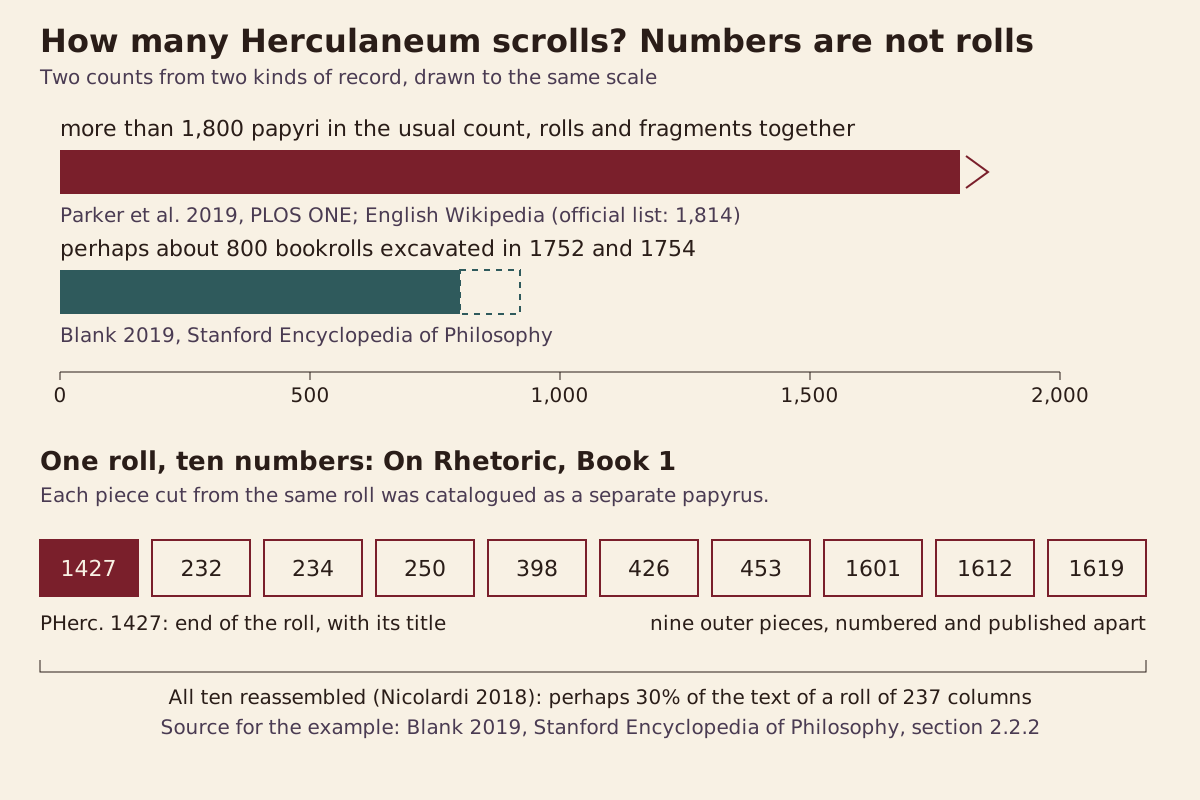
How many rolls there were depends on what is counted. Parker and colleagues (2019) give more than 1,800 papyrus rolls, and English Wikipedia gives an official list of 1,814 rolls and fragments. Blank estimates the bookrolls dug up in 1752 and 1754 at perhaps about 800. The counts measure different things: the official list includes fragments, and Blank notes that each piece cut from a roll got its own papyrus number.
Whose library?
Blank lists who else is on the shelves. Besides Philodemus and Epicurus there are other Epicureans (Demetrius of Laconia, Colotes, Polystratus, Carneiscus, Metrodorus and Zeno of Sidon), at least two books by the Stoic Chrysippus, and a group of Latin rolls. The Latin group includes a poem on the battle of Actium (PHerc. 817) and a history by Seneca the Elder (PHerc. 1067), and K. Kleve identified a possible manuscript of Lucretius.
Philodemus's own titles named in the encyclopedia include On Music, On Poems, On Rhetoric, On Death, On the Gods, On Vices and On Anger. Those hoped-for lost books of Livy are tracked in the Lost Books of Antiquity.
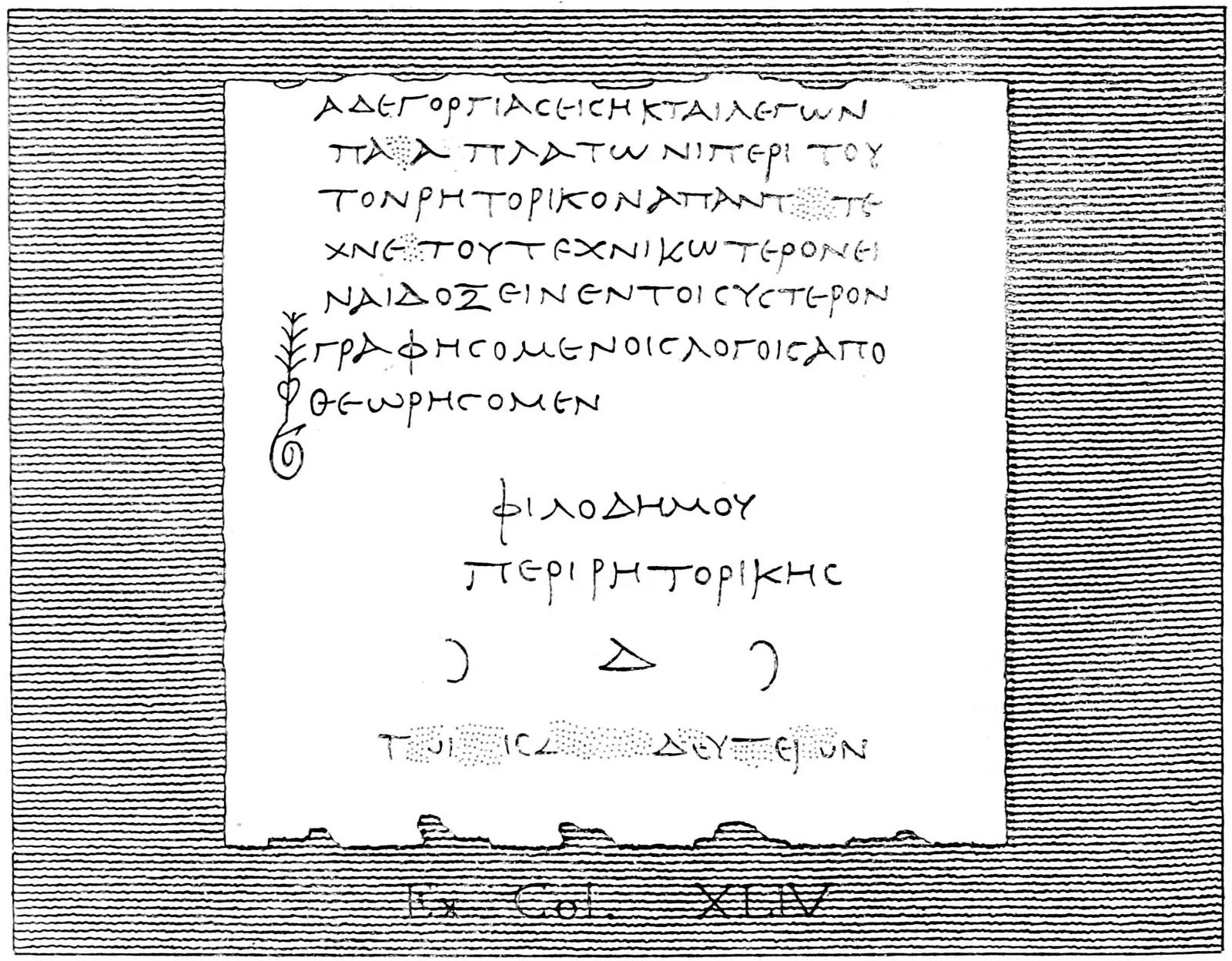
The "mostly Philodemus" description comes with a caveat. Blank notes that many rolls have lost the closing page where a scribe wrote the author and title, and nearly all have lost the opening one. Many such rolls were assigned to Philodemus indirectly, from the handwriting, the kind of roll, and the style and content of the text, though Blank adds that most attributions to Philodemus are generally accepted by scholars.
Source and licence
"Tesoro letterario di Ercolano p76b" by Giacomo Castrucci, Tesoro letterario di Ercolano, ossia, La reale officina dei papiri ercolanesi (Naples: Fibreno, 1858), page 76 — https://commons.wikimedia.org/wiki/File:Tesoro_letterario_di_Ercolano_p76b.jpg — Public domain (plate in Giacomo Castrucci's book published in Naples in 1858; Castrucci 1794-1858 per the Internet Archive catalogue record of the book; US: published before 1931; EU: more than 70 years after the author's death (an unnamed engraver of an 1858 plate is also past 70 years from publication))Who owned the villa, and its books, is still argued. The three proposals below are set side by side, not ranked.
| Proposal | Evidence offered | Questions raised |
|---|---|---|
| The family of Lucius Calpurnius Piso Caesoninus, Julius Caesar's father-in-law and Philodemus's patron | A bust some scholars identify as Piso and a statue of Athena, a figure linked with Piso by a statue base in Athens (Blank 2019); Parker and colleagues call it a home "believed to belong to the family of Julius Caesar's father-in-law" | Only some scholars identify the bust as Piso; a bronze bust of Piso's son from Herculaneum is not clearly from the villa, and Blank points to Capasso (2010) for a discussion of ownership theories |
| Philodemus himself, as owner of the library | Suggested by Ethel Ross Barker in 1908, as English Wikipedia reports; Blank calls it plausible that at least the philosophical rolls were his | English Wikipedia calls Piso "far more likely" as the owner; Blank asks why the books would have stayed in the villa for about a century after Philodemus's death, and cites decoration that dates the villa to around 40 BC, too late to have been his home in 55 BC, when Cicero puts him with Piso |
| A collector who acquired Philodemus's own library along with other books | Blank's suggestion that the philosophical rolls may have been one specialized collection, perhaps left behind as unused | Blank offers it as a possibility, and notes that copies of Philodemus's works made after his death show a continuing interest in his philosophy |
Unrolling by hand: Piaggio's machine
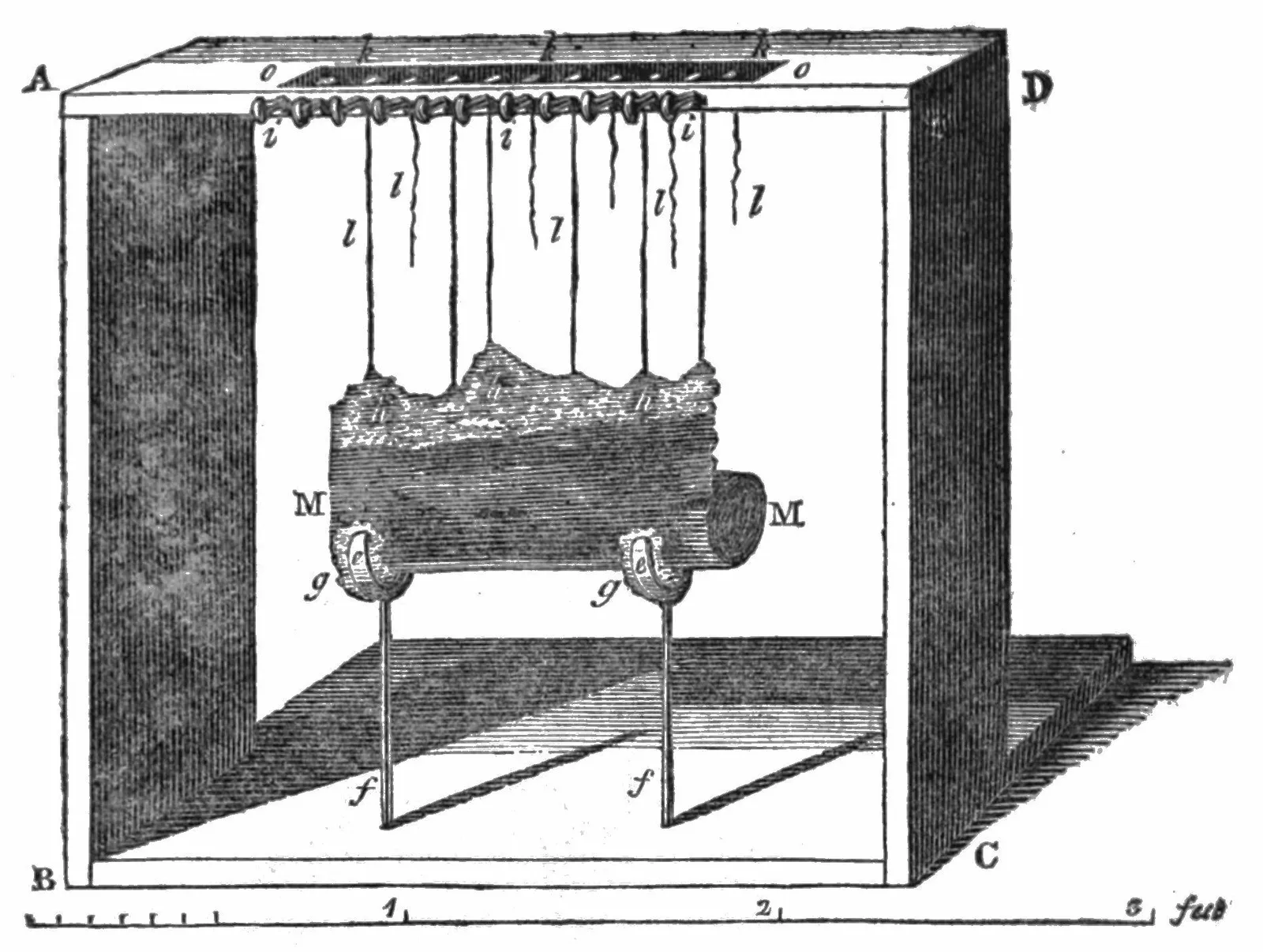
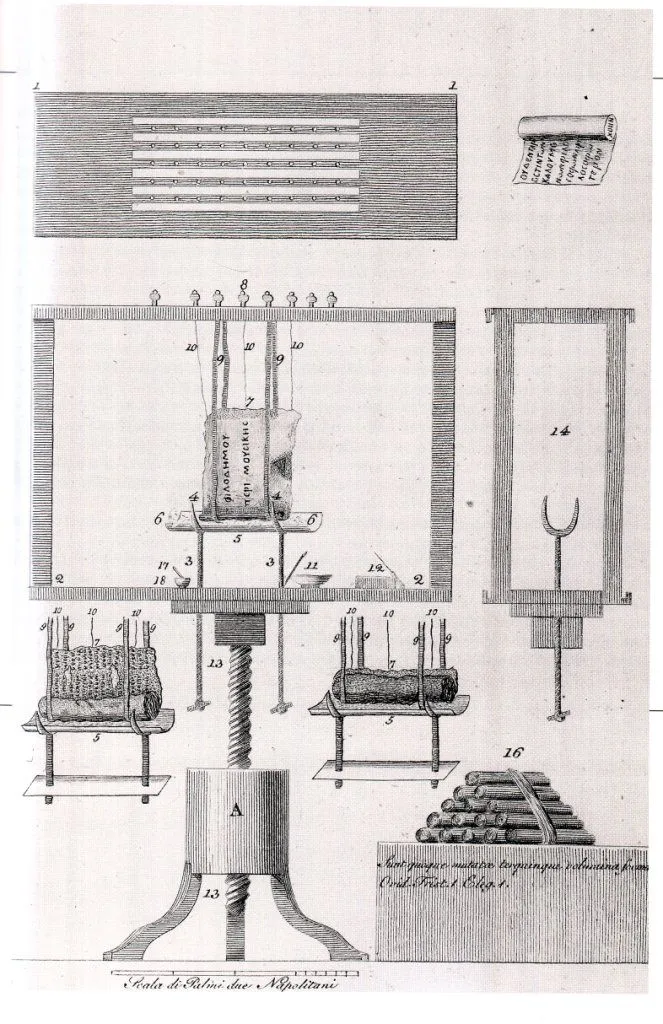
Paderni's own method, as Blank describes it, was to cut a roll lengthwise, copy the layer of writing that showed, then scrape it off to reach the next layer. The copying moved backward through the text and destroyed each layer once it was drawn. The inner cores that survived were opened on a frame built by Antonio Piaggio, a priest, which drew the roll open with silk threads attached to its edge (Ethel Ross Barker's 1908 account, as quoted by English Wikipedia).
Source and licence
"Abbot Piaggios machine Device-to-unroll-papyri 1756 Vatican" by Giacomo Castrucci, Tesoro letterario di Ercolano, ossia, La reale officina dei papiri ercolanesi (Naples: Fibreno, 1858) — https://commons.wikimedia.org/wiki/File:Abbot_Piaggios_machine_Device-to-unroll-papyri_1756_Vatican.jpg — Public domain (plate in Giacomo Castrucci's book published in Naples in 1858; Castrucci 1794-1858 per the Internet Archive catalogue record of the book; US: published before 1931; EU: more than 70 years after the author's death (an unnamed engraver of an 1858 plate is also past 70 years from publication))The sources give two dates for the first result. Blank says that in 1754–55 Piaggio finished unrolling the end of one book, a work by Philodemus against the art of music. English Wikipedia says Piaggio began in 1756 and that the first roll took four years. The work was slow at first, with only 18 rolls successfully unrolled in the workshop's first phase, from 1754 to 1798; under John Hayter, an English clergyman paid by the Prince of Wales, over 200 were unrolled in the five years from 1802 (Blank 2019).
Reading without unrolling
Opened pieces were read under microscopes from 1970 and, from 2000, in digital photographs, most of them in the near infrared (Blank 2019). Closed rolls were harder. Their ink is a carbon ink, "lamp black," long held to be invisible in ordinary micro-CT scans, and the first such scans of closed rolls, in 2009, showed their inner structure but not clearly their ink (Parker and colleagues, 2019).
Parker's team lists phase-contrast X-ray studies that claimed Greek letters and words inside rolled papyri, among them a 2015 paper by Vito Mocella's team. Such results, they wrote, "have yet to be confirmed, extended, or used to reveal complete passages of text," and "no identifiable, readable text has been recovered from inside a closed Herculaneum scroll." In the same paper they trained a machine learning model, a 3D convolutional neural network, to detect carbon ink in micro-CT scans of Herculaneum material.
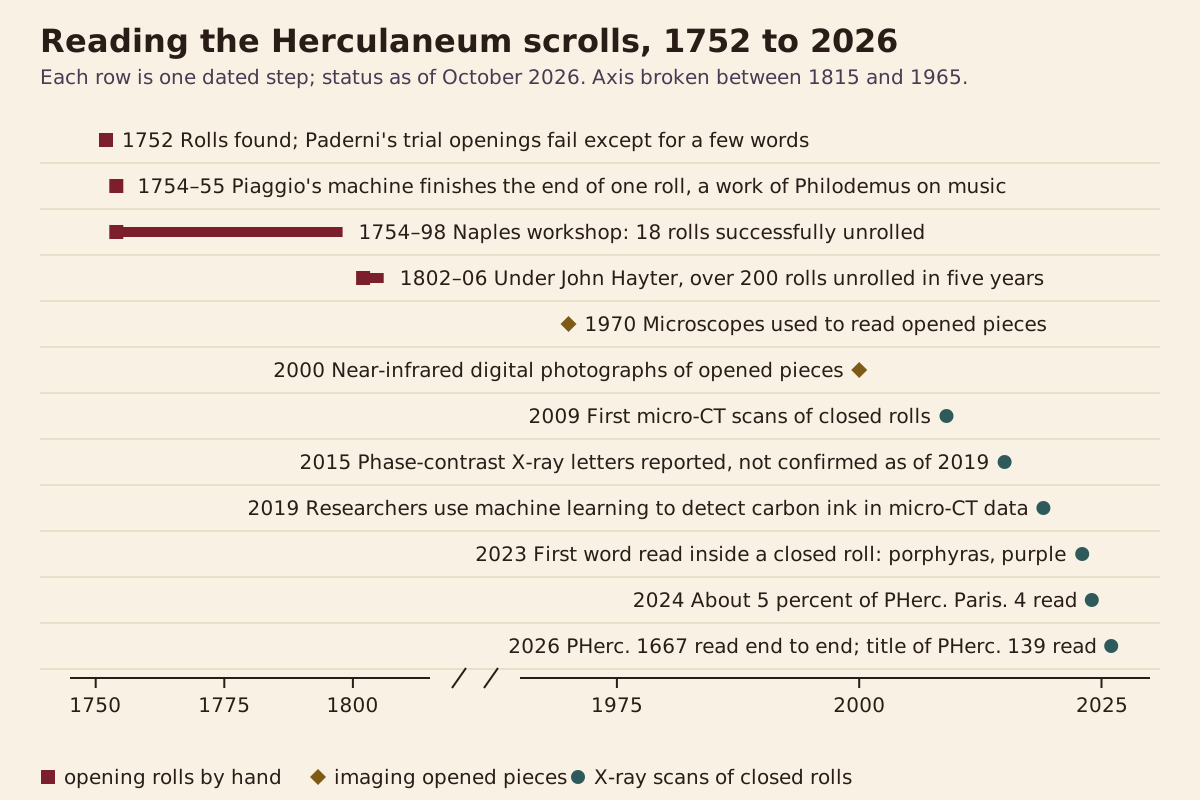
Timeline data: herculaneum-scrolls-reading-timeline.csv, with the source and link for every row.
The Vesuvius Challenge, a prize contest launched on March 15, 2023, by Nat Friedman, Daniel Gross and Brent Seales, released X-ray scans of Institut de France rolls. Its steps since then, as of October 19, 2026:
| Date | Step | Reported by |
|---|---|---|
| October 2023 | A first word, porphyras ("purple"), read inside a closed roll | English Wikipedia |
| February 2024 | More than 2,000 characters from about 5% of PHerc. Paris. 4, on pleasure in the Epicurean sense | Vesuvius Challenge |
| June 2026 | PHerc. 1667 read end to end: about 22 columns, on roughly 1.4 meters of papyrus | Vesuvius Challenge; preprint by Angelotti and colleagues |
| June 2026 | Title of PHerc. 139 read: Philodemus, On Gods, Book 8 | Vesuvius Challenge |
PHerc. 1667 is the inner core left after hand openings in the 19th century, in 1969 and in the 1980s. The team says it was scanned by phase-contrast X-ray microtomography at the European Synchrotron Radiation Facility in Grenoble. The researchers then traced the wound sheet and flattened it, picked out the ink with machine learning, and papyrologists transcribed the columns. Its last surviving column mentions Aristocreon, a nephew and student of the Stoic Chrysippus, and from that name and the text's wording and subjects the team places this ethical treatise among Stoic writings.
The project counts hundreds of rolls as still sealed. In October 2026 it paid a prize for letters found inside PHerc. 343.
What is still underground
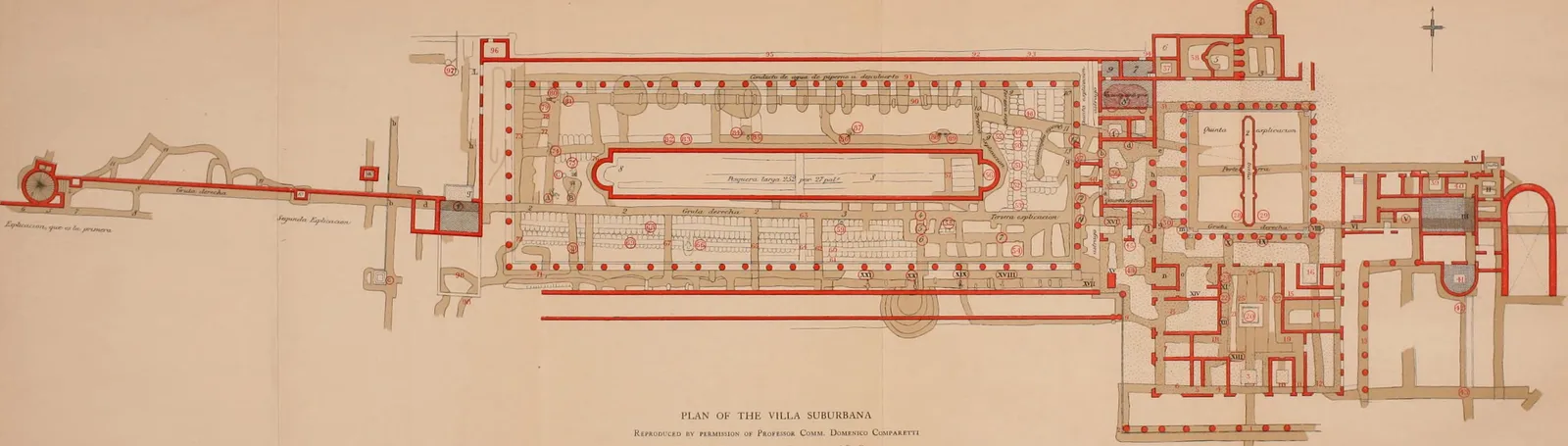
As English Wikipedia summarizes it, the villa was explored through tunnels from 1750 until digging was halted in 1765. The Swiss engineer Karl Weber worked there under Roque Joaquín de Alcubierre, who headed the Herculaneum excavations. The site was then lost for two centuries until it was found again in 1986 through an ancient well, and excavations in the 1990s uncovered two lower floors. Wikipedia reports that as of 2012 some 2,800 square meters were still to be dug, and that most of the villa remains underground.
Source and licence
"Herculaneum, past, present and future (1908) (14596218878)" by Karl Weber (survey, 1750-58); facsimile by Domenico Comparetti and Giulio De Petra; reprinted as Plate 48 in Charles Waldstein and Leonard Shoobridge, Herculaneum: Past, Present and Future (London: Macmillan, 1908) — https://commons.wikimedia.org/wiki/File:Herculaneum,_past,_present_and_future_(1908)_(14596218878).jpg — Public domain (plan taken from Karl Weber's survey of 1750-58, an 18th-century work; facsimile by Domenico Comparetti (1835-1927) and Giulio De Petra (1841-1925); reprinted in London in 1908 by permission of Comparetti; US: published before 1931; EU: more than 70 years after the deaths of all named contributors to the plan. Flickr 'No known copyright restrictions' on Commons is a lead only)Whether more rolls lie in those levels is an open question. English Wikipedia quotes Mocella and colleagues hoping for papyri not yet found, perhaps a second library of Latin papyri, at a lower level not yet dug. The Latin rolls already known are the group Blank describes.
Earliest ink
- Herculaneum papyri: 1752. Camillo Paderni's letter to Dr. Mead, dated Naples, November 18, 1752, printed in Philosophical Transactions 48 (1753), pp. 71–73, reports the rolls found less than a month earlier. It is the earliest dated written report of the rolls in the sources checked for this page (Royal Society record).
- Philodemus's philosophical works: first century BC to first century AD. Blank writes that these works survive only in papyri copied while Philodemus was alive or within a century of his death, so for each treatise the first-ink date is that of its Herculaneum copy (Stanford Encyclopedia of Philosophy). The notes on how the site dates records explain why that marks where the paper evidence starts, not where a text began.
Sources checked through 2026-10-19.
Where the trail goes next
- Books known only from later witnesses: Lost Books of Antiquity follows works such as Livy's lost books, the kind of text eighteenth-century scholars hoped the rolls would hold.
- Another library left in a ruined building: Library of Ashurbanipal traces the clay tablets dug from the palace ruins of Nineveh.
- Philodemus himself: David Blank's Stanford Encyclopedia of Philosophy entry discusses his works by subject, with their roll numbers.
Cite this page
Where Tales Began. “Herculaneum Scrolls: The Villa Library Was Mostly Philodemus.” First published October 20, 2026; last substantive revision October 20, 2026. https://wheretalesbegan.com/lostbooks/herculaneum-scrolls/. Accessed: add the date you read this page.
- Author
- Where Tales Began
- Title
- Herculaneum Scrolls: The Villa Library Was Mostly Philodemus
- Published
- Revised
- Address
- https://wheretalesbegan.com/lostbooks/herculaneum-scrolls/
Sources
- Camillo Paderni, "Extract of a Letter from Signor Camillo Paderni, to Dr. Mead, concerning the Antiquities Dug Up from the Antient Herculaneum, dated from Naples, Nov. 18, 1752. Translated from the Italian," Philosophical Transactions 48 (1753): 71–73. doi.org/10.1098/rstl.1753.0010 Read: pp. 71–73 of the 1753 printed text (vol. 48, part 1)
- David Blank, "Philodemus," The Stanford Encyclopedia of Philosophy, first published April 10, 2013, substantive revision January 16, 2019. plato.stanford.edu/entries/philodemus Read: opening summary and sections 1.4, 2.2.1–2.2.4
- C. Seth Parker, Stephen Parsons, Jack Bandy, Christy Chapman, Frederik Coppens and W. Brent Seales, "From invisibility to readability: Recovering the ink of Herculaneum," PLOS ONE 14, no. 5 (2019): e0215775. doi.org/10.1371/journal.pone.0215775 Read: full text: introduction, related work and discussion Text licence: CC BY 4.0
- Vito Mocella, Emmanuel Brun, Claudio Ferrero and Daniel Delattre, "Revealing letters in rolled Herculaneum papyri by X-ray phase-contrast imaging," Nature Communications 6 (2015): 5895. doi.org/10.1038/ncomms6895 Read: bibliographic record only
- Giorgio Angelotti, Stephen Parsons, Federica Nicolardi and 24 other authors, "Complete virtual unwrapping and reading of a rolled Herculaneum papyrus," preprint, arXiv:2606.29085, June 27, 2026. doi.org/10.48550/arXiv.2606.29085 Read: bibliographic record only
- Vesuvius Challenge, "We read an entire scroll — without ever opening it," June 25, 2026. scrollprize.org/firstscroll Read: full page
- Vesuvius Challenge, "Vesuvius Challenge 2023 Grand Prize awarded: we can read the first scroll!," February 5, 2024. scrollprize.org/grandprize Read: full page
- Vesuvius Challenge, "Winners" (list of prizes awarded, read 2026-10-19). scrollprize.org/winners Read: prize list from October 2026 back to 2023
- English Wikipedia, "Herculaneum papyri" (read 2026-10-19). en.wikipedia.org/wiki/Herculaneum_papyri Read: full article, revision of August 16, 2026
- English Wikipedia, "Villa of the Papyri" (read 2026-10-19). en.wikipedia.org/wiki/Villa_of_the_Papyri Read: full article
- English Wikipedia, "Philodemus" (read 2026-10-19). en.wikipedia.org/wiki/Philodemus Read: full article