Comparison table or list
Lost Books of Antiquity: Summaries That Outlived the Books
- By
- Where Tales Began
- Published
- Last substantive revision
How records are checked: Following the paper trail. Corrections: Fixes to the record. Questions: Contact us.
Fast facts
- Name
- Lost books of antiquity: 12 works in this catalogue
- Classification
- Grouped by evidence: summary, quotation or scrap, catalogue entry, or little more than a title
- Earliest ink
- Earliest dated witnesses in the sources checked: Herodotus citing the Cypria (5th century BC) and Aristophanes parodying Euripides' Andromeda (411 BC)
- Where found
- Works in Greek, Latin and Chinese; witnesses from Rome to Constantinople and Tang China
- TL;DR
- Twelve ancient works that no longer survive whole, each listed with the kind of evidence that shows it existed. Summaries, quotations, papyrus scraps, catalogue entries and bare titles keep them on record. The latest dated witness checked for each falls between the 2nd and 12th centuries AD.
Download these facts (CSV, lost-books-antiquity-fast-facts.csv)
Livy wrote 142 books of Roman history, and 107 of them are lost. Yet short summaries called the Periochae survive for 105 of those missing books, so their contents can still be listed book by book. Lost books of antiquity are ancient works that are gone as wholes but known because later writers summarized, quoted, listed or named them.
This entry covers 12 of them, written in Greek, Latin and Chinese. For each, it gives the kind of evidence and the latest dated witness in the sources checked.
How a lost book leaves evidence
The evidence for a lost book is sorted here into five kinds of trace. A summary keeps the outline but not the words, while a quotation keeps a few exact words. A scrap of an old copy keeps part of a page, a catalogue keeps a title and often a length, and a passing mention may keep only the name. The chart below sorts the 12 works by these traces.
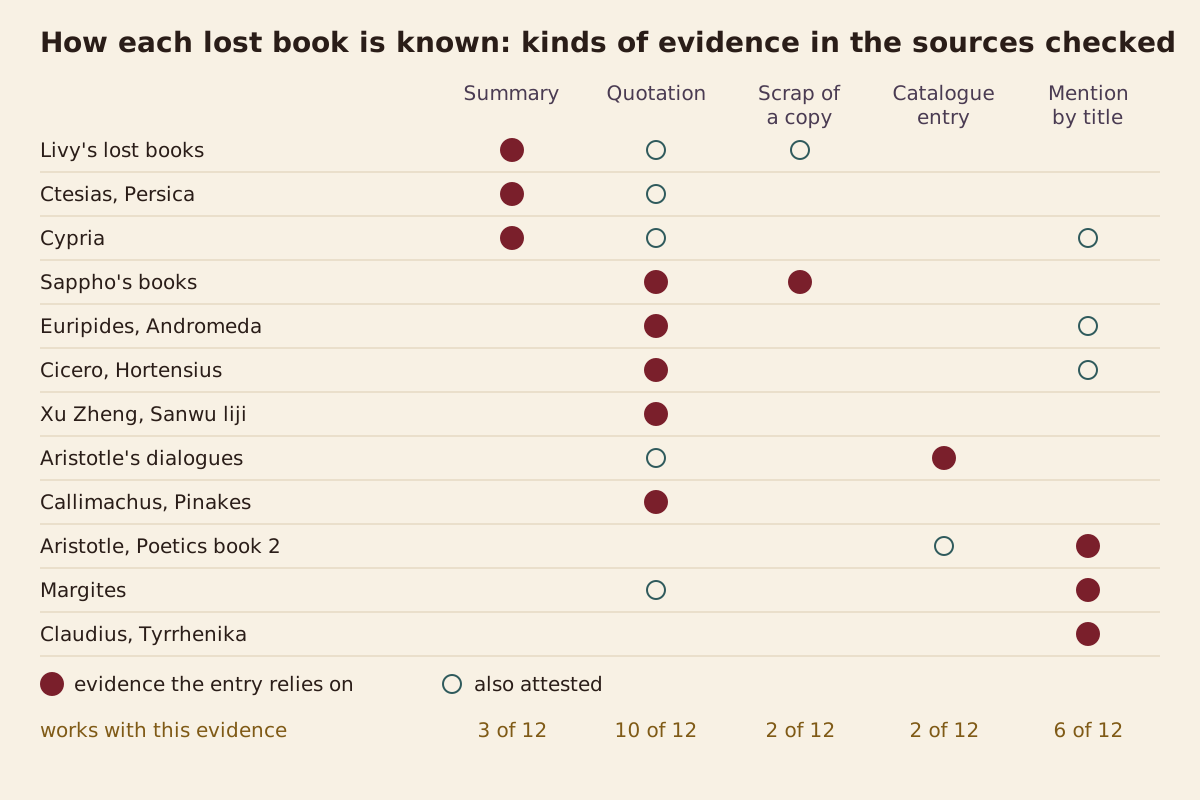
In this set, quotation is the commonest trace: 10 of the 12 works are quoted somewhere in these sources. The table gives each work's main witness and its latest dated witness. Here a latest dated witness means the latest ancient or medieval text in these sources that copies, quotes, sums up, lists or names the work, other than to say it is gone.
Dates come from the editions cited or, where those give none, from English Wikipedia's summaries. The page on how the site follows a paper trail explains how records are dated. The CSV names a source for every row.
| Work | Written | Main witness | Latest dated witness checked |
|---|---|---|---|
| Livy, History of Rome, books 11–20 and 46–142 | 27–9 BC | the Periochae, short summaries | the Periochae, 4th century AD |
| Ctesias, Persica, 23 books | after 398 BC | Photius, Bibliotheca, codex 72 | Photius, 9th century AD |
| Cypria, 11 books | c. 7th century BC | Proclus's plot summary | John Tzetzes, 12th century AD |
| Sappho's poems | c. 630–570 BC | Dionysius of Halicarnassus; P.Oxy. 7 | parchment copies, 6th–7th century AD |
| Euripides, Andromeda | 412 BC | Aristophanes' parody, 411 BC | Lucian, 2nd century AD |
| Cicero, Hortensius | 45 BC | Augustine, Confessions | Augustine, AD 397–400 |
| Xu Zheng, Sanwu liji | 3rd century AD | quoted in the Yiwen leiju | Yiwen leiju, AD 624 |
| Aristotle's dialogues | 4th century BC | Diogenes Laertius's catalogue | Diogenes Laertius, 3rd century AD |
| Callimachus, Pinakes, 120 books | about 245 BC | citations in Athenaeus | Athenaeus, c. AD 200 |
| Aristotle, Poetics book 2 | c. 335 BC | Aristotle's own cross-references | Diogenes Laertius, 3rd century AD |
| Margites | uncertain | Aristotle, Poetics chapter 4 | the Suda, 10th century AD |
| Claudius, Tyrrhenika, 20 books | 10 BC–AD 54 | Suetonius, Life of Claudius | Suetonius, c. AD 121 |
Table data: lost-books-antiquity-catalogue.csv, with the sources and links for every row.
Known from a summary
Livy wrote his History of Rome between 27 and 9 BC, and it once ran to 142 books. Of those, 35 survive: books 1–10 and 21–45, four of them with gaps. The Periochae, short summaries made in the 4th century AD according to English Wikipedia, cover every book except 136 and 137.
The summaries are terse. In the Latin text on Wikisource, the one for book 138 has three short sentences: the Raeti are subdued by Tiberius and Drusus, Agrippa dies, and Drusus holds a census.
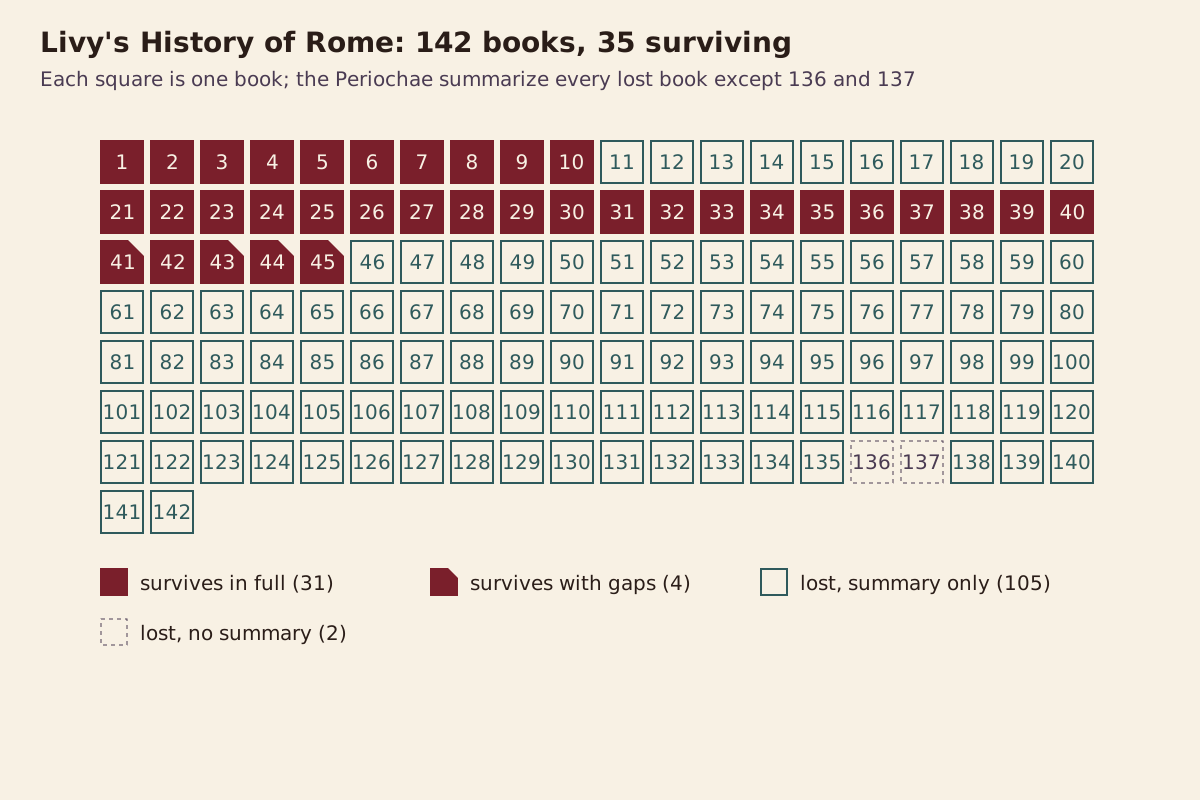
The numbering needs care. W. A. McDevitte's English translation of 1850 numbers the summaries only to 140, and its book 136 matches book 138 in the Latin text. The status of every book is in lost-books-antiquity-livy-books.csv.
Ctesias of Cnidus was a court physician to the Persian king Artaxerxes Mnemon from 401 to 384 BC, as J. H. Freese notes in his 1920 translation of Photius. Ctesias wrote a Persica in 23 books, now lost.
Photius, patriarch of Constantinople in the 9th century, still read it. Codex 72 of his Bibliotheca opens, "Read the Persica of Ctesias of Cnidus in twenty-three books," and then sums it up (Freese). The Persica ended its story in 398 BC, by English Wikipedia's dates, so Photius read it more than 1,100 years later.
The Cypria was an epic in 11 books on the Trojan War up to the point where the Iliad begins, known chiefly from a plot summary by one Proclus in a handbook called the Chrestomathy. H. G. Evelyn-White's 1914 translation names him Eutychius Proclus of Sicca, while English Wikipedia calls that link uncertain. A later reader did see the poem itself: Pausanias, who lived about AD 110–180, wrote, "I know, because I have read it in the epic Cypria" (Evelyn-White's translation). In the 12th century, by English Wikipedia's dating, John Tzetzes still named its author: "Stasinus composed the Cypria" (Evelyn-White).
Known from quotations and scraps
Sappho's poems filled at least eight books in their ancient Alexandrian edition, English Wikipedia says. H. T. Wharton, writing before his death in 1895, says only that nine books "are said to have existed." Only one poem, the Ode to Aphrodite, is certainly complete. The whole of it survives only because Dionysius of Halicarnassus quoted it.
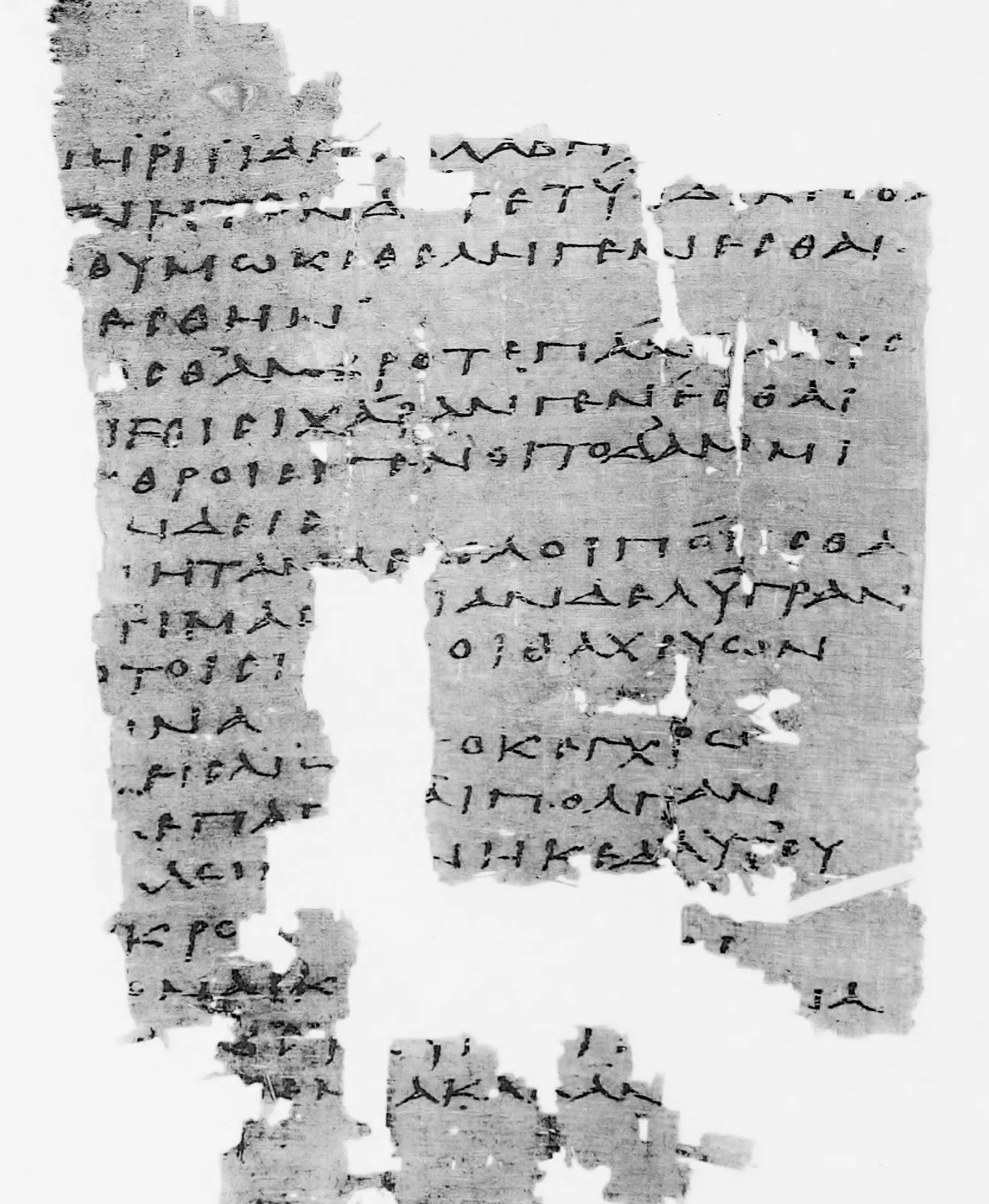
Dionysius quoted it at Rome as a model of smooth, finished style, about 25 BC by Wharton's date or between 20 and 10 BC by the conjecture in W. Rhys Roberts's 1910 edition. Papyrus adds more. P.Oxy. 7, a 3rd-century AD copy found at Oxyrhynchus in Egypt, appeared in print in 1898 with part of another poem.
Source and licence
"P.Oxy. I 7" by The Egypt Exploration Fund — https://commons.wikimedia.org/wiki/File:P.Oxy._I_7.jpg — Public domain (photographic plate of a 3rd-century AD papyrus published in 1898 in B. P. Grenfell and A. S. Hunt, The Oxyrhynchus Papyri, Part I (Egypt Exploration Fund), no photographer named; US: published before 1931; EU: published without a named author more than 70 years ago, and a faithful photograph of a public-domain two-dimensional artifact creates no new rights (EU DSM Directive art. 14))Euripides first staged his Andromeda in 412 BC, and Aristophanes mocked it in the Thesmophoriazusae a year later, as English Wikipedia summarizes. More than five centuries on, in the 2nd century AD, Lucian retold a story of a fever at Abdera whose victims went about reciting the play. He quotes the start of Perseus's speech: "O Love, who lord'st it over Gods and men" (H. W. and F. G. Fowler's translation, 1905). The myth behind it, with Andromeda chained to a rock, is traced in the Cassiopeia entry.
Cicero's Hortensius (45 BC), a dialogue urging readers toward philosophy, survives only in fragments that English Wikipedia finds in five later authors. Among them is Augustine. His Confessions (AD 397–400) say he came on the book in his nineteenth year: "This book of his contains an exhortation to philosophy, and is called 'Hortensius'" (E. B. Pusey's translation).
The Chinese Sanwu liji (三五曆紀), credited to Xu Zheng of the 3rd century AD, is lost, and Chinese Wikipedia says only passages survive, quoted in later encyclopedias such as the Yiwen leiju, finished in 624. Its passage on the world's beginning opens "天地混沌如雞子.盤古生其中", which reads "Heaven and earth were one formless mass like a hen's egg, and Pangu was born inside it" (Translation: Where Tales Began). A note in the Wikisource text used here says this chapter is missing from the Song printing and was filled in from a Ming one.
Known from a list
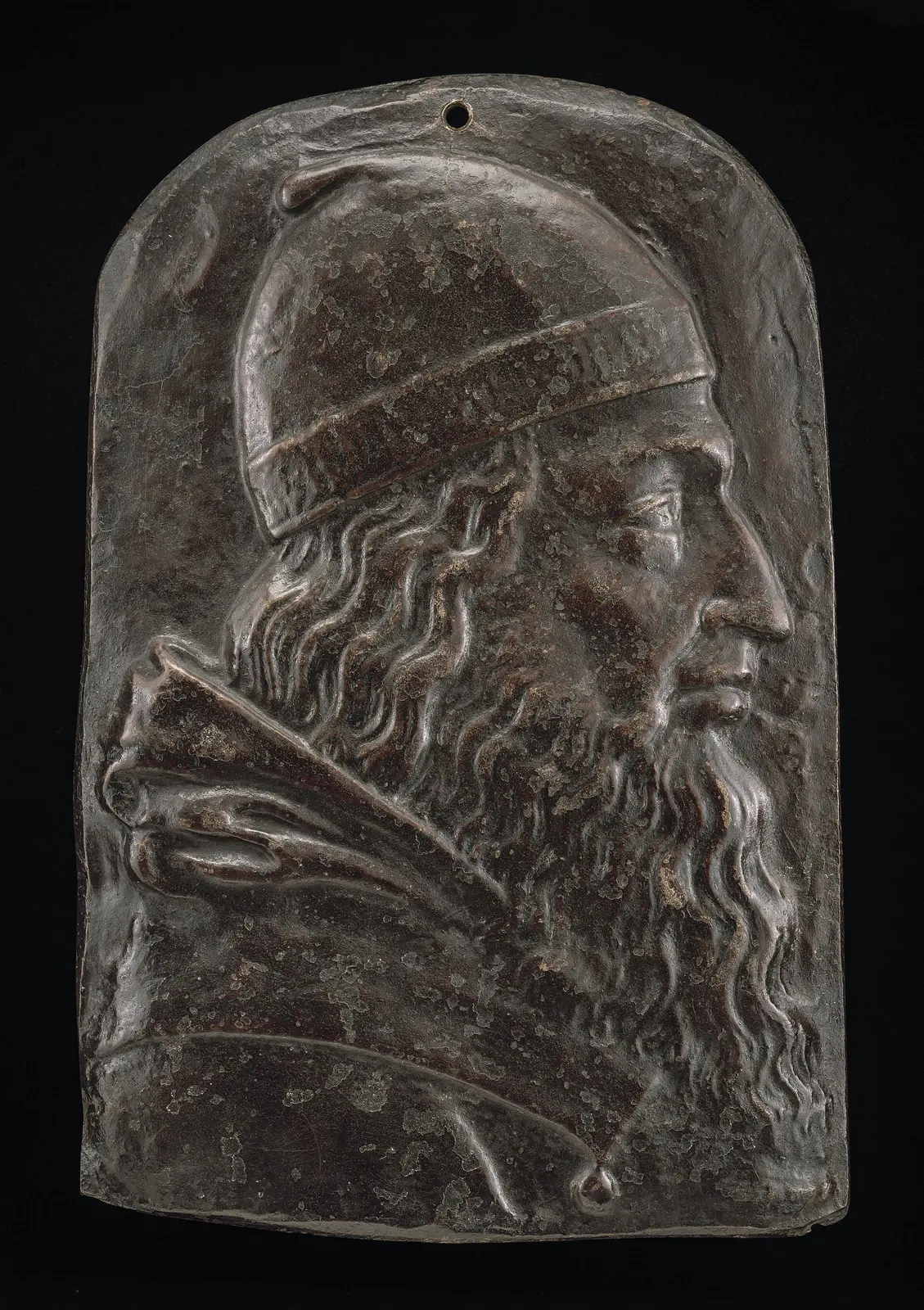
Lists keep titles even when the books are gone. Diogenes Laertius, who wrote in the first half of the 3rd century AD, gives a catalogue of Aristotle's works that opens with On Justice, On Poets and On Philosophy. It closes, "In all 445,270 lines" (R. D. Hicks's 1925 translation, Perseus Digital Library).
Elsewhere Diogenes calls On Philosophy a dialogue. English Wikipedia's article on the Aristotelian corpus says the dialogues survive only in fragments.
Source and licence
"Florentine 15th Century, Bust of Aristotle, 15th century, NGA 43846" by Florentine 15th Century; National Gallery of Art, Washington, Samuel H. Kress Collection 1957.14.126 — https://commons.wikimedia.org/wiki/File:Florentine_15th_Century,_Bust_of_Aristotle,_15th_century,_NGA_43846.jpg — CC0 1.0 (https://creativecommons.org/publicdomain/zero/1.0/)A book list can itself be lost. Callimachus's Pinakes ("Tables"), from about 245 BC, listed the authors held at the Library of Alexandria in 120 books, as English Wikipedia summarizes it. Its form shows through later citations.
Athenaeus, writing about AD 200, says Callimachus listed books on the art of making cheesecakes. In a list of laws, he adds, Callimachus "quoted the first words" of a code of rules for banquets. In C. D. Yonge's 1854 translation, that quotation ends, "it is written in three hundred and twenty-three verses."
A list can show that a book existed without saving a line of it. The same question, what a record of books can prove once the books are gone, comes up at a royal library of the 7th century BC at Nineveh. It is followed in the Library of Ashurbanipal entry.
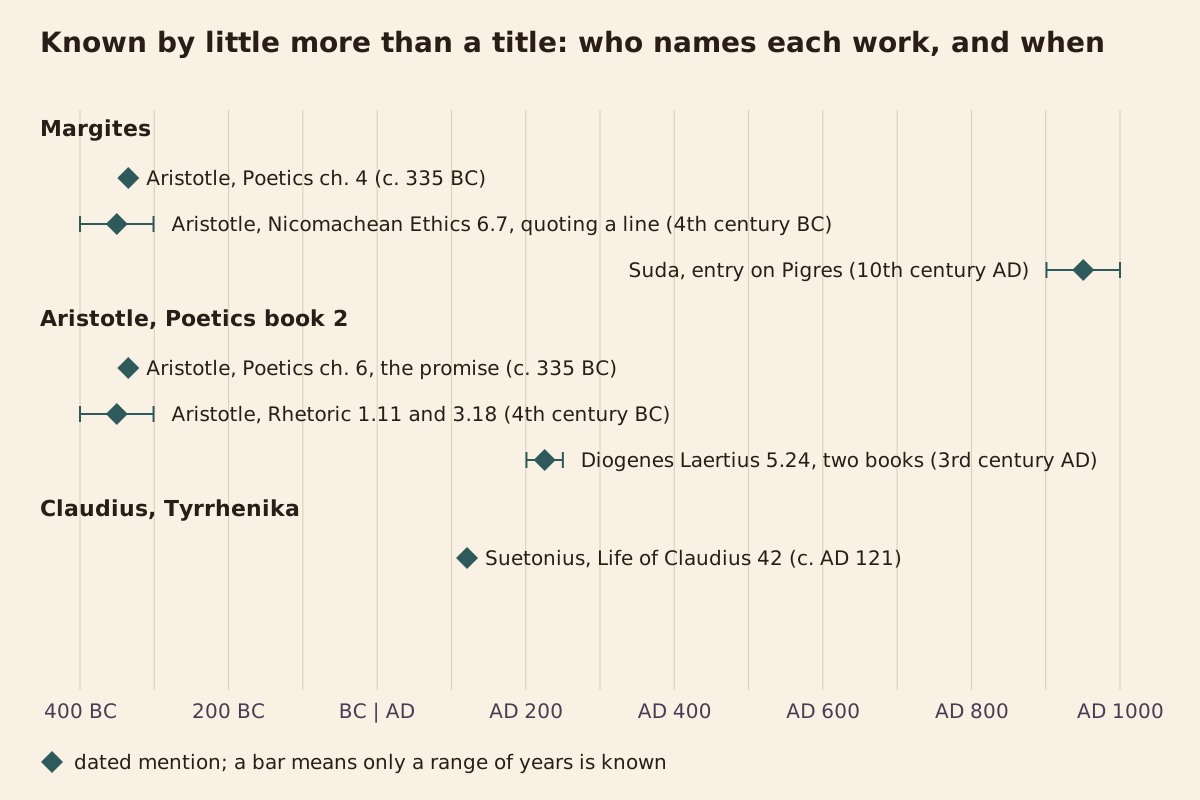
Known by little more than a title
Aristotle's Poetics promises more than survives. Chapter 6 says, "Of the poetry which imitates in hexameter verse, and of Comedy, we will speak hereafter" (S. H. Butcher's translation). Yet the part that survives covers tragedy and epic, as English Wikipedia notes.
The Rhetoric twice points readers to a discussion of jokes in the Poetics, and J. H. Freese's 1926 note on the second passage says, "The chapters are lost." Diogenes Laertius lists "A Treatise on the Art of Poetry, two books."
The Margites was a comic poem about a fool. Aristotle, who credits it to Homer in Poetics chapter 4, writes that it "bears the same relation to Comedy that the Iliad and Odyssey do to Tragedy" (Butcher).
Evelyn-White's 1914 collection prints five fragments, only a handful of lines, among them "He knew many things but knew all badly." The Suda, a 10th-century encyclopedia, gives the poem to Pigres of Halicarnassus instead.
Claudius, emperor from AD 41 to 54, wrote in Greek a history of the Etruscans in 20 books and one of Carthage in 8. The source is Suetonius's Life of Claudius, written around 121.
Suetonius also says that a second museum at Alexandria, named after Claudius, was added to the old one. On set days each year, the Etruscan history was to be read through in one museum and the Carthaginian in the other, with readers taking turns. English Wikipedia's article on Claudius says none of his works survived.
Source and licence
"Dated mentions of three lost works known by little more than a title" by Where Tales Began, https://wheretalesbegan.com/lostbooks/lost-books-antiquity/, licensed under CC BY 4.0 (https://creativecommons.org/licenses/by/4.0/)Last seen
The timeline below sets each work's date of writing beside its latest dated witness in the sources checked. The dates are in lost-books-antiquity-witnesses.csv. Read each latest witness as a floor, not a date of loss, since a later copy or quotation may exist outside these sources.
This entry assigns no cause of loss to any of the 12 works; it only marks where each trail goes quiet.
Those latest witnesses run from the 2nd century AD to the 12th. Suetonius named Claudius's histories around 121, and Lucian quoted the Andromeda later in the same century. Augustine wrote about the Hortensius around 400, Photius read the Persica in the 9th century, and John Tzetzes named the author of the Cypria in the 12th.
The last ancient copies of Sappho that survive are parchment pages of the 6th and 7th centuries. By the 12th century, English Wikipedia reports, John Tzetzes wrote that time had destroyed Sappho and her works.
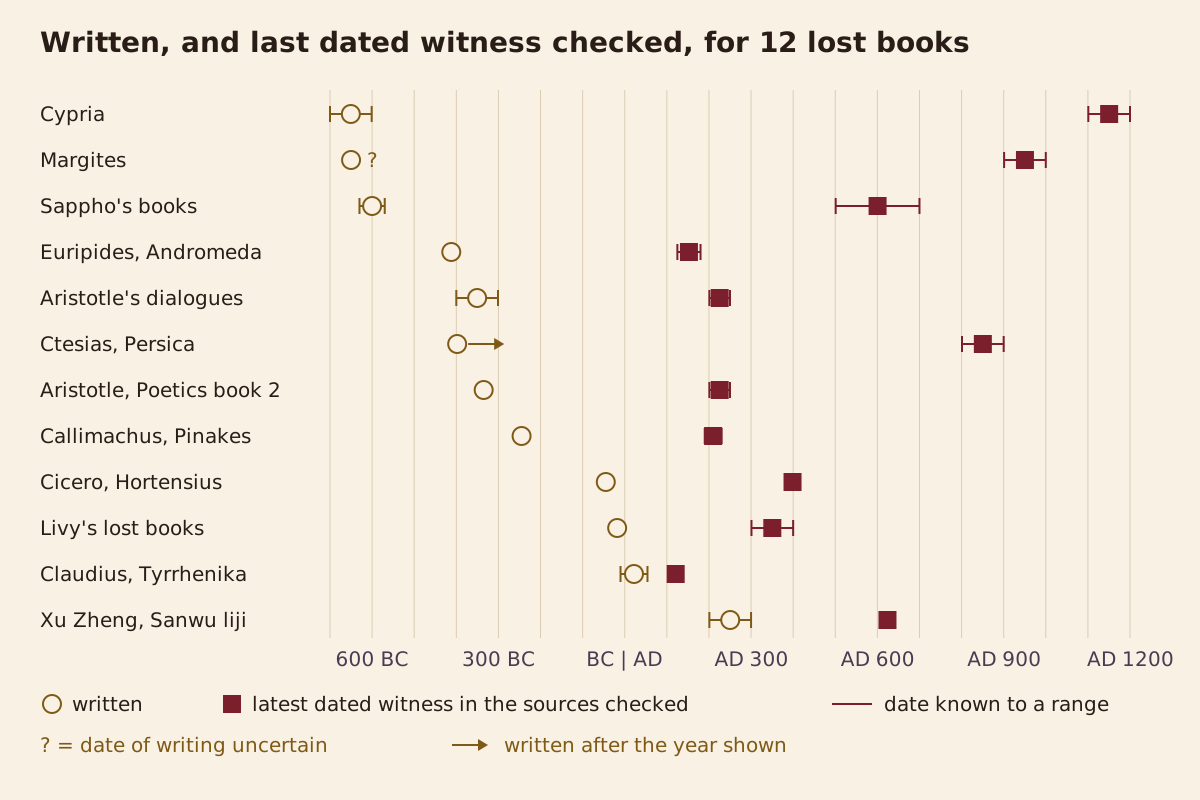
What became of the Library of Alexandria is a separate question. This entry leaves it aside. The table shows something narrower: the latest witnesses for the Persica, the Margites and the Cypria are Byzantine writings of the 9th, 10th and 12th centuries.
Some lost text has come back. A set of papyri published in 2014 holds parts of ten consecutive poems by Sappho, according to English Wikipedia. The Homeric Hymn to Demeter survives in only one manuscript, found at Moscow, as Evelyn-White notes. Its story is followed in the entry on Persephone's pomegranate.
One open case is a set of more than 1,800 numbered papyri from the Villa of the Papyri at Herculaneum. English Wikipedia (read October 2026) says ways to read them are still being worked out; see the Herculaneum scrolls.
Earliest ink
- Citation: 5th century BC. Herodotus cites the Cypria, the earliest dated citation in this table: "For it is said in the Cypria that Alexandrus came with Helen to Ilium from Sparta in three days" (Evelyn-White 1914, Cypria fragment 10; Herodotus's century as given in English Wikipedia's article on Sappho).
- Parody: 411 BC. Aristophanes' Thesmophoriazusae parodies Euripides' Andromeda a year after its premiere, the earliest dated reference to the play in the sources checked, as summarized by English Wikipedia's article on the play.
- Title: c. 335 BC. Aristotle's Poetics names the Margites in chapter 4 and promises a discussion of comedy in chapter 6, the earliest dated mentions of the three works in this table known by little more than a title (Butcher translation).
- Catalogue: 3rd century AD. Diogenes Laertius's list of Aristotle's works is the oldest surviving catalogue in this table (Hicks 1925, Perseus Digital Library).
- Summary: 4th century AD. The Periochae of Livy are the oldest dated summary in this table; Proclus's summary of the Cypria may be older, but who he was and when he wrote are uncertain (Latin text).
Sources checked through 2026-10-19.
Where the trail goes next
- A buried library still being read: Herculaneum scrolls, where carbonized rolls from the Villa of the Papyri are the open case.
- A library known from clay tablets: Library of Ashurbanipal, for what tablets and lists show about a royal collection at Nineveh.
- The summarizer himself: Photius's Bibliotheca in J. H. Freese's 1920 translation, from codex 72 on.
Cite this page
Where Tales Began. “Lost Books of Antiquity: Summaries That Outlived the Books.” First published October 20, 2026; last substantive revision October 20, 2026. https://wheretalesbegan.com/lostbooks/lost-books-antiquity/. Accessed: add the date you read this page.
- Author
- Where Tales Began
- Title
- Lost Books of Antiquity: Summaries That Outlived the Books
- Published
- Revised
- Address
- https://wheretalesbegan.com/lostbooks/lost-books-antiquity/
Sources
- Photius, The Library of Photius, vol. 1, trans. J. H. Freese (London: Society for Promoting Christian Knowledge; New York: Macmillan, 1920), codex 72 and note 303. www.gutenberg.org/ebooks/79139 Read: codex 72 (Ctesias, Persica), the translator's note 303, and the table of patriarchs of Constantinople
- Hesiod, the Homeric Hymns and Homerica, trans. H. G. Evelyn-White (1914), introduction and fragments of the Cypria and the Margites. www.gutenberg.org/ebooks/348 Read: introduction (the Epic Cycle, the Hymn to Demeter, the burlesque poems); Cypria fragments 1-22; Margites fragments 1-5
- Dionysius of Halicarnassus, On Literary Composition, ed. and trans. W. Rhys Roberts (London: Macmillan, 1910), ch. 23 and the note on the Hymn to Aphrodite. www.gutenberg.org/ebooks/50212 Read: introduction and chapter 23 with its notes
- H. T. Wharton, Sappho: Memoir, Text, Selected Renderings and a Literal Translation, 5th ed. (London: John Lane, 1908). www.gutenberg.org/ebooks/57390 Read: life of Sappho, note on fragment 1, and the memoir of Wharton (death in 1895)
- Lucian, The Way to Write History, in The Works of Lucian of Samosata, trans. H. W. Fowler and F. G. Fowler, vol. 2 (Oxford: Clarendon Press, 1905). www.gutenberg.org/ebooks/6585 Read: opening section (the fever at Abdera)
- Augustine, The Confessions of Saint Augustine, trans. E. B. Pusey, books 3 and 8. www.gutenberg.org/ebooks/3296 Read: book 3 (reading the Hortensius) and book 8
- Ouyang Xun et al., Yiwen leiju 藝文類聚, juan 1, Chinese Wikisource transcription (read 2026-10-18). zh.wikisource.org/wiki/%E8%97%9D%E6%96%87%E9%A1%9E%E8%81%9A/%E5%8D%B7001 Read: juan 1, section on heaven: the quotation from Xu Zheng's Sanwu liji and the editorial note on the Song and Ming printings
- Diogenes Laertius, Lives of Eminent Philosophers, trans. R. D. Hicks (Cambridge, MA: Harvard University Press; London: William Heinemann, 1925), 1.8 and 5.21-27; digital edition urn:cts:greekLit:tlg0004.tlg001.perseus-eng2, Perseus Digital Library, PerseusDL/canonical-greekLit (GitHub, commit 0189b9c), CC BY-SA 4.0. github.com/PerseusDL/canonical-greekLit/blob/0189b9c8d8d1f148133f2f0af309b4ee90ea4332/data/tlg0004/tlg001/tlg0004.tlg001.perseus-eng2.xml Read: 1.8 and 5.21-27 Text licence: CC BY-SA 4.0
- Athenaeus, The Deipnosophists, or Banquet of the Learned, trans. C. D. Yonge, vol. 3 (London: Henry G. Bohn, 1854), books 13-15. www.gutenberg.org/ebooks/66508 Read: book 13 (Callimachus's third catalogue of laws) and book 14, ch. 51 (cheesecake treatises)
- Aristotle, The Poetics of Aristotle, trans. S. H. Butcher, chs. 4 and 6. www.gutenberg.org/ebooks/1974 Read: chapters 4 and 6
- Aristotle, The "Art" of Rhetoric, trans. J. H. Freese (London: William Heinemann; Cambridge, MA: Harvard University Press, 1926), 1.11.29 and 3.18.7 with the translator's notes; digital edition urn:cts:greekLit:tlg0086.tlg038.perseus-eng2, Perseus Digital Library, PerseusDL/canonical-greekLit (GitHub, commit 0189b9c), CC BY-SA 4.0. github.com/PerseusDL/canonical-greekLit/blob/0189b9c8d8d1f148133f2f0af309b4ee90ea4332/data/tlg0086/tlg038/tlg0086.tlg038.perseus-eng2.xml Read: 1.11.29 and 3.18.7 with notes Text licence: CC BY-SA 4.0
- Suetonius, The Lives of the Twelve Caesars: Claudius, trans. Alexander Thomson, revised by T. Forester, ch. 42. www.gutenberg.org/ebooks/6390 Read: chapter 42
- Livy, Ab urbe condita: Periochae, Latin text, Latin Wikisource (read 2026-10-18). la.wikisource.org/wiki/Ab_urbe_condita/Periochae Read: index of books 1-142 (136 and 137 marked as missing) and the summary of book 138
- Livy, The History of Rome, Books Thirty-Seven to the End, with the Epitomes and Fragments of the Lost Books, trans. W. A. McDevitte (London: Henry G. Bohn, 1850). www.gutenberg.org/ebooks/44318 Read: epitomes of books 135-140 as numbered in this edition
- English Wikipedia, "History of Rome (Livy)" (read 2026-10-18). en.wikipedia.org/wiki/History_of_Rome_(Livy) Read: summarized here through English Wikipedia: Corpus, Abridgements, and the table of contents
- English Wikipedia, "Ctesias" (read 2026-10-18). en.wikipedia.org/wiki/Ctesias Read: summarized here through English Wikipedia: lead and Persica section
- English Wikipedia, "Bibliotheca (Photius)" (read 2026-10-18). en.wikipedia.org/wiki/Bibliotheca_(Photius) Read: summarized here through English Wikipedia: lead and overview
- English Wikipedia, "Cypria" (read 2026-10-18). en.wikipedia.org/wiki/Cypria Read: summarized here through English Wikipedia: lead and infobox
- English Wikipedia, "Epic Cycle" (read 2026-10-18). en.wikipedia.org/wiki/Epic_Cycle Read: summarized here through English Wikipedia: section on Proclus and the Venetus A summary
- English Wikipedia, "Pausanias (geographer)" (read 2026-10-18). en.wikipedia.org/wiki/Pausanias_(geographer) Read: summarized here through English Wikipedia: infobox dates
- English Wikipedia, "Sappho" (read 2026-10-18). en.wikipedia.org/wiki/Sappho Read: summarized here through English Wikipedia: lead, Works, Transmission
- English Wikipedia, "Papyrus Oxyrhynchus 7" (read 2026-10-18). en.wikipedia.org/wiki/Papyrus_Oxyrhynchus_7 Read: summarized here through English Wikipedia: full article
- English Wikipedia, "Andromeda (Euripides)" (read 2026-10-18). en.wikipedia.org/wiki/Andromeda_(Euripides) Read: summarized here through English Wikipedia: lead, plot, later references
- English Wikipedia, "Lucian" (read 2026-10-18). en.wikipedia.org/wiki/Lucian Read: summarized here through English Wikipedia: infobox dates and bibliography
- English Wikipedia, "Hortensius (Cicero)" (read 2026-10-18). en.wikipedia.org/wiki/Hortensius_(Cicero) Read: summarized here through English Wikipedia: lead
- English Wikipedia, "Confessions (Augustine)" (read 2026-10-18). en.wikipedia.org/wiki/Confessions_(Augustine) Read: summarized here through English Wikipedia: lead
- English Wikipedia, "Pangu" (read 2026-10-18). en.wikipedia.org/wiki/Pangu Read: summarized here through English Wikipedia: bibliography section
- English Wikipedia, "Yiwen Leiju" (read 2026-10-18). en.wikipedia.org/wiki/Yiwen_Leiju Read: summarized here through English Wikipedia: lead
- Chinese Wikipedia, "三五曆記" (Sanwu liji) (read 2026-10-19). zh.wikipedia.org/wiki/%E4%B8%89%E4%BA%94%E6%9B%86%E8%A8%98 Read: summarized here through Chinese Wikipedia: lead
- English Wikipedia, "Corpus Aristotelicum" (read 2026-10-18). en.wikipedia.org/wiki/Corpus_Aristotelicum Read: summarized here through English Wikipedia: sections on Diogenes Laertius's list and the fragments
- English Wikipedia, "Diogenes Laertius" (read 2026-10-18). en.wikipedia.org/wiki/Diogenes_Laertius Read: summarized here through English Wikipedia: lead and life
- English Wikipedia, "Pinakes" (read 2026-10-18). en.wikipedia.org/wiki/Pinakes Read: summarized here through English Wikipedia: lead and history
- English Wikipedia, "Athenaeus" (read 2026-10-18). en.wikipedia.org/wiki/Athenaeus Read: summarized here through English Wikipedia: lead
- English Wikipedia, "Poetics (Aristotle)" (read 2026-10-18). en.wikipedia.org/wiki/Poetics_(Aristotle) Read: summarized here through English Wikipedia: lead and background
- English Wikipedia, "Claudius" (read 2026-10-18). en.wikipedia.org/wiki/Claudius Read: summarized here through English Wikipedia: infobox and scholarly works
- English Wikipedia, "The Twelve Caesars" (read 2026-10-18). en.wikipedia.org/wiki/The_Twelve_Caesars Read: summarized here through English Wikipedia: lead
- English Wikipedia, "Herculaneum papyri" (read 2026-10-18). en.wikipedia.org/wiki/Herculaneum_papyri Read: summarized here through English Wikipedia: lead
- English Wikipedia, "Library of Ashurbanipal" (read 2026-10-18). en.wikipedia.org/wiki/Library_of_Ashurbanipal Read: summarized here through English Wikipedia: lead and infobox