Catalogue entry
Izanami: In the Nihon Shoki's Main Text, She Never Dies
- By
- Where Tales Began
- Published
- Last substantive revision
How records are checked: Following the paper trail. Corrections: Fixes to the record. Questions: Contact us.
Fast facts
- Name
- Izanami (伊耶那美 in the Kojiki; 伊奘冉 in the Nihon Shoki)
- Classification
- Deity who, with Izanagi, gives birth to the islands of Japan and many gods
- Earliest ink
- Kojiki, 712 (earliest dated text in the sources checked); Nihon Shoki, 720
- Languages and regions
- Japan; both texts written in Chinese characters, the Kojiki with Japanese words spelled by sound
- Core motifs
- Death after bearing the fire god; food of the land of the dead; a forbidden look
- Surviving texts or data sources
- Kojiki, upper volume; Nihon Shoki, Book 1, main text and 11 variants; English by Chamberlain (1882) and Aston (1896)
- TL;DR
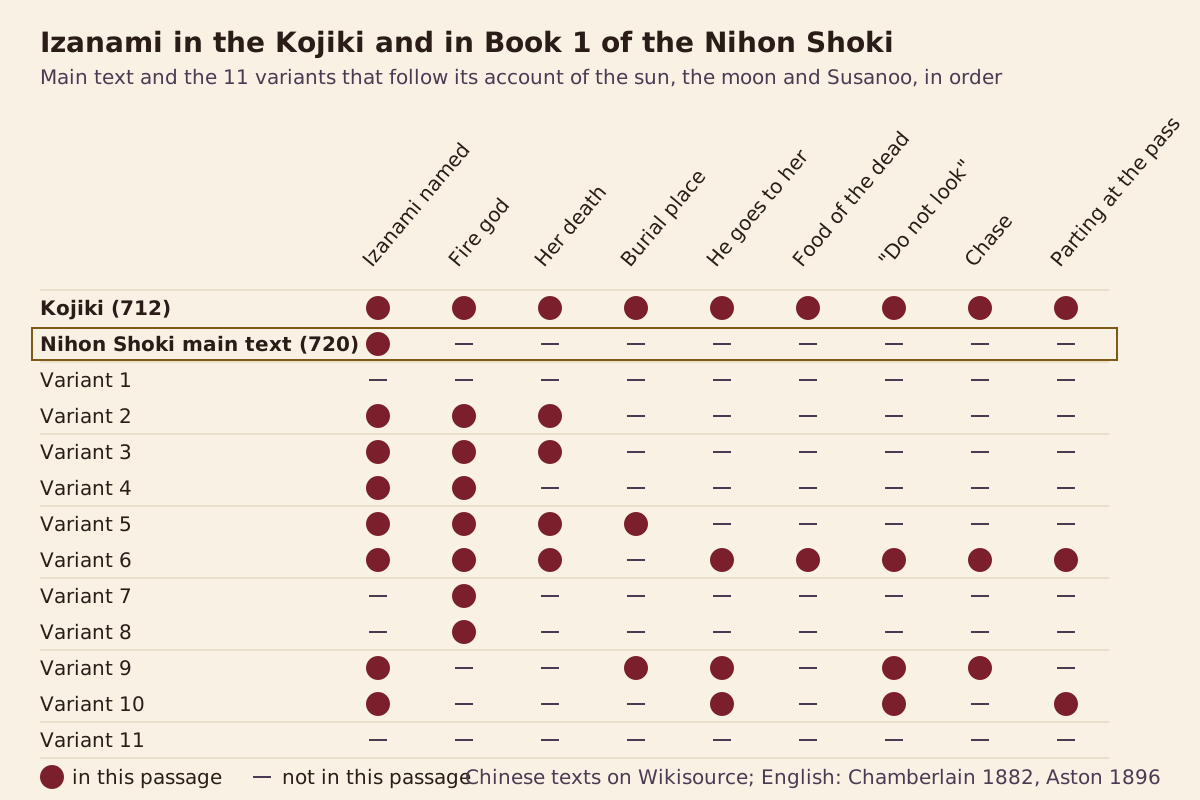
- The Kojiki (712) has Izanami die after giving birth to the fire god and stay in Yomi once she has eaten its food. The main text of the Nihon Shoki (720) never records her death. Its death and Yomi scenes come only from the variants it quotes, which disagree on her burial, her words and the chase.
Source and licence
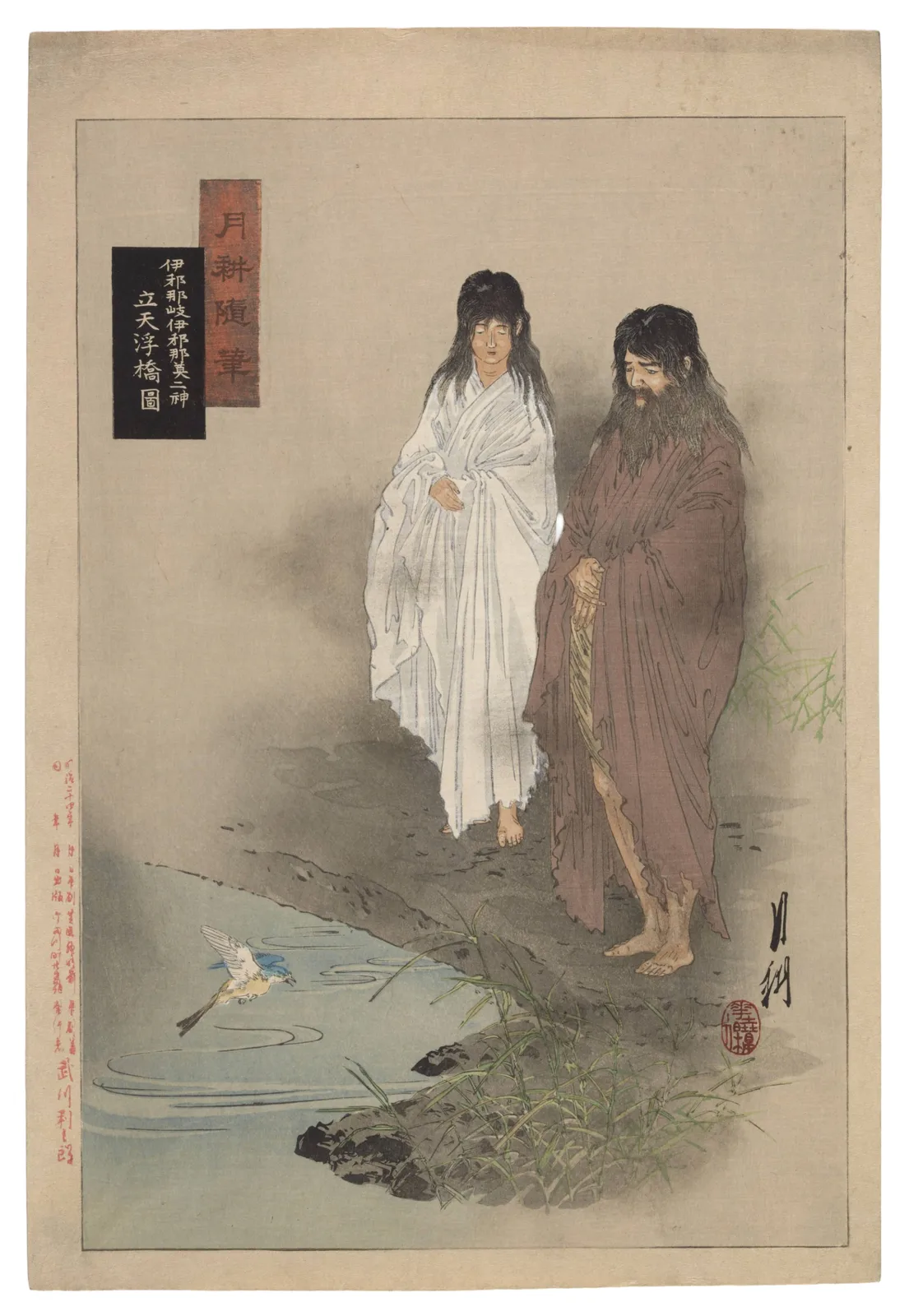
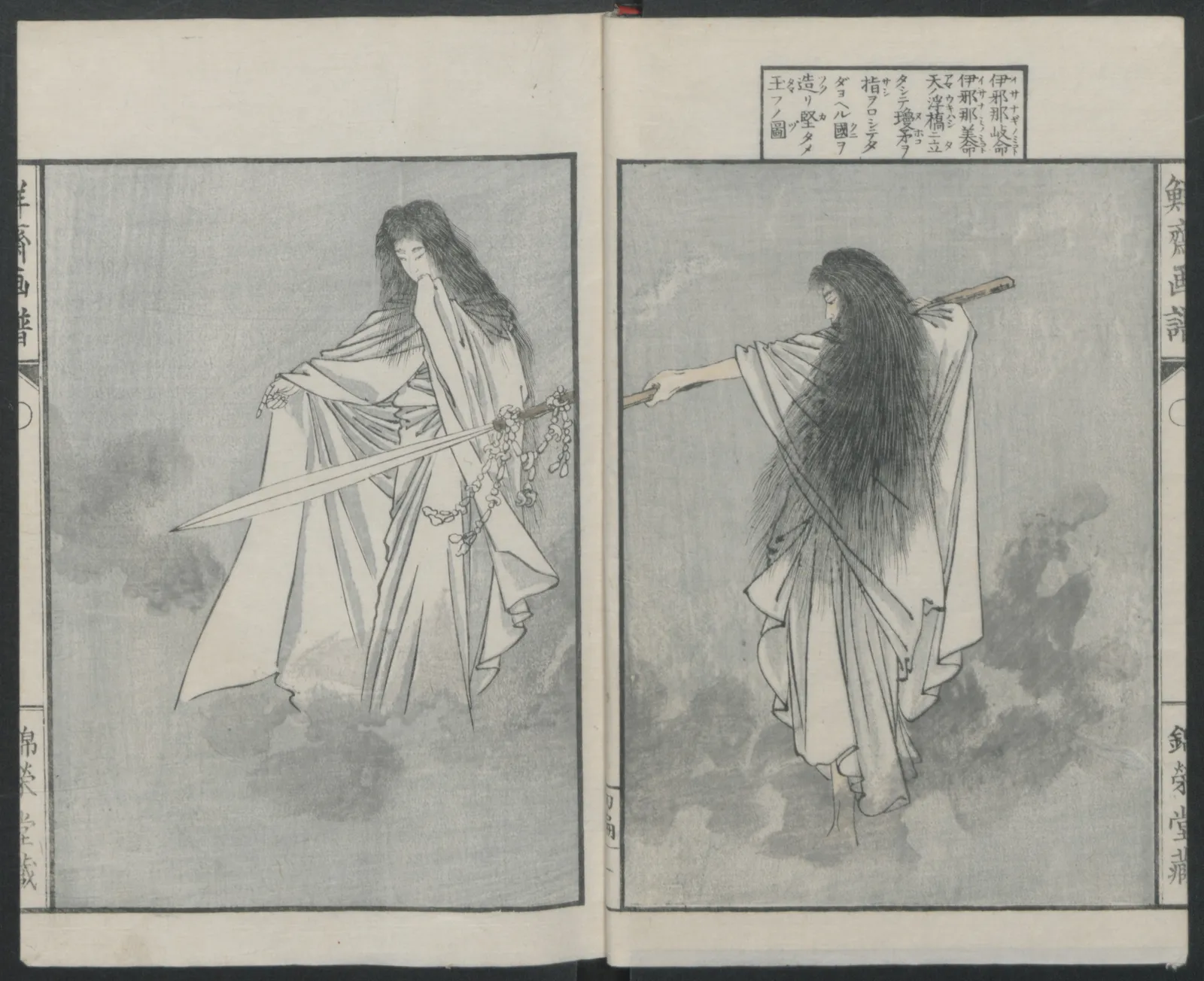
"Ogata Gekko - The Two Gods Izanagi and Izanami Standing on the Bridge of Heaven 1891" by Ogata Gekkō; Smithsonian's National Museum of Asian Art, S2003.8.1683 — https://commons.wikimedia.org/wiki/File:Ogata_Gekko_-_The_Two_Gods_Izanagi_and_Izanami_Standing_on_the_Bridge_of_Heaven_1891.jpg — Public domain (artist Ogata Gekkō d. 1920 (Commons creator page: 1859-1920); US: published 1891, before 1931; EU: 70 years after the artist's death)In the Nihon Shoki's main narrative, Izanami is still alive when she and Izanagi banish their son Susanoo. She is the goddess who, with her husband Izanagi, gives birth to the islands of Japan and to many gods in the two Japanese court histories of the early 700s. The Kojiki, presented in 712, has her die of burns after she bears the fire god, and has Izanagi follow her to Yomi, the land of the dead. The Nihon Shoki, completed in 720, keeps her death and Izanagi's visit to Yomi out of its main text; both appear only in the alternative versions it quotes after that text.
Each of those versions opens with the characters 一書曰, which W. G. Aston's 1896 translation renders "In one writing it is said." By this page's count, 11 variants follow the main text's account of the sun, the moon and Susanoo. Four of them record Izanami's death: variants 2, 3, 5 and 6, numbered in the order they appear. A search of the other 29 books of the Nihon Shoki on Chinese Wikisource finds her name in none of them.
Two books, eight years apart
Basil Hall Chamberlain published his English Kojiki in 1882. He wrote that the Nihon Shoki "was completed in A.D. 720, eight years after the 'Records of Ancient Matters' had been presented to the Empress Gem-miyō." The Kojiki's own preface is dated to the first month of 712. For 720, the court annal Shoku Nihongi records under the fifth month that Prince Toneri presented the finished work, in thirty books with one more book of genealogy.
Chamberlain found the Kojiki's prose mostly Chinese in build, helped along by Japanese words written by sound. The Nihon Shoki, he found, was written in Chinese and polished to look like a Chinese history. He summed it up: "In short we may say of this work what was said of the Septuagint,—that it rationalizes." His example is a line in variant 6: the pass out of Yomi may be "no distinct place, but simply the moment when breathing ceases at the time of death."
For Izanami, what matters is the layout. The Nihon Shoki prints one account as its main text, then quotes other accounts after it, one variant at a time.
Where the Nihon Shoki keeps her alive
In the main text, after the islands, the pair produce the sea, the rivers, the mountains, the ancestor of trees and the ancestor of herbs. Then, in Aston's translation, "Izanagi no Mikoto and Izanami no Mikoto consulted together" and produced the Sun-Goddess, the Moon-god, the leech-child and Susanoo. Susanoo, Aston's Sosa no wo, wails until the green mountains wither, and "the two Gods, his parents," send him away to the Nether Land, which Aston's note takes to mean Yomi (Aston, pp. 18–20). The fire god never appears in this main text, so nothing in it burns Izanami.
The main text then follows Susanoo up to Heaven to see his sister. After this, Izanagi, "his divine task having been accomplished," builds himself "an abode of gloom in the island of Ahaji," and the sun goddess, hearing that Susanoo is coming, speaks of "the charge which our parents gave to their children" (Aston, pp. 33–34). Izanami drops out of the main narrative, alive the last time it names her.
The variants fill that silence in different ways. The table divides them as the Chinese text does: in Aston's 1896 printing, the quotation marks around variant 2 close one sentence before her death, which the Chinese keeps inside that variant (Aston, p. 21).
| Variant | What it says about Izanami | How her end is worded (Aston 1896) |
|---|---|---|
| 1 | Not named; Izanagi alone produces the sun and the moon from two mirrors, and Susanoo as he turns his head | none |
| 2 | Burned by the fire god Kagu tsuchi; bears the earth and water goddesses as she lies dying | "so that she died" (literally "ended") |
| 3 | Burned by her child Ho-no-musubi, "Fire-growth" in Aston's note | "died" (literally "retired") |
| 4 | Falls ill as she is about to bear the fire god | no death stated |
| 5 | Burned; buried at the village of Arima in Kumano, in Kii | "died" |
| 6 | Burned; Izanagi follows her into Yomi | "suffered change and departed" |
| 7 and 8 | Not named; Izanagi cuts the fire god into pieces | none |
| 9 | Meets Izanagi at her temporary burial-place and asks him not to look | no death stated |
| 10 | Asks him not to look, then stays in the land of Yomi | no death stated |
| 11 | Not named | none |
Table data: izanami-versions.csv, with the passage, the Chinese wording and the link for every row.
Read side by side, the versions show motif drift: the same point in one myth is filled differently from version to version, and the table records the difference without claiming that one version grew out of another. Even the wording of her end changes: Aston's notes give "ended" for variant 2 and "retired" for variant 3, and variant 6 says she "suffered change and departed." Variants 4, 9 and 10 never state her death, though variant 9 sets their meeting at her temporary burial-place.
How did Izanami die?
In the Kojiki, Izanami is burned in giving birth to the fire deity, and she lies down sick. Deities are born from her vomit, her excrement and her urine, and then she "at length divinely retired," a phrase Chamberlain's note glosses as "died." Izanagi weeps that he has exchanged her "for this single child" and buries her "on Mount Hiba at the boundary of the Land of Idzumo and the Land of Hahaki." Variant 5 of the Nihon Shoki puts her grave elsewhere, at Arima in Kumano.
Izanagi then follows her to Yomi, which Chamberlain renders as "the Land of Hades," and asks her to come back because "the lands that I and thou made are not yet finished making." She comes out of the palace door to meet him. In Chamberlain's 1882 translation, she answers.
"Lamentable indeed that thou camest not sooner! I have eaten of the furnace of Hades. Nevertheless, as I reverence the entry here of Thine Augustness my lovely elder brother, I wish to return. Moreover I will discuss it particularly with the Deities of Hades. Look not at me!"
Chamberlain's note says that one character in the phrase 黃泉戶喫 "almost certainly" stands for a character meaning "a place for cooking," so she means she has eaten "of the food of Hades." Variant 6 of the Nihon Shoki has the same line in other characters, 飡泉之竈: "I have already eaten of the cooking-furnace of Yomi" (Aston, p. 24). By this page's count, no other variant mentions the food.
Source and licence
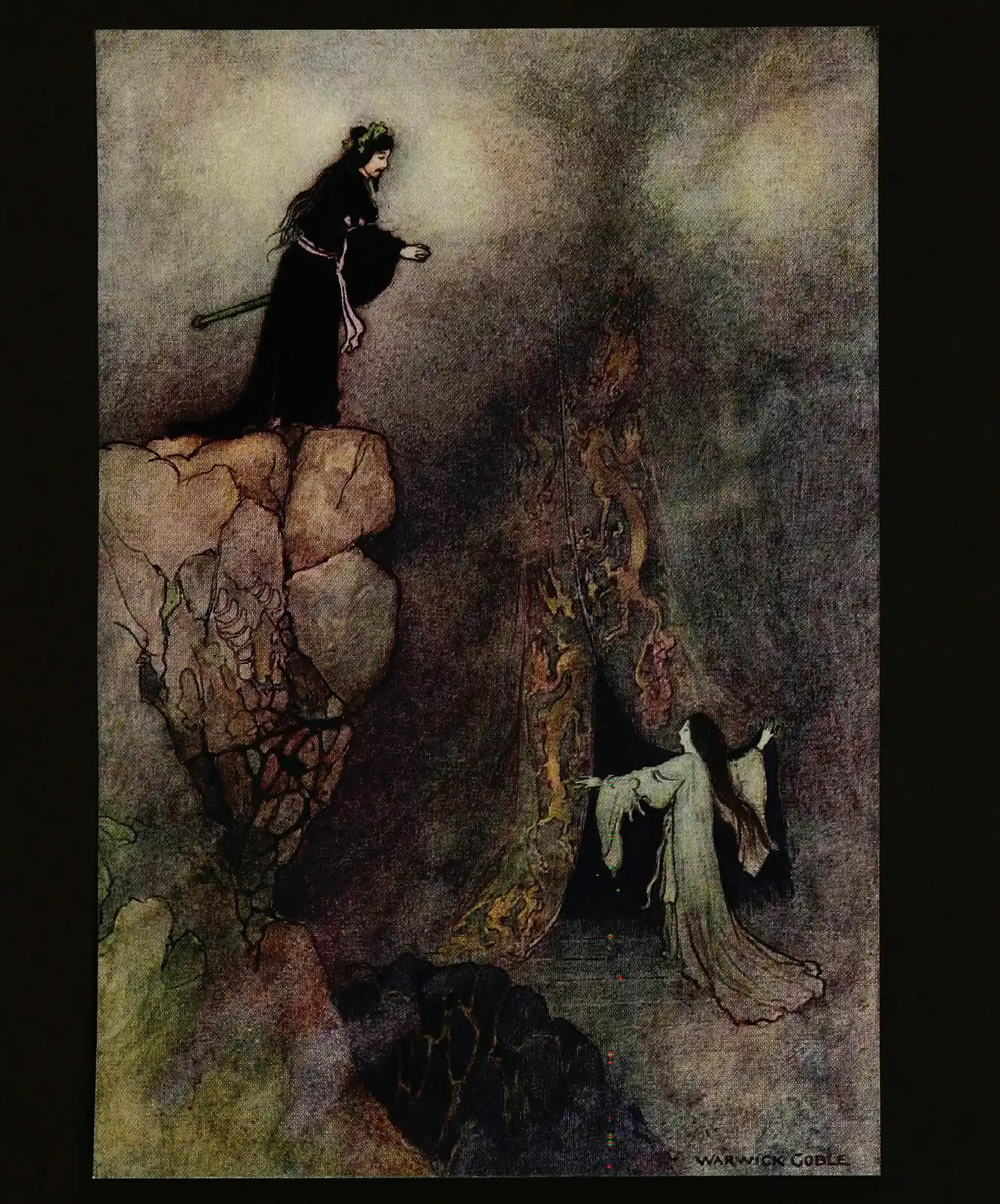
"Green willow and other Japanese fairy tales (1910) (14593788578)" by Warwick Goble (illustrator); in Grace James, Green Willow and Other Japanese Fairy Tales (London: Macmillan, 1910); scan by Internet Archive Book Images from a Cornell University Library copy — https://commons.wikimedia.org/wiki/File:Green_willow_and_other_Japanese_fairy_tales_(1910)_(14593788578).jpg — Public domain (illustrator Warwick Goble d. 1943 (Commons creator page: 1862-1943); US: published in London by Macmillan in 1910, before 1931; EU: 70 years after the illustrator's death; the plate carries no text but his signature)Why couldn't Izanagi bring Izanami back?
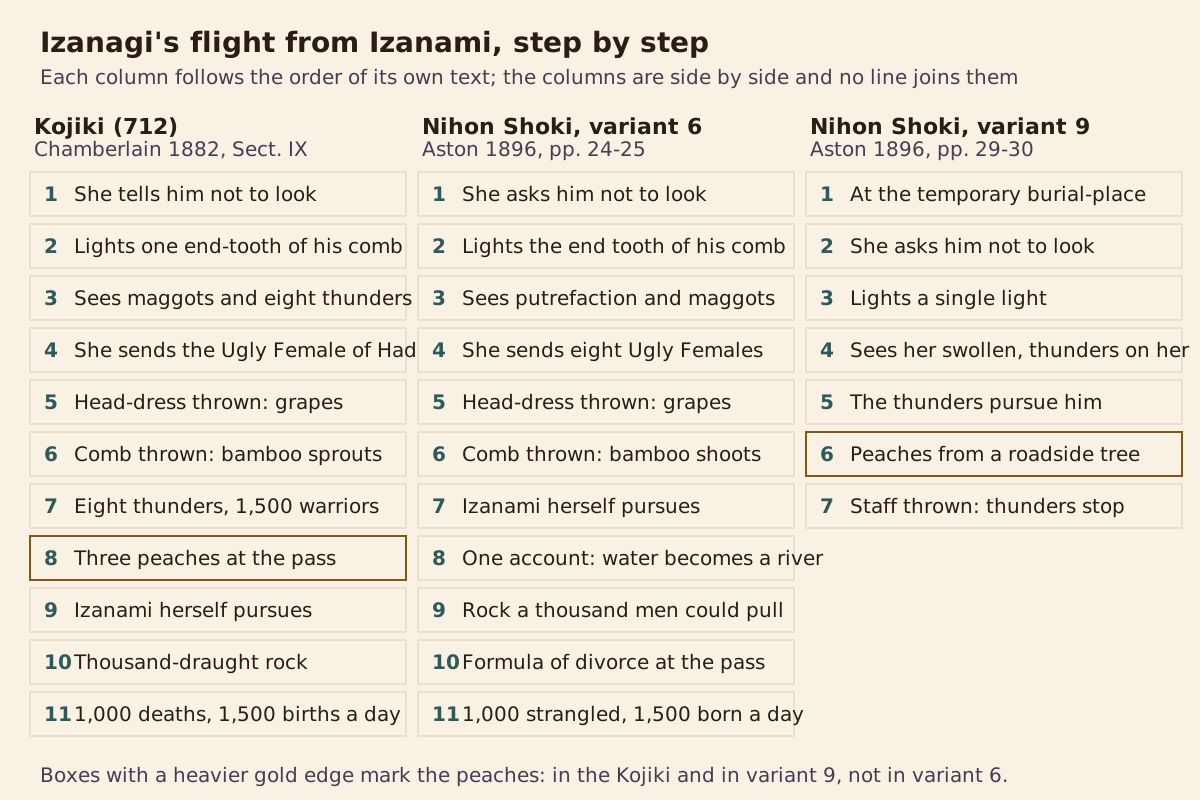
In the Kojiki, Izanami has already eaten "of the furnace of Hades," and Izanagi loses her when he looks at her despite her plea. She goes back inside, and because she "tarried there very long," he breaks off an end-tooth of the comb in his hair, lights it and looks. "Maggots were swarming, and [she was] rotting," with eight thunder deities born in her body. "Thou hast put me to shame," she says, and sends the Ugly-Female-of-Hades after him.
The chase is a run of thrown objects. His head-dress turns into grapes and his comb into bamboo sprouts, which the pursuer stops to eat. At the base of the Even Pass of Hades, three peaches drive back the eight thunders and their 1,500 warriors.
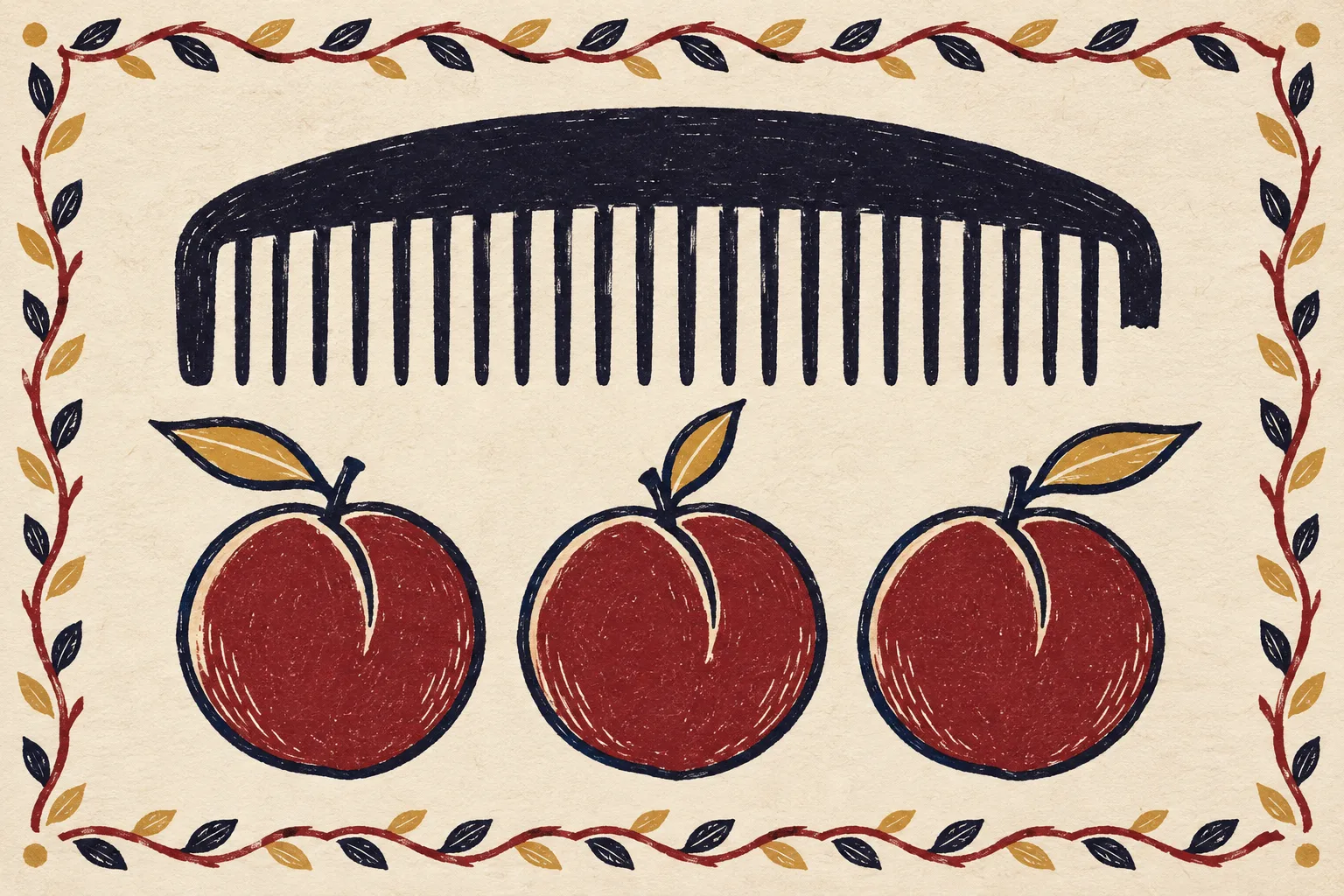
Izanagi blocks the pass with "a thousand-draught rock." Across it Izanami vows to strangle a thousand of his people a day, and he answers that he will set up fifteen hundred birthing houses. In Chamberlain's translation the exchange ends: "In this manner each day a thousand people would surely die, and each day a thousand and five hundred people would surely be born."
The variants divide the scene differently, as the chart below shows. Variant 6 keeps the grapes and bamboo shoots and adds a river made from Izanagi's water "according to one account." It has a rock and "the formula of divorce," but no peaches. Aston's 1896 note on this chase sends readers to Andrew Lang's Custom and Myth for "the throwing behind of a comb, which turns into a thicket."
Variant 9 is set at her temporary burial-place. There the peaches come from a large tree by the roadside as Izanagi runs, and the text calls this "the origin of the practice of keeping off evil spirits by means of peaches." Variant 10 gives Izanami's own reason for staying. It comes as a message from the road-wardens of Yomi.
"I and thou have produced countries. Why should we seek to produce more? I shall stay in this land, and will not depart along with thee." (Aston 1896, p. 31)
Lookers and eaters elsewhere
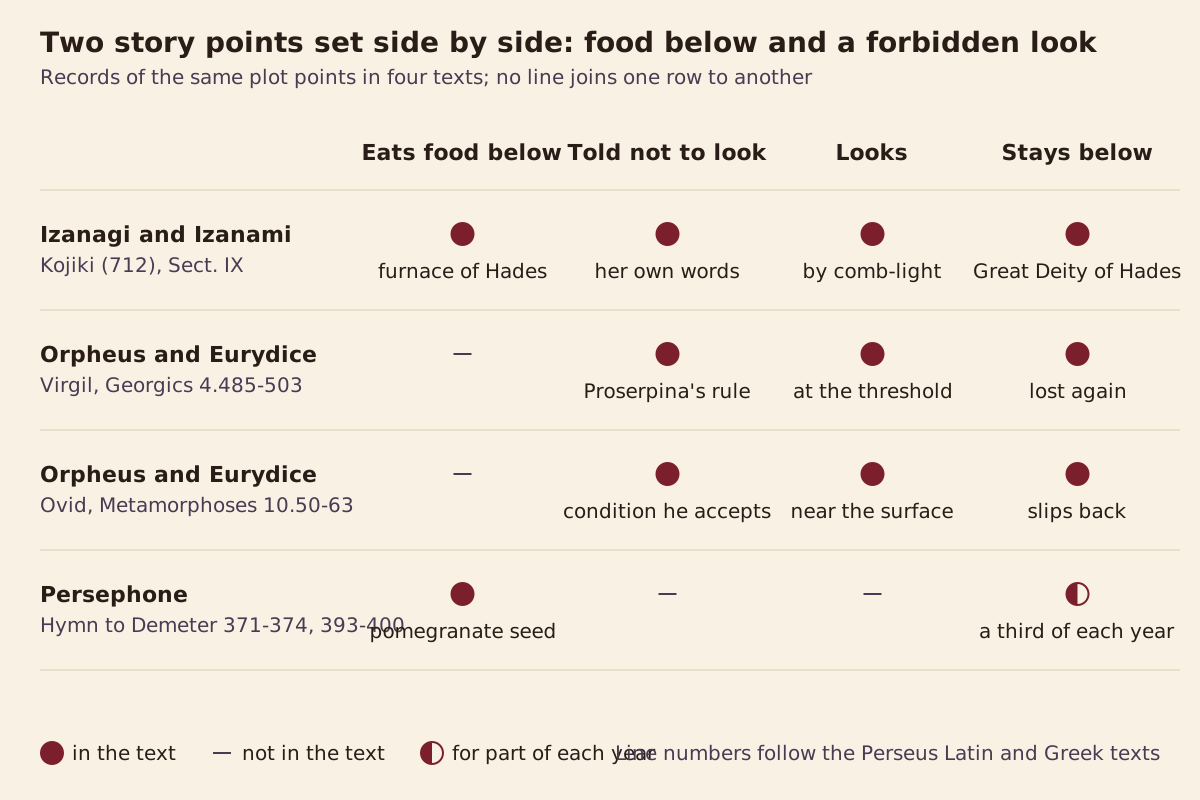
Chamberlain's 1882 introduction calls Izanagi "Orpheus-like" as he visits his wife in the underworld. In Virgil's Georgics 4, Orpheus is leading Eurydice upward under a rule: "So Proserpine had ruled it." At the edge of daylight, "He stopped, turned, looked upon Eurydice / His own once more" (Latin lines 485–491, in James Rhoades's 1921 translation).
In Ovid's Metamorphoses 10, Orpheus must not turn his eyes back until he has left the valleys of Avernus (lines 50–52). Near the surface he looks, and "Instantly she slipped away" (Brookes More, 1922).
The food line has its own parallels. Aston's note on "the cooking-furnace of Yomi" compares it with Ovid's Proserpine, who has eaten seven pomegranate seeds. The note also points to the story of Nachiketas in the Taittiriya Brahmana and the Katha Upanishad.
In the Homeric Hymn to Demeter, Hades secretly gives Persephone a pomegranate seed to eat before she leaves (lines 371–374). Demeter's first question to her returned daughter is whether she has "tasted any food while you were below." If she has, she must spend "a third part of the seasons every year" beneath the earth (lines 393–400, in Hugh G. Evelyn-White's 1914 translation). The entry on Persephone's pomegranate follows that seed through five versions.
These are records of the same plot points set side by side: a look that was forbidden and food eaten below. Neither Chamberlain's comparison nor Aston's note argues that one story derives from another, and this entry makes no such claim. In the Kojiki, the plea not to look comes from Izanami herself. In Virgil, the condition is Proserpina's rule.
Earliest ink
The dates below are first-ink dates for the scope named in each line, the earliest written records checked rather than the age of the myth; how the site dates records sets out the rule.
- Izanami's death and her stay in Yomi: 712. Kojiki, upper volume, whose preface is dated to the first month of 712; the earliest dated text of the story in the sources checked. Chinese text on Wikisource
- The Nihon Shoki's main text and its 11 variants: 720. The Shoku Nihongi, Book 8, records the presentation of the finished work under the fifth month of 720. Chinese text on Wikisource
- A medieval copy of the Kojiki: 1371–72. The Shinpukuji manuscript, credited to Ken'yu and dated 1371–72 on the Commons page for its 1924–25 facsimile; Chinese Wikisource calls it the oldest manuscript and collates its text against it. Facsimile page

Sources checked through 2026-10-19.
Where the trail goes next
- A Greek goddess who also ate among the dead: Persephone's pomegranate, where the number of seeds changes from text to text.
- Another myth set out source by source: the flood myths compared, nine flood texts side by side with no arrows between them.
- The variants in English: W. G. Aston's 1896 Nihongi, Book 1, on Wikisource.
Cite this page
Where Tales Began. “Izanami: In the Nihon Shoki's Main Text, She Never Dies.” First published October 20, 2026; last substantive revision October 20, 2026. https://wheretalesbegan.com/myth/izanami/. Accessed: add the date you read this page.
- Author
- Where Tales Began
- Title
- Izanami: In the Nihon Shoki's Main Text, She Never Dies
- Published
- Revised
- Address
- https://wheretalesbegan.com/myth/izanami/
Sources
- Nihon Shoki (日本書紀), Book 1 (Age of the Gods, part 1), completed 720; Chinese text, Wikisource, "日本書紀/卷第一" (read 2026-10-19). zh.wikisource.org/wiki/%E6%97%A5%E6%9C%AC%E6%9B%B8%E7%B4%80/%E5%8D%B7%E7%AC%AC%E4%B8%80 Read: Book 1 in full: the main text and the 11 variants after its account of the sun, the moon and Susanoo; the page does not name its base edition
- Nihon Shoki (日本書紀), Books 2-30; Chinese text, Wikisource, "日本書紀" (read 2026-10-19). zh.wikisource.org/wiki/%E6%97%A5%E6%9C%AC%E6%9B%B8%E7%B4%80 Read: Books 2-30, searched for each written form of Izanami's name used in Book 1; none found
- Kojiki (古事記), preface and upper volume, presented 712; Chinese text, Wikisource, "古事記/上卷" (read 2026-10-19). zh.wikisource.org/wiki/%E5%8F%A4%E4%BA%8B%E8%A8%98/%E4%B8%8A%E5%8D%B7 Read: preface, dated to the first month of 712, and the upper volume from the birth of the fire deity to the banishment of Susanoo; the index page says the text is collated against the Shinpukuji manuscript
- Shoku Nihongi (續日本紀), Book 8 (718-721); Chinese text, Wikisource, "續日本紀/卷第八" (read 2026-10-19). zh.wikisource.org/wiki/%E7%BA%8C%E6%97%A5%E6%9C%AC%E7%B4%80/%E5%8D%B7%E7%AC%AC%E5%85%AB Read: entry for the fifth month of 720, on the presentation of the Nihongi in thirty books with one book of genealogy
- W. G. Aston, trans., Nihongi: Chronicles of Japan from the Earliest Times to A.D. 697, vol. 1 (London: Kegan Paul, Trench, Trübner, for the Japan Society, 1896), Book I; Wikisource transcription (read 2026-10-19). en.wikisource.org/wiki/Nihongi/Book_I Read: Book I, pp. 18-34, with notes 68, 71, 75, 76, 84, 101 and 105; preface
- Basil Hall Chamberlain, trans., "Ko-ji-ki, or Records of Ancient Matters," Transactions of the Asiatic Society of Japan 10, supplement (Yokohama: R. Meiklejohn, 1882), Sect. VII, IX and X; Wikisource transcription (read 2026-10-19). en.wikisource.org/wiki/Kojiki_(Chamberlain,_1882)/Section_9 Read: Sect. VII (pp. 29-31), Sect. IX (pp. 34-39) and Sect. X (pp. 39-43), with notes
- Basil Hall Chamberlain, "Introduction," in Ko-ji-ki, or Records of Ancient Matters (Yokohama, 1882); Wikisource transcription (read 2026-10-19). en.wikisource.org/wiki/Kojiki_(Chamberlain,_1882)/Introduction Read: Introduction, parts 1 and 3, and its summary of the myth
- Virgil, Georgics 4.485-503, Latin text ed. J. B. Greenough (1881) and English translation by James Rhoades (1921); digital editions urn:cts:latinLit:phi0690.phi002.perseus-lat2 and perseus-eng2, Perseus Digital Library, PerseusDL/canonical-latinLit (GitHub, commit 128a05af), CC BY-SA 4.0. github.com/PerseusDL/canonical-latinLit/blob/128a05afa9cc7179ab18f8d05f78a9f1dd50e415/data/phi0690/phi002/phi0690.phi002.perseus-eng2.xml Read: book 4, lines 453-527 (Latin) and the matching lines of the translation Text licence: CC BY-SA 4.0
- Ovid, Metamorphoses 10.46-63, Latin text ed. Hugo Magnus (1892) and English translation by Brookes More (1922); digital editions urn:cts:latinLit:phi0959.phi006.perseus-lat2 and perseus-eng3, Perseus Digital Library, PerseusDL/canonical-latinLit (GitHub, commit 128a05af), CC BY-SA 4.0. github.com/PerseusDL/canonical-latinLit/blob/128a05afa9cc7179ab18f8d05f78a9f1dd50e415/data/phi0959/phi006/phi0959.phi006.perseus-eng3.xml Read: book 10, lines 1-85 in the translation and lines 46-63 in the Latin Text licence: CC BY-SA 4.0
- Homeric Hymn to Demeter 371-374 and 393-400, Greek text and English translation by Hugh G. Evelyn-White (1914); digital editions urn:cts:greekLit:tlg0013.tlg002.perseus-grc2 and perseus-eng2, Perseus Digital Library, PerseusDL/canonical-greekLit (GitHub, commit 0189b9c8), CC BY-SA 4.0. github.com/PerseusDL/canonical-greekLit/blob/0189b9c8d8d1f148133f2f0af309b4ee90ea4332/data/tlg0013/tlg002/tlg0013.tlg002.perseus-eng2.xml Read: lines 370-374 and 390-404 in Greek and English Text licence: CC BY-SA 4.0
- Wikimedia Commons, "File:Shinpukuji-bon Kojiki (真福寺本古事記).png," page from the 1924-1925 facsimile of the Shinpukuji manuscript of the Kojiki (read 2026-10-19). commons.wikimedia.org/wiki/File:Shinpukuji-bon_Kojiki_(%E7%9C%9F%E7%A6%8F%E5%AF%BA%E6%9C%AC%E5%8F%A4%E4%BA%8B%E8%A8%98).png Read: file description: Ken'yu named as author, dated 1371-1372, facsimile published 1924-1925