Comparison table or list
Flood Myths Compared: The Famous Flood Tablet Is a Late Copy
- By
- Where Tales Began
- Published
- Last substantive revision
How records are checked: Following the paper trail. Corrections: Fixes to the record. Questions: Contact us.
Fast facts
- Name
- Flood myths: nine texts compared, from Ziusudra, Atrahasis and Gilgamesh Tablet XI to Genesis, Deucalion, Manu, Yu and Bergelmer
- Earliest ink
- Earliest surviving copies among the nine texts checked: Old Babylonian tablets of about 1900-1600 BC (the Sumerian Flood Story from Nippur; an Atrahasis copy dated under Ammi-saduqa, 17th century BC)
- Where found
- Written down in Sumerian and Akkadian (Mesopotamia), Hebrew, Greek and Latin, Sanskrit, Classical Chinese and Old Norse; places of record, not a route
- TL;DR
- The Nineveh Flood Tablet that George Smith presented in 1872 is a copy made in the 7th century BC. A flood story in Atrahasis survives on a tablet about a thousand years older. The nine texts are set side by side here without claiming that one comes from another.
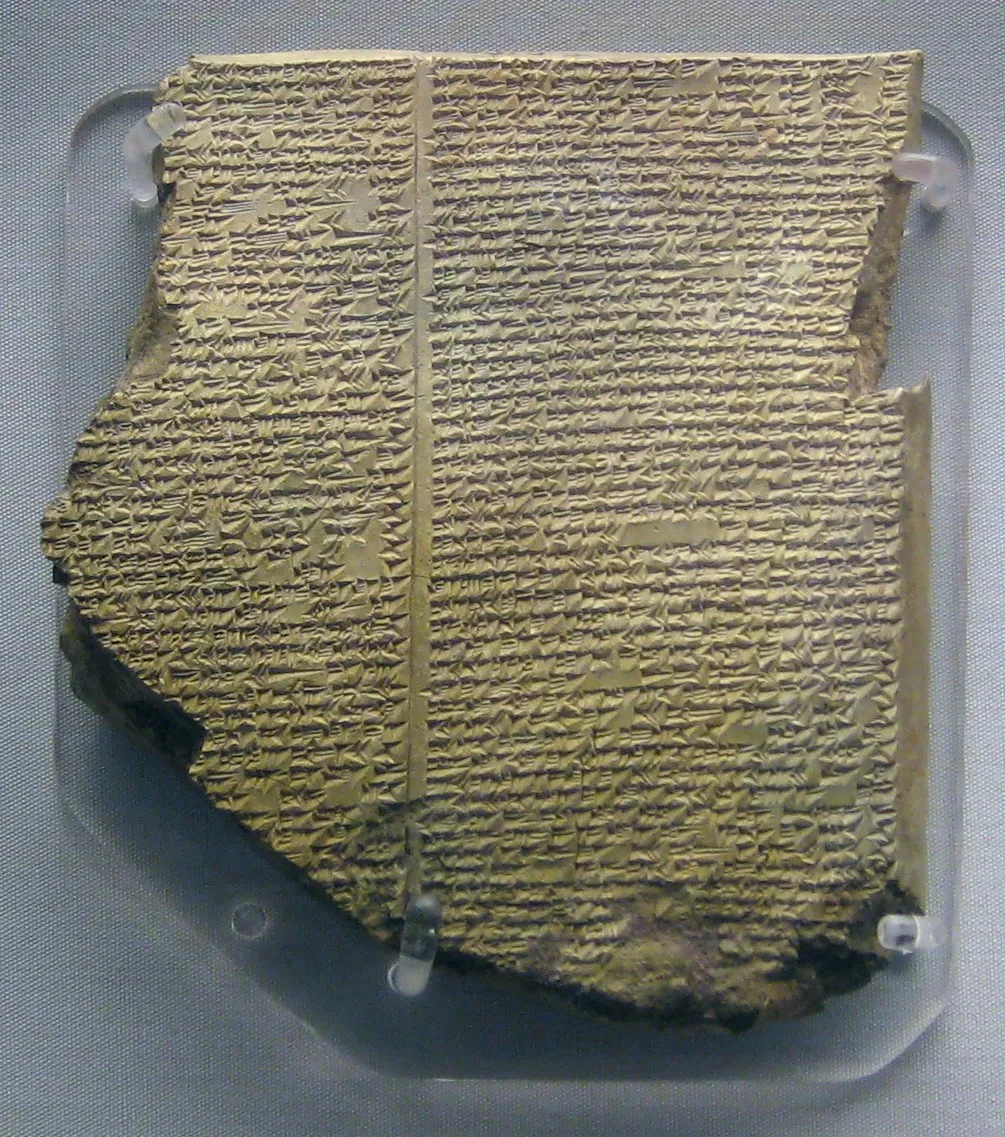
George Smith's flood tablets, deciphered at the British Museum in 1872, were copies made for an Assyrian king. They came from the Nineveh library of King Ashurbanipal, who reigned from 668 to about 630 BC. A flood story in the Babylonian poem Atrahasis survives on a far older copy. That copy is dated in the reign of Ammi-saduqa of Babylon, in the 17th century BC, about a thousand years before the Nineveh copies.
The tables below set nine flood texts side by side, with the date each was written down. They run from Sumerian and Akkadian tablets to Genesis, Ovid, a Sanskrit ritual text, the Chinese Mengzi and the Icelandic Prose Edda.
What George Smith read in 1872
Smith was sorting fragments from Kouyunjik, the mound opposite Mosul where Layard had found part of the royal Assyrian library. In The Chaldean Account of Genesis (1876), Smith recalled the moment: "my eye caught the statement that the ship rested on the mountains of Nizir, followed by the account of the sending forth of the dove." He pieced the story together from parts of three copies.
On December 3, 1872, he presented it to the Society of Biblical Archæology. E. A. Wallis Budge of the British Museum, writing in 1920, called him the scholar "who was the first to translate" the Tablet XI text. The museum's Ashurbanipal Library Project lists Smith's trips to Nineveh in 1873, 1874 and 1876 as following "his dramatic discovery of the Flood Tablet." He went to look for its missing pieces.
The project gives Ashurbanipal's reign as 668 to about 630 BC. In his introduction to a 1920 Yale volume he published with Albert T. Clay, Morris Jastrow Jr. called the Nineveh form of the epic "a late copy of a much older original." The palaces where those tablets were dug up are the subject of the Library of Ashurbanipal entry.
Nine flood texts, side by side
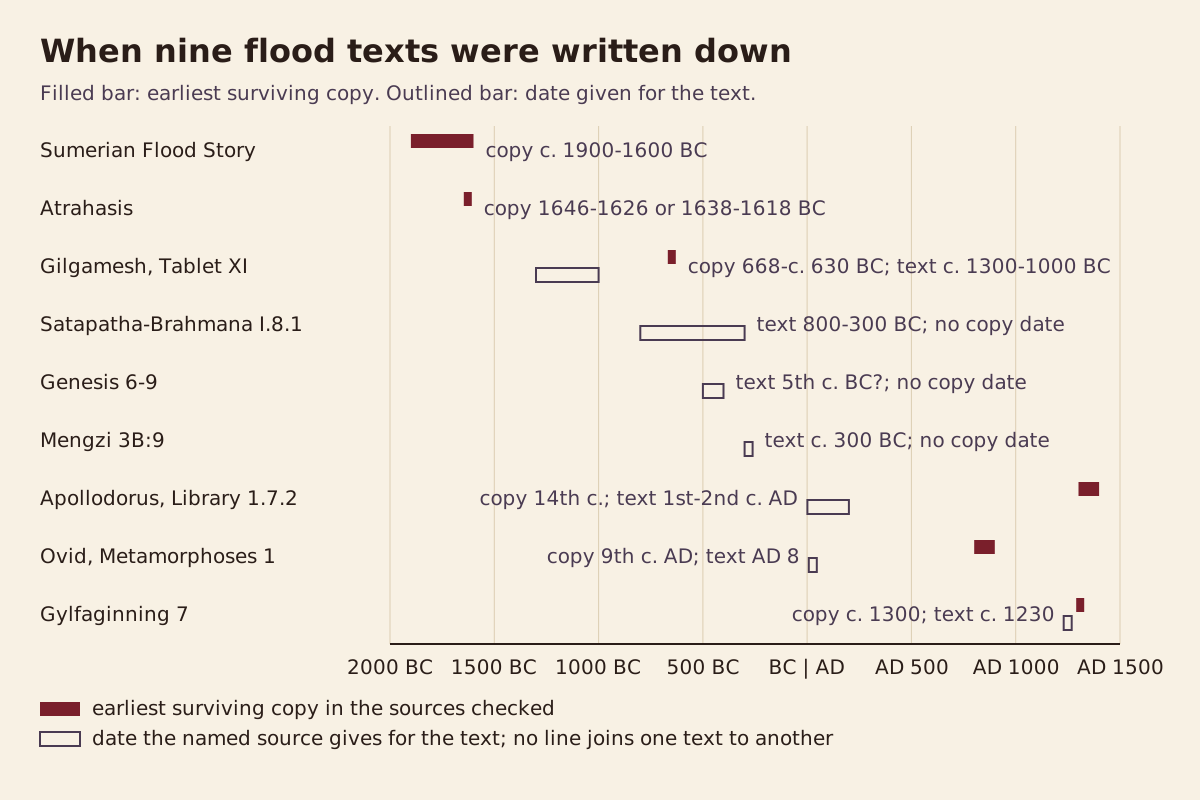
Each row below is one text. The date of its earliest surviving copy is kept apart from the date a named source gives for the text, since the two can lie centuries apart. The copy column gives the first-ink date in the sources checked. It marks where the clay or manuscript evidence starts, not where a story began.
| Text | Language | Earliest surviving copy | Date given for the text |
|---|---|---|---|
| Sumerian Flood Story | Sumerian | Tablet from Nippur, Old Babylonian period, about 1900–1600 BC | Not settled in the sources checked |
| Atrahasis | Akkadian | Copy dated in the reign of Ammi-saduqa, 1646–1626 or 1638–1618 BC | Not settled in the sources checked |
| Gilgamesh, Tablet XI | Akkadian | Nineveh tablets, reign of Ashurbanipal, 668 to about 630 BC | Standard version of the epic, about 1300–1000 BC |
| Satapatha-Brahmana I.8.1 | Sanskrit | Not given in the sources checked | 8th–6th century BC (A. B. Keith); about 700 BC (Asko Parpola); final written form 300 BC (Julius Eggeling) |
| Genesis 6–9 | Hebrew | Dead Sea Scrolls fragments of the book, undated in the sources checked | Possibly 5th century BC; other proposals before 550 BC or in the 270s BC |
| Mengzi 3B:9 | Classical Chinese | Not given in the sources checked | Compiled about 300 BC |
| Apollodorus, Library 1.7.2 | Greek | A 14th-century manuscript in Paris, the source of the other surviving copies | 1st or 2nd century AD |
| Ovid, Metamorphoses 1.253–415 | Latin | Fragments with portions of Books 1–3, 9th century AD | AD 8 |
| Gylfaginning 7 (Prose Edda) | Old Norse | Prose Edda parchment manuscripts of about 1300 | About 1230, Rudolf Keyser's date for Snorri Sturluson's part, as Anderson reports |
| Text | Survivor | Warned by | Vessel | Birds released | Afterward |
|---|---|---|---|---|---|
| Sumerian Flood Story | Zi-ud-sura, a king and priest | A voice at a wall; the speaker is not named in the surviving lines | A very large boat | Not in the surviving lines | Eternal life in Dilmun |
| Atrahasis | Atrahasis | Enki, speaking to the wall of a reed hut | A boat with a roof | Lines lost | Limits set on human births and lifespans |
| Gilgamesh, Tablet XI | Uta-napishtim and his wife | Ea, speaking to a reed house | A ship as broad as it is long | Dove, swallow, raven | Made like the gods, living at the mouth of the rivers |
| Satapatha-Brahmana I.8.1 | Manu | A fish he raises | A ship tied to the fish's horn | None | Descendants through a woman produced from his offering |
| Genesis 6–9 | Noah and his family | God | An ark of gopher wood, 300 by 50 by 30 cubits | A raven, then a dove three times | A covenant marked by the bow in the cloud |
| Mengzi 3B:9 | No single survivor | No warning | None; Yu digs channels to the sea | None | People live on level ground again |
| Apollodorus, Library 1.7.2 | Deucalion and Pyrrha | Prometheus | A chest, afloat nine days and nights | None | Thrown stones become men and women |
| Ovid, Metamorphoses 1 | Deucalion and Pyrrha | No warning | A small boat | None | Thrown stones become people |
| Gylfaginning 7 | Bergelmer and his wife | No warning | A vessel Anderson translates as an ark | None | New races of frost giants |
Table data: flood-myths-flood-texts.csv, with the source and link for every row.
The tables set the texts side by side and make no claim that any one of them comes from another. How the site dates a record is set out in Following the Paper Trail. Only four texts have both a dated copy and a date for the text in the sources checked: Gilgamesh Tablet XI, Apollodorus, Ovid and Gylfaginning. The chart below leaves a missing date blank rather than guess it.
Ziusudra, Atrahasis, Utnapishtim
The Sumerian Flood Story survives on a broken tablet from Nippur, CBS 10673 + CBS 10867. The Cuneiform Digital Library Initiative dates it to the Old Babylonian period, about 1900–1600 BC. Arno Poebel published it in 1914. In the English translation by the Electronic Text Corpus of Sumerian Literature, gaps of roughly 32 to 39 lines break the story.
What survives tells of Zi-ud-sura, a king and priest, who hears a warning at a wall and rides out seven days and seven nights of flood in a very large boat. Afterward the gods grant him eternal life in Dilmun.
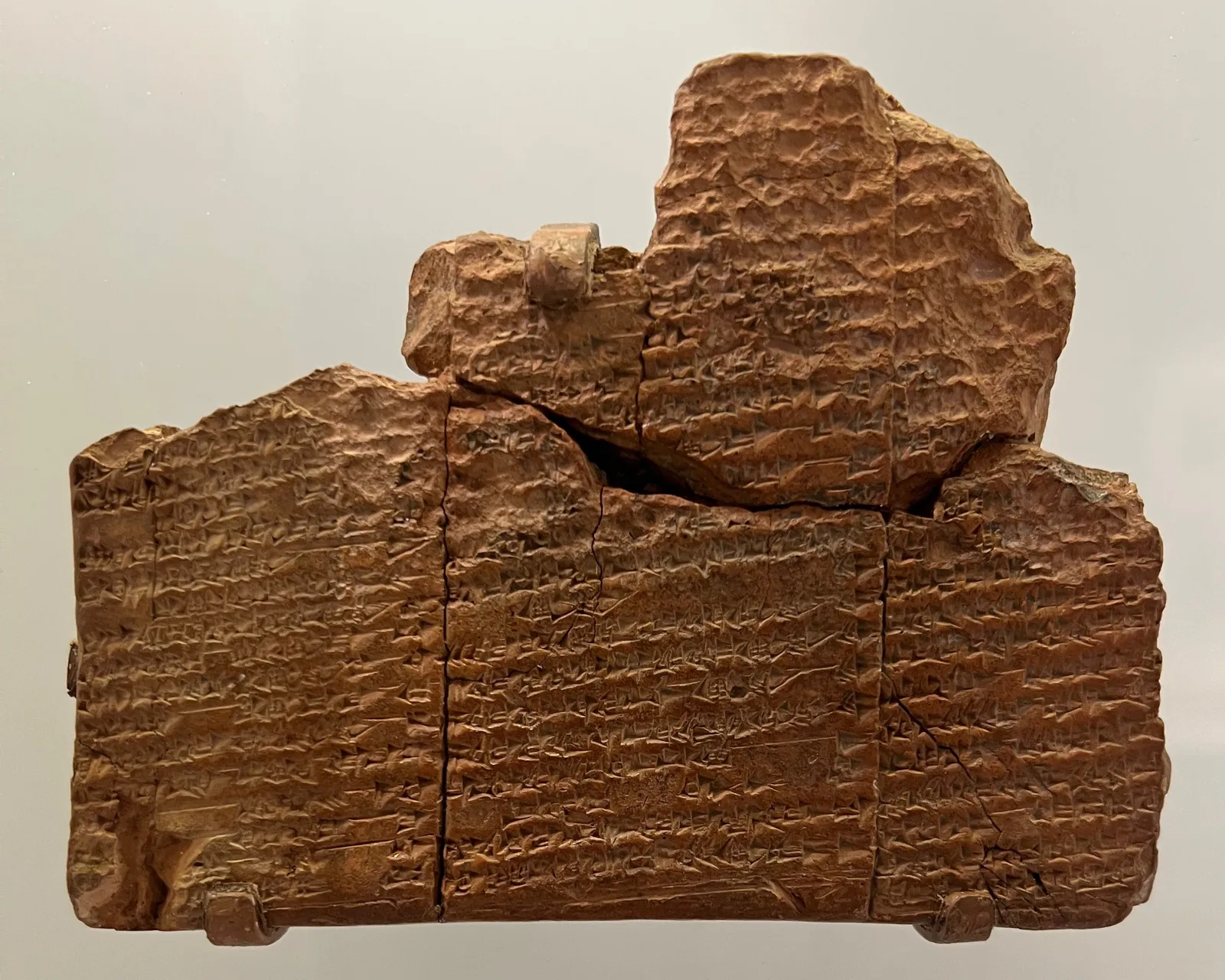
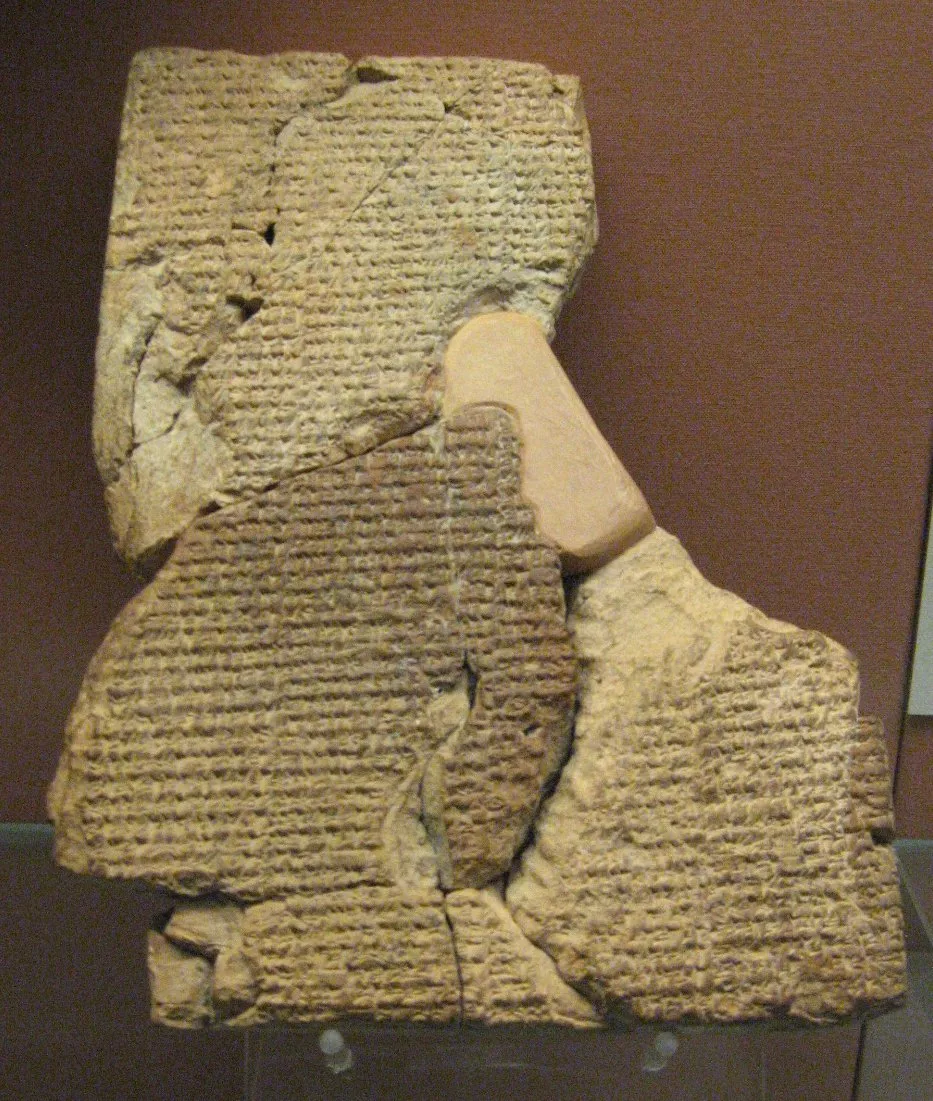
Atrahasis is an Akkadian poem named for its hero. As English Wikipedia summarizes it, the oldest known copy is dated by its colophon, the scribe's note at the end of a tablet, to the reign of Ammi-saduqa of Babylon. Its article on that king gives the reign as 1646–1626 BC or 1638–1618 BC, depending on the chronology. In its summary of the poem, the god Enki gives the warning by speaking to the wall of the hero's reed hut.
That summary also notes that the Atrahasis tablets break off where Gilgamesh Tablet XI has its birds. Older books give older numbers for the same reign. In 1920 Jastrow placed a deluge fragment from Ammi-saduqa's eleventh year at "c. 1967 B.C." and noted that it names the hero Atra-hasis. Budge, who put it at "about B.C. 2000," added that its colophon marks it as the second tablet of a series that was not the Gilgamesh epic.
Source and licence
"Bm-epic-g" by Jack1956 — https://commons.wikimedia.org/wiki/File:Bm-epic-g.jpg — Public domain (photograph released into the public domain worldwide by its author, English Wikipedia user Jack1956 (PD-user-w on the source page); US and EU: the release applies in both; the tablet itself is an ancient object)Tablet XI of the Epic of Gilgamesh has a survivor named Uta-napishtim, who tells Gilgamesh how the god Ea warned him through the wall of a reed house. Near the end, Ea says in Budge's 1920 translation, "I made Atra-hasis to see a vision," so at line 196 the hero carries the older poem's name.
Budge argued that the flood story "had not originally any connection" with Gilgamesh and was added by a late editor. English Wikipedia's summary, drawing on Jeffrey H. Tigay's book, lists lines such as "Wall, listen to me" in Atrahasis that were copied more or less directly into Tablet XI.
Budge's translation gives the birds at lines 147–155:
I brought out a dove and let her go free. The dove flew away and [then] came back; Because she had no place to alight on she came back. I brought out a swallow and let her go free. The swallow flew away and [then] came back; Because she had no place to alight on she came back. I brought out a raven and let her go free. The raven flew away, she saw the sinking waters. She ate, she pecked in the ground, she croaked, she came not back.
Genesis 6–9
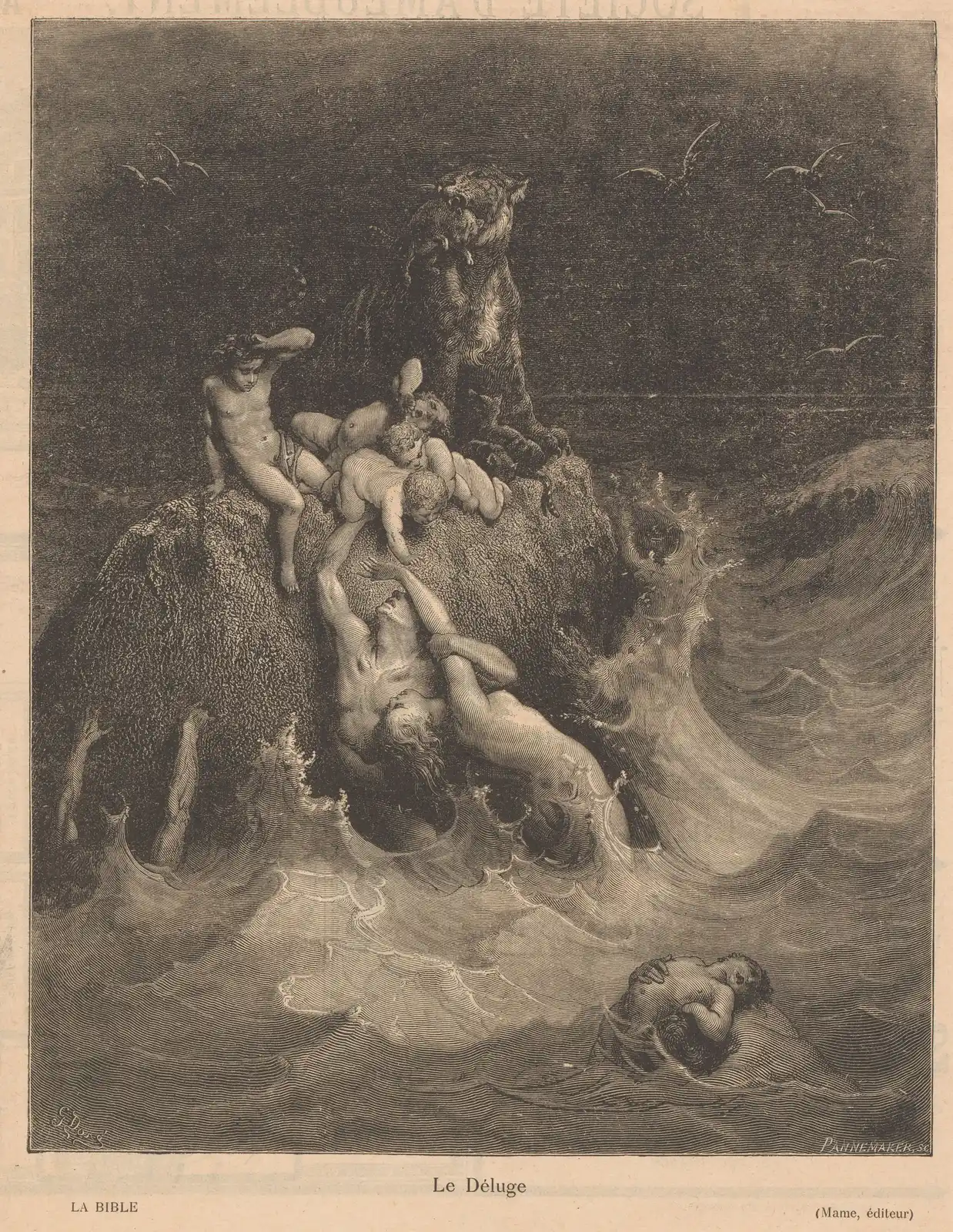
God tells Noah, "Make thee an ark of gopher wood," and sets its size at "three hundred cubits" long, "fifty cubits" broad and "thirty cubits" high (Genesis 6:14–15, American Standard Version, 1901). It comes to rest "upon the mountains of Ararat" (8:4).
Noah sends out a raven, which "went forth to and fro" (8:7). Then he sends a dove three times. It comes back with nothing, then with "an olive-leaf plucked off," and the third time "returned not again unto him any more" (8:8–12). The flood ends with a covenant whose token is "my bow in the cloud" (9:13).
Source and licence
"Le Déluge, RP-P-OB-33.983" by Adolphe François Pannemaker after Gustave Doré (Rijksmuseum) — https://commons.wikimedia.org/wiki/File:Le_D%C3%A9luge,_RP-P-OB-33.983.jpg — CC0 1.0 (https://creativecommons.org/publicdomain/zero/1.0/)English Wikipedia's article on the Genesis flood narrative, read on 2026-10-18, summarizes the prevailing scholarly view that the story was adapted from older Mesopotamian flood traditions, especially the Epic of Gilgamesh. The same article describes Genesis 6–9 as two sources woven together, one Priestly and one not, and notes scholars who question that division.
Its article on the Book of Genesis reports a 21st-century consensus that the book was composed after the Babylonian captivity, possibly in the fifth century BC. It also reports that Ronald Hendel and Aaron Hornkohl propose a date before 550 BC, and that Russell Gmirkin argues for the late 270s BC.
Deucalion and Pyrrha
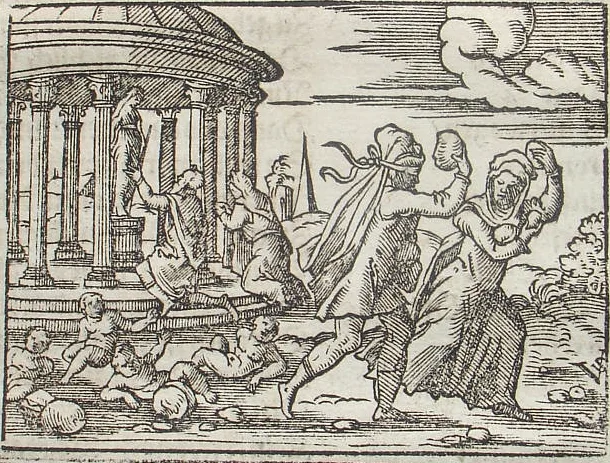
Ovid's Metamorphoses, a Latin poem of AD 8, has Jupiter flood the world while Neptune sends the rivers over the land. Deucalion and Pyrrha reach Parnassus "in a small and fragile boat." Jupiter ends the flood when he sees the two of them left (Book 1, Brookes More's 1922 translation).
The goddess Themis tells them to throw "the bones of your great mother" behind them. Deucalion reads the riddle as the stones of the Earth. The stones they throw become people.
Source and licence
"Virgil Solis - Deucalion Pyrrha" by Virgil Solis — https://commons.wikimedia.org/wiki/File:Virgil_Solis_-_Deucalion_Pyrrha.jpg — Public domain (Virgil Solis, 1514-1562, or his workshop; woodcut for Ovid's Metamorphoses, reprinted in many 16th-century editions; US: published before 1931; EU: more than 70 years after the artist's death; faithful scan of a two-dimensional print)The Greek Library attributed to Apollodorus tells the story another way. English Wikipedia dates this handbook of myths to the first or second century AD and traces its surviving manuscripts to a 14th-century one in Paris. In this version Prometheus advises his son Deucalion to build a chest. Deucalion floats in it "over the sea for nine days and as many nights" before landing on Parnassus (1.7.2, J. G. Frazer's 1921 translation).
After a sacrifice to Zeus, the stones that Deucalion and Pyrrha throw over their heads become men and women. Neither the Latin nor the Greek version sends out birds.
The same Library records a second flood sent as a punishment. Cassiepea, wife of the Ethiopian king Cepheus, boasted that she was more beautiful than the Nereids. Then "Poseidon, sharing their wrath, sent a flood and a monster to invade the land" (2.4.3). Her story is the subject of the Cassiopeia entry, where Poseidon's flood stands beside the flood stories in these tables as a parallel, not a source.
Manu's fish
The Satapatha-Brahmana is a Sanskrit ritual text. As English Wikipedia summarizes, A. B. Keith placed it in the eighth to sixth centuries BC and Asko Parpola around 700 BC, while its translator Julius Eggeling put its final written form at 300 BC. Its flood story sits inside a passage about an offering (I.8.1, Eggeling's 1882 translation, pp. 216–219).
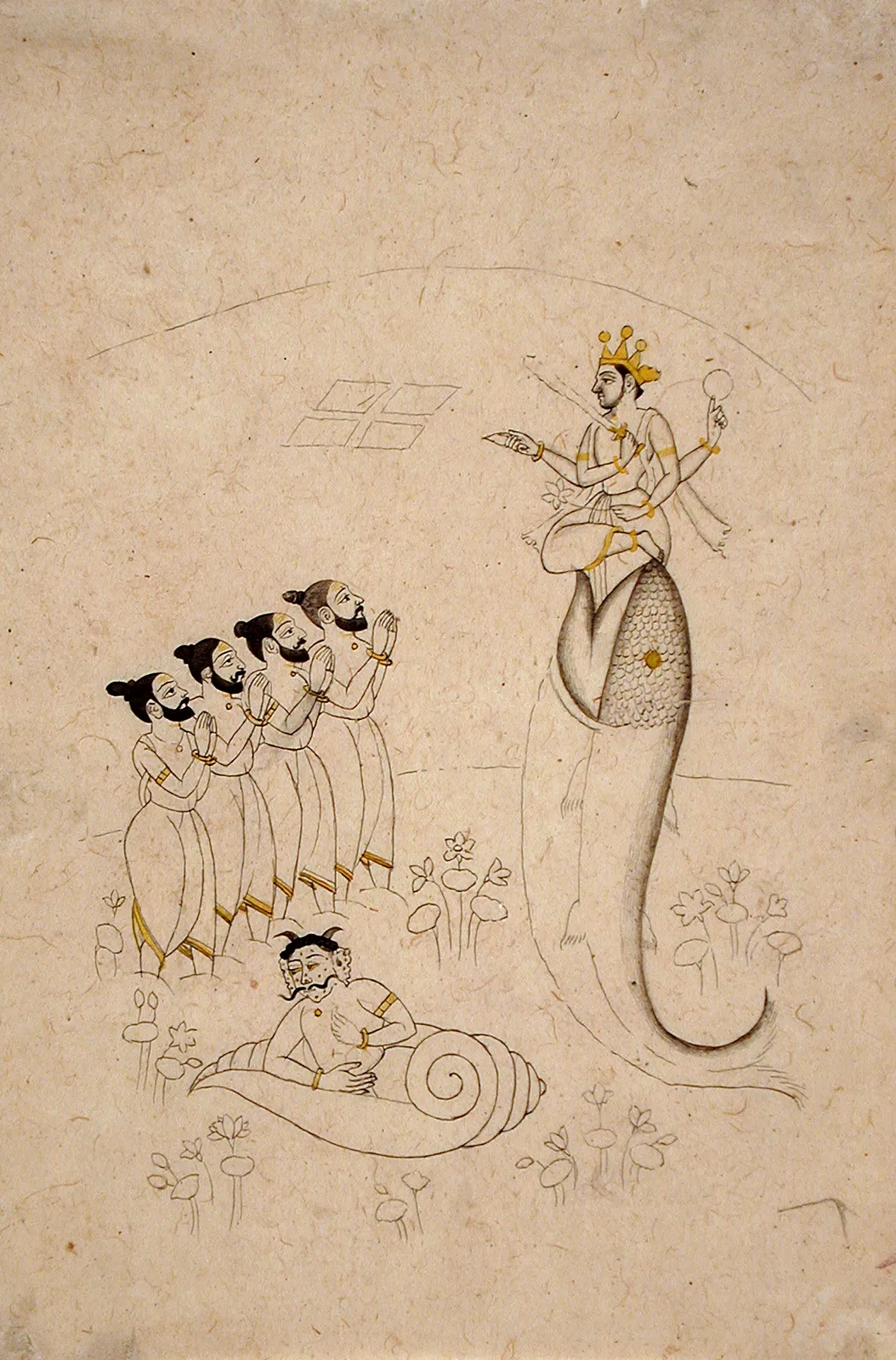
A small fish comes into Manu's hands as he washes. It promises to save him from a flood if he raises it, first in a jar, then in a pit, then in the sea. Manu builds a ship, ties it to the fish's horn and reaches the northern mountain. The flood sweeps every other creature away, and a woman produced from his offering becomes the means of his descendants.
The text does not name its fish. The drawing below, dated about 1700–1725 or later, shows Matsya, the fish form of Vishnu.
Source and licence
"Matsya Avatar of Vishnu LACMA M.79.252.8" by Unknown artist (Los Angeles County Museum of Art, M.79.252.8) — https://commons.wikimedia.org/wiki/File:Matsya_Avatar_of_Vishnu_LACMA_M.79.252.8.jpg — Public domain (unknown artist, about 1700-1725 or later as dated on the source page; US: anonymous work more than 120 years old, released by LACMA as public domain; EU: anonymous work more than 70 years after it was made or first made public)Yu's channels, Ymir's blood
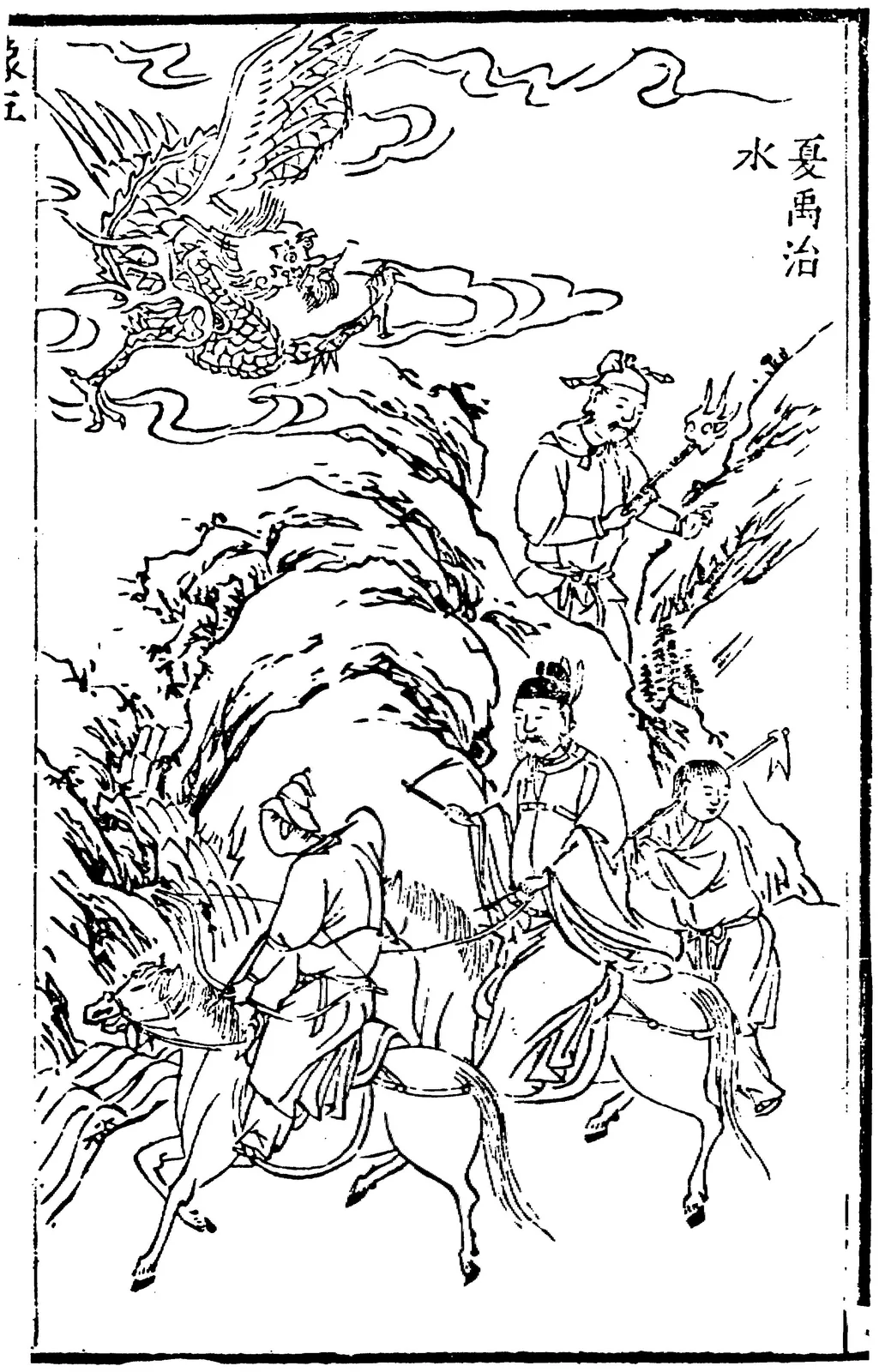
The Chinese Mengzi collects sayings of the philosopher Mencius and is thought to have been compiled around 300 BC. Its flood is one that nobody sails out. In the time of Yao, it says, "水逆行,泛濫於中國," "the waters flowed backward and spread over the central states" (Translation: Where Tales Began).
Then "禹掘地而注之海," "Yu dug the ground and led the water to the sea" (Translation: Where Tales Began). After that, people could live on level ground again (3B:9). The zh.wikisource text quoted here does not name the edition it follows.
Source and licence
"夏禹治水(廿一史通俗衍義)" by Unknown artist — https://commons.wikimedia.org/wiki/File:%E5%A4%8F%E7%A6%B9%E6%B2%BB%E6%B0%B4%EF%BC%88%E5%BB%BF%E4%B8%80%E5%8F%B2%E9%80%9A%E4%BF%97%E8%A1%8D%E7%BE%A9%EF%BC%89.jpg — Public domain (anonymous woodcut in a book dated 1736 on the source page (PD-old there); US: published before 1931; EU: anonymous work published more than 70 years ago; faithful reproduction of a two-dimensional print)Gylfaginning is part of the Prose Edda. Anderson's 1879 introduction names Snorri Sturluson, who died in 1241, and his nephew Olaf Thordsson, who died in 1259, as the men usually credited with the work. Its flood is made of blood. When the sons of Bor kill the giant Ymir (Ymer in Rasmus B. Anderson's translation), "there flowed so much blood from his wounds that they drowned therein the whole race of frost giants; excepting one, who escaped with his household" (section 7, in Anderson's chapter "The Creation of the World").
That survivor is Bergelmer: "He and his wife went on board his ark and saved themselves in it." New races of frost giants come from the pair. Anderson dates two parchment manuscripts of the Prose Edda to about 1300. Following Rudolf Keyser, he credits Gylfaginning to Snorri and dates that part to about 1230.
Why this table has no arrows
Among the sources checked, one pair of texts in the table has a published case for direct copying. It is Atrahasis and Gilgamesh Tablet XI, with their shared lines and Budge's 1920 view that the flood was added to the Gilgamesh series. For Genesis, the summaries above report a prevailing view of adaptation from Mesopotamian traditions, with the date still argued.
For the Greek, Roman, Indian, Chinese and Icelandic texts, the sources checked record similar episodes in different languages and centuries but no line of copying between them. The chart below places each text by region and period and draws no line between any two.
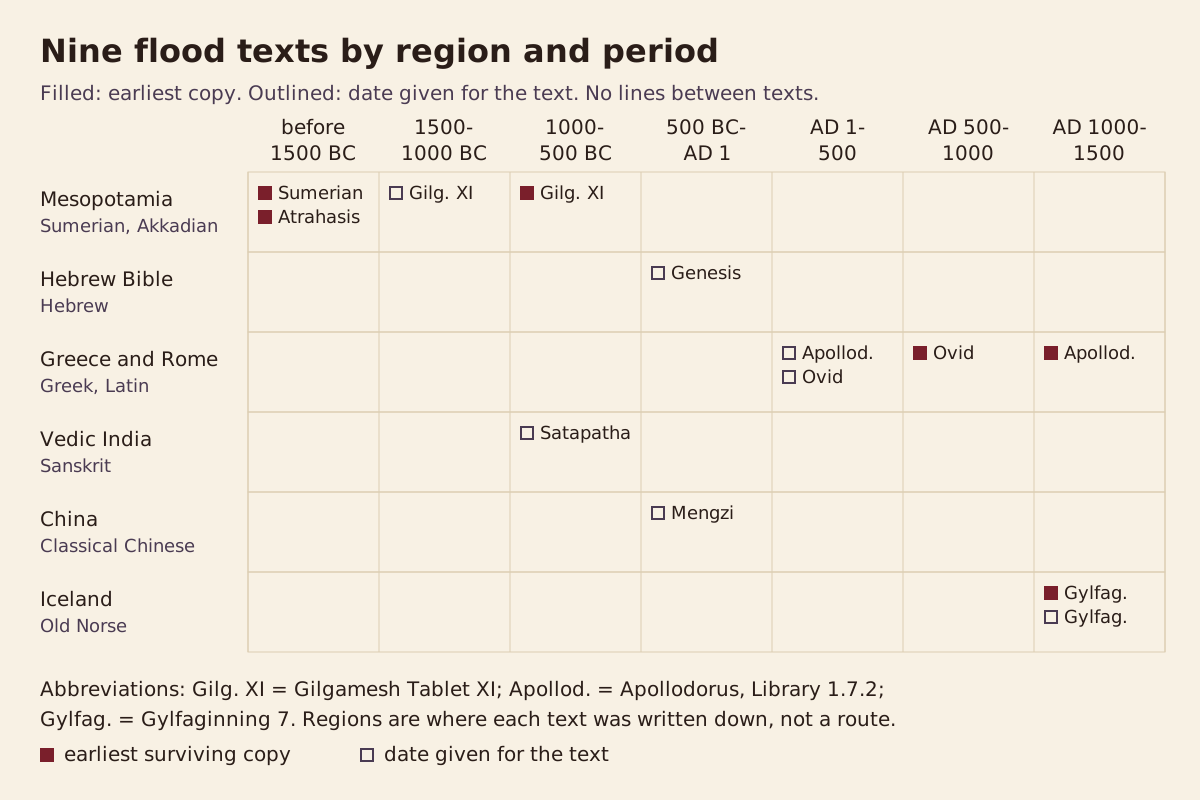
This entry treats the flood as an episode found in many texts, not as one story told many times. How folklorists number whole tales, and why a shared number does not prove a shared ancestor, is the subject of the Aarne–Thompson–Uther Index entry.
Earliest ink
- Flood narrative, among the nine texts checked: Old Babylonian period, about 1900–1600 BC. Among the nine texts in the tables, the earliest surviving copies in the sources checked are the Sumerian Flood Story tablet from Nippur (CDLI P265876) and the Atrahasis copy dated in the reign of Ammi-saduqa, 1646–1626 or 1638–1618 BC (English Wikipedia, "Atra-Hasis" and "Ammi-Saduqa").
- The Flood Tablet: 7th century BC. A Nineveh copy from the library of Ashurbanipal, 668 to about 630 BC, read by George Smith and presented on December 3, 1872 (Smith 1876, pp. 4–5).
Sources checked through 2026-10-18.
Where the trail goes next
- Back to the palaces that kept the tablets: Library of Ashurbanipal follows the Nineveh collection where Smith's flood tablets were found.
- Another motif traced source by source: Persephone's Pomegranate sets out what the old texts say about eating the food of the dead.
- The same rule in Japan's chronicles: Izanami puts the Japanese account beside the Greek one.
Cite this page
Where Tales Began. “Flood Myths Compared: The Famous Flood Tablet Is a Late Copy.” First published October 20, 2026; last substantive revision October 20, 2026. https://wheretalesbegan.com/myth/flood-myths/. Accessed: add the date you read this page.
- Author
- Where Tales Began
- Title
- Flood Myths Compared: The Famous Flood Tablet Is a Late Copy
- Published
- Revised
- Address
- https://wheretalesbegan.com/myth/flood-myths/
Sources
- George Smith, The Chaldean Account of Genesis (New York: Scribner, Armstrong, 1876), Wikisource transcription (read 2026-10-18). en.wikisource.org/wiki/The_Chaldean_Account_of_Genesis Read: ch. 1, pp. 1–11
- E. A. Wallis Budge, The Babylonian Story of the Deluge as Told by Assyrian Tablets from Nineveh (British Museum, 1920), Project Gutenberg eBook #7096. www.gutenberg.org/ebooks/7096 Read: full text, including the Tablet XI translation (lines 1–205) and notes
- Morris Jastrow Jr. and Albert T. Clay, An Old Babylonian Version of the Gilgamesh Epic, Yale Oriental Series, Researches IV.3 (Yale University Press, 1920), Project Gutenberg eBook #11000. www.gutenberg.org/ebooks/11000 Read: prefatory note and introduction (by Jastrow)
- Cuneiform Digital Library Initiative (CDLI), artifact entry P265876: CBS 10673 + CBS 10867, Penn Museum, Flood story (ETCSL 1.7.4), entry of 2023-06-15. cdli.earth/P265876 Read: artifact record: period, provenience, museum numbers, publication
- The Electronic Text Corpus of Sumerian Literature (ETCSL), 1.7.4 "The Flood story": translation, University of Oxford. etcsl.orinst.ox.ac.uk/section1/tr174.htm Read: full translation, summarized here
- Ashurbanipal Library Project, "The Ashurbanipal Library Project" (home page), Department of the Middle East, British Museum, on Oracc. oracc.museum.upenn.edu/asbp Read: home page Text licence: CC BY-SA 3.0
- Jonathan Taylor, "Which tablets are which," Ashurbanipal Library Project, British Museum, 2022, on Oracc. oracc.museum.upenn.edu/asbp/ArchaeologyoftheLibrary/Whichtabletsarewhich Read: full page Text licence: CC BY-SA 3.0
- The Holy Bible: American Standard Version (1901), Genesis 6:9–9:17, Wikisource transcription (read 2026-10-18). en.wikisource.org/wiki/Bible_(American_Standard)/Genesis Read: Genesis 5:5–10:6 (printed pp. 5–8)
- Ovid, Metamorphoses 1.253–415, trans. Brookes More (Boston: Cornhill Publishing Company, 1922); digital edition urn:cts:latinLit:phi0959.phi006.perseus-eng3, Perseus Digital Library, PerseusDL/canonical-latinLit (GitHub, commit 669d365), CC BY-SA 4.0. github.com/PerseusDL/canonical-latinLit/blob/669d3657637ee44fb0aed2c37dd0f95c2b062193/data/phi0959/phi006/phi0959.phi006.perseus-eng3.xml Read: Book 1, cards 253 and 348 (lines 253–415) Text licence: CC BY-SA 4.0
- Apollodorus, The Library 1.7.2 and 2.4.3, trans. J. G. Frazer, Loeb Classical Library (London: William Heinemann; Cambridge, MA: Harvard University Press, 1921); digital edition urn:cts:greekLit:tlg0548.tlg001.perseus-eng2, Perseus Digital Library, PerseusDL/canonical-greekLit (GitHub, commit 7042732), CC BY-SA 4.0. github.com/PerseusDL/canonical-greekLit/blob/70427323b61267cdcd0256b9b02009c23392de07/data/tlg0548/tlg001/tlg0548.tlg001.perseus-eng2.xml Read: 1.7.2 and 2.4.3 (notes not used) Text licence: CC BY-SA 4.0
- Julius Eggeling, trans., The Satapatha-Brâhmana, according to the text of the Mâdhyandina school, Part I, Sacred Books of the East 12 (Oxford: Clarendon Press, 1882). archive.org/details/satapathabrhma01eggeuoft Read: I.8.1.1–11, pp. 216–219, summarized here; introduction pp. xxxix–xl
- Mengzi, "Teng Wen Gong II" (滕文公下), chapter 9, Chinese text on Chinese Wikisource, edition not named on the page (read 2026-10-18). zh.wikisource.org/wiki/%E5%AD%9F%E5%AD%90/%E6%BB%95%E6%96%87%E5%85%AC%E4%B8%8B Read: chapter 9
- Rasmus B. Anderson, trans., The Younger Edda: Also Called Snorre's Edda, or the Prose Edda (Chicago: Scott, Foresman and Company, 1901; copyright 1879), Project Gutenberg eBook #18947. www.gutenberg.org/ebooks/18947 Read: introduction and The Fooling of Gylfe, section 7 in the chapter The Creation of the World (1901 printing)
- English Wikisource, "Mencius" (page on English translations, with a header note on the text) (read 2026-10-18). en.wikisource.org/wiki/Mencius Read: header note
- English Wikipedia, "Atra-Hasis" (read 2026-10-18). en.wikipedia.org/wiki/Atra-Hasis Read: summarized here through English Wikipedia
- English Wikipedia, "Ammi-Saduqa" (read 2026-10-18). en.wikipedia.org/wiki/Ammi-Saduqa Read: summarized here through English Wikipedia
- English Wikipedia, "Gilgamesh flood myth" (read 2026-10-18). en.wikipedia.org/wiki/Gilgamesh_flood_myth Read: summarized here through English Wikipedia
- English Wikipedia, "Genesis flood narrative" (read 2026-10-18). en.wikipedia.org/wiki/Genesis_flood_narrative Read: summarized here through English Wikipedia
- English Wikipedia, "Book of Genesis" (read 2026-10-18). en.wikipedia.org/wiki/Book_of_Genesis Read: summarized here through English Wikipedia
- English Wikipedia, "Metamorphoses" (read 2026-10-18). en.wikipedia.org/wiki/Metamorphoses Read: summarized here through English Wikipedia
- English Wikipedia, "Bibliotheca (Pseudo-Apollodorus)" (read 2026-10-18). en.wikipedia.org/wiki/Bibliotheca_(Pseudo-Apollodorus) Read: summarized here through English Wikipedia
- English Wikipedia, "Shatapatha Brahmana" (read 2026-10-18). en.wikipedia.org/wiki/Shatapatha_Brahmana Read: summarized here through English Wikipedia