Catalogue entry
Persephone's Pomegranate: The Hymn Says One Seed, Not Six
- By
- Where Tales Began
- Published
- Last substantive revision
How records are checked: Following the paper trail. Corrections: Fixes to the record. Questions: Contact us.
Fast facts
- Name
- Persephone's pomegranate (Greek Persephone, Roman Proserpina)
- Earliest ink
- Earliest text with the seed (sources checked): Homeric Hymn to Demeter, 7th century BC per Evelyn-White 1914. Hesiod's Theogony 912-914 tells the abduction with no seed.
- Languages and regions
- Greek (Homeric Hymn, Apollodorus), Latin (Ovid), English (Hawthorne, 1853)
- Core motifs
- Abduction to the underworld; food of the dead; a year split between two worlds
- Surviving texts or data sources
- Homeric Hymn to Demeter (one manuscript); Apollodorus, Library 1.5.3; Ovid, Metamorphoses 5 and Fasti 4; Hawthorne, Tanglewood Tales (1853)
- TL;DR
- Persephone, Demeter's daughter, is carried off by Hades, and in the Homeric Hymn he gives her one pomegranate seed, so she must spend a third of each year below. Ovid has seven seeds in one poem and three in another, with half the year below. Six seeds and six months appear in Hawthorne's 1853 retelling, the only six-seed text among those checked here.
Download these facts (CSV, persephone-pomegranate-entry-facts.csv)
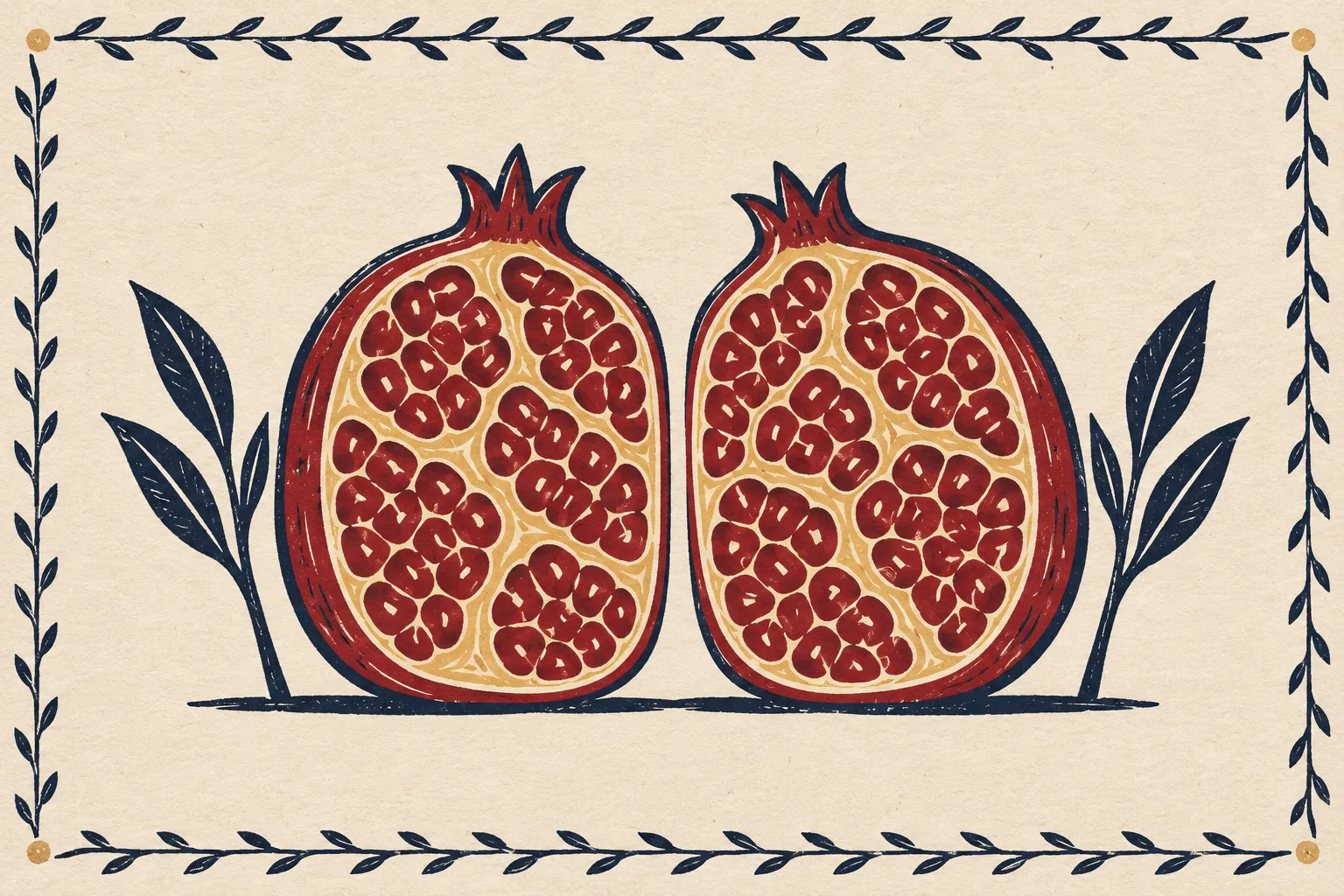
Hades slips Persephone a single pomegranate seed just before she boards the chariot home. The scene comes from the Homeric Hymn to Demeter, a Greek poem whose probable date, in Hugh G. Evelyn-White's 1914 edition, is the seventh century BC, and its word for the seed, kokkon, is singular both times it appears. Persephone is Demeter's daughter; Hades, ruler of the dead, has carried her off to the underworld. Because she ate there, the Hymn sends her back below for a third of every year.
Later versions give other counts. Ovid gives seven seeds in the Metamorphoses and three in the Fasti; both poems date from about AD 8 and send her below for half the year. Nathaniel Hawthorne's 1853 retelling for children gives six seeds, one month for each; of the texts checked for this entry, it is the only one with six.
One seed in the Hymn to Demeter
The Hymn opens with Persephone picking flowers in a meadow when the earth splits and Hades carries her off in his golden chariot (lines 1–20). Demeter withdraws in grief, and "the ground would not make the seed sprout" until famine threatens everyone (lines 305–311, in Evelyn-White's translation). Zeus sends Hermes to bring Persephone back to the light (lines 334–339). Hades lets her go, but first, in Evelyn-White's 1914 translation of lines 371–374:
"But he on his part secretly gave her sweet pomegranate seed to eat, taking care for himself that she might not remain continually with grave, dark-robed Demeter."
Reunited, Demeter asks at once whether her daughter has eaten. If she has, she must "dwell a third part of the seasons every year" beneath the earth and spend the other two parts with her mother (lines 398–400). Persephone's own account adds what the narrator left out: Hades "secretly put in my mouth sweet food, a pomegranate seed, and forced me to taste against my will" (lines 411–413).
Both passages use the same Greek words, rhoiēs kokkon (ῥοιῆς κόκκον), "a pomegranate seed" in Evelyn-White's rendering, with the noun in the singular. By this page's count, they are the only two places the poem names the seed. Zeus's settlement repeats the share: "the third part of the circling year" below and "the two parts" above (lines 445–447).
The Hymn survives in a single manuscript, found at Moscow in 1777. Evelyn-White's 1914 list dates it to the 14th century; English Wikipedia, citing later studies, dates it to the first half of the 15th. Parts of lines 387–401 are lost and supplied by editors, but Zeus's terms at lines 445–447 are complete. The lost books of antiquity entry follows works that survive in no copy at all.
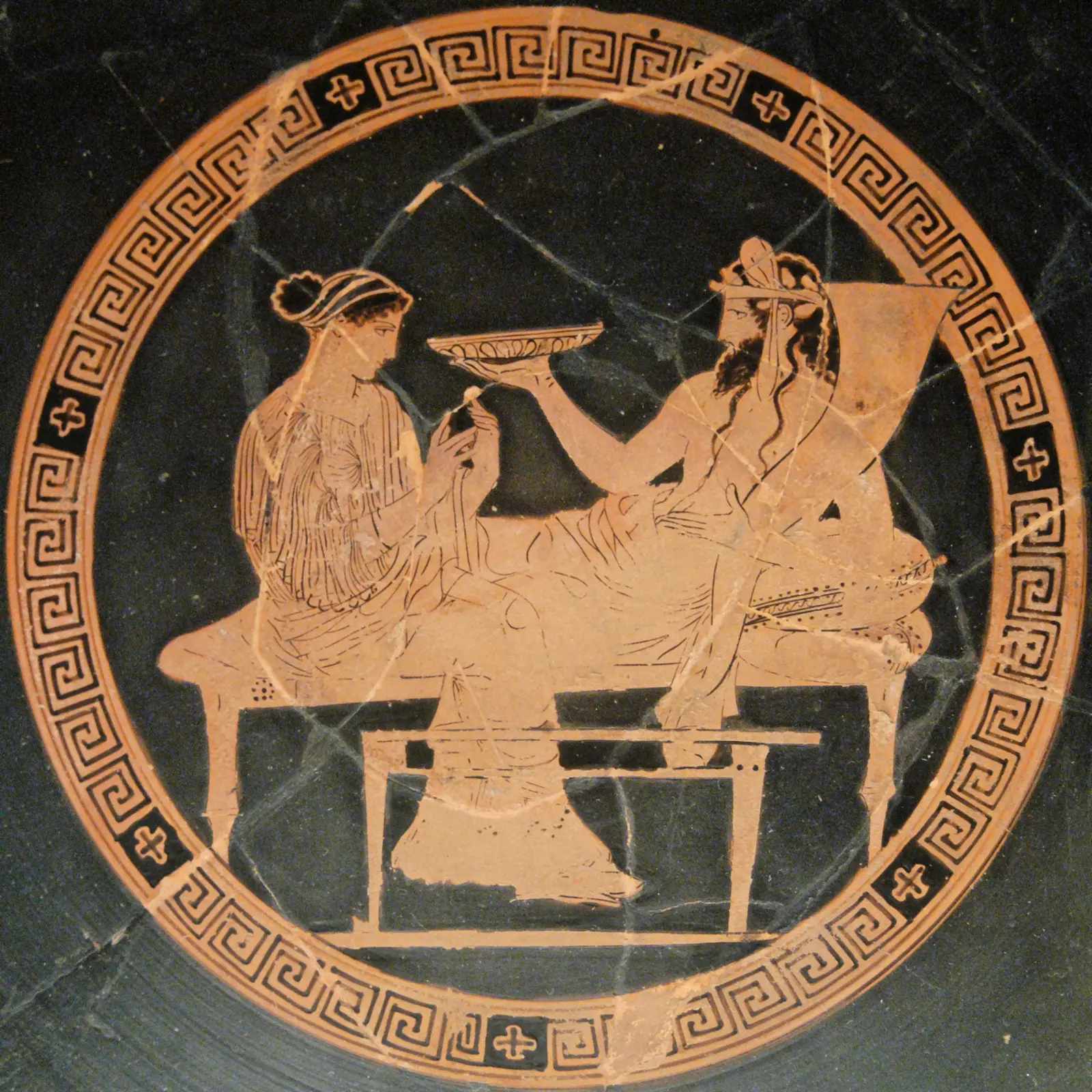
Counting seeds, version by version
Five texts give a count, and they do not agree. The table lists them in date order with the name each one uses. The Greek texts call her Persephone. Ovid's Metamorphoses mostly calls her Proserpina and his Fasti mostly Persephone, while Hawthorne keeps the Latin name.
| Version | Date | Name used | Seeds | Time below | Passage |
|---|---|---|---|---|---|
| Homeric Hymn to Demeter | 7th century BC (Evelyn-White) | Persephone | 1 | One third of the year | lines 371–374, 398–400, 445–447 |
| Ovid, Metamorphoses 5 | AD 8 | Proserpina, once Persephone | 7 | Half the year | lines 533–538, 564–567 |
| Ovid, Fasti 4 | AD 8 | Persephone, once Proserpina | 3 | Half the year | lines 607–608, 613–614 |
| Apollodorus, Library | 1st or 2nd century AD | Persephone, "the Maid" | 1 | One third of the year | 1.5.3 |
| Hawthorne, Tanglewood Tales | 1853 | Proserpina | 6 | Six months, one per seed | "The Pomegranate Seeds" |
Table data: persephone-pomegranate-seed-counts.csv, with the source and link for every row.
In the site's terms, this is motif drift: the versions differ at the same point in the story, and the table records the difference without claiming that one count grew out of another.
Apollodorus has Pluto give her "a seed of a pomegranate," in J. G. Frazer's 1921 translation, and sets her time below at a third of the year, as the Hymn does. Frazer's note on that passage lists Ovid's two poems, Hyginus (Fabulae 146), Servius on Virgil's Georgics and the Second Vatican Mythographer for the half-year version; Hyginus is not among the sources checked for this page.
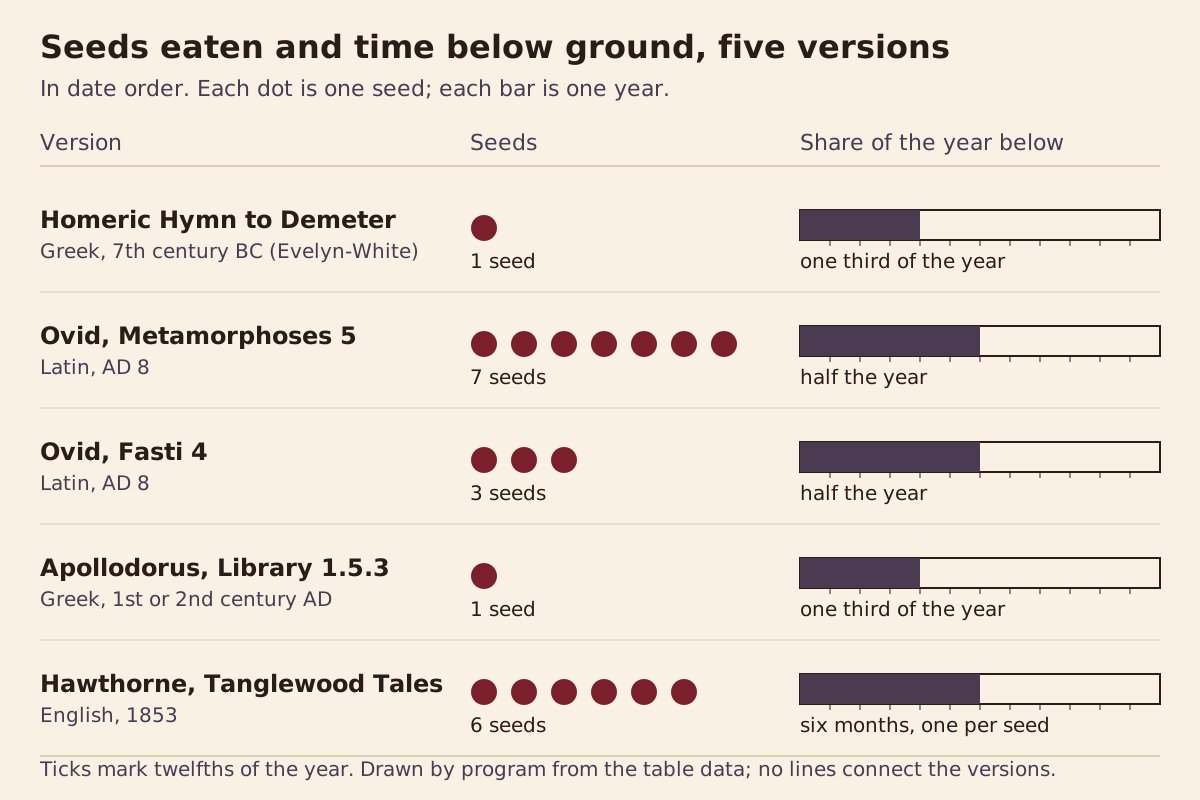
On the seasons, the Hymn ties her yearly return to spring: she will come up "when the earth shall bloom with the fragrant flowers of spring in every kind" (lines 401–403). By this page's count, no word for winter appears in its Greek text, and "a most dreadful and cruel year" in the poem is one year of famine caused by Demeter's grief (lines 305–311).
Modern readings differ. English Wikipedia's Persephone article sets out two, citing Walter Burkert, Timothy Gantz and Martin Nilsson. In one, her months below are autumn and winter; in the other, they are the dry Greek summer, when grain sat in storage jars underground.
Ovid's seven seeds and the half-year
In Ovid's Metamorphoses the eating happens in a garden below. Proserpina, wandering there, picks a fruit from a tree and eats seven seeds; only Ascalaphus sees her, and she turns him into an owl for telling (book 5, lines 533–550). In Hugo Magnus's 1892 Latin text and Brookes More's 1922 translation:
Poeniceum curva decerpserat arbore pomum / sumptaque pallenti septem de cortice grana / presserat ore suo.
"While there she plucked the fruit by bending a pomegranate tree, and plucked, and chewed seven grains, picked from the pallid rind"
Jupiter then divides the year: in More's words, "for six months with her mother she abides, and six months with her husband" (lines 564–567). The Latin divides the year ex aequo, "equally," and gives her totidem … totidem, "as many … as many" months with each (Translation: Where Tales Began); More turns that into six and six.
The Fasti, Ovid's poem on the Roman calendar, tells the story again. The count differs. Mercury reports what she ate below, and Jupiter strikes a bargain (book 4, lines 607–608 and 613–614, in J. G. Frazer's 1931 Latin text):
rapta tribus dixit ‘solvit ieiunia granis, / Punica quae lento cortice poma tegunt.’
"The girl who was carried off," he said, "broke her fast with three seeds, which pomegranates keep under a tough rind." (Translation: Where Tales Began)
et factura fuit, pactus nisi Iuppiter esset, / bis tribus ut caelo mensibus illa foret.
"And she would have done it, had Jupiter not agreed that the girl should be in heaven for twice three months." (Translation: Where Tales Began)
The "she" is Ceres, the Roman Demeter, who had just said that heaven was no place for her either (lines 611–612). By this page's count, the Fasti calls the daughter Persephone in five lines and Proserpina in one (587).
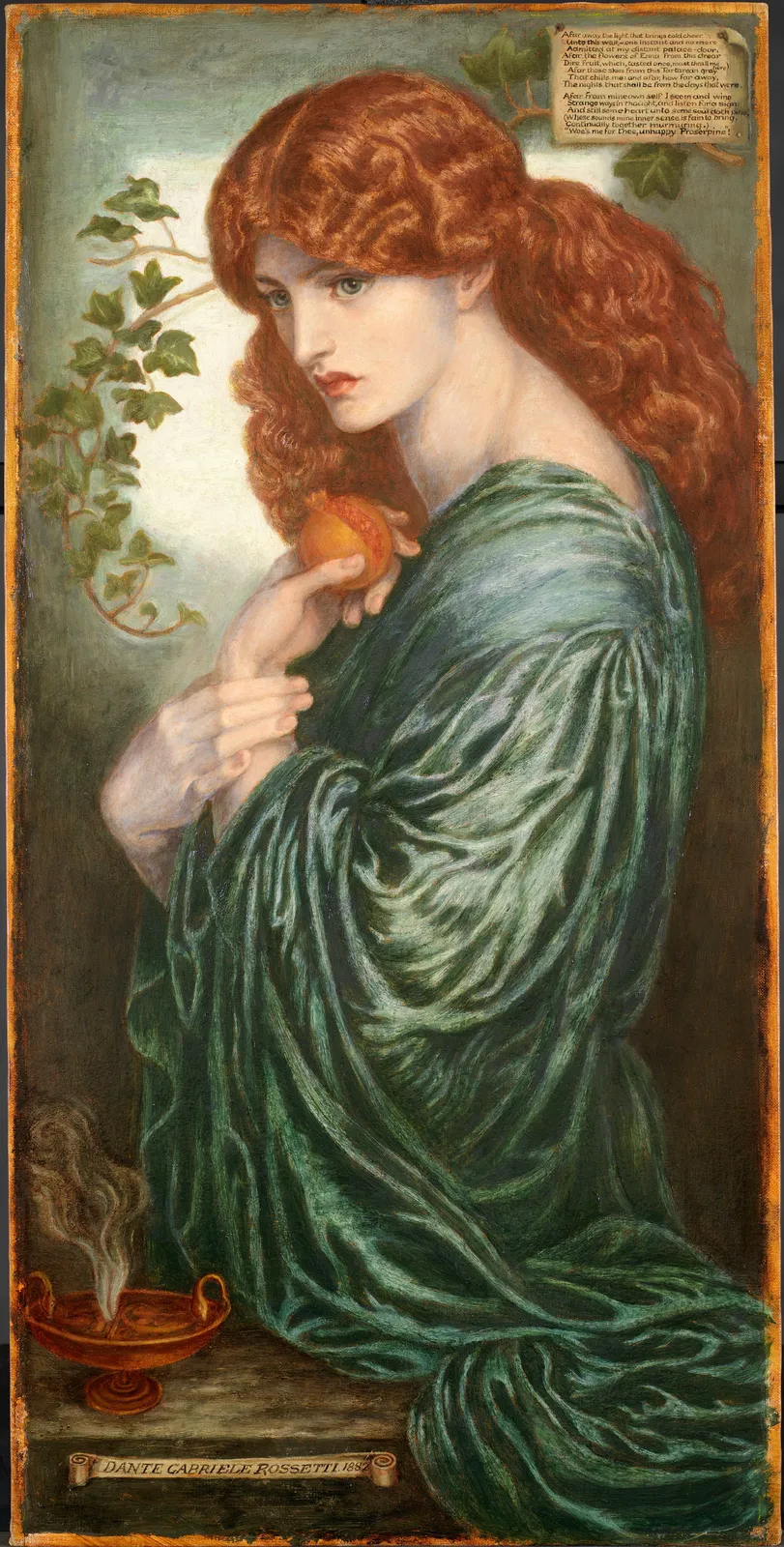
Source and licence
"Dante Gabriel Rossetti - Proserpine - Google Art Project (JQFW5c2ZLfpmbw)" by Dante Gabriel Rossetti — https://commons.wikimedia.org/wiki/File:Dante_Gabriel_Rossetti_-_Proserpine_-_Google_Art_Project_(JQFW5c2ZLfpmbw).jpg — Public domain (artist Dante Gabriel Rossetti d. 1882, painting dated 1882; US: term of life plus 70 years long expired; EU: 70 years after the artist's death (since 1953); a faithful photograph of a two-dimensional work adds no new rights (EU DSM Directive art. 14; Bridgeman v. Corel))Where the six seeds come from
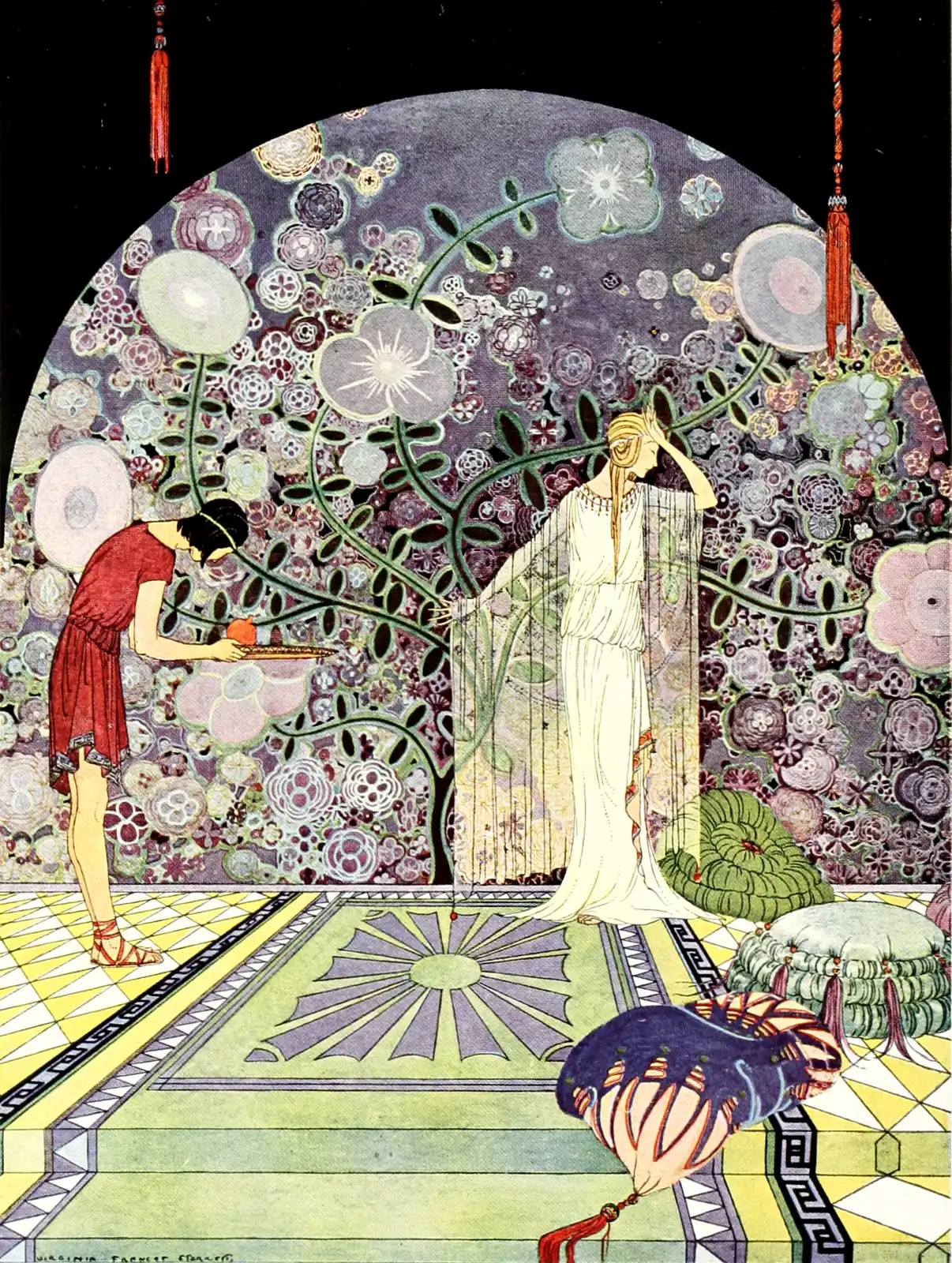
Six seeds appear in Nathaniel Hawthorne's Tanglewood Tales (1853), a book of Greek myths retold for children, in the chapter "The Pomegranate Seeds." Hawthorne's Proserpina is a little girl. She has eaten nothing in Pluto's palace for six months. His servant can find only "a single pomegranate, and that so dried up as not to be worth eating," because Mother Ceres has stopped the fruit from growing.
Proserpina bites it almost before she knows it. Back with her mother, she confesses that "six of the pomegranate seeds, I am afraid, remained in my mouth." Ceres answers: "For each of those six pomegranate seeds you must spend one month of every year in King Pluto's palace."
None of the four ancient texts in the table links the months below to the number of seeds. Each ties them to the fact that she ate. English Wikipedia's Persephone article says that in some versions she spends six months below for six seeds, citing modern studies rather than an ancient text. Of the sources checked for this page, all listed under Sources below, Hawthorne's 1853 chapter is the only dated text with six seeds; an older six-seed text, if there is one, lies outside that range.
Source and licence
"Plate facing page 200 of Tanglewood Tales (1921)" by Virginia Frances Sterrett — https://commons.wikimedia.org/wiki/File:Plate_facing_page_200_of_Tanglewood_Tales_(1921).png — Public domain (illustrator Virginia Frances Sterrett d. 1931; US: published 1921 (Penn Publishing Company edition of Tanglewood Tales), before 1931; EU: 70 years after the artist's death (since 2002))Food of the dead elsewhere
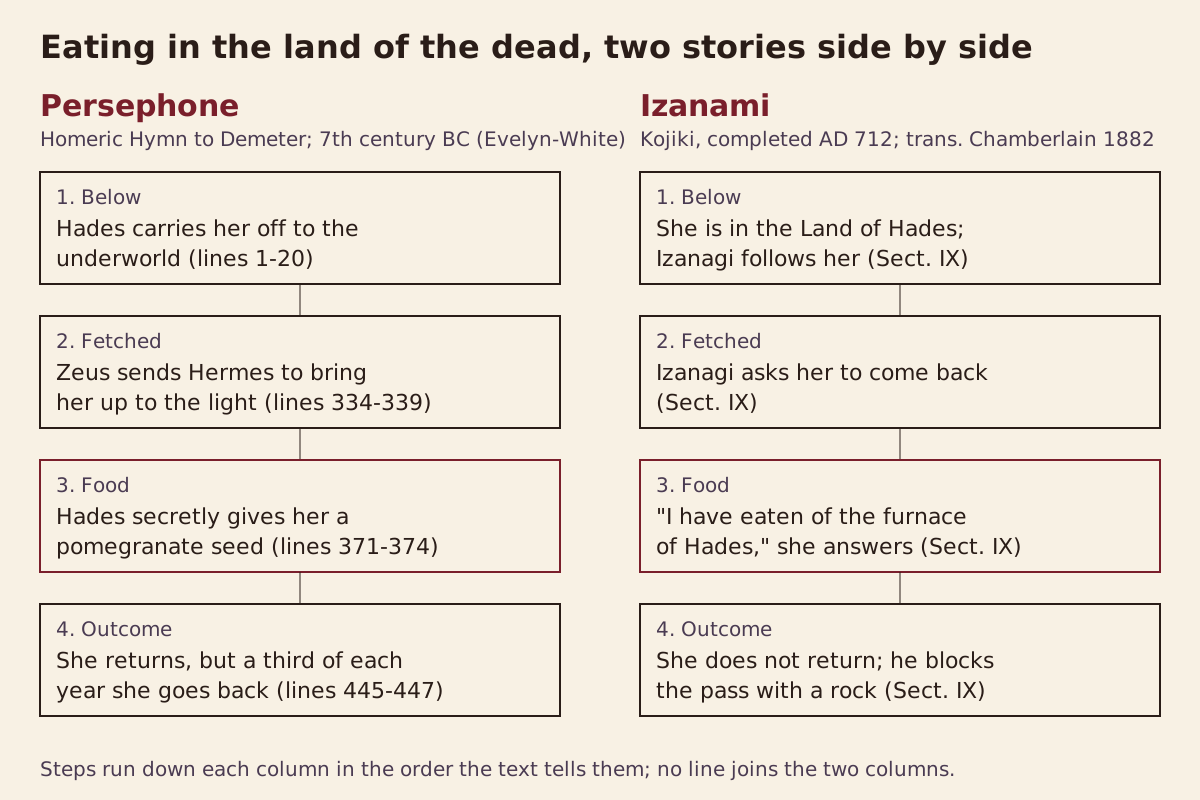
A goddess who has eaten in the land of the dead also appears in the Japanese Kojiki, which Basil Hall Chamberlain's 1882 translation says was completed in AD 712. When her husband Izanagi follows Izanami into the Land of Hades and asks her to come back, she answers: "Lamentable indeed that thou camest not sooner! I have eaten of the furnace of Hades." Chamberlain's note glosses the phrase as eating "of the food of Hades," reading the written character as a word for a place for cooking.
Izanami says she wishes to return and will discuss it with the Deities of Hades, but tells him not to look at her. He looks, flees, and blocks the pass to Hades with a rock (Sect. IX). The full story, and how the Nihon Shoki tells it, is in the Izanami entry.
This entry sets Persephone and Izanami side by side as two records of the same plot point, with no claim that either story borrowed from the other. Chamberlain's own introduction calls Izanagi "Orpheus-like" and does not mention Persephone. J. G. Frazer's 1921 note to Apollodorus gathers rules against eating in the world of the dead from ancient Egypt, New Caledonia, Melanesia and New Zealand, and against fairy food in the Scottish Highlands. For each, the note names a source published between 1856 and 1900.
Earliest ink
Each date below is a first-ink date for the stated scope, not the age of the story; how the site dates records explains the difference.
- Persephone carried off by Hades: c. 730–700 BC. Hesiod, Theogony 912–914, the earliest mention of the abduction in the sources checked: Demeter "bore white-armed Persephone whom Aidoneus carried off from her mother" (Evelyn-White 1914), with no pomegranate; English Wikipedia dates the poem c. 730–700 BC. Perseus text
- The pomegranate seed: 7th century BC. Homeric Hymn to Demeter, lines 371–374 and 411–413, the earliest text with the seed in the sources checked. Evelyn-White dates the poem to the seventh century BC; English Wikipedia's table, citing Helene Foley, gives the late 7th to early 6th century BC. Greek text
- Six seeds: 1853. Nathaniel Hawthorne, Tanglewood Tales, "The Pomegranate Seeds," the only dated six-seed text in the sources checked for this page; an older one, if there is one, lies outside them. Project Gutenberg
Sources checked through 2026-10-19.
Where the trail goes next
- Another goddess who ate in the land of the dead: Izanami, whose story the Kojiki and the Nihon Shoki tell in different ways.
- Another myth laid out source by source: the flood texts compared, nine flood stories in one table with no arrows between them.
- The Hymn itself: Evelyn-White's 1914 Greek text and English translation, in the Perseus Digital Library files.
Cite this page
Where Tales Began. “Persephone's Pomegranate: The Hymn Says One Seed, Not Six.” First published October 20, 2026; last substantive revision October 20, 2026. https://wheretalesbegan.com/myth/persephone-pomegranate/. Accessed: add the date you read this page.
- Author
- Where Tales Began
- Title
- Persephone's Pomegranate: The Hymn Says One Seed, Not Six
- Published
- Revised
- Address
- https://wheretalesbegan.com/myth/persephone-pomegranate/
Sources
- Homeric Hymn 2, To Demeter, Greek text, ed. Hugh G. Evelyn-White, in Hesiod, the Homeric Hymns and Homerica (London: William Heinemann; New York: The Macmillan Co., 1914); digital edition urn:cts:greekLit:tlg0013.tlg002.perseus-grc2, Perseus Digital Library, PerseusDL/canonical-greekLit (GitHub, commit 0189b9c), CC BY-SA 4.0 github.com/PerseusDL/canonical-greekLit/blob/0189b9c8d8d1f148133f2f0af309b4ee90ea4332/data/tlg0013/tlg002/tlg0013.tlg002.perseus-grc2.xml Read: full Greek text Text licence: CC BY-SA 4.0
- Homeric Hymn 2, To Demeter, trans. Hugh G. Evelyn-White, in Hesiod, the Homeric Hymns and Homerica (London: William Heinemann; New York: The Macmillan Co., 1914); digital edition urn:cts:greekLit:tlg0013.tlg002.perseus-eng2, Perseus Digital Library, PerseusDL/canonical-greekLit (GitHub, commit 0189b9c), CC BY-SA 4.0 github.com/PerseusDL/canonical-greekLit/blob/0189b9c8d8d1f148133f2f0af309b4ee90ea4332/data/tlg0013/tlg002/tlg0013.tlg002.perseus-eng2.xml Read: full English translation Text licence: CC BY-SA 4.0
- Hugh G. Evelyn-White, Hesiod, the Homeric Hymns and Homerica (London: William Heinemann; New York: The Macmillan Co., 1914), preface and introduction www.gutenberg.org/ebooks/348 Read: preface, introduction on the Homeric Hymns, and the list of manuscripts
- Hesiod, Theogony 912–914, trans. Hugh G. Evelyn-White, in Hesiod, the Homeric Hymns and Homerica (London: William Heinemann; New York: The Macmillan Co., 1914); digital edition urn:cts:greekLit:tlg0020.tlg001.perseus-eng2, Perseus Digital Library, PerseusDL/canonical-greekLit (GitHub, commit 0189b9c), CC BY-SA 4.0 github.com/PerseusDL/canonical-greekLit/blob/0189b9c8d8d1f148133f2f0af309b4ee90ea4332/data/tlg0020/tlg001/tlg0020.tlg001.perseus-eng2.xml Read: lines 912–914 in English, with the Greek text of lines 910–916 Text licence: CC BY-SA 4.0
- Ovid, Metamorphoses 5.385–571, Latin text, ed. Hugo Magnus, Die Metamorphosen des P. Ovidius Naso (Gotha: F. A. Perthes, 1892); digital edition urn:cts:latinLit:phi0959.phi006.perseus-lat2, Perseus Digital Library, PerseusDL/canonical-latinLit (GitHub, commit 128a05a), CC BY-SA 4.0 github.com/PerseusDL/canonical-latinLit/blob/128a05afa9cc7179ab18f8d05f78a9f1dd50e415/data/phi0959/phi006/phi0959.phi006.perseus-lat2.xml Read: book 5, lines 385–395, 466–472, 500–508 and 525–571 Text licence: CC BY-SA 4.0
- Ovid, Metamorphoses, trans. Brookes More (Boston: Cornhill Publishing Company, 1922), book 5; digital edition urn:cts:latinLit:phi0959.phi006.perseus-eng3, Perseus Digital Library, PerseusDL/canonical-latinLit (GitHub, commit 128a05a), CC BY-SA 4.0 github.com/PerseusDL/canonical-latinLit/blob/128a05afa9cc7179ab18f8d05f78a9f1dd50e415/data/phi0959/phi006/phi0959.phi006.perseus-eng3.xml Read: book 5, the passage on Proserpina's seeds, Ascalaphus and the divided year Text licence: CC BY-SA 4.0
- Ovid, Fasti 4.417–620, Latin text, ed. J. G. Frazer, Ovid's Fasti (London: William Heinemann; Cambridge, Mass.: Harvard University Press, 1931); digital edition urn:cts:latinLit:phi0959.phi007.perseus-lat2, Perseus Digital Library, PerseusDL/canonical-latinLit (GitHub, commit 128a05a), CC BY-SA 4.0 github.com/PerseusDL/canonical-latinLit/blob/128a05afa9cc7179ab18f8d05f78a9f1dd50e415/data/phi0959/phi007/phi0959.phi007.perseus-lat2.xml Read: book 4, lines 417–426, 445–455, 478–490 and 575–620 (Latin only) Text licence: CC BY-SA 4.0
- Apollodorus, The Library 1.5.3, trans. J. G. Frazer (London: William Heinemann; Cambridge, Mass.: Harvard University Press, 1921), with Frazer's notes; digital edition urn:cts:greekLit:tlg0548.tlg001.perseus-eng2, Perseus Digital Library, PerseusDL/canonical-greekLit (GitHub, commit 0189b9c), CC BY-SA 4.0 github.com/PerseusDL/canonical-greekLit/blob/0189b9c8d8d1f148133f2f0af309b4ee90ea4332/data/tlg0548/tlg001/tlg0548.tlg001.perseus-eng2.xml Read: 1.5.3 and its three notes, with the Greek text of 1.5.3 Text licence: CC BY-SA 4.0
- Nathaniel Hawthorne, Tanglewood Tales (1853), "The Pomegranate Seeds" www.gutenberg.org/ebooks/976 Read: the chapter "The Pomegranate Seeds" in full
- Basil Hall Chamberlain, trans., "Ko-ji-ki," or "Records of Ancient Matters," Transactions of the Asiatic Society of Japan 10, supplement (Yokohama: R. Meiklejohn and Co., 1882), Translator's Introduction and Sect. IX, "The Land of Hades," pp. 34–39; English Wikisource transcription (read 2026-10-19) en.wikisource.org/wiki/Kojiki_(Chamberlain,_1882)/Section_9 Read: Sect. IX with Chamberlain's notes, pp. 34–39, and the Translator's Introduction
- English Wikipedia, "Homeric Hymns" (read 2026-10-19) en.wikipedia.org/wiki/Homeric_Hymns Read: summarized here through English Wikipedia: the table of hymns and the section on manuscripts
- English Wikipedia, "Persephone" (read 2026-10-19) en.wikipedia.org/wiki/Persephone Read: summarized here through English Wikipedia: sections on the abduction and on interpretation of the myth
- English Wikipedia, "Theogony" (read 2026-10-19) en.wikipedia.org/wiki/Theogony Read: summarized here through English Wikipedia: opening section
- English Wikipedia, "Metamorphoses" (read 2026-10-19) en.wikipedia.org/wiki/Metamorphoses Read: summarized here through English Wikipedia: infobox and opening section
- English Wikipedia, "Fasti (poem)" (read 2026-10-19) en.wikipedia.org/wiki/Fasti_(poem) Read: summarized here through English Wikipedia: opening section
- English Wikipedia, "Bibliotheca (Pseudo-Apollodorus)" (read 2026-10-19) en.wikipedia.org/wiki/Bibliotheca_(Pseudo-Apollodorus) Read: summarized here through English Wikipedia: opening section
- English Wikipedia, "Tanglewood Tales" (read 2026-10-19) en.wikipedia.org/wiki/Tanglewood_Tales Read: summarized here through English Wikipedia: opening section