Comparison table or list
All 88 Constellations: 38 Were Added After 1500
- By
- Where Tales Began
- Published
- Last substantive revision
How records are checked: Following the paper trail. Corrections: Fixes to the record. Questions: Contact us.
Fast facts
- Name
- The 88 IAU constellations
- Classification
- Official list of constellations, International Astronomical Union
- Earliest ink
- Ptolemy's Almagest, c. 150, lists 48 constellations; Aratus's Phaenomena, from the third century BC, describes 47 of them (texts checked for this page)
- Where found
- The whole sky; 50 of the 88 descend from Ptolemy's 48, and 38 were added by globe and map makers between 1536 and 1756
- TL;DR
- The IAU agreed on its list of 88 constellations in 1922, approved the borders in 1928 and published them in 1930. Fifty of the 88 descend from the 48 in Ptolemy's Almagest. The other 38 were added by globe and map makers between 1536 and 1756.
Download these facts (CSV, 88-constellations-fast-facts.csv) Data source on record: IAU constellation names, abbreviations and English names (The Constellations, read 2026-10-18), IAU, CC BY 4.0, https://iauarchive.eso.org/public/themes/constellations/
Source and licence
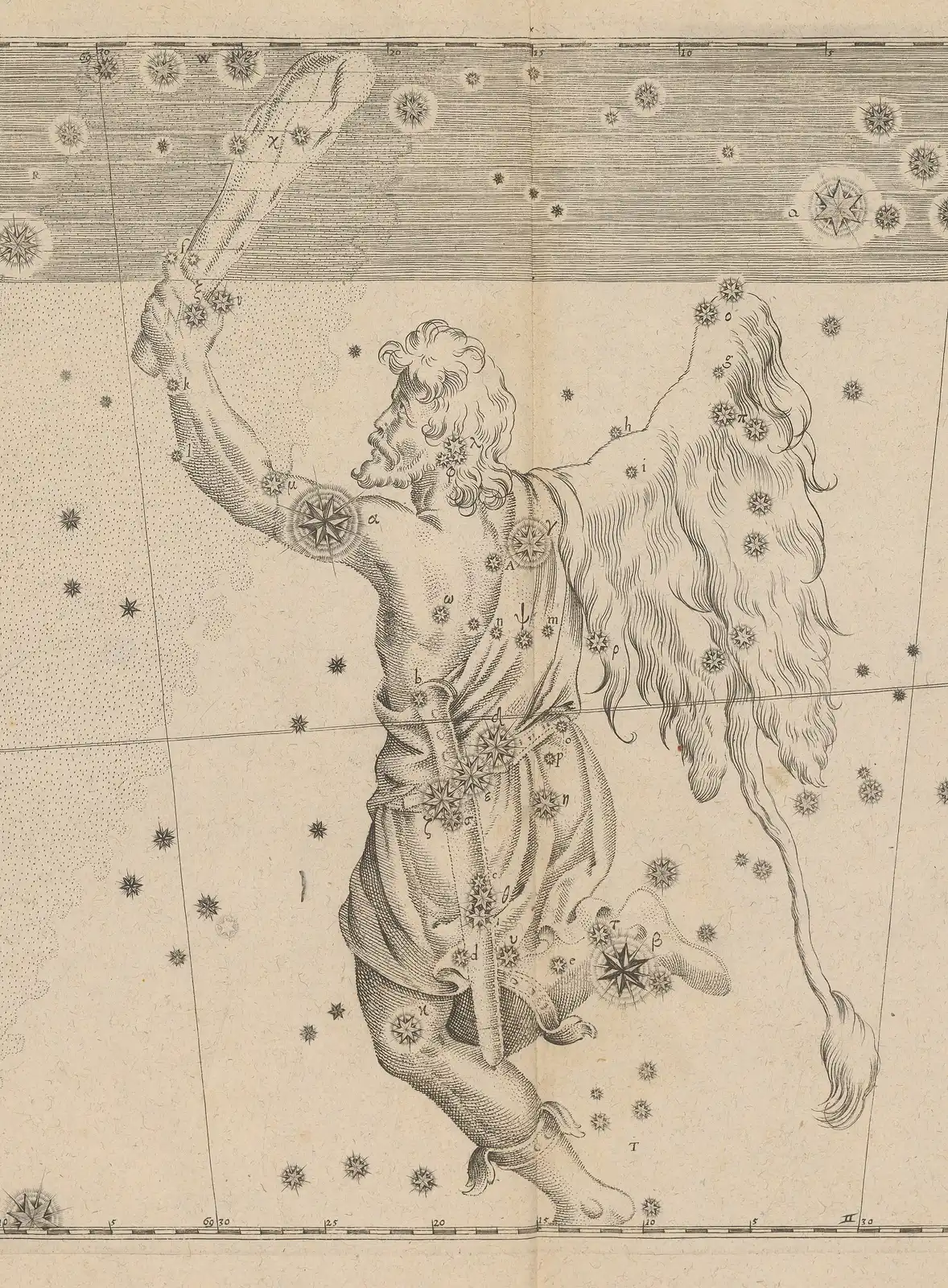
"Uranometria orion" by Johann Bayer; scan courtesy of the United States Naval Observatory Library — https://commons.wikimedia.org/wiki/File:Uranometria_orion.jpg — Public domain (engraved plate of Johann Bayer's Uranometria (first published 1603; Bayer d. 1625, engraver Alexander Mair d. 1617), this impression printed 1661; US: published before 1931; EU: more than 70 years after the deaths of author and engraver; a faithful scan of a two-dimensional print adds no new rights)Thirty-eight of the 88 official constellations were added by globe and map makers between 1536 and 1756. The list of 88 is younger still. The International Astronomical Union (IAU) agreed on it at its first General Assembly, in Rome in 1922, and gave each name a three-letter abbreviation. Borders drawn by Eugène Delporte were approved in 1928 and published in 1930, according to the IAU's own history of the list.
The other 50 descend from the 48 constellations in Ptolemy's Almagest, a Greek astronomy textbook from around AD 150. Ptolemy's ship, Argo, now counts as three. In the sources checked for this page, the 38 later ones came from four sets of maps. A globe of 1536 added one, globes and maps made between 1592 and 1613 added 16, Johannes Hevelius's atlas of 1690 added seven, and Nicolas-Louis de Lacaille's map of the southern sky, dated 1756, added 14.
Ptolemy's 48, and the 50 that descend from them
Ptolemy's star catalogue fills books 7 and 8 of the Almagest. In the Greek text edited by J. L. Heiberg it runs through 48 constellation headings: 21 northern, 12 along the zodiac and 15 southern. Its closing tally gives 1,022 stars in all. Counting Argo's three later parts, Ptolemy's 48 make 50 of today's 88.
The exception to a one-to-one match is Argo, the ship. Lacaille lettered its stars in three parts, the keel, the stern and the sails, and the IAU list keeps them as Carina, Puppis and Vela. English Wikipedia's Argo Navis article dates that split to Lacaille's "1755 catalogue" in its opening and to his catalogue of 1763 further down. Wikipedia's table of the 88 gives 1756.
Source and licence
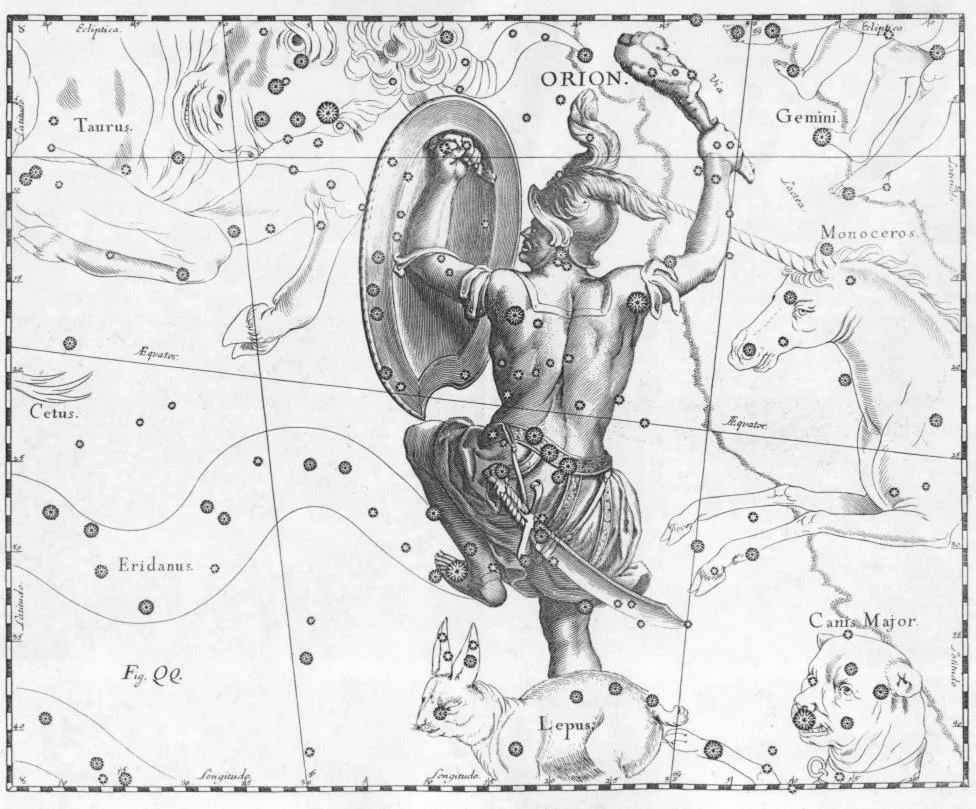
"Orion constellation Hevelius" by Johannes Hevelius; scan by Torsten Bronger — https://commons.wikimedia.org/wiki/File:Orion_constellation_Hevelius.jpg — Public domain (Johannes Hevelius d. 1687; plate QQ of Firmamentum Sobiescianum, published 1690; US: published before 1931; EU: more than 70 years after the author's death; a faithful scan of a two-dimensional print adds no new rights)Ptolemy also listed stars outside any figure. Among the "unformed" stars around Leo he records "νεφελοειδοῦς συστροφῆς καλουμένου Πλοκάμου," "a cloudy cluster called the Lock" (Translation: Where Tales Began), in Almagest 7.5. The Latin De Astronomia credited to Hyginus says that Conon of Samos and Callimachus took those stars to be Queen Berenice's hair, which she had vowed to cut off if her husband came home victorious (book 2, chapter 24).
As one of today's constellations, the Lock is younger. English Wikipedia credits Caspar Vopel's celestial globe of 1536 with making it one, and also credits Tycho Brahe, who catalogued it in 1602. The same article notes that the ancient astronomers Hipparchus and Geminus had already recognized it as a distinct constellation.
The 88 at a glance
The timeline below places Ptolemy's 48 at about AD 150 and each later constellation at the year a globe or map maker first showed it, in the sources checked. Where those sources give two years, the square sits at the later one. Each year comes from the source named in its row of the index, following how this site dates a record.
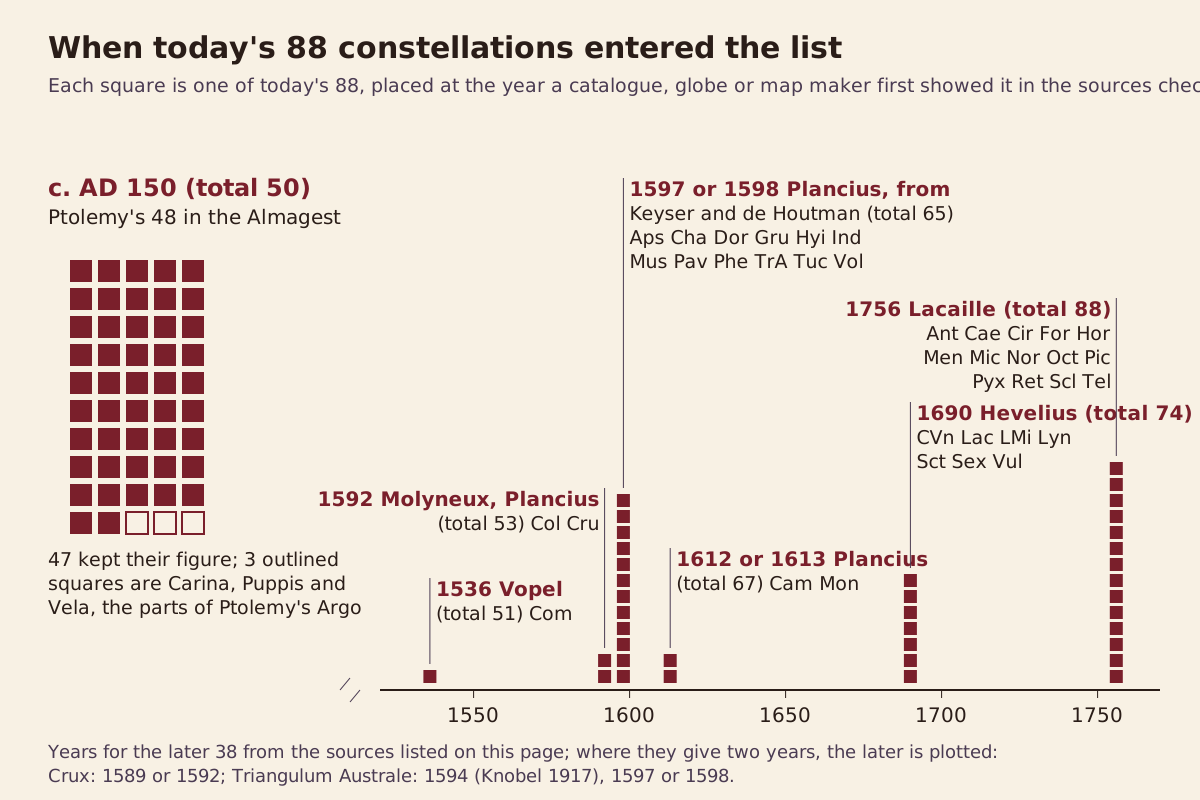
The names come from two kinds of source. The IAU's page describes its list as a mix of the ancient Greek patterns recorded by Ptolemy and patterns added later by astronomers. The table gives each newer constellation's mapmaker, from Vopel in 1536 to Lacaille in 1756. In 1922 the IAU fixed one Latin name and one abbreviation for every entry.
| Constellation | Abbr. | English name (IAU) | Entered the list via | In Aratus, Ovid or Hyginus |
|---|---|---|---|---|
| Andromeda | And | Chained Maiden | Ptolemy's 48, c. 150 | Yes |
| Antlia | Ant | Air Pump | Lacaille, 1756 | No |
| Apus | Aps | Bird of Paradise | Plancius, from Keyser and de Houtman, 1597 or 1598 | No |
| Aquarius | Aqr | Water Bearer | Ptolemy's 48, c. 150 | Yes |
| Aquila | Aql | Eagle | Ptolemy's 48, c. 150 | Yes |
| Ara | Ara | Altar | Ptolemy's 48, c. 150 | Yes |
| Aries | Ari | Ram | Ptolemy's 48, c. 150 | Yes |
| Auriga | Aur | Charioteer | Ptolemy's 48, c. 150 | Yes |
| Boötes | Boo | Herdsman | Ptolemy's 48, c. 150 | Yes |
| Caelum | Cae | Engraving Tool | Lacaille, 1756 | No |
| Camelopardalis | Cam | Giraffe | Plancius, 1612 or 1613 | No |
| Cancer | Cnc | Crab | Ptolemy's 48, c. 150 | Yes |
| Canes Venatici | CVn | Hunting Dogs | Hevelius, 1690 | No |
| Canis Major | CMa | Great Dog | Ptolemy's 48, c. 150 | Yes |
| Canis Minor | CMi | Lesser Dog | Ptolemy's 48, c. 150 | Yes |
| Capricornus | Cap | Sea Goat | Ptolemy's 48, c. 150 | Yes |
| Carina | Car | Keel | Ptolemy's 48 (part of Argo), split by Lacaille | Yes |
| Cassiopeia | Cas | Seated Queen | Ptolemy's 48, c. 150 | Yes |
| Centaurus | Cen | Centaur | Ptolemy's 48, c. 150 | Yes |
| Cepheus | Cep | King | Ptolemy's 48, c. 150 | Yes |
| Cetus | Cet | Sea Monster | Ptolemy's 48, c. 150 | Yes |
| Chamaeleon | Cha | Chameleon | Plancius, from Keyser and de Houtman, 1597 or 1598 | No |
| Circinus | Cir | Drawing Compass | Lacaille, 1756 | No |
| Columba | Col | Dove | Plancius, 1592 | No |
| Coma Berenices | Com | Berenice's Hair | Vopel, 1536 | Yes |
| Corona Australis | CrA | Southern Crown | Ptolemy's 48, c. 150 | Yes |
| Corona Borealis | CrB | Northern Crown | Ptolemy's 48, c. 150 | Yes |
| Corvus | Crv | Crow | Ptolemy's 48, c. 150 | Yes |
| Crater | Crt | Cup | Ptolemy's 48, c. 150 | Yes |
| Crux | Cru | Southern Cross | Molyneux and Plancius, 1592 (1589 in one list; in its correct place from 1598) | No |
| Cygnus | Cyg | Swan | Ptolemy's 48, c. 150 | Yes |
| Delphinus | Del | Dolphin | Ptolemy's 48, c. 150 | Yes |
| Dorado | Dor | Swordfish | Plancius, from Keyser and de Houtman, 1597 or 1598 | No |
| Draco | Dra | Dragon | Ptolemy's 48, c. 150 | Yes |
| Equuleus | Equ | Little Horse | Ptolemy's 48, c. 150 | No |
| Eridanus | Eri | River | Ptolemy's 48, c. 150 | Yes |
| Fornax | For | Furnace | Lacaille, 1756 | No |
| Gemini | Gem | Twins | Ptolemy's 48, c. 150 | Yes |
| Grus | Gru | Crane | Plancius, from Keyser and de Houtman, 1597 or 1598 | No |
| Hercules | Her | Hercules | Ptolemy's 48, c. 150 | Yes |
| Horologium | Hor | Clock | Lacaille, 1756 | No |
| Hydra | Hya | Female Water Snake | Ptolemy's 48, c. 150 | Yes |
| Hydrus | Hyi | Male Water Snake | Plancius, from Keyser and de Houtman, 1597 or 1598 | No |
| Indus | Ind | Indian | Plancius, from Keyser and de Houtman, 1597 or 1598 | No |
| Lacerta | Lac | Lizard | Hevelius, 1690 | No |
| Leo | Leo | Lion | Ptolemy's 48, c. 150 | Yes |
| Leo Minor | LMi | Lesser Lion | Hevelius, 1690 | No |
| Lepus | Lep | Hare | Ptolemy's 48, c. 150 | Yes |
| Libra | Lib | Scales | Ptolemy's 48, c. 150 | Yes |
| Lupus | Lup | Wolf | Ptolemy's 48, c. 150 | Yes |
| Lynx | Lyn | Lynx | Hevelius, 1690 | No |
| Lyra | Lyr | Lyre | Ptolemy's 48, c. 150 | Yes |
| Mensa | Men | Table Mountain | Lacaille, 1756 | No |
| Microscopium | Mic | Microscope | Lacaille, 1756 | No |
| Monoceros | Mon | Unicorn | Plancius, 1612 or 1613 | No |
| Musca | Mus | Fly | Plancius, from Keyser and de Houtman, 1597 or 1598 | No |
| Norma | Nor | Carpenter's Square | Lacaille, 1756 | No |
| Octans | Oct | Octant | Lacaille, 1756 | No |
| Ophiuchus | Oph | Serpent Bearer | Ptolemy's 48, c. 150 | Yes |
| Orion | Ori | Hunter | Ptolemy's 48, c. 150 | Yes |
| Pavo | Pav | Peacock | Plancius, from Keyser and de Houtman, 1597 or 1598 | No |
| Pegasus | Peg | Winged Horse | Ptolemy's 48, c. 150 | Yes |
| Perseus | Per | Hero | Ptolemy's 48, c. 150 | Yes |
| Phoenix | Phe | Phoenix | Plancius, from Keyser and de Houtman, 1597 or 1598 | No |
| Pictor | Pic | Painter's Easel | Lacaille, 1756 | No |
| Pisces | Psc | Fishes | Ptolemy's 48, c. 150 | Yes |
| Piscis Austrinus | PsA | Southern Fish | Ptolemy's 48, c. 150 | Yes |
| Puppis | Pup | Stern | Ptolemy's 48 (part of Argo), split by Lacaille | Yes |
| Pyxis | Pyx | Mariner Compass | Lacaille, 1756 | No |
| Reticulum | Ret | Reticle | Lacaille, 1756 | No |
| Sagitta | Sge | Arrow | Ptolemy's 48, c. 150 | Yes |
| Sagittarius | Sgr | Archer | Ptolemy's 48, c. 150 | Yes |
| Scorpius | Sco | Scorpion | Ptolemy's 48, c. 150 | Yes |
| Sculptor | Scl | Sculptor | Lacaille, 1756 | No |
| Scutum | Sct | Shield | Hevelius, 1690 | No |
| Serpens | Ser | Serpent | Ptolemy's 48, c. 150 | Yes |
| Sextans | Sex | Sextant | Hevelius, 1690 | No |
| Taurus | Tau | Bull | Ptolemy's 48, c. 150 | Yes |
| Telescopium | Tel | Telescope | Lacaille, 1756 | No |
| Triangulum | Tri | Triangle | Ptolemy's 48, c. 150 | Yes |
| Triangulum Australe | TrA | Southern Triangle | Plancius, from Keyser and de Houtman, 1597 or 1598 (on a Plancius map of 1594 in Knobel 1917) | No |
| Tucana | Tuc | Toucan | Plancius, from Keyser and de Houtman, 1597 or 1598 | No |
| Ursa Major | UMa | Great Bear | Ptolemy's 48, c. 150 | Yes |
| Ursa Minor | UMi | Little Bear | Ptolemy's 48, c. 150 | Yes |
| Vela | Vel | Sails | Ptolemy's 48 (part of Argo), split by Lacaille | Yes |
| Virgo | Vir | Maiden | Ptolemy's 48, c. 150 | Yes |
| Volans | Vol | Flying Fish | Plancius, from Keyser and de Houtman, 1597 or 1598 | No |
| Vulpecula | Vul | Fox | Hevelius, 1690 | No |
Table data: 88-constellations-index.csv Data source on record: IAU constellation names, abbreviations and English names (The Constellations, read 2026-10-18), IAU, CC BY 4.0, https://iauarchive.eso.org/public/themes/constellations/, with each row's source and link, plus the Aratus line, Ovid passage and Hyginus chapter behind the matrix further down.
Navigators' stars and Bayer's 1603 atlas
Twelve of the 38 later constellations are credited to a trading voyage. Pieter Dirkszoon Keyser was chief navigator on the first Dutch voyage to the East Indies, which left Texel on April 2, 1595. According to E. B. Knobel's 1917 study of the southern constellations, the cartographer Petrus Plancius had taught him mathematics and astronomy. English Wikipedia adds that Plancius asked him to map the southern sky.
Keyser probably made most of his observations at Madagascar, where the fleet stopped from September 1595, English Wikipedia says. He died in 1596. Wikipedia names Frederick de Houtman among his helpers, but Knobel, calling his evidence circumstantial, credited the twelve new constellations to Keyser alone. Wikipedia says Plancius put them on a globe published by Jodocus Hondius in late 1597, and its table of the 88 gives 1598.
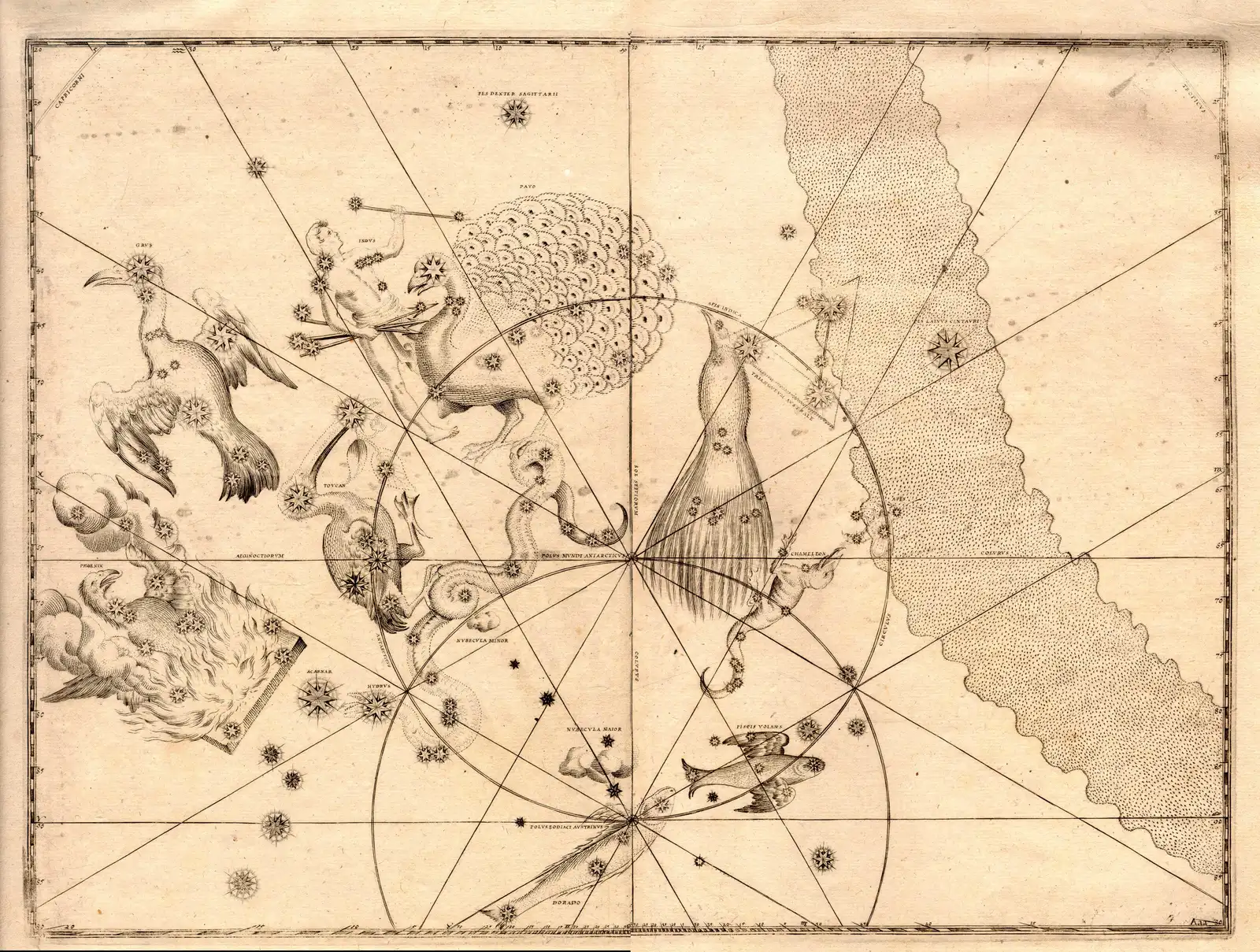
Writing in 1917, Knobel gave three works of 1603 as the earliest publications of them: Johann Bayer's atlas Uranometria, de Houtman's star catalogue and a globe by Willem Blaeu. Bayer printed all twelve on one plate and credited them to "Petrus Theodori," a Latin form of Keyser's name, and he is often wrongly credited with them, English Wikipedia notes. Most are named after animals that 16th-century explorers had encountered, among them the bird of paradise (Apus), the toucan (Tucana), the flying fish (Volans) and the chameleon.
According to Knobel, one of the twelve, Triangulum Australe, was already on a world map that Plancius made in 1594, before the fleet sailed. Knobel could not trace where it came from.
Source and licence
"Bayer-Uranometria-Southern Constellations" by Johann Bayer; scan from the United States Naval Observatory Library — https://commons.wikimedia.org/wiki/File:Bayer-Uranometria-Southern_Constellations.jpg — Public domain (plate of the far southern sky from Johann Bayer's Uranometria (first published 1603; Bayer d. 1625), this impression printed 1661; US: published before 1931; EU: more than 70 years after the author's death; a faithful scan of a two-dimensional print adds no new rights)Plancius added more of his own. As English Wikipedia summarizes it, he drew Columba, which he called Noah's Dove, on a wall map of 1592. He put Camelopardalis (the giraffe) and Monoceros (the unicorn) on a globe of 1612 or 1613.
Crux, the Southern Cross, is the knottiest row. Navigators described it before the mapmakers did: Knobel cites Antonio Pigafetta on Magellan's voyage of 1519 and a sketch by Andrea Corsali, in a letter that Knobel dates to 1517 and English Wikipedia to 1516. Wikipedia's Crux article says a globe by Emery Molyneux and a map by Plancius showed it in 1592, in the wrong place, and that globes by Plancius and Hondius placed it correctly in 1598 and 1600. Wikipedia's table of the 88 gives 1589 instead.
Hevelius adds seven, 1690
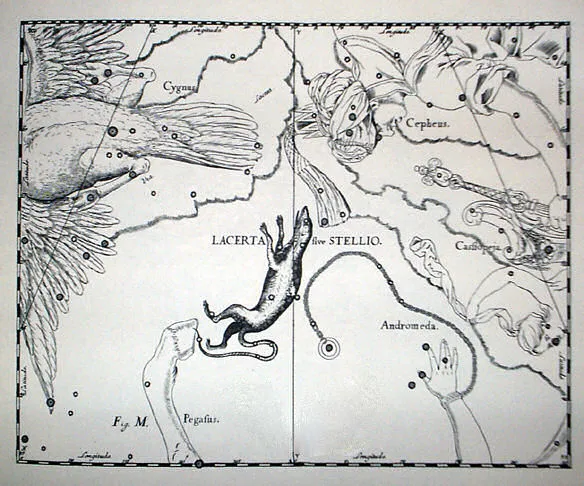
Johannes Hevelius, an astronomer and city councillor in Danzig (Gdańsk), described ten new constellations, of which seven are still in use. His star atlas Firmamentum Sobiescianum appeared around 1690, three years after his death in 1687, and English Wikipedia credits his widow, Elisabeth, with publishing two of his works posthumously. The seven are Canes Venatici (the hunting dogs), Lacerta (the lizard), Leo Minor, Lynx, Scutum, Sextans and Vulpecula (the fox).
The IAU's history notes that astronomers were free to invent figures between the existing ones, often to flatter a patron or a monarch. According to English Wikipedia, Hevelius named Scutum Scutum Sobiescianum, Sobieski's Shield, to mark King John III Sobieski's victory at the Battle of Vienna in 1683. Sextans recalls the sextant he lost when fire destroyed his observatory on September 26, 1679.
Source and licence
"Johannes Hevelius - Prodromus Astronomia - Volume III "Firmamentum Sobiescianum, sive uranographia" - Tavola M - Lacerta sive stellio" by Johannes Hevelius — https://commons.wikimedia.org/wiki/File:Johannes_Hevelius_-_Prodromus_Astronomia_-_Volume_III_%22Firmamentum_Sobiescianum,_sive_uranographia%22_-_Tavola_M_-_Lacerta_sive_stellio.jpg — Public domain (Johannes Hevelius d. 1687; plate M of Firmamentum Sobiescianum, published 1690; US: published before 1931; EU: more than 70 years after the author's death; a faithful scan of a two-dimensional print adds no new rights)Lacaille's fourteen: instruments and a mountain
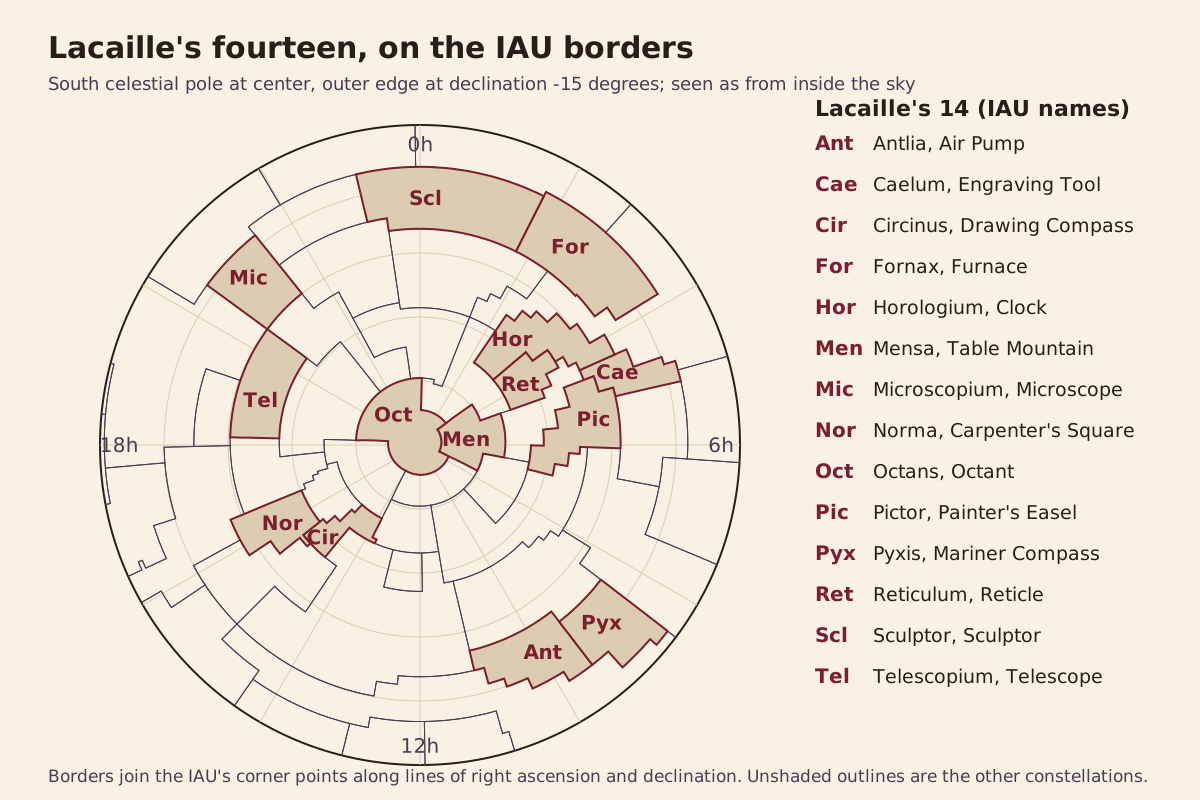
Nicolas-Louis de Lacaille studied the southern sky from the Cape of Good Hope between 1750 and 1754. A planisphere of the southern sky dated 1756 already shows several of his new figures, under French names such as "Octans de Reflexion," "Montagne de la Table" and "Reticule Romboide." His full catalogue, Coelum Australe Stelliferum, came out in 1763. That was the year after his death.
Thirteen of the fourteen take their names from instruments and tools. Their English names in the IAU's list include the Air Pump, the Furnace, the Clock, the Microscope, the Octant and the Telescope. English Wikipedia's table records that Sculptor began as Apparatus Sculptoris, the sculptor's tools. The fourteenth, Mensa, is named for Table Mountain at the Cape, which English Wikipedia calls the only constellation named after a feature on Earth.
The map below shades Lacaille's fourteen on the IAU borders around the south celestial pole. Pyxis, the compass, lies near what was once counted as part of Argo's mast, as English Wikipedia's Argo Navis article notes, yet Lacaille treated it as a separate instrument.
Where the myths are written
Not every constellation has a myth in the three classical sources checked for this page. By this page's count, 50 of today's 88 appear in at least one of them and 38 in none. The 38 are Equuleus, the little horse that Ptolemy lists, and every post-1500 addition except Coma Berenices.
The oldest of the texts checked is the Phaenomena of Aratus, a Greek poem from the third century BC. The poem puts a lost work by Eudoxus into verse. It describes 47 of Ptolemy's 48, all except Equuleus, and it gives the stars of the Southern Crown as a ring without a name (lines 400–401). Aratus is frank about the kneeling figure.
τὸ μὲν οὔτις ἐπίσταται ἀμφαδὸν εἰπεῖν, οὐδʼ ὅτινι κρέμαται κεῖνος πόνῳ, ἀλλά μιν αὕτως Ἐγγόνασιν καλέουσι. (Aratus, Phaenomena 64–66, Greek text ed. G. R. Mair, 1921)
No one knows how to say plainly what it is, or at what labor he toils; they simply call him the Kneeler. (Translation: Where Tales Began)
The Latin De Astronomia credited to Hyginus covers 47 of the 48 in 41 chapters, some shared by two or three figures, and it tucks Berenice's hair into the chapter on Leo. Its date is uncertain. English Wikipedia places it probably in the reign of Augustus, while noting that its star lists follow Ptolemy's order, which supports the idea of a second-century compilation.
Ovid's Fasti, a poem on the Roman calendar made public in AD 8, names many of Ptolemy's figures as stars. With his Metamorphoses, it names 28 of the 48 by this page's count, plus Capella, the goat star in Auriga.
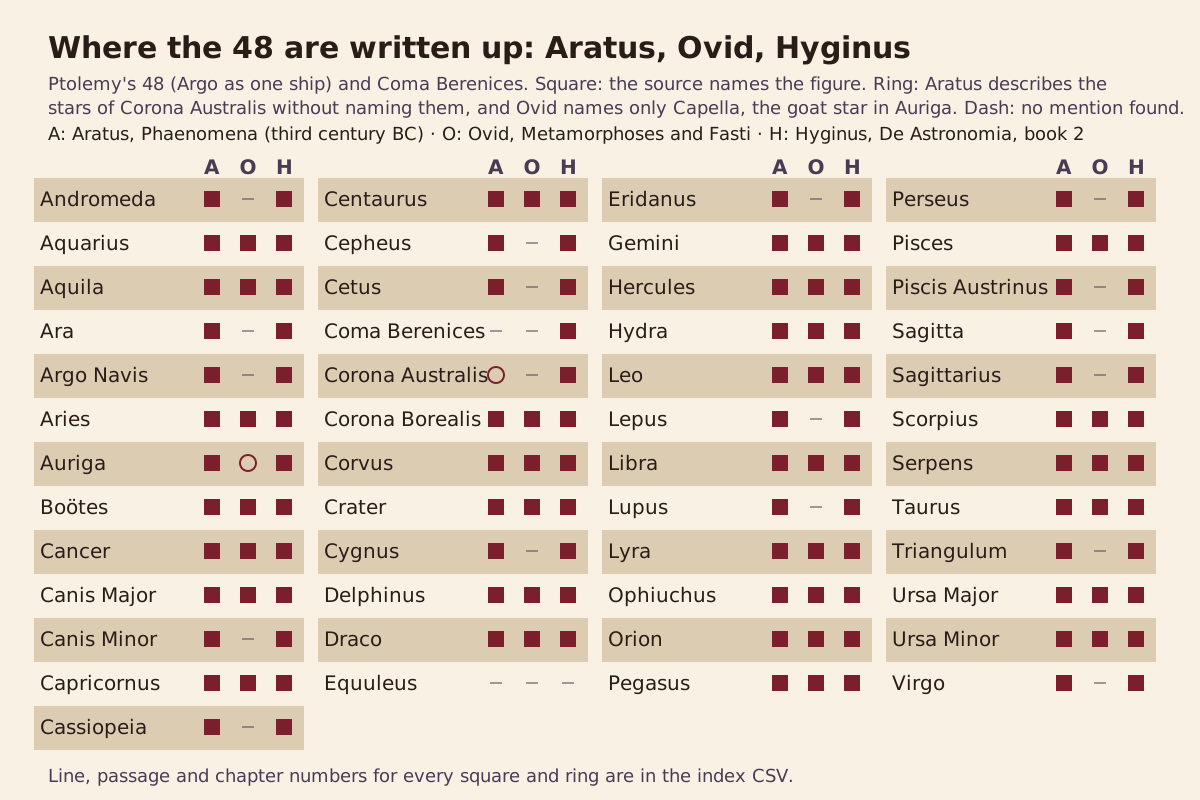
Perseus, Andromeda, Cepheus and Cassiope all appear in book 4 of the Metamorphoses, but not as stars. The matrix leaves out the Greek star-myth collection known as the Catasterismi, as no edition of it was read for this page. Cassiopeia is one of Aratus's 47 (line 189) with her own chapter in Hyginus (2.10); the Cassiopeia entry follows her further.
How the list and the borders became official
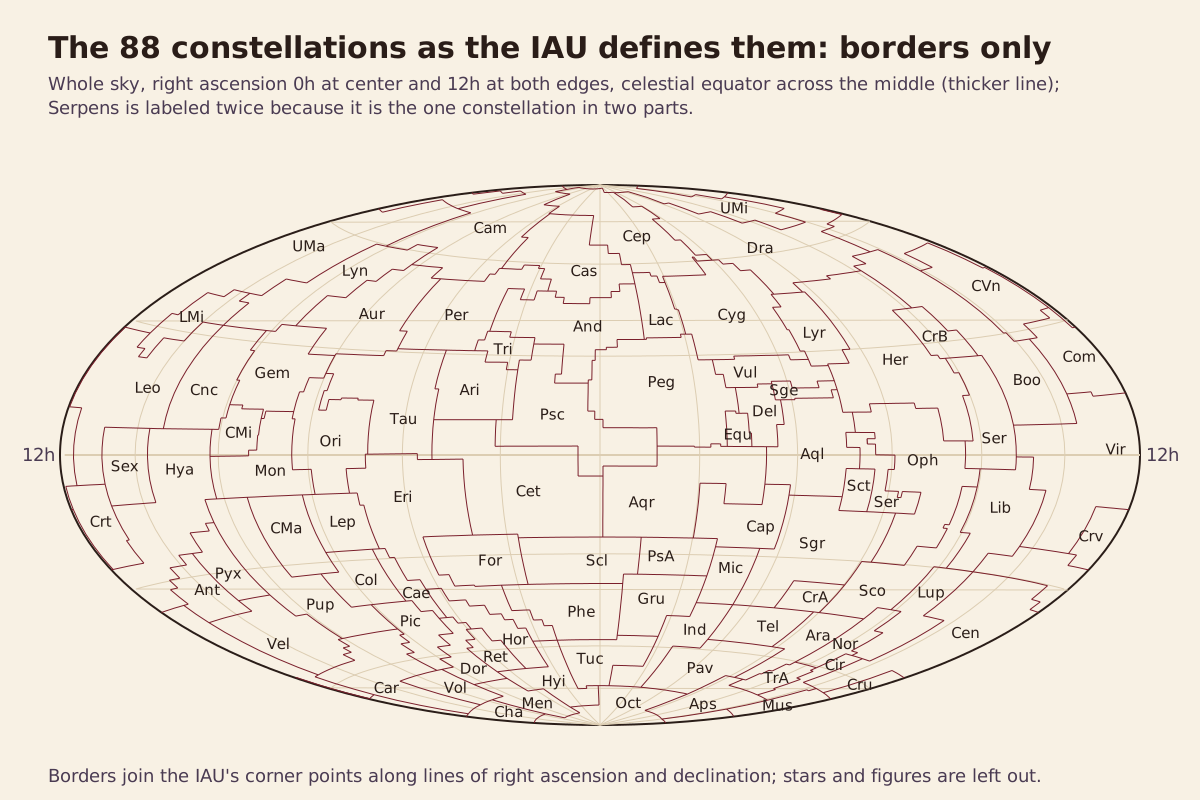
By the 19th century more than a hundred constellations could be found on star charts, the IAU's history notes, because nothing stopped astronomers from inventing new ones. At its first General Assembly, in Rome in 1922, the IAU's Commission on Notations and Units agreed on a list of 88. The list covers the whole sky, and each name has a three-letter abbreviation.
At the 1925 General Assembly in Cambridge, England, Eugène Delporte of the Royal Observatory in Brussels proposed a set of borders. They ran along lines of right ascension and declination, the sky's longitude and latitude. The IAU asked him to keep every known variable star in the constellation it already belonged to, which produced some awkward outlines. His boundaries were approved at Leiden in 1928 and published in 1930 in Délimitation scientifique des constellations, with an Atlas céleste.
Since then, a star or galaxy is "in" a constellation when it lies inside those borders, whatever figure is drawn around it. Where Tales Began treats the borders as a modern administrative survey, approved at a General Assembly in 1928, not as a legacy of the myths.
Earliest ink
- Ptolemy's 48 constellations: about AD 150. The star catalogue in books 7 and 8 of the Almagest, in J. L. Heiberg's Greek text (First1KGreek digital edition); the earliest text checked for this page that names all 48 under headings.
- Most of the same figures, described: third century BC. Aratus, Phaenomena, lines 26–452, which describes 47 of the 48 (Perseus digital edition); the earliest of the texts checked for this page.
- Coma Berenices on a globe as a constellation of its own: 1536. Caspar Vopel's celestial globe, as English Wikipedia summarizes it; the same article says Hipparchus and Geminus had already recognized it as a distinct constellation.
- The list of 88: 1922; the borders: approved 1928, published 1930. IAU, "The Constellations".
Sources checked through 2026-10-18.
Where the trail goes next
- One cluster, two counts: The Pleiades, which Aratus calls seven while saying only six can be seen (lines 257–258).
- The seated queen: Cassiopeia, one of Aratus's 47 and one of Ptolemy's northern figures, from the star chart to the story told about her.
- The poem itself: Aratus's Phaenomena in the Perseus Digital Library's Greek text, where the tour of the constellations runs from line 26 to line 452.
Cite this page
Where Tales Began. “All 88 Constellations: 38 Were Added After 1500.” First published October 20, 2026; last substantive revision October 20, 2026. https://wheretalesbegan.com/starlore/88-constellations/. Accessed: add the date you read this page.
- Author
- Where Tales Began
- Title
- All 88 Constellations: 38 Were Added After 1500
- Published
- Revised
- Address
- https://wheretalesbegan.com/starlore/88-constellations/
Sources
- International Astronomical Union (IAU), "The Constellations" (IAU themes page), read 2026-10-18. iauarchive.eso.org/public/themes/constellations Read: full page: the 1922, 1925, 1928 and 1930 history, the table of 88 names and abbreviations, and the boundary file format Text licence: CC BY 4.0
- International Astronomical Union (IAU), constellation boundary files (J2000 corner points), 89 TXT files linked from "The Constellations". iauarchive.eso.org/public/themes/constellations Read: all 89 files (Serpens in two parts) Text licence: CC BY 4.0
- Ptolemy, Syntaxis mathematica (Almagest), books 7–8, Greek text ed. J. L. Heiberg (Leipzig: Teubner, 1898); digital edition urn:cts:greekLit:tlg0363.tlg001.1st1K-grc1, First1KGreek (Harvard College Library), OpenGreekAndLatin/First1KGreek, CC BY-SA 4.0. github.com/OpenGreekAndLatin/First1KGreek/blob/03776b39f4047c5cff06f5296fae4b2bae4b08fb/data/tlg0363/tlg001/tlg0363.tlg001.1st1K-grc1.xml Read: books 7.5 and 8.1, the star catalogue: all 48 constellation headings, the unformed stars around Leo, and the closing star total Text licence: CC BY-SA 4.0
- Aratus, Phaenomena, Greek text ed. G. R. Mair (1921); digital edition urn:cts:greekLit:tlg0653.tlg001.perseus-grc2, Perseus Digital Library, PerseusDL/canonical-greekLit, CC BY-SA 4.0. github.com/PerseusDL/canonical-greekLit/blob/0189b9c8d8d1f148133f2f0af309b4ee90ea4332/data/tlg0653/tlg001/tlg0653.tlg001.perseus-grc2.xml Read: lines 1–452 (the constellation section); quotation from lines 64–66 Text licence: CC BY-SA 4.0
- Ovid, Metamorphoses, Latin text ed. Hugo Magnus (1892); digital edition urn:cts:latinLit:phi0959.phi006.perseus-lat2, Perseus Digital Library, PerseusDL/canonical-latinLit, CC BY-SA 4.0. github.com/PerseusDL/canonical-latinLit/blob/128a05afa9cc7179ab18f8d05f78a9f1dd50e415/data/phi0959/phi006/phi0959.phi006.perseus-lat2.xml Read: passages listed in the index CSV (2.171–200, 2.505–507, 4.663–764, 8.176–182) Text licence: CC BY-SA 4.0
- Ovid, Fasti, Latin text ed. J. G. Frazer (1931); digital edition urn:cts:latinLit:phi0959.phi007.perseus-lat2, Perseus Digital Library, PerseusDL/canonical-latinLit, CC BY-SA 4.0. github.com/PerseusDL/canonical-latinLit/blob/128a05afa9cc7179ab18f8d05f78a9f1dd50e415/data/phi0959/phi007/phi0959.phi007.perseus-lat2.xml Read: passages listed in the index CSV Text licence: CC BY-SA 4.0
- Hyginus, De Astronomia, book 2, Latin Wikisource transcription, edition not stated (read 2026-10-18). la.wikisource.org/wiki/De_Astronomia/Liber_II Read: chapter headings 1–43; chapters 2.10, 2.24, 2.26, 2.27, 2.38 and 2.40
- Wikimedia Commons, "Lacaille’s southern planisphere of 1756" (file page and image; source scan from Gallica), read 2026-10-18. commons.wikimedia.org/wiki/File:Lacaille%E2%80%99s_southern_planisphere_of_1756.png Read: file page (dated 1756, author Lacaille) and image labels near the south pole
- Wikimedia Commons, "Lacerta Hevelius.jpg" (file description of a plate from Hevelius's atlas), read 2026-10-18. commons.wikimedia.org/wiki/File:Lacerta_Hevelius.jpg Read: file description: "The view is mirrored following the tradition of celestial globes, showing the celestial sphere in a view from outside"
- E. B. Knobel, "On Frederick de Houtman's Catalogue of Southern Stars, and the Origin of the Southern Constellations," Monthly Notices of the Royal Astronomical Society 77, no. 5 (March 1917): 414–432. doi.org/10.1093/mnras/77.5.414 Read: pp. 414–421 (1917 printing), paraphrased
- English Wikipedia, "IAU designated constellations" (read 2026-10-18). en.wikipedia.org/wiki/IAU_designated_constellations Read: summarized here through English Wikipedia
- English Wikipedia, "Almagest" (read 2026-10-18). en.wikipedia.org/wiki/Almagest Read: summarized here through English Wikipedia
- English Wikipedia, "Aratus" (read 2026-10-18). en.wikipedia.org/wiki/Aratus Read: summarized here through English Wikipedia
- English Wikipedia, "De astronomia" (read 2026-10-18). en.wikipedia.org/wiki/De_astronomia Read: summarized here through English Wikipedia
- English Wikipedia, "Fasti (poem)" (read 2026-10-18). en.wikipedia.org/wiki/Fasti_(poem) Read: summarized here through English Wikipedia
- English Wikipedia, "Argo Navis" (read 2026-10-18). en.wikipedia.org/wiki/Argo_Navis Read: summarized here through English Wikipedia
- English Wikipedia, "Coma Berenices" (read 2026-10-18). en.wikipedia.org/wiki/Coma_Berenices Read: summarized here through English Wikipedia
- English Wikipedia, "Pieter Dirkszoon Keyser" (read 2026-10-18). en.wikipedia.org/wiki/Pieter_Dirkszoon_Keyser Read: summarized here through English Wikipedia
- English Wikipedia, "Columba (constellation)" (read 2026-10-18). en.wikipedia.org/wiki/Columba_(constellation) Read: summarized here through English Wikipedia
- English Wikipedia, "Camelopardalis" (read 2026-10-18). en.wikipedia.org/wiki/Camelopardalis Read: summarized here through English Wikipedia
- English Wikipedia, "Monoceros" (read 2026-10-18). en.wikipedia.org/wiki/Monoceros Read: summarized here through English Wikipedia
- English Wikipedia, "Crux" (read 2026-10-18). en.wikipedia.org/wiki/Crux Read: summarized here through English Wikipedia
- English Wikipedia, "Johannes Hevelius" (read 2026-10-18). en.wikipedia.org/wiki/Johannes_Hevelius Read: summarized here through English Wikipedia
- English Wikipedia, "Nicolas-Louis de Lacaille" (read 2026-10-18). en.wikipedia.org/wiki/Nicolas-Louis_de_Lacaille Read: summarized here through English Wikipedia

