Catalogue entry
Pleiades: The Seven Sisters Aratus Said Show Only Six
- By
- Where Tales Began
- Published
- Last substantive revision
How records are checked: Following the paper trail. Corrections: Fixes to the record. Questions: Contact us.
Fast facts
- Name
- Pleiades, the Seven Sisters (Subaru in Japanese, Matariki in Māori)
- Classification
- Star cluster in Taurus (Messier 45)
- Earliest ink
- Homer, Iliad and Odyssey, 8th or 7th century BC, and Hesiod, Works and Days, about 700 BC (earliest dated texts checked for this entry)
- Languages and regions
- Greek and Latin poems; Japan (Subaru, early 1000s); New Zealand (Matariki, 1871 dictionary)
- Core motifs
- Seven sisters with only six seen; a sister who hides; rising and setting as a farm calendar
- Surviving texts or data sources
- Homer, Iliad and Odyssey; Hesiod, Works and Days; Aratus, Phaenomena; Ovid, Fasti; Galileo, Sidereus Nuncius (1610); IAU WGSN star-name list (2021-01-01)
- TL;DR
- In a poem written after about 276 BC, Aratus says the Pleiades are called seven though only six are seen. Ovid, in AD 8, offered two candidates for the hidden sister: Merope or Electra. The IAU star-name list, as of 2021, names nine stars in the cluster, the seven sisters and their parents.
Download these facts (CSV, pleiades-entry-facts.csv) Data source on record: IAU WGSN, List of IAU-approved Star Names (as of 2021-01-01), CC BY 4.0, https://iauarchive.eso.org/public/themes/naming_stars/
Source and licence
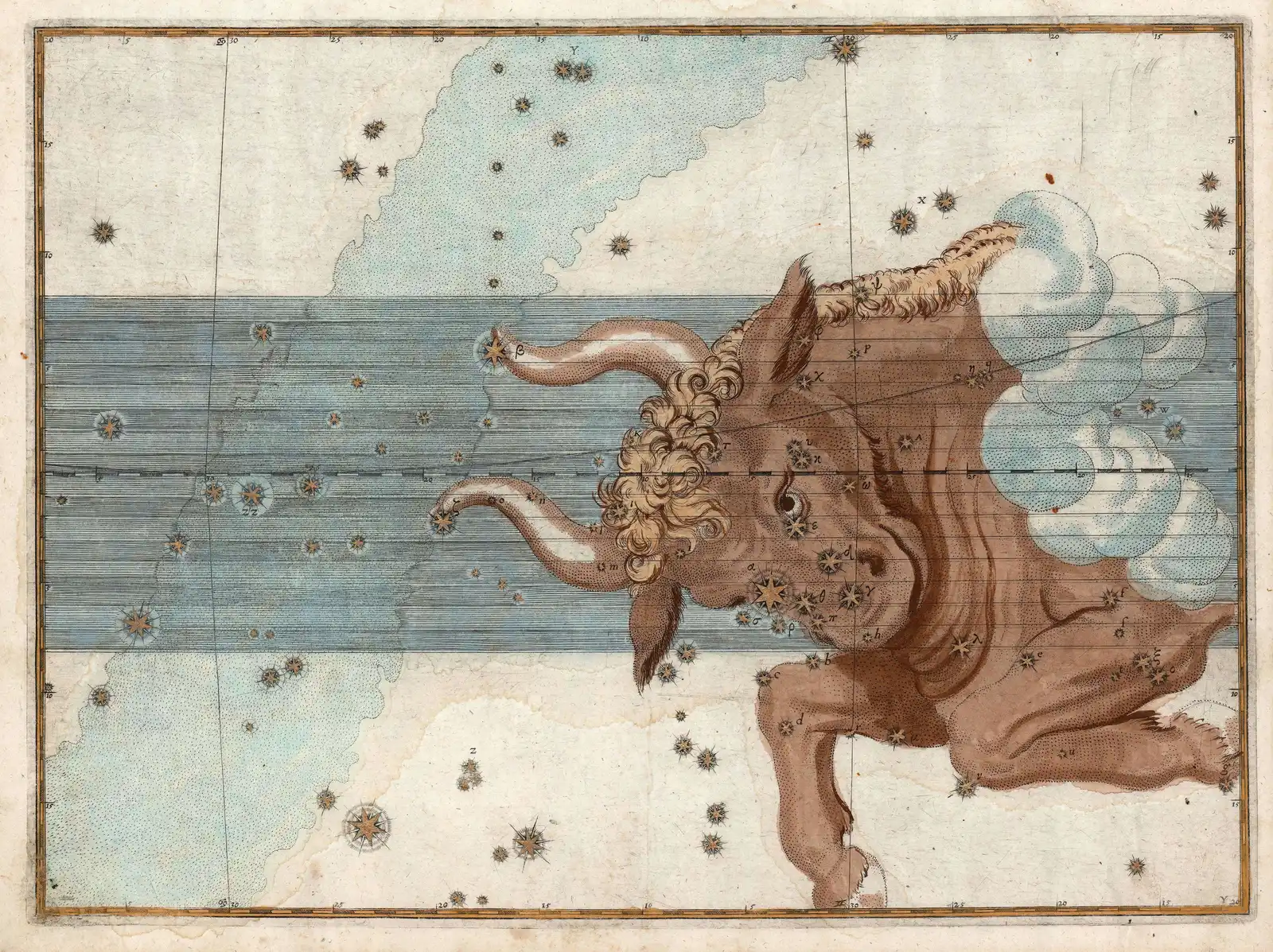
"Johann Bayer -- Taurus" by Johann Bayer — https://commons.wikimedia.org/wiki/File:Johann_Bayer_--_Taurus.jpg — Public domain (author Johann Bayer d. 1625; US: published 1603, before 1931; EU: a 1603 print, so all its makers died more than 70 years ago; faithful scan of a two-dimensional public-domain work)Aratus called the Pleiades seven, then wrote in the next line that only six can be seen. His Phaenomena, a Greek poem about the constellations, names all seven: Alcyone, Merope, Celaeno, Electra, Sterope, Taygete and Maia. The Pleiades, known in English as the Seven Sisters, are a small star cluster in Taurus, the bull, which has its own row in the index of all 88 constellations. The International Astronomical Union's star-name list, as of January 1, 2021, gives official names to nine stars in the cluster: the seven sisters and their parents, Atlas and Pleione.
Seven named, six seen
English Wikipedia places the writing of the Phaenomena at the court of the Macedonian king Antigonus II Gonatas, where Aratus went about 276 BC. In the texts checked here, the name is older than the poem. Homer's Iliad (18.486) and Odyssey (5.272) name the Pleiades among other stars, with no number and no father in those lines. English Wikipedia dates both poems to around the 8th century BC and notes arguments for a date in the mid-7th.
Hesiod's Works and Days, dated to around 700 BC, already calls the Pleiades daughters of Atlas, about four centuries before Aratus. What Aratus adds is the count, and the trouble with it:
ἑπτάποροι δὴ ταί γε μετʼ ἀνθρώπους ὑδέονται, ἓξ οἶαί περ ἐοῦσαι ἐπόψιαι ὀφθαλμοῖσιν.
"Seven-pathed they are called among people, though only six of them can be seen with the eyes." (Translation: Where Tales Began)
Those are lines 257–258 in G. R. Mair's 1921 Greek text. In the next three lines Aratus insists that no star has gone missing from the sky in living memory; the number seven is simply what is said. He gives no reason for the gap, and he names no hidden sister.
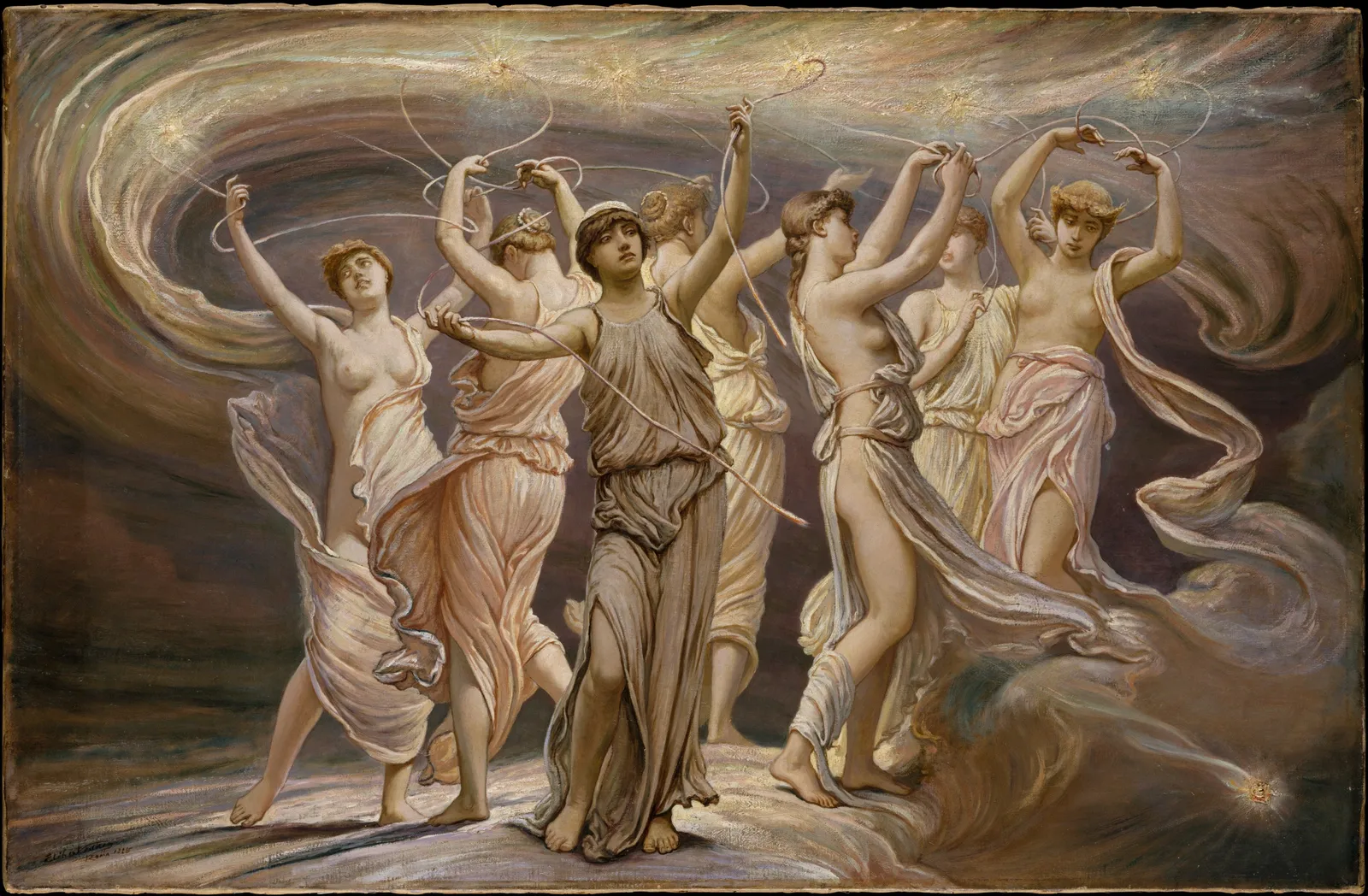
Apollodorus's Library, in J. G. Frazer's 1921 translation, spells out the family: "Atlas and Pleione, daughter of Ocean, had seven daughters called the Pleiades." Frazer's note adds that Aratus gives the same seven names in the same order.
The name itself is not settled in the sources checked. Frazer's note reports that some derived "Pleiades" from the mother's name, Pleione. To him "the most probable view appears to be" that it comes from the Greek πλεῖν, "to sail," because in the Mediterranean the cluster was visible at night from mid-May to the beginning of November, the ancient sailing season. The cluster stayed in the night sky after November, though; Hesiod has it hidden only forty days a year.
Which seven? The nine names on the IAU list
The International Astronomical Union set up its Working Group on Star Names (WGSN) in 2016 to catalogue official names for stars. Its list as of January 1, 2021 includes nine stars in the Pleiades, each with a J2000 position and a V magnitude. Magnitude is a brightness scale on which a lower number means a brighter star, as English Wikipedia defines it. The nine names were approved between June 30 and August 21, 2016.
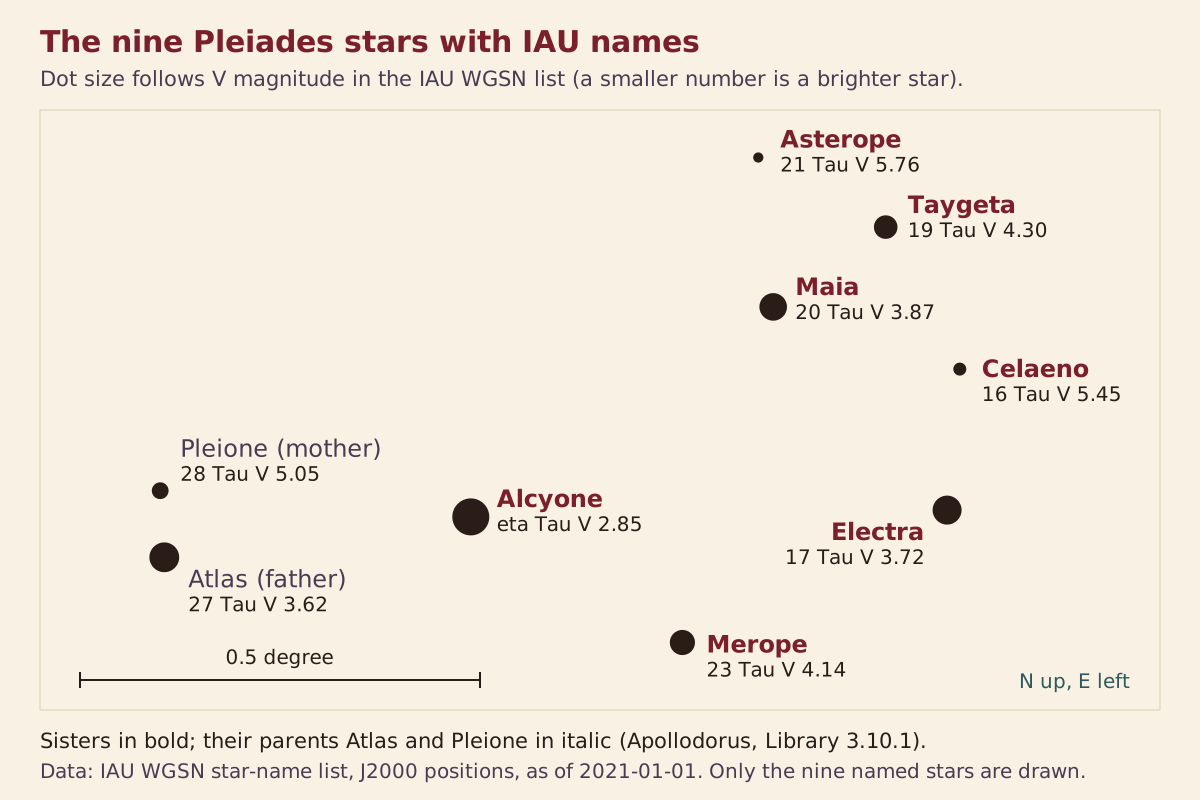
Table data: pleiades-wgsn-named-stars.csv Data source on record: IAU WGSN, List of IAU-approved Star Names (as of 2021-01-01), CC BY 4.0, https://iauarchive.eso.org/public/themes/naming_stars/, with the designation, magnitude, position and approval date of each star.
Ranked by magnitude, the six brightest named stars are Alcyone (2.85), Atlas (3.62), Electra (3.72), Maia (3.87), Merope (4.14) and Taygeta (4.30), by this page's count. One of those six is Atlas, the father, not a sister. The two faintest names, Celaeno at 5.45 and Asterope at 5.76, both belong to sisters. The list gives names to stars; it does not say which star any ancient poet had in mind.
The list spells two sisters differently from Aratus: Asterope for his Sterope, and Taygeta for Taygete. Frazer's 1921 note already writes of "Sterope or Asterope, as she is also called." Alcyone's designation in the list is eta Tauri (η Tau), the same Greek letter that sits beside the cluster on Bayer's 1603 chart at the top of this page.
The lost sister, explained twice
Ovid's Fasti, a Latin poem on the Roman calendar made public in AD 8, about 280 years after Aratus, repeats the count and then explains it. In book 4, lines 169–170, he writes of the Pleiades:
quae septem dici, sex tamen esse solent
"which are said to be seven, but are usually six" (Translation: Where Tales Began)
Ovid gives two reasons in lines 171–178. Six sisters had gods as lovers: Sterope had Mars, Alcyone and Celaeno had Neptune, and Maia, Electra and Taygete had Jove. Merope, the seventh, married Sisyphus, a mortal, and hides in shame; or else Electra could not bear to watch Troy fall and put her hand before her eyes.
Frazer, annotating Apollodorus in 1921, called these "alternative and equally probable theories" and gave Ovid as one writer who states them. He added a third candidate: the hidden Pleiad "is identified by modern astronomers with Celaeno, a star of almost the seventh magnitude," citing A. von Humboldt's Cosmos. The WGSN list gives the star now named Celaeno a V magnitude of 5.45, so the 1921 description and the 2021 table do not match. Ovid's two candidates are among the brighter stars in that table: Electra at 3.72 and Merope at 4.14.
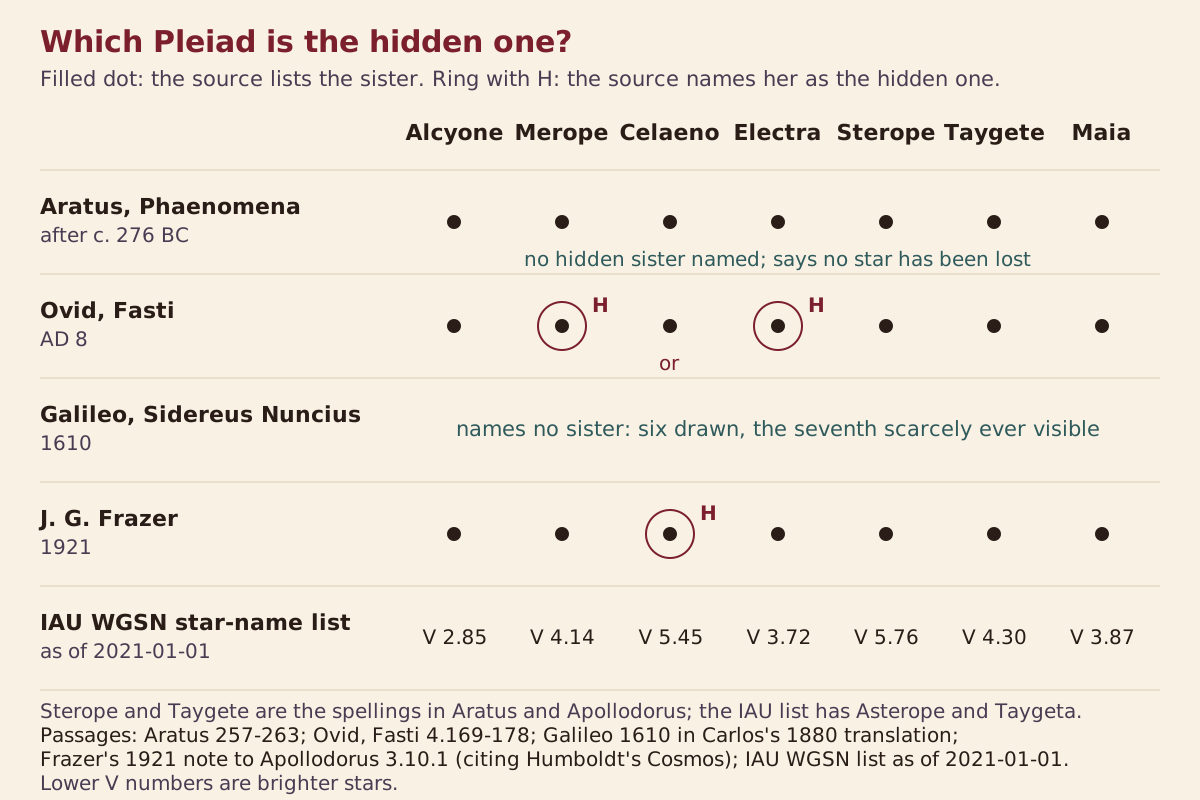
Table data: pleiades-missing-sister-sources.csv Data source on record: IAU WGSN, List of IAU-approved Star Names (as of 2021-01-01), CC BY 4.0, https://iauarchive.eso.org/public/themes/naming_stars/, with the passage and link for every source.
Galileo counts again, 1610
Galileo turned a telescope on the cluster and printed what he saw in Sidereus Nuncius, published in Venice with a dedication dated March 12, 1610. Edward Stafford Carlos's 1880 English translation reads:
As a second example I have depicted the six stars of the constellation Taurus, called the Pleiades (I say six intentionally, since the seventh is scarcely ever visible) [...] Near these there lie more than forty others invisible to the naked eye, no one of which is much more than half a degree off any of the aforesaid six; of these I have noticed only thirty-six in my diagram.
His text still speaks of six stars and a seventh "scarcely ever visible," nearly 1,900 years after Aratus. The telescope adds the fainter neighbors, and the passage names no missing sister.
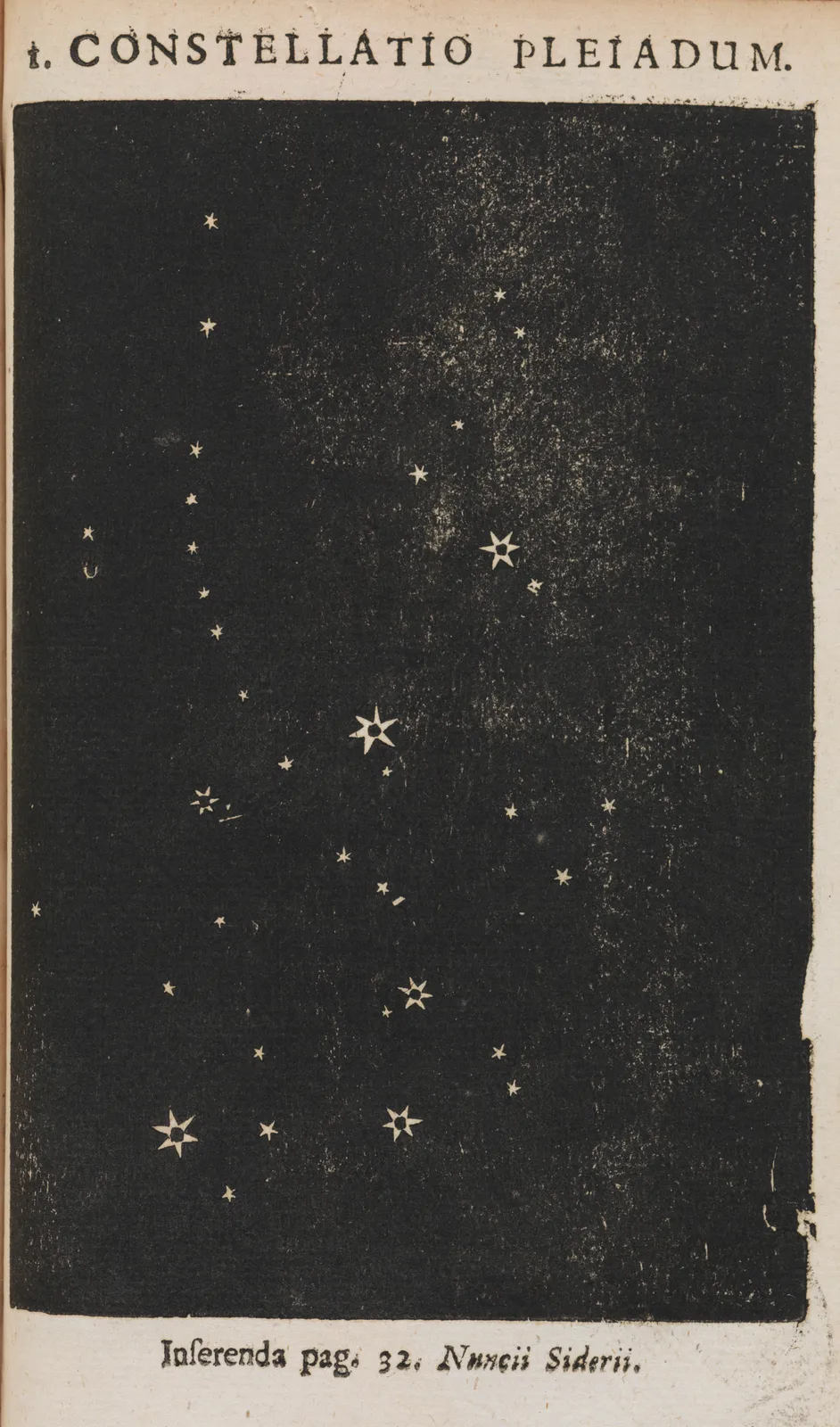
Source and licence
"Illustration of Constellation Pleiadum Wellcome L0073701" by Wellcome Library, London — https://commons.wikimedia.org/wiki/File:Illustration_of_Constellation_Pleiadum_Wellcome_L0073701.jpg — CC BY 4.0 (https://creativecommons.org/licenses/by/4.0/)A farmer's calendar, and when to look
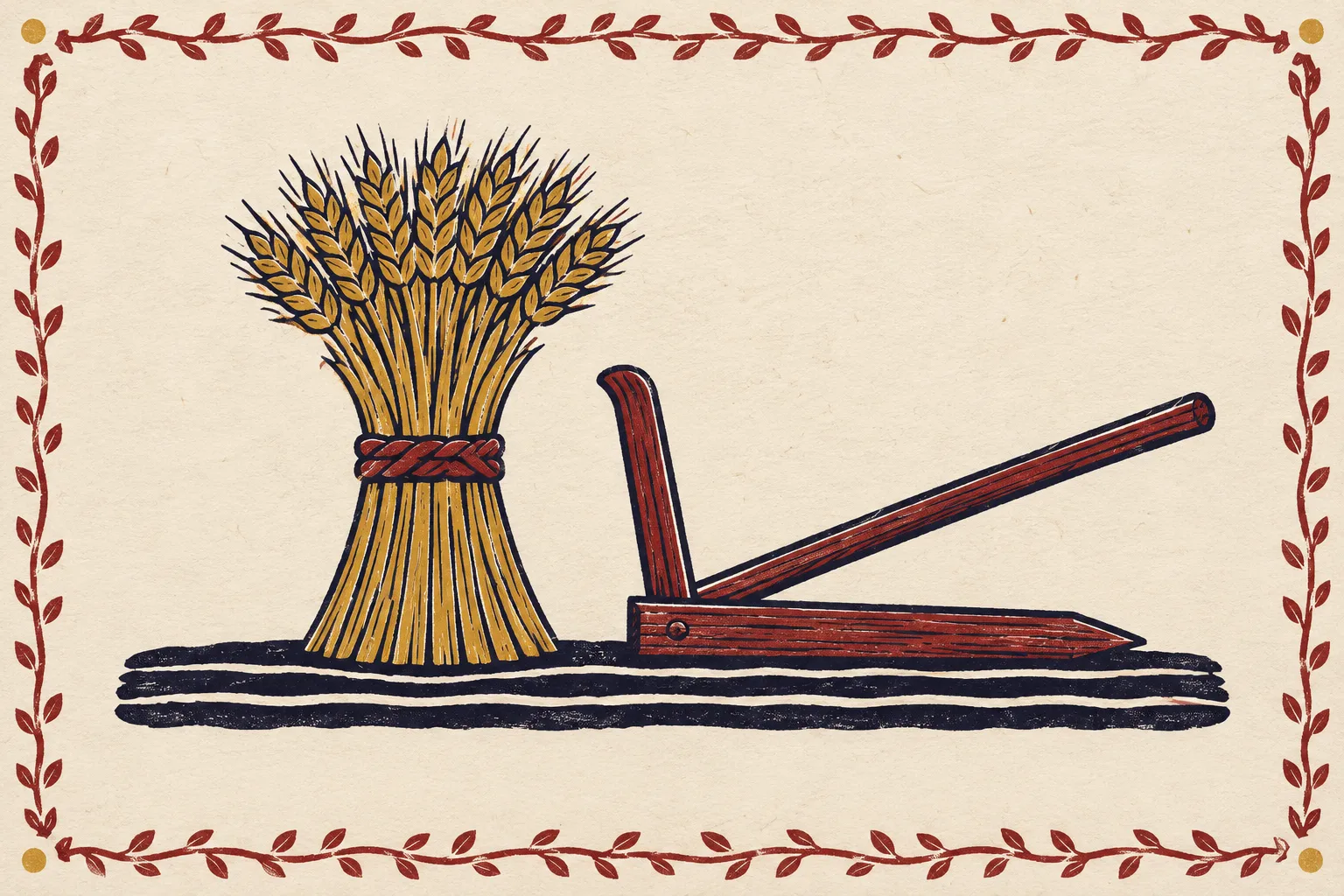
Hesiod used the cluster as a farm clock. In H. G. Evelyn-White's 1914 translation of Works and Days, lines 383–387:
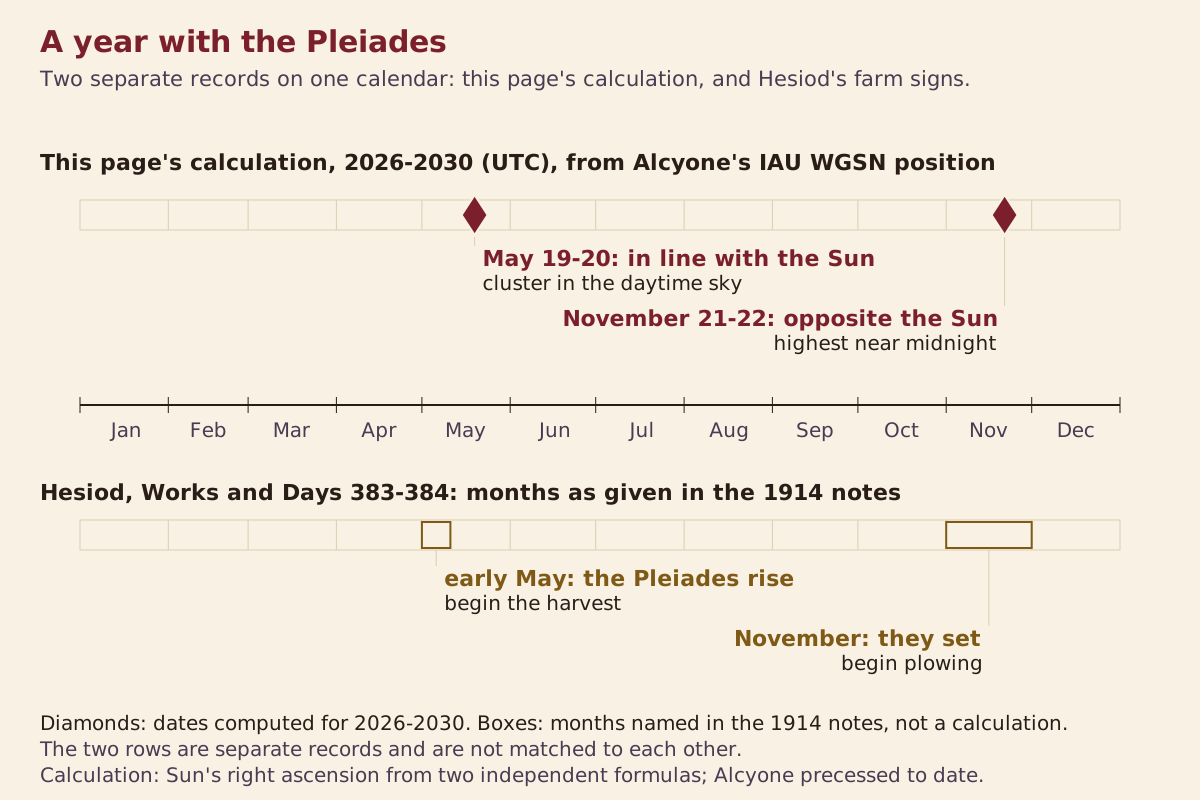
"When the Pleiades, daughters of Atlas, are rising, begin your harvest, and your ploughing when they are going to set. Forty nights and days they are hidden and appear again as the year moves round, when first you sharpen your sickle."
The notes in that 1914 edition place the rising in early May and the setting in November. Aratus gives the faint cluster the same job, saying that Zeus made it the sign for the start of summer, the start of winter and the coming of plowing (lines 264–267). The date of Easter is another calendar set against the sky, with a difference: its rule follows a table moon rather than the moon in the sky.
The Pleiades stand opposite the Sun around November 21–22 and cross the meridian near midnight, by this page's calculation from Alcyone's WGSN position and the Sun's position worked out with two independent formulas. Around May 19–20 the cluster lines up with the Sun and sits in the daytime sky (dates for 2026–2030, UTC). English Wikipedia describes the cluster as a prominent winter sight in the Northern Hemisphere.
Subaru, Matariki and other names
In Japanese the Pleiades are called Subaru. Sei Shōnagon's Makura no Sōshi (The Pillow Book) puts the cluster at the head of a list of stars; English Wikipedia says the work was completed in 1002, and Japanese Wikisource dates it to 1013. In the 1903 Kokubun taikan printing, page 324:
星は すばる、ひこぼし、明星、ゆふづゝ。
"Stars: Subaru, Hikoboshi, the morning star, the evening star." (Translation: Where Tales Began)
The Māori name for the cluster is Matariki. William Williams's Māori dictionary, in its 1871 third edition, glosses Matariki as the Pleiades and as the sign of the first month. As English Wikipedia summarizes it, the cluster's first rising in late June or early July marks the start of the new year in the Māori lunar calendar, though some Māori use Puanga (Rigel) or other stars instead; Matariki became a public holiday in 2022. Employment New Zealand's holiday table puts the 2027 holiday on Friday, June 25.
The first-ink date for each name below is the date of the earliest written record of it that can be checked in the sources for this entry; it marks where the paper evidence starts, not where the name began (how this site dates records).
| Name | Language | Earliest dated record checked | Date |
|---|---|---|---|
| Pleiades | Greek | Homer, Iliad 18.486 and Odyssey 5.272 | 8th or 7th century BC |
| Pleiades, daughters of Atlas | Greek | Hesiod, Works and Days 383–387 | about 700 BC |
| Pleiades, called heptaporoi ("seven-pathed") | Greek | Aratus, Phaenomena 257–258 | after about 276 BC |
| Pleiades | Latin | Ovid, Fasti 4.169–178 | AD 8 |
| Subaru | Japanese | Sei Shōnagon, Makura no Sōshi | early 1000s (1002 or 1013) |
| Matariki | Māori | Williams, A Dictionary of the New Zealand Language, 3rd ed. | 1871 |
| Nine star names | IAU | WGSN list | approved 2016 |
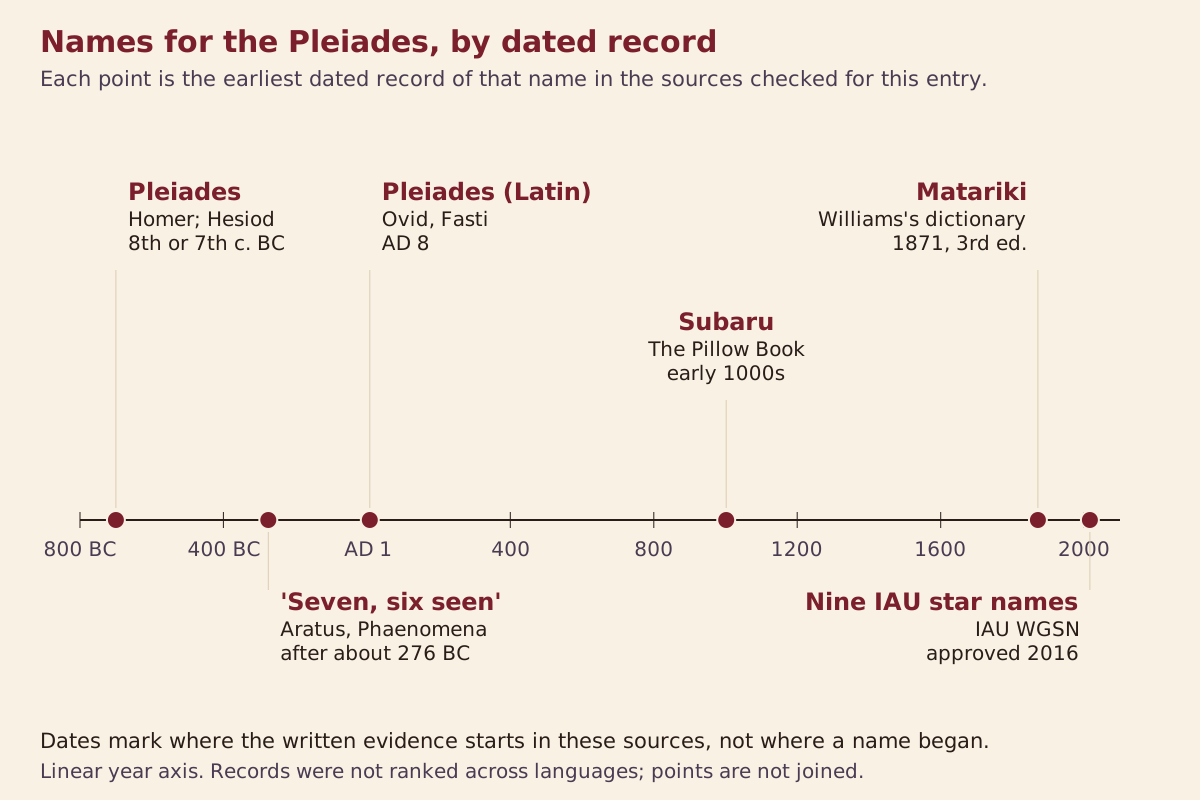
Table data: pleiades-names-earliest-ink.csv Data source on record: IAU WGSN, List of IAU-approved Star Names (as of 2021-01-01), CC BY 4.0, https://iauarchive.eso.org/public/themes/naming_stars/, with the passage, scope and link for every row.
Earliest ink
- The Pleiades as a named group: 8th or 7th century BC. Homer, Iliad 18.486, in Monro and Allen's Greek text (Perseus Digital Library), and Odyssey 5.272, in Murray's 1919 Greek text (Perseus Digital Library); and Hesiod, Works and Days 383–387 and 615–620, in Evelyn-White's 1914 translation (Perseus Digital Library), the earliest text checked that names their father. English Wikipedia dates the Homeric poems to around the 8th century BC, noting arguments for the mid-7th, and Works and Days to around 700 BC, so the two dates overlap; these are the earliest dated texts checked for this entry. English Wikipedia also cites Babylonian star catalogues that name the cluster, which this entry did not check.
- Seven called, six seen: after about 276 BC. Aratus, Phaenomena 257–261, in Mair's 1921 Greek text (Perseus Digital Library); the earliest text checked for this entry that gives the count.
- Two explanations for the hidden sister: AD 8. Ovid, Fasti 4.169–178 (Latin text, Perseus Digital Library); the earliest text checked for this entry that explains the hidden sister.
- Subaru: early 1000s. Makura no Sōshi, completed in 1002 (English Wikipedia) or 1013 (Japanese Wikisource); the only text checked for the name, in Kokubun taikan vol. 9 (1903), page 324 (Japanese Wikisource).
- Matariki: 1871. Williams, A Dictionary of the New Zealand Language, 3rd ed., under Matariki (Internet Archive); the first edition, whose preface is dated 1844, was not checked.
- Nine IAU star names: 2016. IAU WGSN list as of January 1, 2021 (IAU).
Sources checked through 2026-10-19.
Where the trail goes next
- Find the bull on the whole sky: All 88 constellations gives Taurus its row, with who added each constellation and when.
- Another family set among the stars: Cassiopeia, the queen whom the myth turns upside down in the sky.
- A calendar that reads the sky through tables: How the date of Easter is calculated, where the rule follows a table moon.
Cite this page
Where Tales Began. “Pleiades: The Seven Sisters Aratus Said Show Only Six.” First published October 20, 2026; last substantive revision October 20, 2026. https://wheretalesbegan.com/starlore/pleiades/. Accessed: add the date you read this page.
- Author
- Where Tales Began
- Title
- Pleiades: The Seven Sisters Aratus Said Show Only Six
- Published
- Revised
- Address
- https://wheretalesbegan.com/starlore/pleiades/
Sources
- Aratus, Phaenomena 254–267, ed. G. R. Mair, in Callimachus and Lycophron; Aratus (Loeb Classical Library, 1921); digital edition urn:cts:greekLit:tlg0653.tlg001.perseus-grc2, Perseus Digital Library, PerseusDL/canonical-greekLit (GitHub, commit 0189b9c8), CC BY-SA 4.0 github.com/PerseusDL/canonical-greekLit/blob/0189b9c8d8d1f148133f2f0af309b4ee90ea4332/data/tlg0653/tlg001/tlg0653.tlg001.perseus-grc2.xml Read: lines 254–267 (Greek text) Text licence: CC BY-SA 4.0
- Hesiod, Works and Days 383–387 and 615–620, trans. H. G. Evelyn-White, in Hesiod, the Homeric Hymns and Homerica (Loeb Classical Library, 1914); digital edition urn:cts:greekLit:tlg0020.tlg002.perseus-eng2, Perseus Digital Library, PerseusDL/canonical-greekLit (GitHub, commit 0189b9c8), CC BY-SA 4.0 github.com/PerseusDL/canonical-greekLit/blob/0189b9c8d8d1f148133f2f0af309b4ee90ea4332/data/tlg0020/tlg002/tlg0020.tlg002.perseus-eng2.xml Read: lines 383–387 and 615–620 with the 1914 notes (English translation) Text licence: CC BY-SA 4.0
- Homer, Iliad 18.483–489, Greek text ed. D. B. Monro and T. W. Allen, Homeri Opera, 3rd ed. (Oxford: Clarendon Press, 1908–1920); English translation consulted: A. T. Murray (Loeb Classical Library, 1924–1925); digital editions urn:cts:greekLit:tlg0012.tlg001.perseus-grc2 and perseus-eng3, Perseus Digital Library, PerseusDL/canonical-greekLit (GitHub, commit 0189b9c8), CC BY-SA 4.0 github.com/PerseusDL/canonical-greekLit/blob/0189b9c8d8d1f148133f2f0af309b4ee90ea4332/data/tlg0012/tlg001/tlg0012.tlg001.perseus-grc2.xml Read: book 18, lines 483–489 (Greek text, with Murray's English translation) Text licence: CC BY-SA 4.0
- Homer, Odyssey 5.270–275, Greek text and English translation by A. T. Murray (Loeb Classical Library, 1919); digital editions urn:cts:greekLit:tlg0012.tlg002.perseus-grc2 and perseus-eng3, Perseus Digital Library, PerseusDL/canonical-greekLit (GitHub, commit 0189b9c8), CC BY-SA 4.0 github.com/PerseusDL/canonical-greekLit/blob/0189b9c8d8d1f148133f2f0af309b4ee90ea4332/data/tlg0012/tlg002/tlg0012.tlg002.perseus-grc2.xml Read: book 5, lines 270–275 (Greek text, with Murray's English translation) Text licence: CC BY-SA 4.0
- Ovid, Fasti 4.169–178 and 5.83–84, Latin text ed. J. G. Frazer (Loeb Classical Library, 1931); digital edition urn:cts:latinLit:phi0959.phi007.perseus-lat2, Perseus Digital Library, PerseusDL/canonical-latinLit (GitHub, commit 128a05af), CC BY-SA 4.0 github.com/PerseusDL/canonical-latinLit/blob/128a05afa9cc7179ab18f8d05f78a9f1dd50e415/data/phi0959/phi007/phi0959.phi007.perseus-lat2.xml Read: book 4, lines 169–178; book 5, lines 83–84 (Latin text) Text licence: CC BY-SA 4.0
- Apollodorus, The Library 3.10.1, with the translator's note, trans. J. G. Frazer (Loeb Classical Library, 1921); digital edition urn:cts:greekLit:tlg0548.tlg001.perseus-eng2, Perseus Digital Library, PerseusDL/canonical-greekLit (GitHub, commit 0189b9c8), CC BY-SA 4.0 github.com/PerseusDL/canonical-greekLit/blob/0189b9c8d8d1f148133f2f0af309b4ee90ea4332/data/tlg0548/tlg001/tlg0548.tlg001.perseus-eng2.xml Read: 3.10.1 and Frazer's notes on it (English translation) Text licence: CC BY-SA 4.0
- Galileo Galilei, The Sidereal Messenger, trans. Edward Stafford Carlos (London: Rivingtons, 1880); Project Gutenberg eBook #46036 www.gutenberg.org/ebooks/46036 Read: title page, dedication (Padua, March 12, 1610) and the Pleiades passage
- Sei Shōnagon, Makura no sōshi (枕草紙), in Kokubun taikan, vol. 9, Nikki sōshi bu, eds. Motoori Toyokai and others (1903), p. 324; Japanese Wikisource transcription, 枕草紙 (國文大觀) (read 2026-10-19) ja.wikisource.org/wiki/%E6%9E%95%E8%8D%89%E7%B4%99_%28%E5%9C%8B%E6%96%87%E5%A4%A7%E8%A7%80%29 Read: p. 324, the list that begins 星は (Japanese text), and the page header date (1013)
- William Williams, A Dictionary of the New Zealand Language, 3rd ed., with an introduction by W. L. Williams (London: Williams and Norgate, 1871), s.v. Matariki archive.org/details/dictionaryofnewz00willrich Read: the entry Matariki and the extract from the 1844 preface (scan of the 1871 printing)
- IAU Working Group on Star Names (WGSN), List of IAU-approved Star Names as of January 1st, 2021, in Naming Stars, International Astronomical Union iauarchive.eso.org/public/themes/naming_stars Read: the section on the WGSN and the nine Pleiades rows of the list (name, designation, V magnitude, J2000 position, approval date) Text licence: CC BY 4.0
- Employment New Zealand, Public holidays and anniversary dates (last modified 2026-09-25; read 2026-10-19) www.employment.govt.nz/leave-and-holidays/public-holidays/public-holidays-and-anniversary-dates Read: 2027 table, Matariki row
- English Wikipedia, "Pleiades" (read 2026-10-19). en.wikipedia.org/wiki/Pleiades Read: summarized here through English Wikipedia: lead (Seven Sisters, Messier 45, Taurus), visibility in the northern winter, and the list of early records naming the cluster
- English Wikipedia, "Aratus" (read 2026-10-19). en.wikipedia.org/wiki/Aratus Read: summarized here through English Wikipedia: Life section (court of Antigonus II Gonatas from about 276 BC)
- English Wikipedia, "Works and Days" (read 2026-10-19). en.wikipedia.org/wiki/Works_and_Days Read: summarized here through English Wikipedia: lead (around 700 BC)
- English Wikipedia, "Iliad" (read 2026-10-19). en.wikipedia.org/wiki/Iliad Read: summarized here through English Wikipedia: the Iliad and the Odyssey likely composed around the 8th century BC, with arguments for a mid-7th-century date
- English Wikipedia, "Fasti (poem)" (read 2026-10-19). en.wikipedia.org/wiki/Fasti_(poem) Read: summarized here through English Wikipedia: lead (made public in AD 8)
- English Wikipedia, "The Pillow Book" (read 2026-10-19). en.wikipedia.org/wiki/The_Pillow_Book Read: summarized here through English Wikipedia: lead (completed in 1002)
- English Wikipedia, "Matariki" (read 2026-10-19). en.wikipedia.org/wiki/Matariki Read: summarized here through English Wikipedia: lead (first rising in late June or early July marks the Maori new year; Puanga and other stars; public holiday since 2022)
- English Wikipedia, "Apparent magnitude" (read 2026-10-19). en.wikipedia.org/wiki/Apparent_magnitude Read: summarized here through English Wikipedia: lead (a lower magnitude number means a brighter object)