Catalogue entry
Cassiopeia: Why the Myth Says the Queen Turns Upside Down
- By
- Where Tales Began
- Published
- Last substantive revision
How records are checked: Following the paper trail. Corrections: Fixes to the record. Questions: Contact us.
Fast facts
- Name
- Cassiopeia (Greek Kassiepeia; Cassiepia in the Latin De Astronomia); IAU constellation Cas, the Seated Queen
- Classification
- Northern constellation; one of Ptolemy's 48; its five brightest stars form the W
- Earliest ink
- Aratus, Phaenomena 179-204 and 653-658, after about 276 BC: the earliest dated text checked for this entry that describes her stars and her head-first setting
- Languages and regions
- Greek and Latin texts from the 3rd century BC; Arabic star book of al-Sufi (about 964); Chinese star names Wang Liang and Ce for some of the same stars
- Core motifs
- A boast against the Nereids; a flood and sea monster; a queen on a chair carried head down
- Surviving texts or data sources
- Aratus, Phaenomena; Ovid, Metamorphoses 4; De Astronomia 2.10; Apollodorus, Library 2.4.3; IAU WGSN star names (2021)
- TL;DR
- In Aratus's poem, written after about 276 BC, Cassiopeia goes down head first, and the Latin De Astronomia makes that tilt a punishment for her boast. Her W circles the north celestial pole, so from 40 degrees north it reads as an M on November evenings and as a W on May evenings.
Download these facts (CSV, cassiopeia-entry-facts.csv) Data source on record: IAU WGSN, List of IAU-approved Star Names as of January 1st, 2021 (J2000 positions), IAU WGSN, CC BY 4.0, https://iauarchive.eso.org/public/themes/naming_stars/; IAU, The Constellations (name and abbreviation Cas), IAU, CC BY 4.0, https://iauarchive.eso.org/public/themes/constellations/
Source and licence
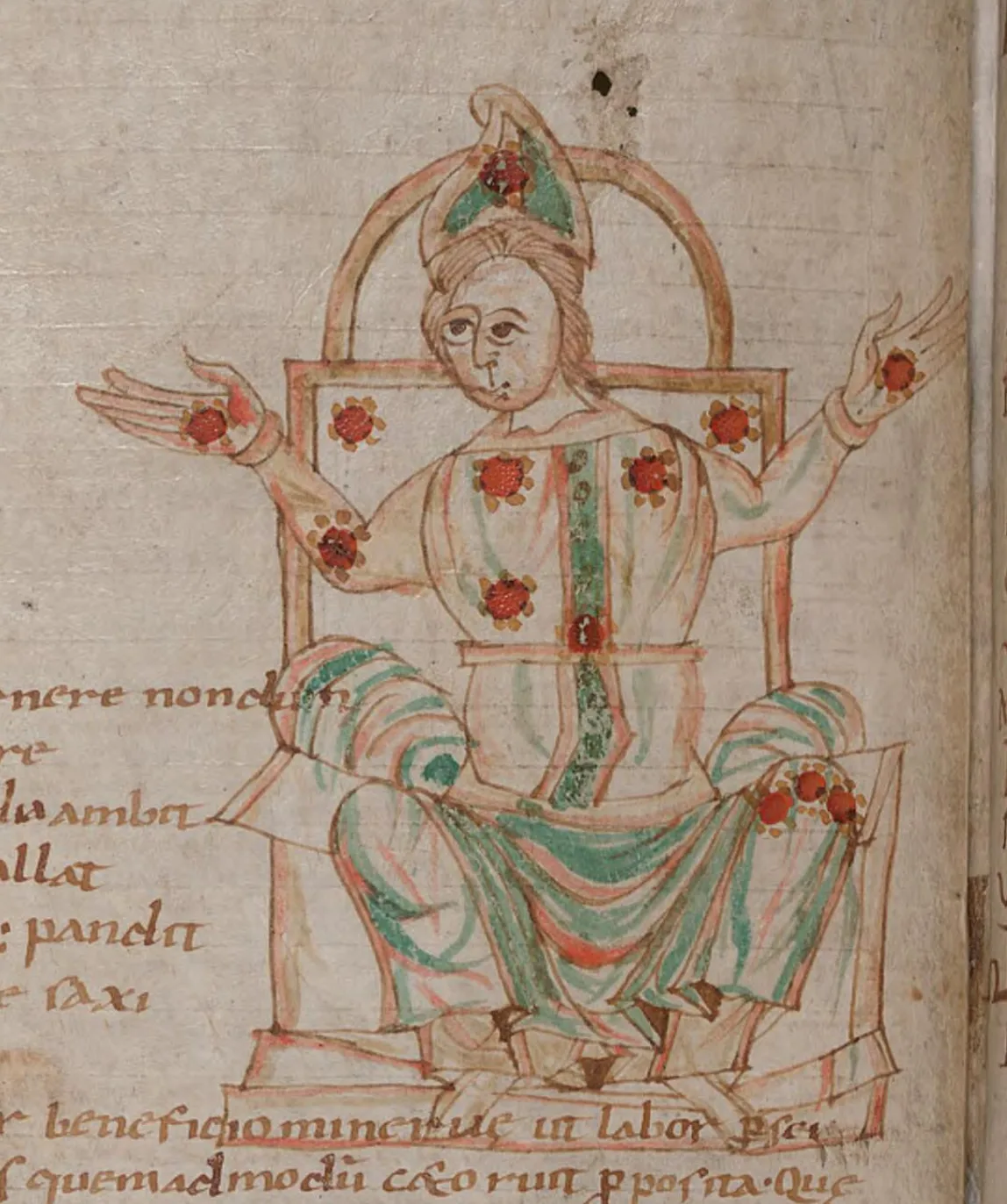
"F19.v. Cassiopeia NLW MS 735C" by Unknown artist, National Library of Wales MS 735C, folio 19v — https://commons.wikimedia.org/wiki/File:F19.v._Cassiopeia_NLW_MS_735C.png — CC0 1.0 (https://creativecommons.org/publicdomain/zero/1.0/)Cassiopeia goes down head first, like a diver, in Aratus's star poem, written after about 276 BC. Her feet and knees stay above her chair as she sinks, Aratus says, because she was not going to measure herself against the sea nymphs Doris and Panope without paying for it (Phaenomena 654–658).
The Latin De Astronomia turns the posture into a punishment. It says she was set among the stars on a chair for claiming to outshine the Nereids, and that for this impiety she seems to ride head back as the sky turns (2.10). Her W does turn: it circles the north celestial pole, so from 40° north it stands high as an M on November evenings and low as a W in May.
A boast, a flood and a sea monster
Of the texts checked, the Library credited to Apollodorus is the one that spells out each step from the queen's claim to the monster. It is a Greek handbook of myths from the first or second century AD. In J. G. Frazer's 1921 translation, "Cassiepea, the wife of Cepheus, vied with the Nereids in beauty and boasted to be better than them all; hence the Nereids were angry, and Poseidon, sharing their wrath, sent a flood and a monster to invade the land" (2.4.3). An oracle of Ammon promised relief if her daughter Andromeda was given to the monster, so Cepheus bound her to a rock, and Perseus killed the beast.
Ovid, writing in AD 8, names no rival in this episode. Brookes More's 1922 translation has Ammon decree that "Andromeda, the Innocent, should grieve / her mother's tongue" (Metamorphoses 4.670–671). Ovid's Latin later blames maternae fiducia formae (4.687), "trust in the mother's beauty" (Translation: Where Tales Began), while More turns it into pride in the daughter: "how her charms / had been her mother's pride."
| Text and date | The boast | What follows | In the sky |
|---|---|---|---|
| Aratus, Phaenomena, after about 276 BC | Rivals the Nereids Doris and Panope (657–658) | No flood in these lines; Andromeda in bonds even among the stars (202–204) | Head first, feet and knees above her chair (654–656) |
| Ovid, Metamorphoses 4, AD 8 | "Her mother's tongue" (4.670–671) | Andromeda chained to rocks; a sea monster (4.672, 4.689) | Not for Cassiope in book 4 |
| De Astronomia 2, probably Augustan, possibly a 2nd-century compilation | Claims to surpass the Nereids (2.10) | A sea monster sent by Neptune (2.31) | On a chair, carried head back (2.10) |
| Apollodorus, Library 2.4.3, 1st or 2nd century AD | Vies with the Nereids and boasts | Poseidon's flood and monster; Andromeda bound | Not mentioned |
Table data: cassiopeia-text-records.csv, with the passage, edition and link for every row.
The same Library also tells of Deucalion's flood (1.7.2), and the comparison of flood myths places both of its floods beside the Sumerian and Akkadian flood tablets. Poseidon's flood, sent as a punishment, stands there as a parallel, with no claim that one story comes from the other.
Source and licence
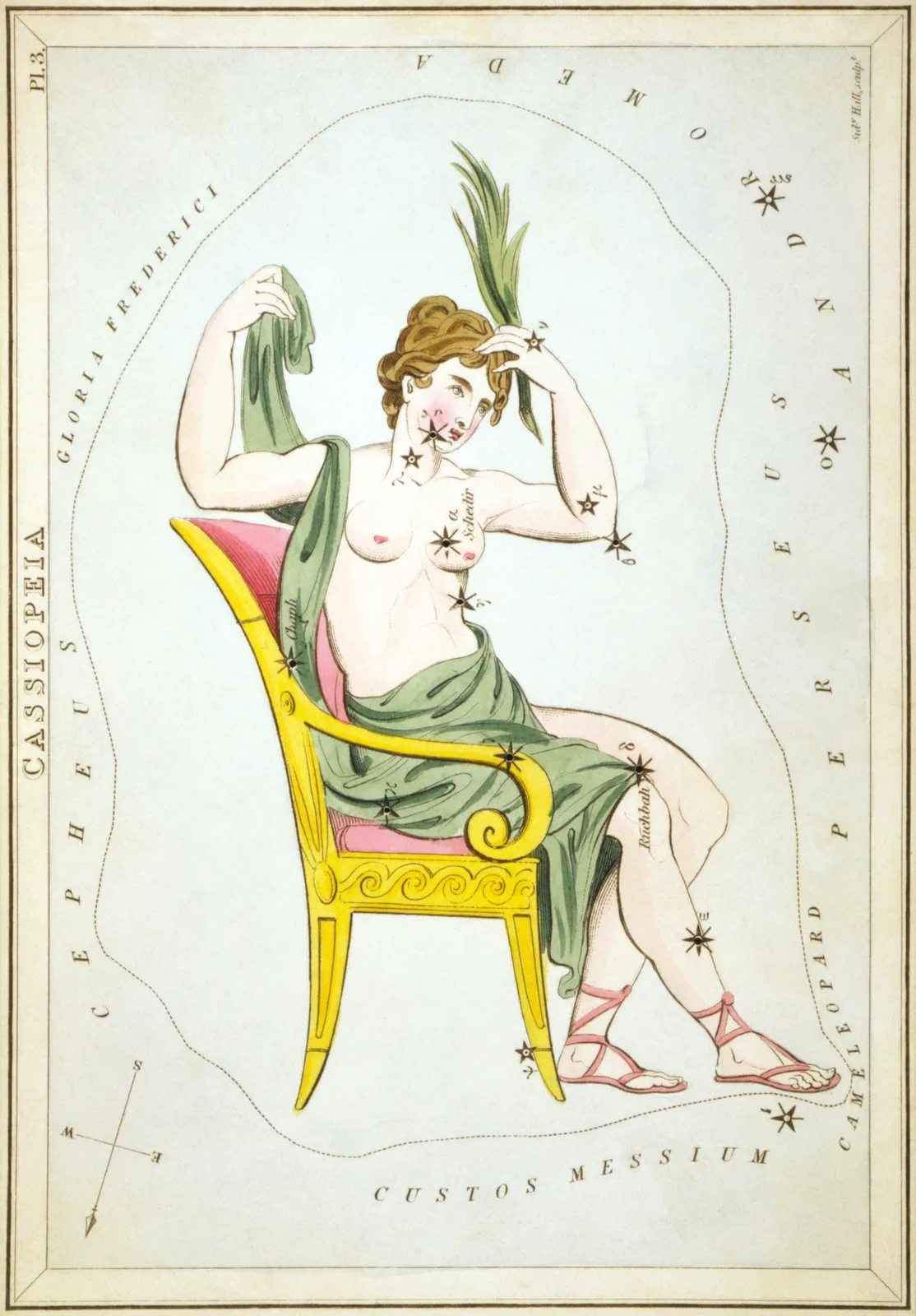
"Sidney Hall - Urania's Mirror - Cassiopeia (image right side up)" by Sidney Hall, engraver; design by Richard Rouse Bloxam; restoration by Adam Cuerden — https://commons.wikimedia.org/wiki/File:Sidney_Hall_-_Urania%27s_Mirror_-_Cassiopeia_(image_right_side_up).jpg — Public domain (engraver Sidney Hall d. 1831; designer Richard Rouse Bloxam, an assistant master at Rugby School and an adult when the set appeared in 1824 (so presumed dead well before 1955); US: published in London 1824-1825, before 1931; EU: more than 70 years after the deaths of engraver and designer; a restoration of a faithful scan adds no new rights)Why is Cassiopeia upside down?
Aratus describes the queen twice. Early in the poem she wheels ahead of Cepheus, a small figure with few stars, stretching out her arms as if grieving for her daughter (188–196). Later, in a passage on the stars that set as others rise, the image turns over.
τὰ δʼ οὐκέτι οἱ κατὰ κόσμον φαίνεται ἐκ δίφροιο, πόδες καὶ γούναθʼ ὕπερθεν, ἀλλʼ ἥ γʼ ἐς κεφαλὴν ἴση δύετʼ ἀρνευτῆρι … ἐπεὶ οὐκ ἄρʼ ἔμελλεν ἐκείνη Δωρίδι καὶ Πανόπῃ μεγάλων ἄτερ ἰσώσασθαι. (Aratus, Phaenomena 654–658, Greek text ed. G. R. Mair, 1921)
Her limbs no longer show in good order from her chair: feet and knees are on top, and she goes down head first like a diver … since she was not to measure herself against Doris and Panope without paying dearly. (Translation: Where Tales Began)
Doris and Panope are two of the fifty daughters of Nereus, the Nereids, whom Hesiod's Theogony lists by name (240–264, in H. G. Evelyn-White's 1914 translation, where Panope is spelled Panopea).
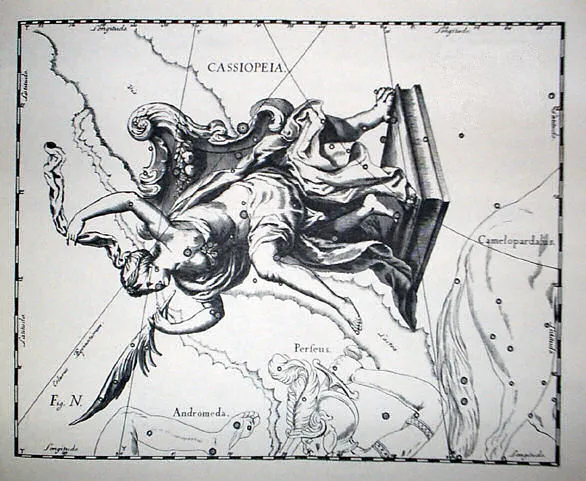
The De Astronomia gives the same tilt a cause. It credits Euripides, Sophocles and several others with the story of her boasting. It sets her among the stars on a chair, a siliquastrum, and says that for her impiety she seems to be carried head back as the heavens turn (2.10). Aratus shows the posture as she sets; the De Astronomia ties it to the turning of the sky.
Source and licence
"Johannes Hevelius - Prodromus Astronomia - Volume III "Firmamentum Sobiescianum, sive uranographia" - Tavola N - Cassiopeia" by Johannes Hevelius — https://commons.wikimedia.org/wiki/File:Johannes_Hevelius_-_Prodromus_Astronomia_-_Volume_III_%22Firmamentum_Sobiescianum,_sive_uranographia%22_-_Tavola_N_-_Cassiopeia.jpg — Public domain (Johannes Hevelius d. 1687; plate N of the "Firmamentum Sobiescianum," published in Danzig in 1690; US: published before 1931; EU: 70 years after the death of the author; a faithful scan of a public-domain print adds no new rights)How do you find Cassiopeia?
Look north. In the IAU's list of approved star names as of January 1, 2021, four of the W's five stars are named: Caph, Schedar, Ruchbah and Segin. By this page's count from those positions, they lie 26° to 33° from the celestial pole, so from 40° north they never set. They circle Polaris once a day, so the W turns over about every twelve hours.
The chart below shows the same view at 9 p.m. standard time on four dates. On November 15 the W stands 64° to 73° above the horizon, above Polaris, and reads as an M; on May 15 it sits 7° to 15° above the northern horizon, below Polaris, and reads as a W. In February it stands on its end to the left of Polaris, in August to the right. The view comes about two hours earlier each month.
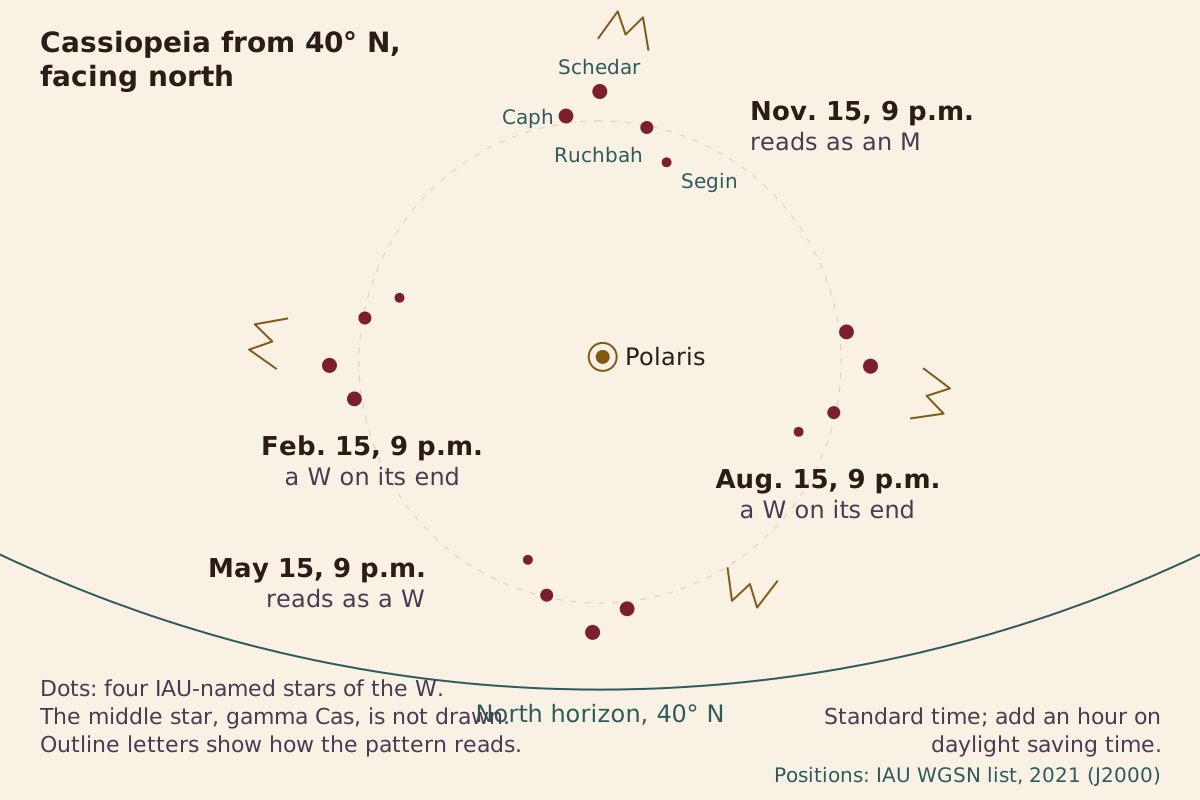
The chart shows only the four named stars. The middle star of the W, gamma Cassiopeiae, has no name in the 2021 IAU list used here, so it is left out. In the index of all 88 constellations, Cassiopeia is one of Ptolemy's 48 and one of the 47 figures that Aratus describes; the IAU lists her as Cas, the Seated Queen.
The lost Andromeda plays
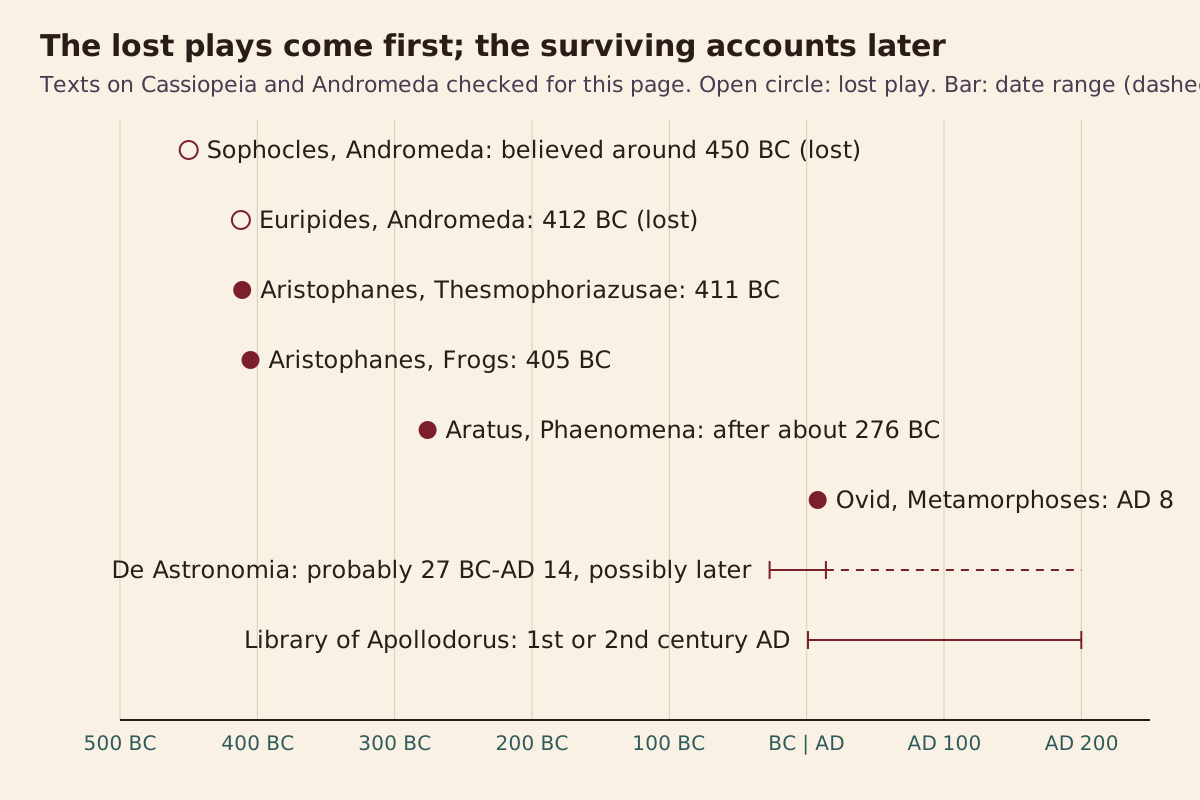
Sophocles and Euripides, the two tragedians that the De Astronomia names as tellers of the story, each wrote an Andromeda, and neither play survives. Frazer's 1921 note to the Library says that "Sophocles and Euripides composed tragedies on the subject, of which some fragments remain." As English Wikipedia summarizes them, Sophocles' Andromeda is believed to date from around 450 BC and Euripides' from 412 BC, and modern reconstructions suggest Euripides' play most likely ended with Athena announcing that all the characters would become constellations.
By the same summary, Aristophanes parodied the Euripides play in the Thesmophoriazusae of 411 BC. In his Frogs of 405 BC, the god Dionysus says that reading it gave him a longing for the dead poet (52–54, 66–67).
καὶ δῆτʼ ἐπὶ τῆς νεὼς ἀναγιγνώσκοντί μοι τὴν Ἀνδρομέδαν πρὸς ἐμαυτὸν ἐξαίφνης πόθος τὴν καρδίαν ἐπάταξε πῶς οἴει σφόδρα. (Aristophanes, Frogs 52–54, Greek text ed. F. W. Hall and W. M. Geldart, 1907)
And there on the ship, as I was reading the Andromeda to myself, a longing suddenly struck my heart, you can't think how hard. (Translation: Where Tales Began)
Under the site's rule for dating records, the lost plays count only through these later reports, so among the texts checked for this page the surviving record of her rivalry with the Nereids starts with Aratus. The later readers of Euripides' play are followed in the catalogue of lost books.
The W in other skies
Aratus describes no letter in her stars. He compares their line to the key that knocks back the bolts of a double door (192–195).
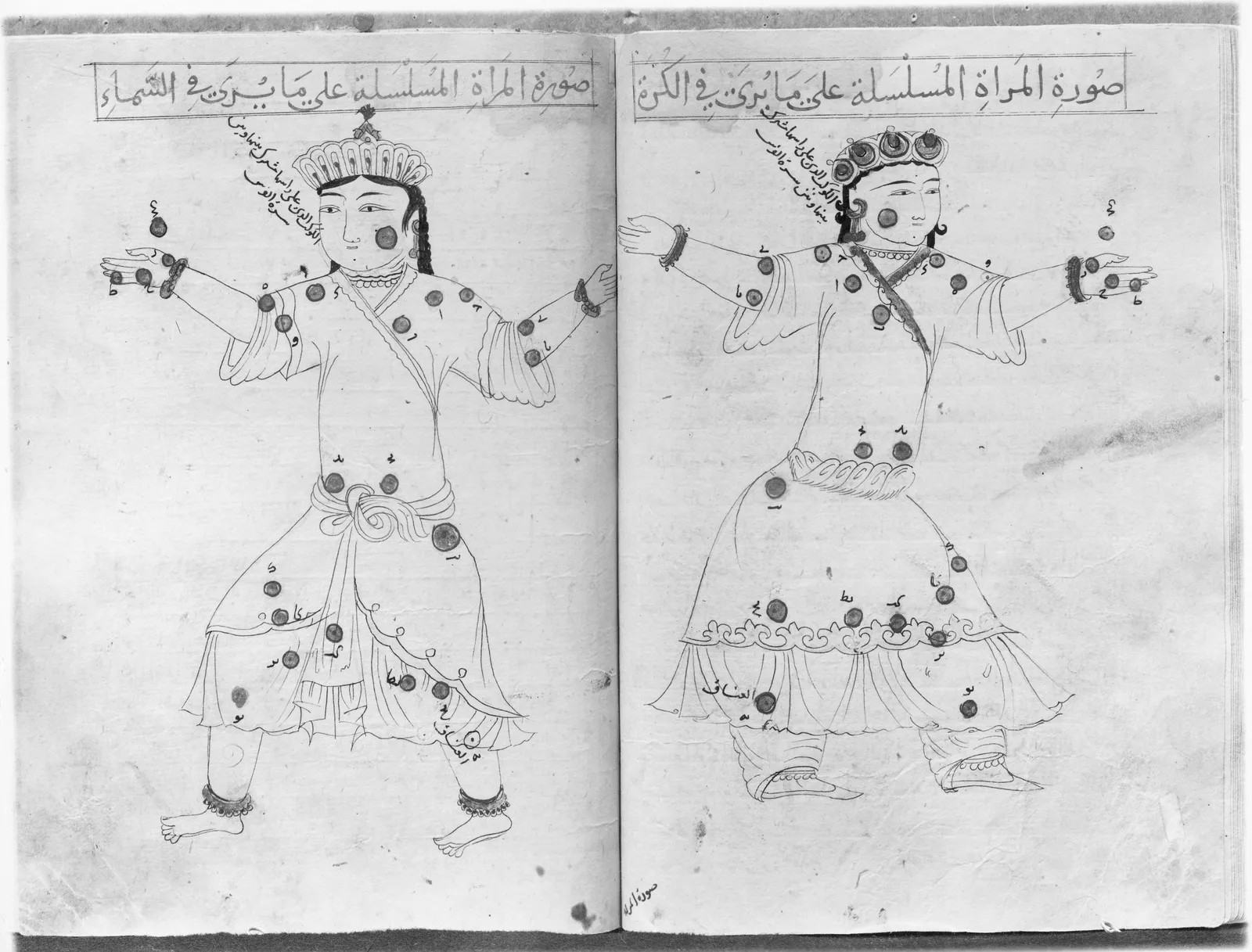
The Persian astronomer al-Sufi wrote his Book of Fixed Stars around 964, more than twelve centuries later. As English Wikipedia summarizes it, he drew each constellation twice, once as seen in the sky and once as seen on a globe. The same encyclopedia says he drew Cassiopeia as a crowned queen holding a staff with a crescent moon. It adds that some Arabic atlases drew a "Tinted Hand" in the same stars.
Source and licence
"Kitab suwar al-kawakib al-thabita (Book of the Images of the Fixed Stars) of al-Sufi MET 21317" by 'Abd al-Rahman al-Sufi; late 15th-century copy, Metropolitan Museum of Art 13.160.10 — https://commons.wikimedia.org/wiki/File:Kitab_suwar_al-kawakib_al-thabita_(Book_of_the_Images_of_the_Fixed_Stars)_of_al-Sufi_MET_21317.jpg — CC0 1.0 (https://creativecommons.org/publicdomain/zero/1.0/)Sima Qian's Shiji, finished before 86 BC, calls four stars in the Milky Way Tiansi (天駟) and adds: "旁一星,曰王良。王良策馬……", "Beside them is one star, called Wang Liang. When Wang Liang whips the horses …" (Translation: Where Tales Began). In the star tables that Chinese Wikipedia follows, the Wang Liang asterism has five stars in Cassiopeia, and Ce (策), "the whip," is gamma Cassiopeiae, the middle star of the W.
Tycho's new star, 1572
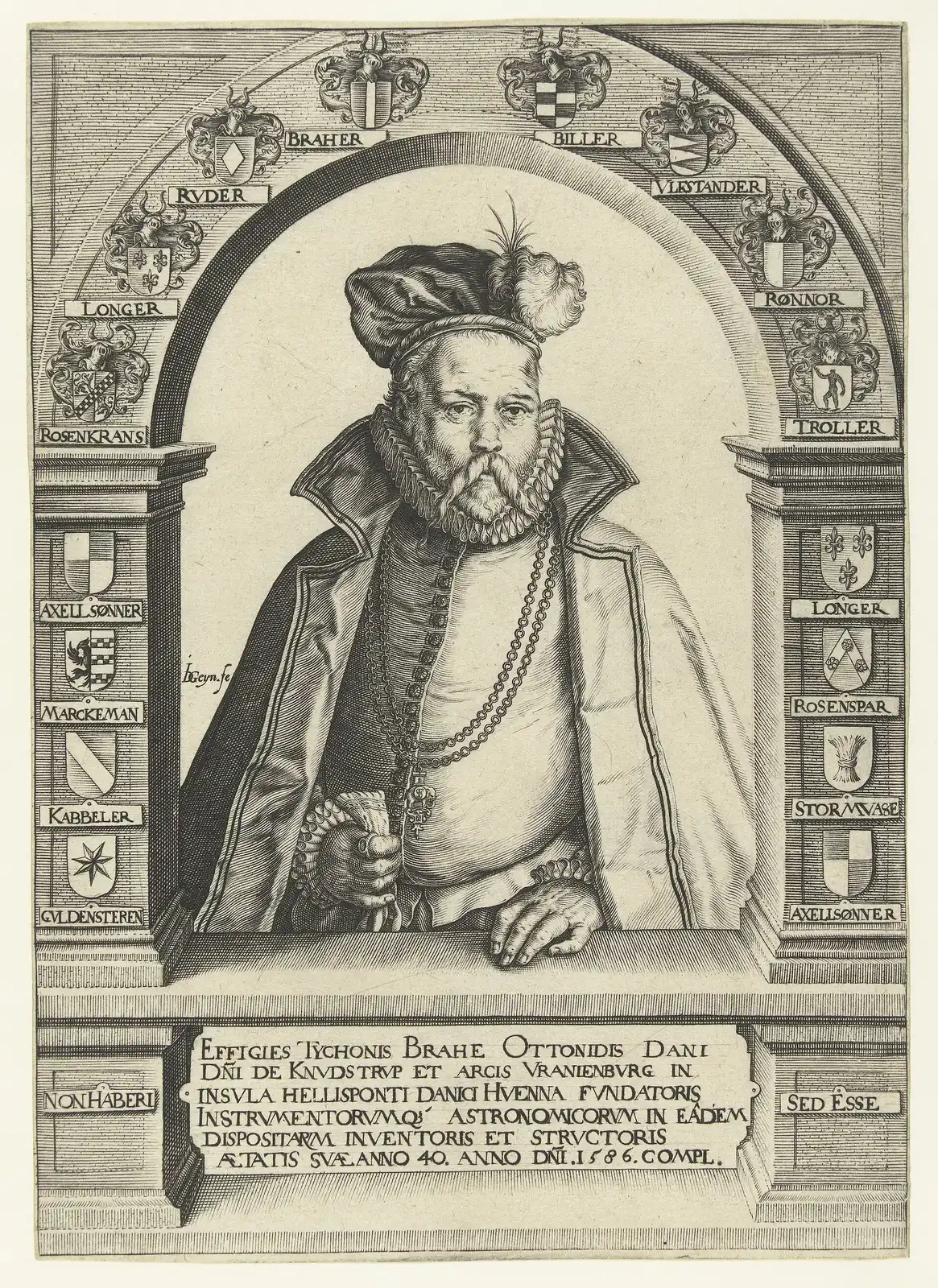
In November 1572 a new star blazed up in Cassiopeia. As English Wikipedia summarizes the reports of the time, it appeared soon after November 2, outshone Jupiter by November 11, peaked around November 16 at about magnitude −4, and stayed visible to the naked eye into early 1574. Tycho Brahe's study of it, De nova stella, was published in 1573. The explosion is often called Tycho's supernova.
Source and licence
"Portret van Tycho Brahe op veertigjarige leeftijd (met muts), RP-P-1909-2761" by Jacob de Gheyn (II), Rijksmuseum RP-P-1909-2761 — https://commons.wikimedia.org/wiki/File:Portret_van_Tycho_Brahe_op_veertigjarige_leeftijd_(met_muts),_RP-P-1909-2761.jpg — CC0 1.0 (https://creativecommons.org/publicdomain/zero/1.0/)Earliest ink
- Cassiopeia among the stars, sinking head first: after about 276 BC. Aratus, Phaenomena 179–204 and 653–658 (Greek text, Perseus Digital Library); the first-ink date for her place in the sky among the texts checked for this page.
- The boast on stage, by later report: around 450 BC and 412 BC, both lost. The Andromeda tragedies of Sophocles and Euripides, whose authors De Astronomia 2.10 credits with Cassiopeia's story, with dates as English Wikipedia summarizes them.
- Poseidon's flood: 1st or 2nd century AD. Apollodorus, Library 2.4.3 (Frazer's 1921 translation, Perseus Digital Library); the only text checked here that sends a flood.
- Wang Liang among the same stars: before 86 BC. Sima Qian, Shiji, treatise on the heavens (Chinese text, Wikisource); the only Chinese text checked for this page.
Sources checked through 2026-10-19.
Where the trail goes next
- The seated queen in the full list: All 88 Constellations, where Cassiopeia's row records her place among Ptolemy's 48 and Aratus's 47.
- A second family in the sky: The Pleiades, seven sisters whom Aratus names in the same poem.
Cite this page
Where Tales Began. “Cassiopeia: Why the Myth Says the Queen Turns Upside Down.” First published October 20, 2026; last substantive revision October 20, 2026. https://wheretalesbegan.com/starlore/cassiopeia/. Accessed: add the date you read this page.
- Author
- Where Tales Began
- Title
- Cassiopeia: Why the Myth Says the Queen Turns Upside Down
- Published
- Revised
- Address
- https://wheretalesbegan.com/starlore/cassiopeia/
Sources
- Aratus, Phaenomena, Greek text ed. G. R. Mair (Loeb, 1921); digital edition urn:cts:greekLit:tlg0653.tlg001.perseus-grc2, Perseus Digital Library, PerseusDL/canonical-greekLit (GitHub, commit 0189b9c8), CC BY-SA 4.0 github.com/PerseusDL/canonical-greekLit/blob/0189b9c8d8d1f148133f2f0af309b4ee90ea4332/data/tlg0653/tlg001/tlg0653.tlg001.perseus-grc2.xml Read: lines 179-205 and 650-660 (Greek) Text licence: CC BY-SA 4.0
- De Astronomia, book 2, chapters 9-12 and 31 (attributed to Hyginus), Latin text, Wikisource (read 2026-10-19) la.wikisource.org/wiki/De_Astronomia/Liber_II Read: book 2, chapters 9-12 and 31; edition not stated on the page
- Apollodorus, The Library 2.4.3, translated by J. G. Frazer (Loeb, 1921), vol. 1; digital edition urn:cts:greekLit:tlg0548.tlg001.perseus-eng2, Perseus Digital Library, PerseusDL/canonical-greekLit (GitHub, commit 0189b9c8), CC BY-SA 4.0 github.com/PerseusDL/canonical-greekLit/blob/0189b9c8d8d1f148133f2f0af309b4ee90ea4332/data/tlg0548/tlg001/tlg0548.tlg001.perseus-eng2.xml Read: 2.4.3 with Frazer's note (vol. 1, pp. 159-161); 1.7.1-1.7.2 (Deucalion's flood) Text licence: CC BY-SA 4.0
- Ovid, Metamorphoses 4, Latin text ed. H. Magnus (1892); digital edition urn:cts:latinLit:phi0959.phi006.perseus-lat2, Perseus Digital Library, PerseusDL/canonical-latinLit (GitHub, commit 128a05af), CC BY-SA 4.0 github.com/PerseusDL/canonical-latinLit/blob/128a05afa9cc7179ab18f8d05f78a9f1dd50e415/data/phi0959/phi006/phi0959.phi006.perseus-lat2.xml Read: book 4, lines 663-740 Text licence: CC BY-SA 4.0
- Ovid, Metamorphoses, translated by Brookes More (Boston: Cornhill, 1922); digital edition urn:cts:latinLit:phi0959.phi006.perseus-eng3, Perseus Digital Library, PerseusDL/canonical-latinLit (GitHub, commit 128a05af), CC BY-SA 4.0 github.com/PerseusDL/canonical-latinLit/blob/128a05afa9cc7179ab18f8d05f78a9f1dd50e415/data/phi0959/phi006/phi0959.phi006.perseus-eng3.xml Read: book 4, More's lines 994-1030 and 1088-1093 Text licence: CC BY-SA 4.0
- Aristophanes, Frogs, Greek text ed. F. W. Hall and W. M. Geldart (Oxford: Clarendon Press, 1907); digital edition urn:cts:greekLit:tlg0019.tlg009.perseus-grc2, Perseus Digital Library, PerseusDL/canonical-greekLit (GitHub, commit 0189b9c8), CC BY-SA 4.0 github.com/PerseusDL/canonical-greekLit/blob/0189b9c8d8d1f148133f2f0af309b4ee90ea4332/data/tlg0019/tlg009/tlg0019.tlg009.perseus-grc2.xml Read: lines 48-72 (Greek) Text licence: CC BY-SA 4.0
- Hesiod, Theogony, translated by H. G. Evelyn-White, in Hesiod, the Homeric Hymns and Homerica (London: Heinemann; New York: Macmillan, 1914); digital edition urn:cts:greekLit:tlg0020.tlg001.perseus-eng2, Perseus Digital Library, PerseusDL/canonical-greekLit (GitHub, commit 0189b9c8), CC BY-SA 4.0 github.com/PerseusDL/canonical-greekLit/blob/0189b9c8d8d1f148133f2f0af309b4ee90ea4332/data/tlg0020/tlg001/tlg0020.tlg001.perseus-eng2.xml Read: lines 240-264 (the daughters of Nereus), English with the Greek text alongside Text licence: CC BY-SA 4.0
- Sima Qian, Shiji, juan 27, "Tianguan shu" (Treatise on the Celestial Offices), Chinese text, Wikisource (read 2026-10-19) zh.wikisource.org/wiki/%E5%8F%B2%E8%A8%98/%E5%8D%B727 Read: main text on Tiansi and Wang Liang; base edition not stated on the page
- IAU Working Group on Star Names, "List of IAU-approved Star Names as of January 1st, 2021," on IAU, "Naming Stars" (read 2026-10-19) iauarchive.eso.org/public/themes/naming_stars Read: table rows for Caph, Schedar, Ruchbah, Segin, Achird, Castula and Polaris Text licence: CC BY 4.0
- IAU, "The Constellations" (read 2026-10-19) iauarchive.eso.org/public/themes/constellations Read: table row for Cassiopeia Text licence: CC BY 4.0
- National Library of Wales, MS 735C, "Texts on astronomy," folio 19v, Cassiopeia, file description on Wikimedia Commons (read 2026-10-19) commons.wikimedia.org/wiki/File:F19.v._Cassiopeia_NLW_MS_735C.png Read: file description: first section (ff. 1-26) copied c. 1000 in the Limoges area
- Johannes Hevelius, "Firmamentum Sobiescianum, sive uranographia" (Danzig, 1690), plate N, Cassiopeia, file description on Wikimedia Commons (read 2026-10-19) commons.wikimedia.org/wiki/File:Johannes_Hevelius_-_Prodromus_Astronomia_-_Volume_III_%22Firmamentum_Sobiescianum,_sive_uranographia%22_-_Tavola_N_-_Cassiopeia.jpg Read: file description: plate N, 1690; the figure is reversed, as on celestial globes
- Metropolitan Museum of Art, "Kitab suwar al-kawakib al-thabita (Book of the Images of the Fixed Stars) of al-Sufi," late 15th century, 13.160.10, file description on Wikimedia Commons (read 2026-10-19) commons.wikimedia.org/wiki/File:Kitab_suwar_al-kawakib_al-thabita_(Book_of_the_Images_of_the_Fixed_Stars)_of_al-Sufi_MET_21317.jpg Read: file description: title, date, accession number
- Jacob de Gheyn (II), "Portret van Tycho Brahe op veertigjarige leeftijd (met muts)," Rijksmuseum RP-P-1909-2761, file description on Wikimedia Commons (read 2026-10-19) commons.wikimedia.org/wiki/File:Portret_van_Tycho_Brahe_op_veertigjarige_leeftijd_(met_muts),_RP-P-1909-2761.jpg Read: file description: maker, date 1593-1597
- English Wikipedia, "Cassiopeia (constellation)" (read 2026-10-19). en.wikipedia.org/wiki/Cassiopeia_(constellation) Read: mythology section; al-Sufi depiction; Tinted Hand; W orientation; summarized here through English Wikipedia
- English Wikipedia, "Aratus" (read 2026-10-19). en.wikipedia.org/wiki/Aratus Read: introduction and Life section; summarized here through English Wikipedia
- English Wikipedia, "De astronomia" (read 2026-10-19). en.wikipedia.org/wiki/De_Astronomica Read: introduction and Authorship and contents; summarized here through English Wikipedia
- English Wikipedia, "Bibliotheca (Apollodorus)" (read 2026-10-19). en.wikipedia.org/wiki/Bibliotheca_(Pseudo-Apollodorus) Read: introduction; summarized here through English Wikipedia
- English Wikipedia, "Metamorphoses" (read 2026-10-19). en.wikipedia.org/wiki/Metamorphoses Read: introduction; summarized here through English Wikipedia
- English Wikipedia, "Andromeda (Euripides)" (read 2026-10-19). en.wikipedia.org/wiki/Andromeda_(Euripides) Read: introduction, Plot, Antecedents, Later references; summarized here through English Wikipedia
- English Wikipedia, "The Frogs" (read 2026-10-19). en.wikipedia.org/wiki/The_Frogs Read: introduction; summarized here through English Wikipedia
- English Wikipedia, "The Book of Fixed Stars" (read 2026-10-19). en.wikipedia.org/wiki/Book_of_Fixed_Stars Read: introduction and Historical context; summarized here through English Wikipedia
- English Wikipedia, "Records of the Grand Historian" (read 2026-10-19). en.wikipedia.org/wiki/Records_of_the_Grand_Historian Read: Textual history; summarized here through English Wikipedia
- Chinese Wikipedia, "王良 (星官)" [Wang Liang (asterism)] (read 2026-10-19). zh.wikipedia.org/wiki/%E7%8E%8B%E8%89%AF_(%E6%98%9F%E5%AE%98) Read: star list (beta, kappa, eta, alpha and lambda Cas); summarized here through Chinese Wikipedia
- Chinese Wikipedia, "策 (恆星)" [Ce, gamma Cassiopeiae] (read 2026-10-19). zh.wikipedia.org/wiki/%E7%AD%96_(%E6%81%86%E6%98%9F) Read: lead and infobox: Ce is gamma Cassiopeiae, the middle star of the W; summarized here through Chinese Wikipedia
- English Wikipedia, "SN 1572" (read 2026-10-19). en.wikipedia.org/wiki/SN_1572 Read: introduction and Historic description; summarized here through English Wikipedia
- English Wikipedia, "Sidney Hall" (read 2026-10-19). en.wikipedia.org/wiki/Sidney_Hall Read: introduction; summarized here through English Wikipedia


