Festival guide
Christmas Traditions: What the Written Record Actually Shows
- By
- Where Tales Began
- Published
- Last substantive revision
How records are checked: Following the paper trail. Corrections: Fixes to the record. Questions: Contact us.
Fast facts
- Name
- Christmas traditions
- When
- December 25, a fixed date. Churches that keep the Julian calendar mark it on January 7 in the Gregorian calendar (1901 to 2099).
- Earliest ink
- 354: the Chronography of 354 lists December 25 as the birth of Christ (earliest dated record in the sources checked)
- Where found
- Dated records in the table come from Rome, Strasbourg, Wittenberg, England and New York
- TL;DR
- December 25 is attested in 354, in a Roman almanac that also marks the birthday of the Unconquered on that day. Eight of the nine customs in the table have no dated record before 1600 in the sources checked: fir trees in homes appear in 1605, reindeer in 1821, stockings by the chimney in 1823 and the card in 1843. A red-suited Santa was in color print by 1902, about three decades before Coca-Cola's Santa ads of the 1930s.
Download these facts (CSV, christmas-traditions-fast-facts.csv)
Source and licence
"The Christmas Tree at Windsor Castle, by J. L. Williams - ILN 1848 (cropped)" by Joseph Lionel Williams, for The Illustrated London News — https://commons.wikimedia.org/wiki/File:The_Christmas_Tree_at_Windsor_Castle,_by_J._L._Williams_-_ILN_1848_(cropped).jpg — Public domain (artist d. 1877; US: published 1848, before 1931; EU: 70 years after the artist's death; faithful reproduction of a two-dimensional print)A Roman list of martyrs' feast days, copied into an almanac for 354, opens with Christmas. Its first entry, for December 25, reads "natus Christus in Betleem Iudeae": "Christ born in Bethlehem of Judea" (Translation: Where Tales Began). That line is the earliest dated record of the date in the sources checked for this page.
The other customs in the table below reach the written record much later. By this page's count, eight of its nine customs have no dated record before 1600 in the sources checked. They run from fir trees in Strasbourg homes in 1605 to a red suit trimmed with white fur, in color print, in 1902.
December 25 in a Roman almanac of 354
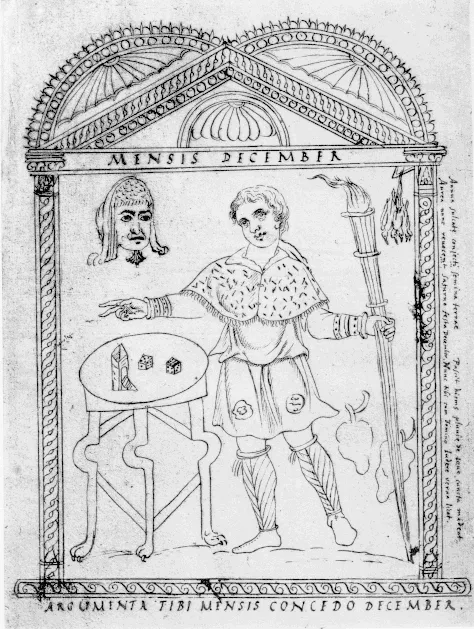
The almanac is the Chronography of 354. It was made for a wealthy Christian aristocrat in Rome named Valentinus and lettered by the calligrapher Furius Dionysius Filocalus. The original codex is lost, as the introduction to Roger Pearse's transcription explains. Its text survives in a ninth-century copy without pictures and in Renaissance copies of a second ninth-century copy, now also lost.
In that narrow sense the almanac belongs with the lost books of antiquity: a book known only through what later copyists made of it. Two of its lists bear on Christmas. The list of martyrs' feasts, the Depositio martyrum, begins with the December 25 entry quoted above.
Clement A. Miles noted in 1912 that the calendar seems to reuse an older document of 336. The entry may therefore be that old. English Wikipedia's article on Christmas reports that this part is generally dated to 336 by liturgical historians.
The almanac's calendar of Roman festivals marks December 25 "N·INVICTI·CM·XXX." The transcription's notes expand N as natalis, "birthday," and CM as circenses missus, "games ordered"; English Wikipedia's article on Sol Invictus gives the feast thirty chariot races. The line reads "birthday of the Unconquered: circus games, 30 races" (Translation: Where Tales Began). The same calendar puts the Saturnalia on December 17, not on the 25th.
Source and licence
"Chronography of 354 Mensis December" by Filocalus, in a 17th-century copy (Barberini lat. 2154) — https://commons.wikimedia.org/wiki/File:Chronography_of_354_Mensis_December.png — Public domain (anonymous 17th-century pen copy of a design of 354; US: an anonymous work created more than 120 years ago is public domain whether or not it was published before 1931; EU: anonymous work made public more than 70 years ago; faithful reproduction of a two-dimensional drawing)Why December 25?
The surviving sources do not settle why Christmas was put on December 25. Miles took the Unconquered of the 354 calendar to be the sun, and in 1912 he called one explanation the view of most scholars: the church set Christ's birth against the birthday of the sun.
Louis Duchesne proposed a calculation instead. A tradition placed the Passion on March 25, and the conception was given the same date. The birth then fell nine months later, on December 25. English Wikipedia's summary of the debate sets out both views and notes that Duchesne found this belief in no early Christian text.
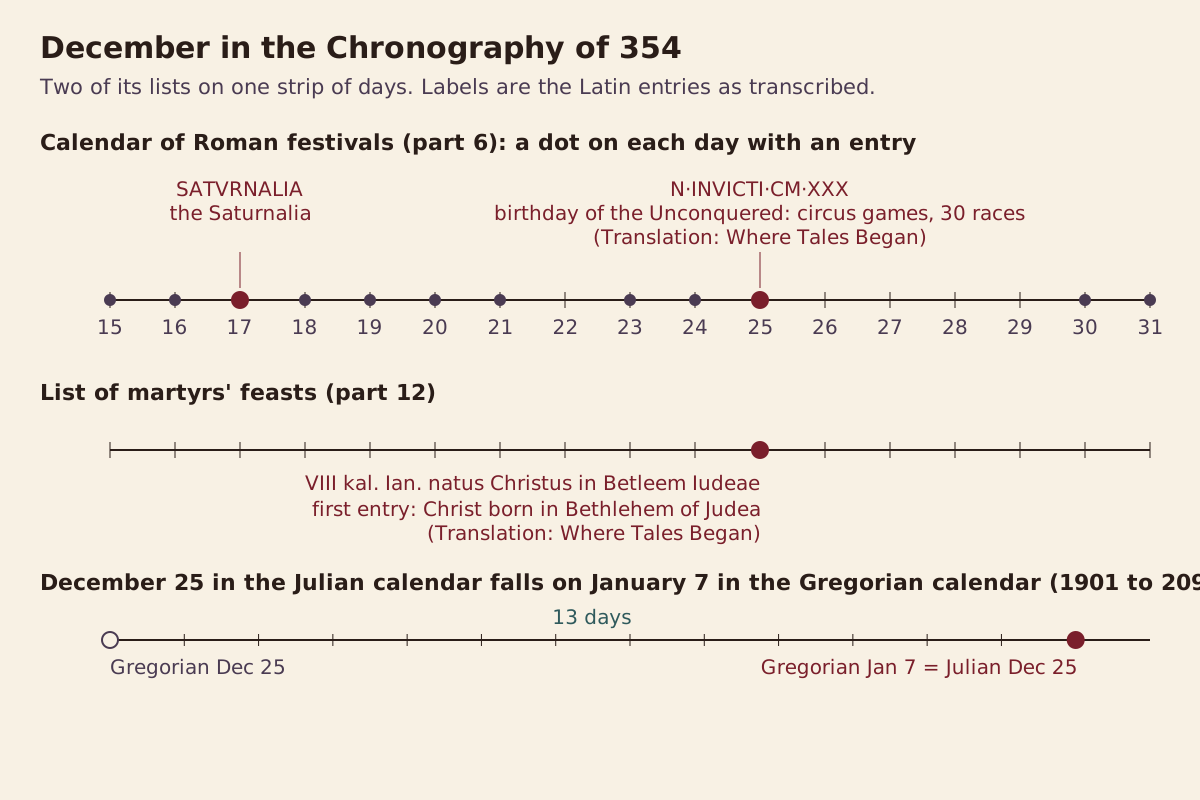
English Wikipedia's Christmas article notes that some Eastern Orthodox churches keep the Julian calendar for fixed feasts like this one. Their December 25 falls on January 7 in the Gregorian calendar; by this page's recomputation, the gap is 13 days in every year from 1901 to 2099. Easter, by contrast, has no fixed date. It is worked out anew each year, as the entry on how Easter is calculated shows.
The record, layer by layer
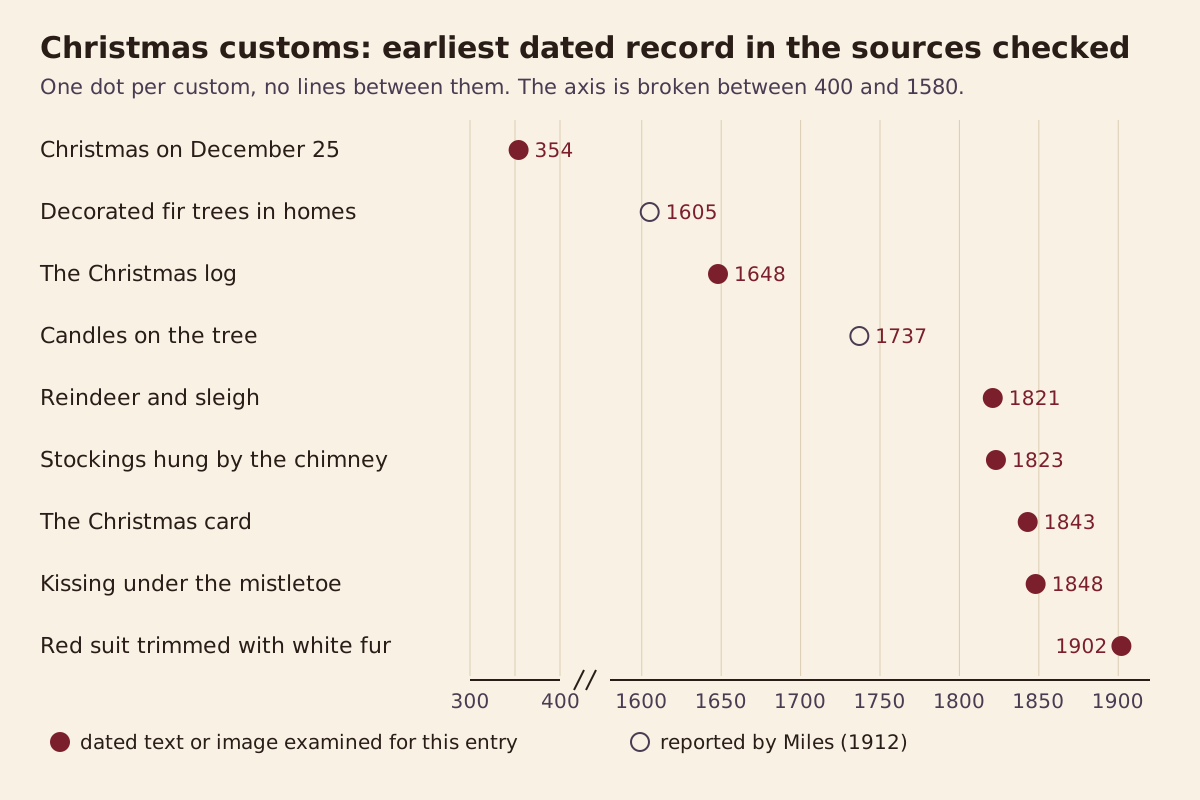
Each row below gives a first-ink date: the date of the earliest written record of a custom that can be checked. It marks where the paper evidence starts, not where the custom began. It also holds only for the sources listed at the end of this page, and how the site dates records sets out the rules. Where a record is known here only from a later summary, the table says so.
| Custom | Earliest dated record in the sources checked | Year |
|---|---|---|
| Christmas on December 25 | Depositio martyrum, Chronography of 354 (the list may copy one of 336) | 354 |
| Decorated fir trees in homes | An anonymous Strasbourg note, known here from Miles (1912); Perry (2010), quoted by English Wikipedia, gives 1604 | 1605 |
| The Christmas log | Robert Herrick, "Ceremonies for Christmas," Hesperides | 1648 |
| Candles on the tree | Karl Gottfried Kissling of Wittenberg, known here from Miles (1912) | 1737 |
| Reindeer and sleigh | The Children's Friend, published in New York | 1821 |
| Stockings hung by the chimney | "Account of a Visit from St. Nicholas," Troy Sentinel | 1823 |
| The Christmas card | Card designed by John Callcott Horsley for Henry Cole (Miles gave 1846) | 1843 |
| Kissing under the mistletoe | Washington Irving, footnote to "Christmas Eve," The Sketch Book, in the 1848 revised text (the essay first appeared in 1820) | 1848 |
| Red suit trimmed with white fur | Puck cover, December 3, 1902 | 1902 |
Table data: christmas-traditions-record-layers.csv, with all 19 records behind this page, their sources and links.
Herrick's poem, printed in 1648, is the earliest English text in the table, 1,294 years after the Roman list:
Come, bring with a noise, / My merry, merry boys, / The Christmas log to the firing;
Robert Herrick, "Ceremonies for Christmas," Hesperides (1648), in Alfred Pollard's 1898 edition
Christmas trees, from guild houses to Windsor
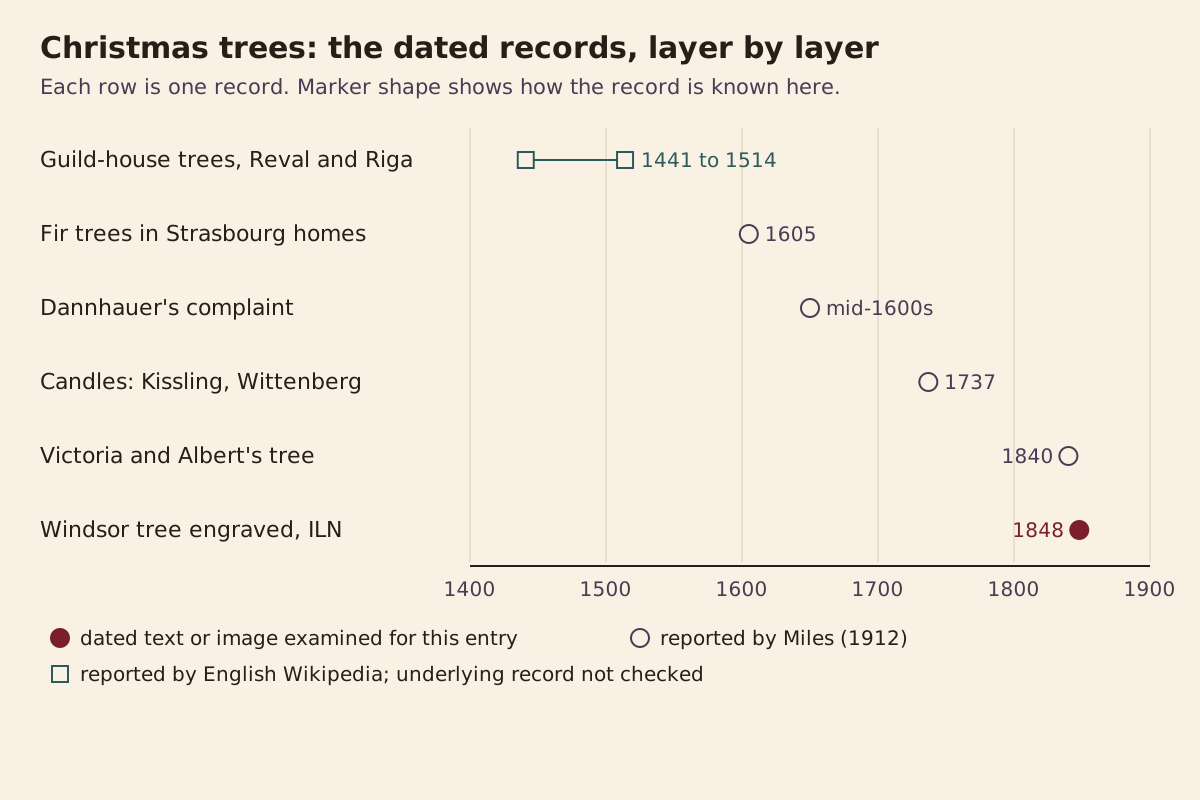
In Miles's 1912 account, the story that Martin Luther set up a candle-lit tree for his children is a legend. Miles gave the earliest historical mention as an anonymous Strasbourg note of 1605, 1,251 years after the Roman list. English Wikipedia quotes Joe Perry's Christmas in Germany (2010), which dates the same chronicle to 1604.
At Christmas, according to the note as Miles renders it in English, people there set up fir trees in their parlors. They hung them with paper roses, apples, wafers, gilt foil and sweets.
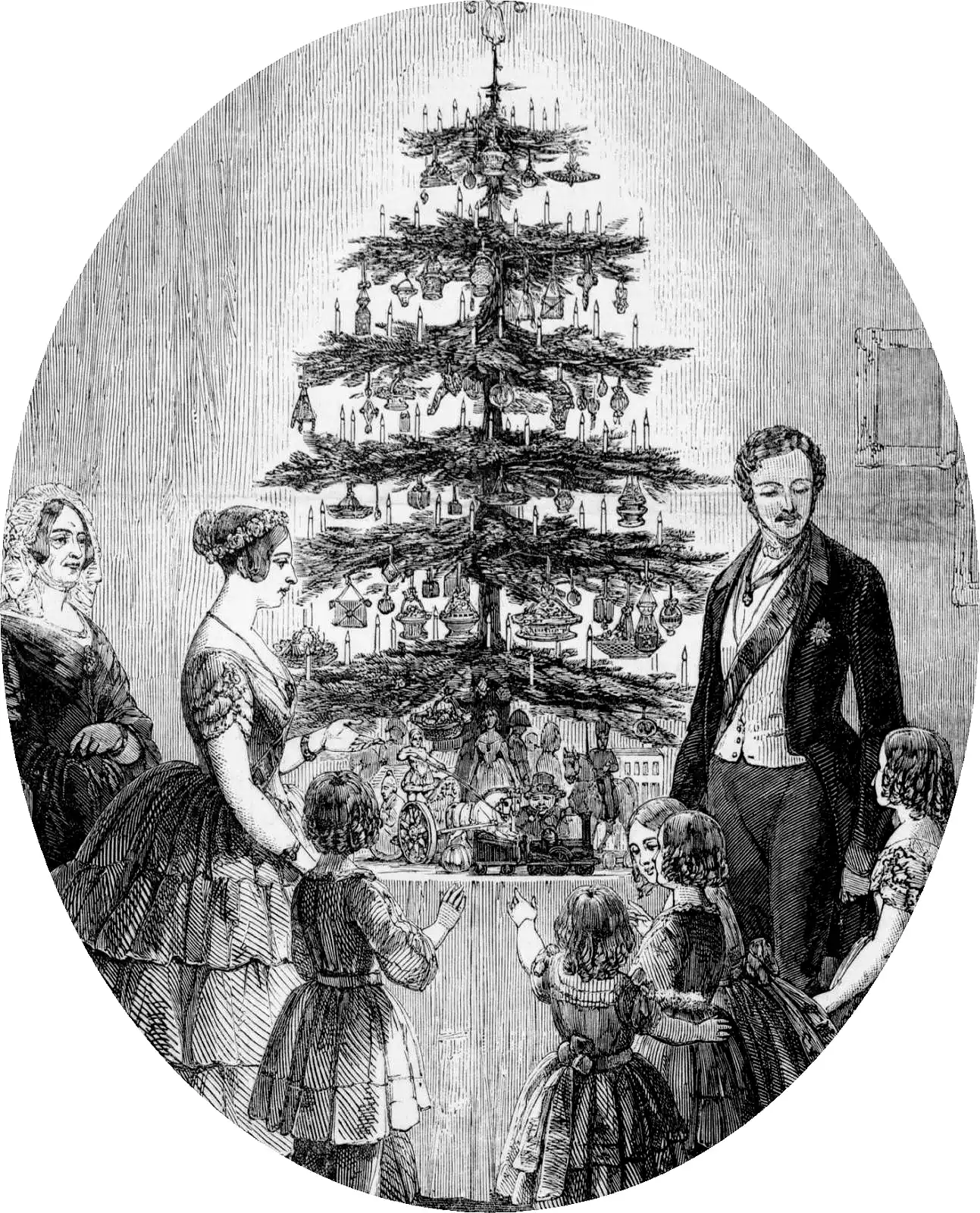
The Strasbourg preacher Johann Konrad Dannhauer complained about such trees in the mid-1600s. Neither record mentions candles. In Miles's account they appear in 1737, in a Latin work by Karl Gottfried Kissling of Wittenberg. In England, Miles noted an allusion to the tree in 1789 and dated a tree kept by Queen Victoria and Prince Albert to 1840; the 1848 engraving at the top of this page shows the royal tree at Windsor.
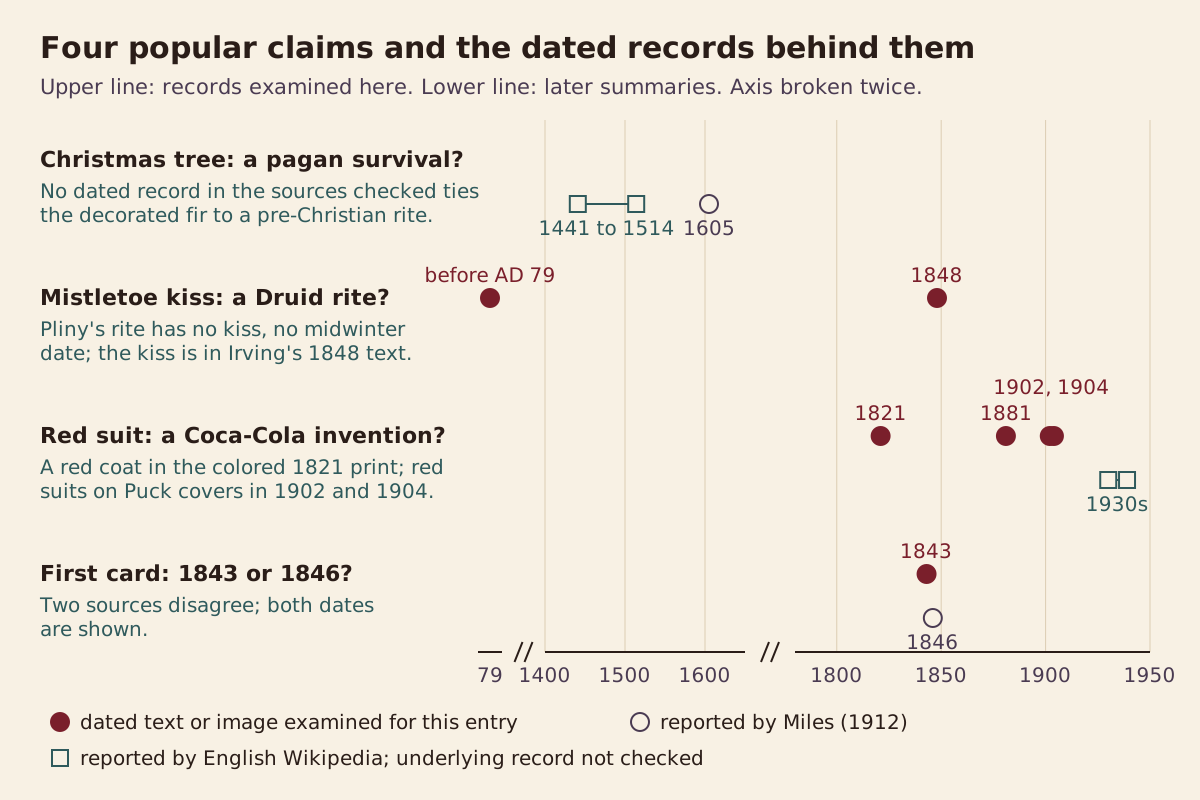
English Wikipedia reports trees older than the Strasbourg note, though not in homes. The Brotherhood of Blackheads set them up in its guild houses in Reval (now Tallinn) and Riga in 1441, 1442, 1510 and 1514. English Wikipedia cites Friedrich Amelung's 1885 history of the guild. This page has not checked those archive entries, so the chart marks them as reported.
Whether the tree descends from older rites is a separate question. Miles called its kinship with other rites of plant life evident but judged its exact ancestry hard to pin down. He reported Alexander Tille's view that it joined Roman New Year greenery with a legend of trees blossoming on Christmas Eve. Miles thought a Roman link very possible, though he found closer parallels in folk customs with no sign of Roman or Greek influence.
English Wikipedia also summarizes a theory, held by some researchers, that the apple-hung "paradise tree" of medieval plays given on December 24 is the forerunner. None of the dated records in the chart names a pre-Christian rite.
Cards, stockings and reindeer
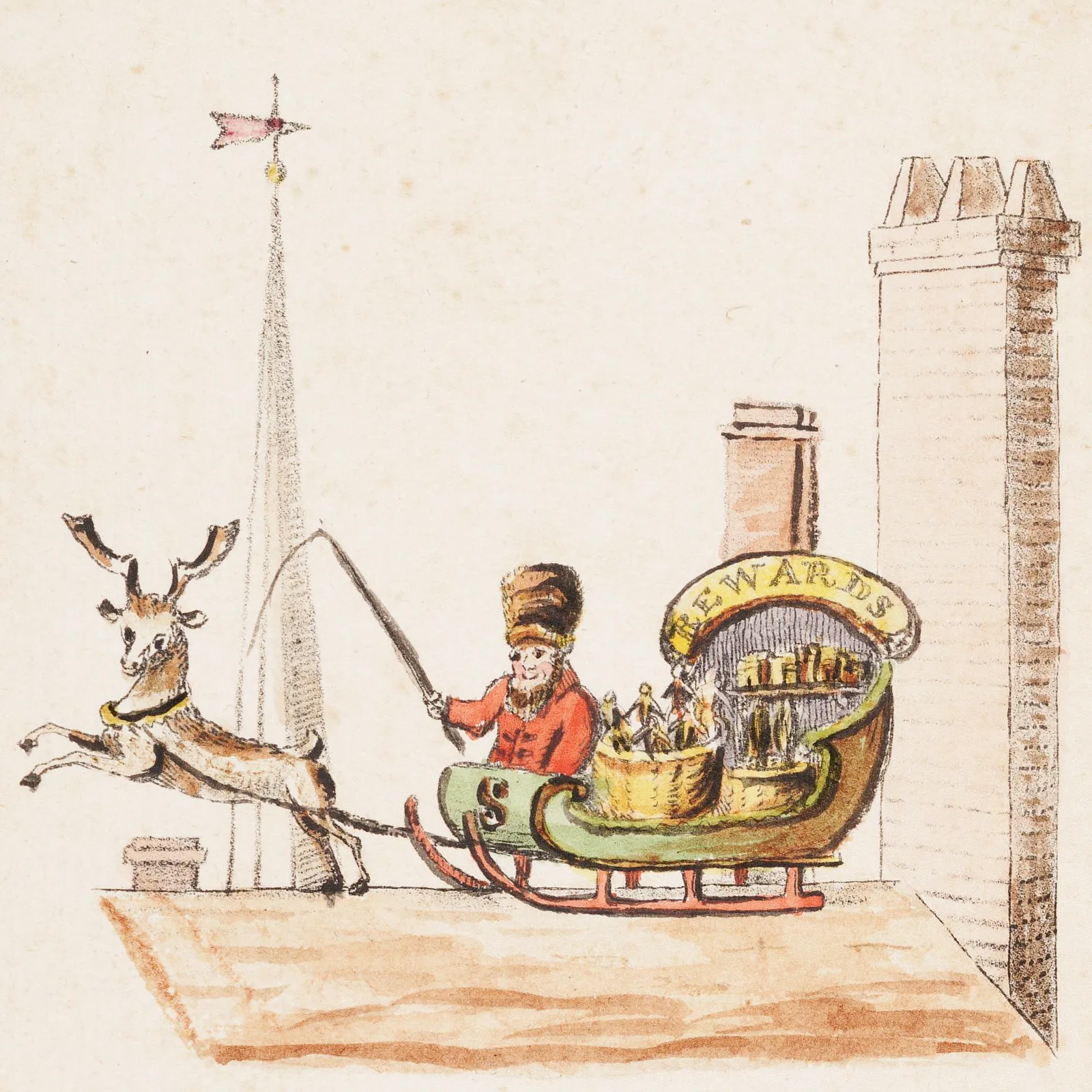
The reindeer reach print in 1821. The Children's Friend, a small book from the New York publisher William B. Gilley, shows "Old Santeclaus" driving a sleigh behind one reindeer over the rooftops. The copy scanned for Wikimedia Commons is in color, with Santeclaus in a red coat. English Wikipedia describes the book's eight illustrations as colored in the original.
Source and licence
"The Children's friend. Number III. A New-Year's present, to the little ones from five to twelve. Part III (1821), page 1" by Unknown artist, The Children's Friend (New York: William B. Gilley, 1821) — https://commons.wikimedia.org/wiki/File:The_Children%27s_friend._Number_III._A_New-Year%27s_present,_to_the_little_ones_from_five_to_twelve._Part_III_(1821),_page_1.jpg — Public domain (anonymous illustration published in New York in 1821; US: published before 1931; EU: anonymous work made public more than 70 years ago; faithful reproduction of a two-dimensional page)Two years later, on December 23, 1823, the Troy Sentinel, a newspaper in Troy, New York, printed "Account of a Visit from St. Nicholas" without an author's name. The poem has the stockings "hung by the chimney with care" and "eight tiny rein-deer." Its newspaper text ends "Happy Christmas to all," where the 1862 illustrated edition reads "Merry Christmas to all."
Clement C. Moore was named as the author in 1837 and printed the poem in his own Poems of 1844. Henry Livingston Jr.'s family and the scholar Donald Foster have argued for Livingston instead. English Wikipedia summarizes both sides.
The poem sets the visit on Christmas Eve, but Miles, writing in 1912, gave another date in his chapter on St. Nicholas's Day. In Holland, Belgium and Tyrol, St. Nicholas called on December 5, the eve of his feast on December 6, and in Lower Austria a figure called Krampus followed him. His chapter on Christmas Eve places a visit by the saint and Ruprecht in south-western Lower Austria on that night. The entry on Krampus lays out what the dated records of these Alpine visits show.
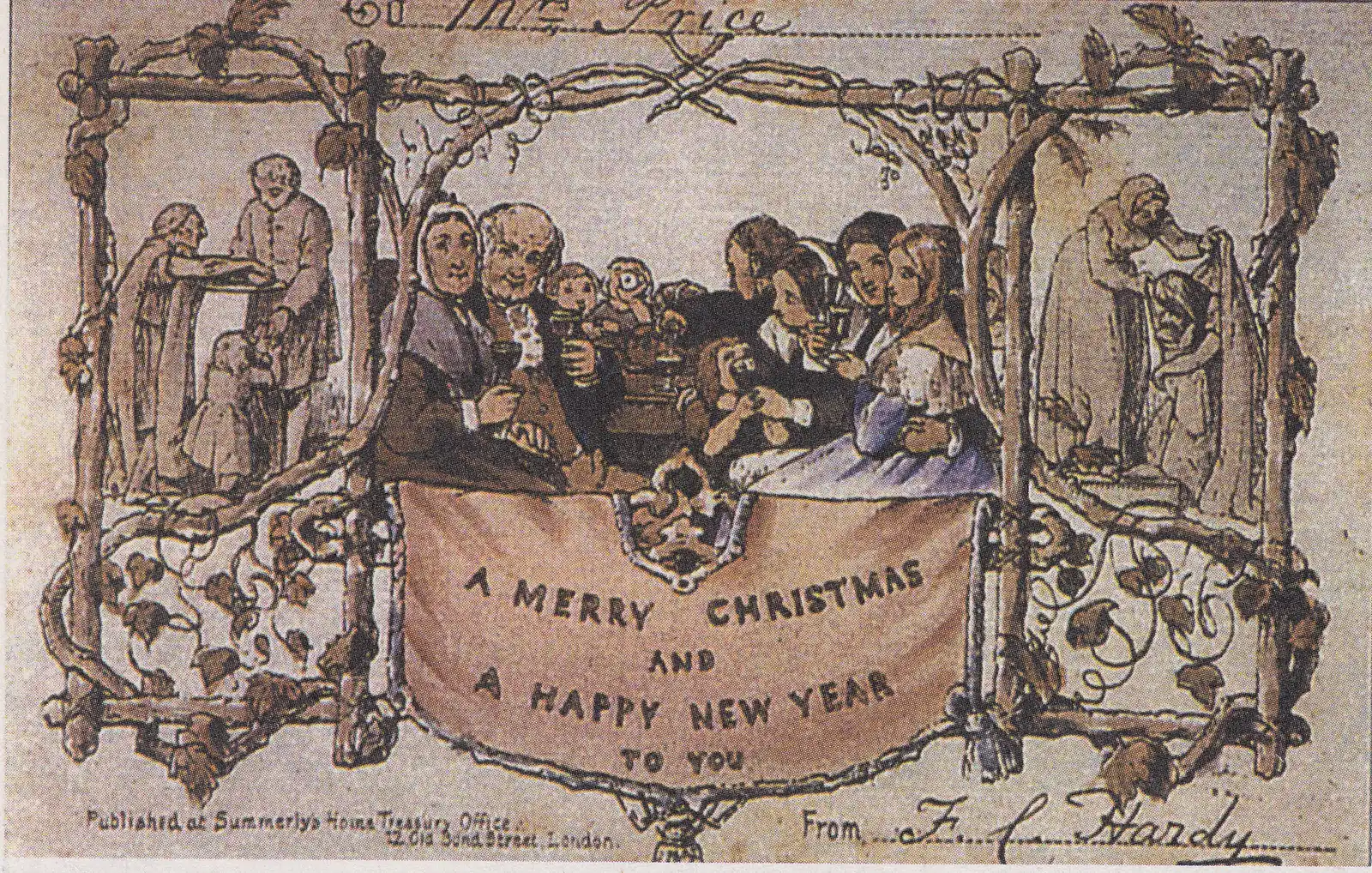
For the Christmas card, the sources disagree on the year. The Commons record for the card John Callcott Horsley designed for Henry Cole dates it to 1843, and English Wikipedia gives the same year. Miles, writing in 1912, said the first true Christmas card seems to have been issued in 1846. He added that sending cards caught on only around 1862.
Source and licence
"FirstX-MasPostcard1843" by John Callcott Horsley, for Henry Cole — https://commons.wikimedia.org/wiki/File:FirstX-MasPostcard1843.jpg — Public domain (designer d. 1903; US: published 1843; EU: 70 years after the designer's death; faithful reproduction of a two-dimensional printed card)Santa's look, from Nast onward
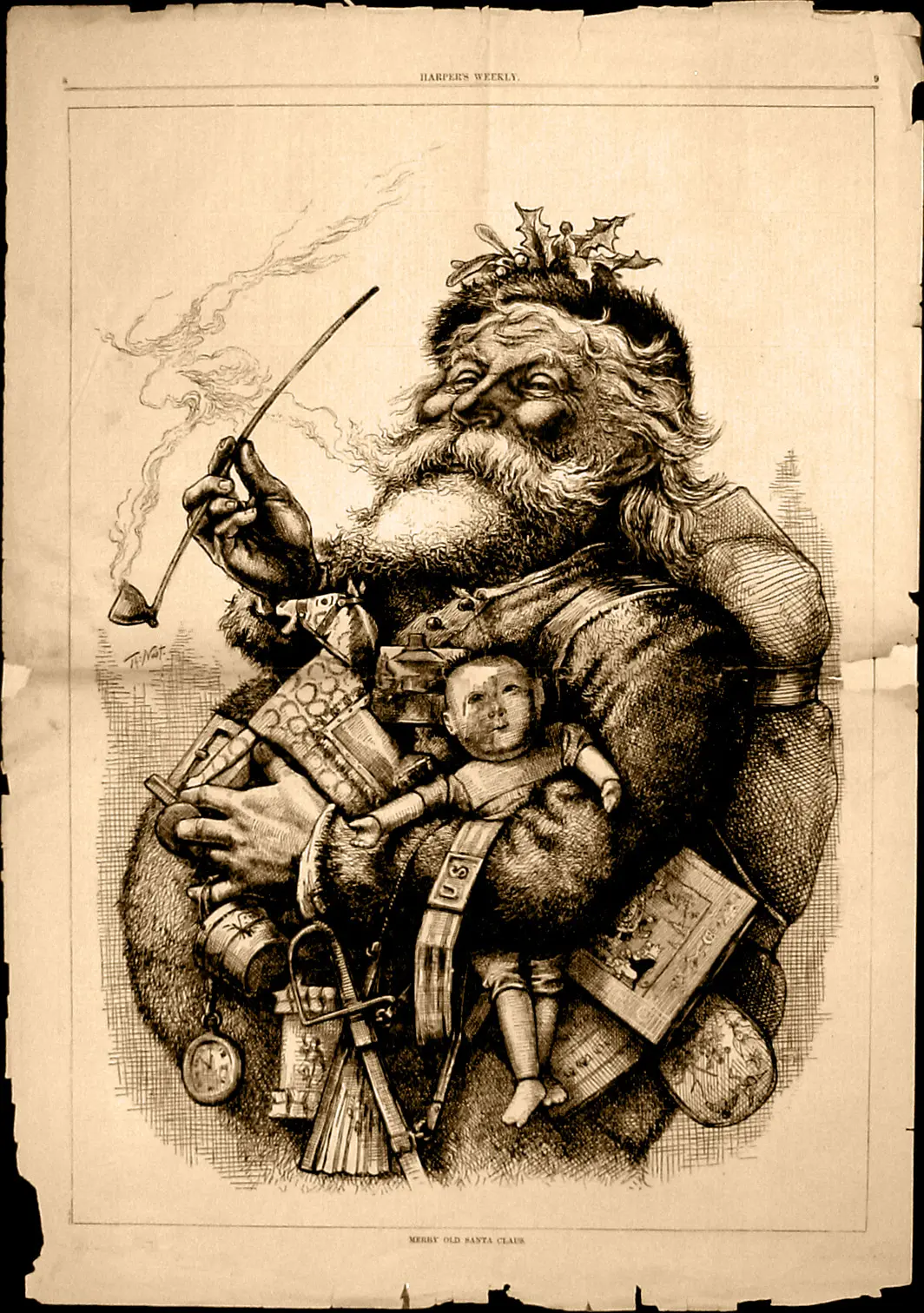
The 1823 poem dresses St. Nicholas "all in fur, from his head to his foot" and gives him a pipe. It names no color for his clothes. Thomas Nast's "Merry Old Santa Claus" appeared in Harper's Weekly on January 1, 1881. It shows him in a fur-trimmed suit with holly in his cap, a pipe and an armful of toys, all in black and white.
Source and licence
"Merry Old Santa Claus, by Thomas Nast, 1881" by Thomas Nast — https://commons.wikimedia.org/wiki/File:Merry_Old_Santa_Claus,_by_Thomas_Nast,_1881.jpg — Public domain (artist d. 1902; US: published 1881; EU: 70 years after the artist's death; faithful reproduction of a printed page)English Wikipedia dates Haddon Sundblom's Santa paintings for Coca-Cola's Christmas advertising to the 1930s. It calls the story that Santa wears red and white because of the company's colors an urban legend. Puck had already printed a Santa in a red suit trimmed with white fur on its covers of December 3, 1902, and December 7, 1904. Both covers survive as Library of Congress prints, viewable on Wikimedia Commons, and both come about three decades before those ads.
Popular claims vs. the record
Each claim in the table below sits beside the dated records that bear on it. All of them come from the sources listed at the end of this page, and the chart after the table plots four of the claims on one time axis.
The mistletoe claim points to a rite that Pliny the Elder, who died in AD 79, described among the Druids of Gaul:
Clad in a white robe the priest ascends the tree, and cuts the mistletoe with a golden sickle, which is received by others in a white cloak.
Pliny the Elder, Natural History 16.95, translated by John Bostock and H. T. Riley (1855)
| Claim | What the dated record shows |
|---|---|
| Christmas took over the Saturnalia | The 354 calendar puts the Saturnalia on December 17 and the birthday of the Unconquered on December 25; why Christmas shares the 25th is still debated |
| The Christmas tree is a pagan survival | Trees appear in guild houses from 1441 (reported) and in Strasbourg homes in 1605; no dated record checked here ties them to a named pre-Christian rite |
| Kissing under the mistletoe is a Druid rite | Pliny describes Druids cutting mistletoe from an oak, with no kiss and no season named; the kiss appears in a footnote to Irving's "Christmas Eve," in its 1848 revised text |
| Coca-Cola invented Santa's red suit | A red coat in the colored print of 1821 and red suits on Puck covers in 1902 and 1904 come before the company's ads of the 1930s |
| The first Christmas card dates from 1843 | Commons and English Wikipedia give 1843; Miles in 1912 gave 1846 |
Earliest ink
- Christmas on December 25: 354. The first entry of the Depositio martyrum in the Chronography of 354, in MGH Chronica Minora I (1892), pp. 71–72, as transcribed by Roger Pearse; the earliest dated record of the date in the sources checked, possibly copying a list of 336.
- Christmas trees in homes: 1605. An anonymous Strasbourg note, known here through Clement A. Miles, Christmas in Ritual and Tradition (1912), p. 265; English Wikipedia, quoting Joe Perry (2010), dates the same chronicle to 1604, and it reports guild-house trees from 1441 that are not checked here.
- Reindeer and stockings by the chimney: 1821 and 1823. The Children's Friend (1821), page 1 and the Troy Sentinel poem of December 23, 1823, the earliest dated texts for each in the sources checked.

Sources checked through 2026-10-18.
Where the trail goes next
- The gift-bringer who comes with a companion: Krampus follows the Alpine St. Nicholas visit of December 5 through its dated records.
- A feast that moves every year: the date of Easter shows how a feast with no fixed date is calculated.
- The 1823 newspaper text: the Wikisource transcription of the Troy Sentinel poem keeps "Dunder and Blixem" where the 1862 edition prints "Dunder and Blitzen."
Cite this page
Where Tales Began. “Christmas Traditions: What the Written Record Actually Shows.” First published October 20, 2026; last substantive revision October 20, 2026. https://wheretalesbegan.com/festivals/christmas-traditions/. Accessed: add the date you read this page.
- Author
- Where Tales Began
- Title
- Christmas Traditions: What the Written Record Actually Shows
- Published
- Revised
- Address
- https://wheretalesbegan.com/festivals/christmas-traditions/
Sources
- Chronography of 354, Part 12: Depositio martyrum, in Theodor Mommsen (ed.), MGH Chronica Minora I (1892), pp. 71–72; transcribed by Roger Pearse (2006), Early Church Fathers – Additional Texts (public domain) www.tertullian.org/fathers/chronography_of_354_12_depositions_martyrs.htm Read: full list with the transcriber's notes
- Chronography of 354, Part 6: Calendar, text edited by Theodor Mommsen; transcribed by Roger Pearse (2006), Early Church Fathers – Additional Texts (public domain) www.tertullian.org/fathers/chronography_of_354_06_calendar.htm Read: December table and the notes on abbreviations and manuscripts
- Roger Pearse, introduction to The Chronography of 354 AD, Early Church Fathers – Additional Texts (2006, public domain) www.tertullian.org/fathers/chronography_of_354_00_eintro.htm Read: sections on the codex, the manuscripts and the order of contents
- Pliny the Elder, The Natural History of Pliny, translated by John Bostock and H. T. Riley, vol. 3 (London: Henry G. Bohn, 1855), book 16, ch. 95, p. 435; Project Gutenberg eBook #59131 www.gutenberg.org/ebooks/59131 Read: book 16, chapter 95
- Robert Herrick, "Ceremonies for Christmas" (no. 784), Hesperides (London, 1648), in The Hesperides & Noble Numbers, ed. Alfred Pollard, revised edition (London: Lawrence & Bullen, 1898); Project Gutenberg eBook #22421 www.gutenberg.org/ebooks/22421 Read: poem 784 and the editor's introduction on the 1648 printing
- Washington Irving, "Christmas Eve," in The Sketch Book of Geoffrey Crayon, Gent. (issued in installments 1819–1820), text of the author's revised edition (1848); Project Gutenberg eBook #2048 www.gutenberg.org/ebooks/2048 Read: "Christmas Eve" and its footnote on the mistletoe, in the revised-edition text
- The Children's Friend. Number III. A New-Year's Present, to the Little Ones from Five to Twelve. Part III (New York: William B. Gilley, 1821), page 1; scan from the Beinecke Library, Yale University, on Wikimedia Commons commons.wikimedia.org/wiki/File:The_Children%27s_friend._Number_III._A_New-Year%27s_present,_to_the_little_ones_from_five_to_twelve._Part_III_(1821),_page_1.jpg Read: page 1 illustration and the file description
- "Account of a Visit from St. Nicholas," Troy Sentinel (Troy, New York), December 23, 1823; Wikisource transcription (read 2026-10-18) en.wikisource.org/wiki/Troy_Sentinel/1823/12/23/Account_of_a_Visit_from_St._Nicholas Read: full text of the poem and the editor's note
- Clement C. Moore, A Visit from Saint Nicholas, illustrated from drawings by F. O. C. Darley (New York: James G. Gregory, 1862); Project Gutenberg eBook #17382 www.gutenberg.org/ebooks/17382 Read: full text
- John Callcott Horsley, Christmas card designed for Henry Cole (London: Summerly's Home Treasury Office), dated 1843 on its Wikimedia Commons file page (read 2026-10-18) commons.wikimedia.org/wiki/File:FirstX-MasPostcard1843.jpg Read: file description and the printed card
- J. L. Williams, "The Christmas Tree at Windsor Castle," Illustrated London News, Christmas supplement, 1848, p. 409; Library of Congress print on Wikimedia Commons (read 2026-10-18) commons.wikimedia.org/wiki/File:The_Christmas_Tree_at_Windsor_Castle,_by_J._L._Williams_-_ILN_1848_(cropped).jpg Read: file description and the engraving
- Thomas Nast, "Merry Old Santa Claus," Harper's Weekly, January 1, 1881, p. 9; Wikimedia Commons file page (read 2026-10-18) commons.wikimedia.org/wiki/File:Merry_Old_Santa_Claus,_by_Thomas_Nast,_1881.jpg Read: file description and the printed page
- Frank A. Nankivell, cover of Puck, vol. 52, no. 1344 (December 3, 1902); Library of Congress print (ppmsca.25693) on Wikimedia Commons (read 2026-10-18) commons.wikimedia.org/wiki/File:Santa1902PuckCover.jpg Read: file description and a reduced view of the cover
- Frank A. Nankivell, cover of Puck, vol. 56, no. 1449 (December 7, 1904); Library of Congress print (ppmsca.25909) on Wikimedia Commons (read 2026-10-18) commons.wikimedia.org/wiki/File:Santa1904PuckCover.jpg Read: file description and a reduced view of the cover
- Clement A. Miles, Christmas in Ritual and Tradition, Christian and Pagan (London: T. Fisher Unwin, 1912); Project Gutenberg eBook #19098 www.gutenberg.org/ebooks/19098 Read: pp. 20–24 with the chapter footnote on Duchesne, 218–220, 232, 265–269, 273–274 and 279; summarized here, not quoted
- English Wikipedia, "Christmas" (read 2026-10-18) en.wikipedia.org/wiki/Christmas Read: sections on the date and on the Julian calendar, summarized here
- English Wikipedia, "Sol Invictus" (read 2026-10-19) en.wikipedia.org/wiki/Sol_Invictus Read: section on the December 25 festival and the Chronograph of 354, summarized here
- English Wikipedia, "Christmas tree" (read 2026-10-18) en.wikipedia.org/wiki/Christmas_tree Read: sections on Livonia and the paradise tree, and the reference note quoting Joe Perry (2010) on the Strasbourg chronicle, summarized here
- English Wikipedia, "A Visit from St. Nicholas" (read 2026-10-18) en.wikipedia.org/wiki/A_Visit_from_St._Nicholas Read: sections on first publication and authorship, summarized here
- English Wikipedia, "Old Santeclaus with Much Delight" (read 2026-10-18) en.wikipedia.org/wiki/Old_Santeclaus_with_Much_Delight Read: lead and publication section, summarized here
- English Wikipedia, "Christmas card" (read 2026-10-18) en.wikipedia.org/wiki/Christmas_card Read: history section, summarized here
- English Wikipedia, "Santa Claus" (read 2026-10-18) en.wikipedia.org/wiki/Santa_Claus Read: section on 20th-century images, summarized here
- English Wikipedia, "The Sketch Book of Geoffrey Crayon, Gent." (read 2026-10-18) en.wikipedia.org/wiki/The_Sketch_Book_of_Geoffrey_Crayon,_Gent. Read: table of contents with first publication dates, summarized here


