Festival guide
Krampus: A 'Pagan' Christmas Devil With No Pagan Paper Trail
- By
- Where Tales Began
- Published
- Last substantive revision
How records are checked: Following the paper trail. Corrections: Fixes to the record. Questions: Contact us.
Fast facts
- Name
- Krampus; also Kramperl (Salzburg, Styria, Salzkammergut, Bavarian Alpine foothills), Bartl (Styria, Carinthia), Tuifl (Tyrol), Klaubauf (Tyrol, Munich); parkelj in Slovenia
- Classification
- a horned, fur-clad Advent figure who punishes children on behalf of St. Nicholas
- When
- Krampusnacht, the evening of December 5 (a Saturday in 2026), the eve of St. Nicholas Day on December 6
- Earliest ink
- Name in print (sources checked): 1856; the custom: no sources before the end of the 16th century (Schuhladen 1983, as cited by German Wikipedia)
- Where found
- the Eastern Alps and neighboring lands: Austria, Old Bavaria, South Tyrol, Trentino and parts of northern Italy, Liechtenstein, Hungary, Croatia, Slovenia, Slovakia and Czechia (German Wikipedia)
- TL;DR
- Krampus is the punishing companion of St. Nicholas in Alpine Advent customs. He is often called an ancient pagan demon, but the sources checked find no record of the custom before the late 1500s and no document tying him to a pre-Christian rite. His name is in print by 1856.
Source and licence
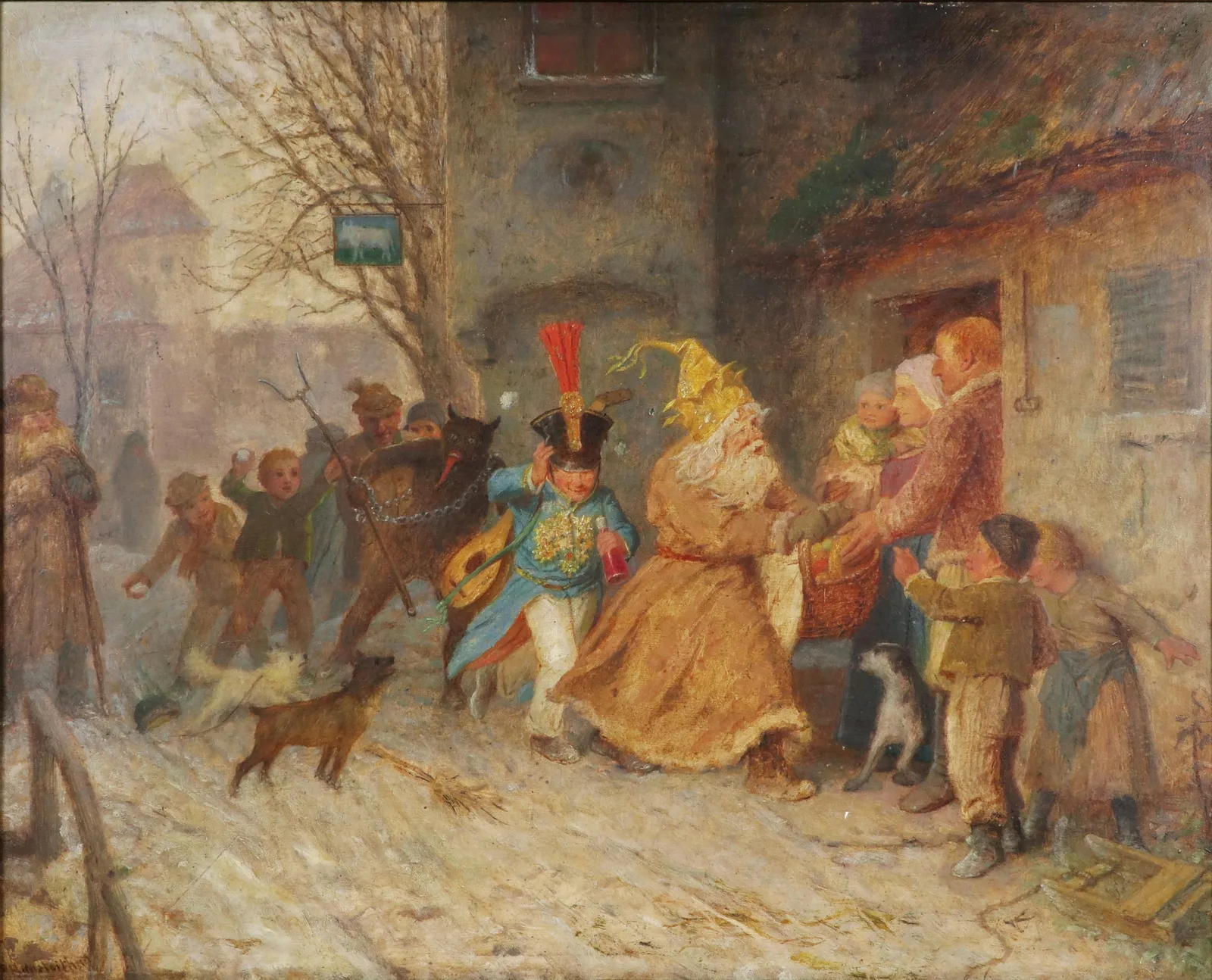
"Rudolf Hausleithner Nikolaus und Krampus" by Rudolf Hausleithner — https://commons.wikimedia.org/wiki/File:Rudolf_Hausleithner_Nikolaus_und_Krampus.jpg — Public domain (artist d. 1918; US: painted before 1918 by an artist who died in 1918, public domain whether or not it was published before 1931; EU: 70 years after the artist's death; faithful photograph of a two-dimensional painting)Krampus is billed as an ancient pagan demon, but no record of his custom predates the late 1500s. He is the horned, fur-clad companion of St. Nicholas in the Eastern Alps who punishes misbehaving children with birch rods on Krampusnacht, the evening of December 5. German Wikipedia, citing a 1983 folklore study by Hans Schuhladen, says there are no sources for the custom before the end of the 16th century. English Wikipedia says historians generally doubt a pre-Christian origin, as the figure has no record before the 16th century.
The name Krampus reaches print in the sources checked in 1856, and the first full description of Krampus at a family's door comes from 1891. In the same sources, readings of a pagan origin appear in 1891 for Knecht Ruprecht and his relatives, Krampus among them, and in 1912 for Krampus by name. None of them cites a dated record of a pre-Christian rite.
What did the earliest writers actually describe?
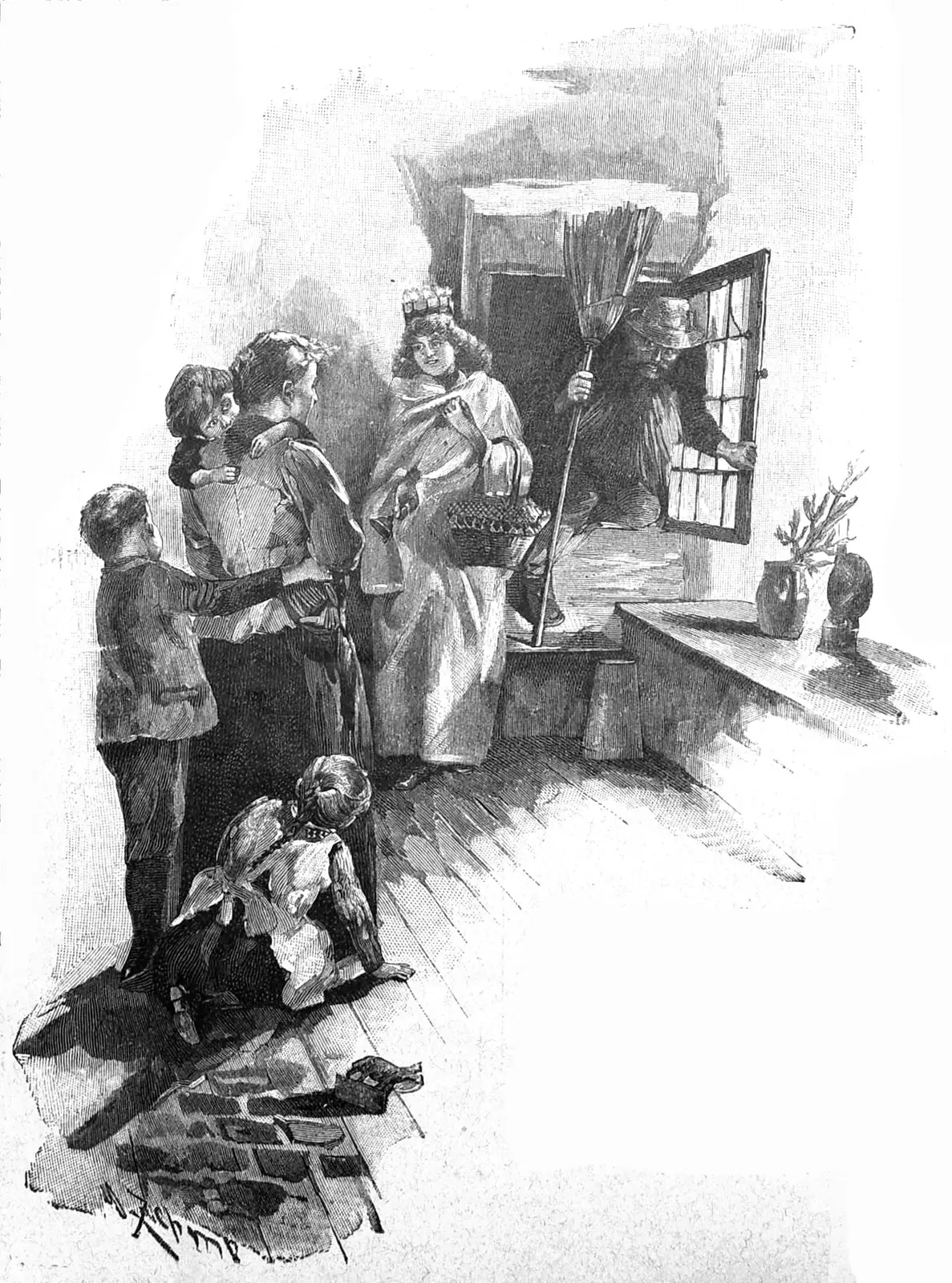
Alexander Tille's 1891 article in the Leipzig magazine Die Gartenlaube gives the fullest early picture in the sources checked: in south-western Lower Austria, he wrote, St. "Niglo" arrives with Krampus as his Schreckmann, his bogeyman. The children sing to welcome the saint. He has each child pray and show their prayer, school and writing books, and at the end each kisses his ring. The black Krampus, in a fur, with glowing eyes, a long red tongue and a big chain, stands at the door "die Befehle seines Herrn zu vollziehen," to carry out his master's orders (Translation: Where Tales Began).
Tille sorted the Christmas masks he described into two groups. He put Niglo's Krampus among the figures in which "die christliche Färbung," the Christian coloring (Translation: Where Tales Began), could not be missed. He set them apart from others, such as a bear played by a young man wrapped in pea straw, which he said survived without any trace of Christianization.
Tille's survey set Krampus among the relatives of Knecht Ruprecht, whom he took for a remnant of heathen custom. In Alsace, for one, the Christkind hands out sweets while Hans Trapp climbs in at the window in a bearskin, his face blackened with soot.
Source and licence
"Die Gartenlaube (1891) b 848" by Werner Zehme, for Die Gartenlaube (1891) — https://commons.wikimedia.org/wiki/File:Die_Gartenlaube_(1891)_b_848.jpg — Public domain (artist d. 1924 (Commons category Werner Zehme, 1859-1924); US: published 1891, before 1931; EU: 70 years after the artist's death; volunteer scan of the printed page)Clement A. Miles, writing in 1912, describes what looks like the same Lower Austrian ceremony, citing O. von Reinsberg-Düringsfeld's Das festliche Jahr. It has a hymn, prayers, lesson-books shown at the table and the kiss on the saint's ring. In his account, though, the figure at the door is called Ruprecht, and the visit falls on Christmas Eve; Krampus follows the saint in his chapter on St. Nicholas's Day. Tille's passage does not name the night.
Is Krampus pagan? The dated records, layer by layer
This entry's working unit is the first-ink date: the date of the earliest written record that can be checked, which marks where the paper evidence starts, not where a custom began (how the site dates records). Some retellings merge the Perchten records, the Krampus records and the printed pagan-origin claims. The table gives each its own layer.
| Date | Record | What it shows |
|---|---|---|
| 11th century | The Mondsee glosses have Giperchtennacht, which Johann Andreas Schmeller and Jacob Grimm read as a rendering of Epiphany (German Wikipedia, "Percht") | The word percht in ink, as part of the name of a Christian feast night |
| End of the 16th century | German Wikipedia's Krampus article, citing Hans Schuhladen (1983): no sources for the custom before this point | A limit, not a record: no earlier sources, per the folklorist cited |
| 1856 | Wurzbach's Biographisches Lexikon, vol. 1: a farce titled Staberl als Klaubauf, glossed "Klaubauf in München was bei uns Krampus" | The name in print: Munich's Klaubauf is "what we call Krampus" (Translation: Where Tales Began) |
| 1886 | Allgemeine Deutsche Biographie, vol. 23: Staberl als Krampus among the farces of the Vienna theater director Carl | The name as a play title; the play itself is undated |
| 1891 | Tille, Die Gartenlaube: Niglo and Krampus visit homes in Lower Austria | Krampus as the saint's enforcer, counted among figures with a Christian coloring |
| 1891 | Tille, same article: Knecht Ruprecht's name derived from a byname of the god Wuotan, with Krampus among the figures Tille calls Ruprecht's relatives | A pagan-origin reading in print, for Ruprecht and, through him, his relatives |
| 1892 | Die Gartenlaube: a note to Oscar Gräf's picture of a Perchten run calls Perchta the wife of Wodan | A pagan-origin reading in print, for the Perchten |
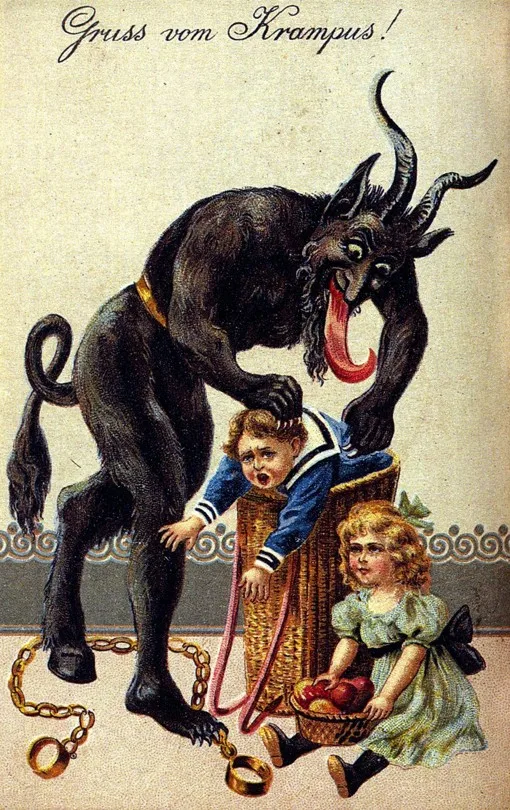
| c. 1900 | A "Gruß vom Krampus" greeting postcard (German Wikipedia's gallery) | Krampus as a greeting-card motif |
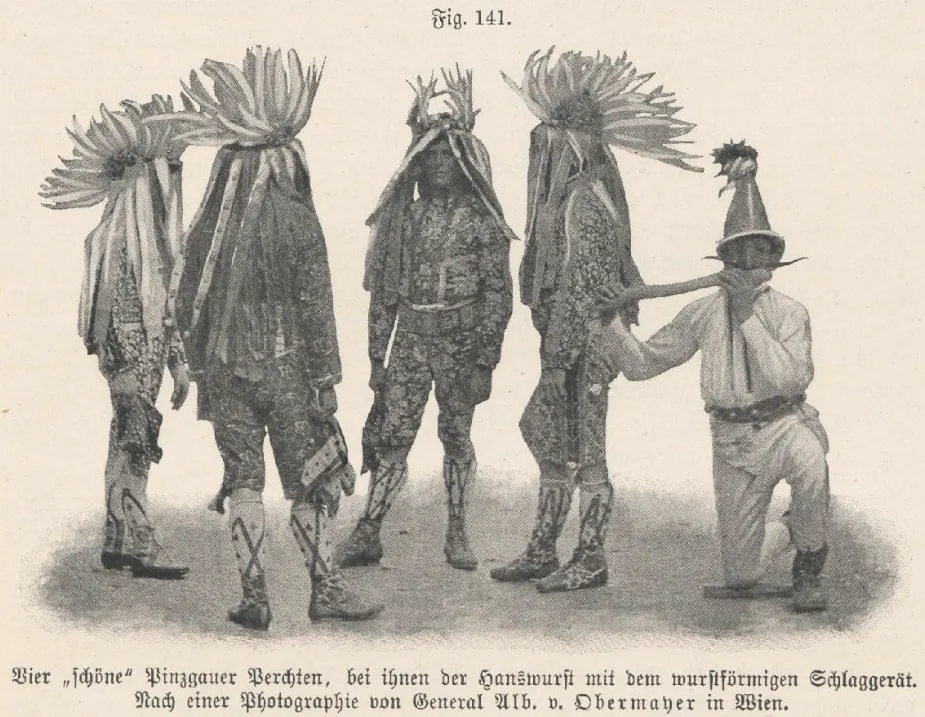
| 1910 | Marie Andree-Eysn's study of the Perchten of Salzburg pictures a carved devil mask from Mittersill and four Pinzgau Schönperchten | Perchten masks and costumes in a dated folklore study |
| 1912 | Miles judges Klaubauf, Krampus and Bartel all heathen in origin, though hard to trace in descent (paraphrased) | A pagan-origin claim that names Krampus, with no footnote |
Table data: krampus-first-ink-layers.csv, with the source and link for every row, plus the six later records charted in the section on why Krampus came back.
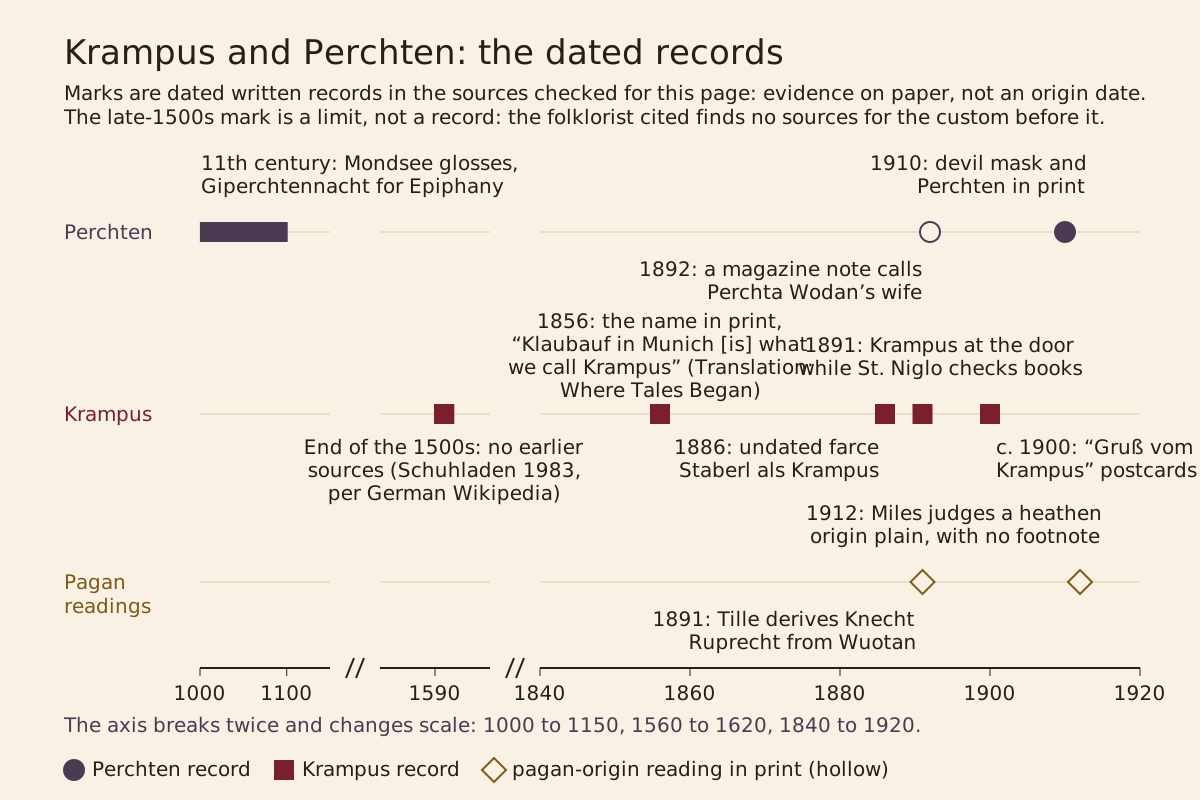
The trail of the custom goes quiet before about 1600. German Wikipedia's sentence, citing Schuhladen's 1983 study of Perchten customs in the Berchtesgaden area, Tyrol and Salzburg, reads "Es gibt keine Quellen vor Ende des 16. Jahrhunderts," there are no sources before the end of the 16th century (Translation: Where Tales Began). Schuhladen's study was not read for this page, so the date rests on that summary.
German Wikipedia's gallery dates a "Gruß vom Krampus" card to around 1900, and English Wikipedia says such Krampus cards, usually with humorous rhymes, have been exchanged since the 19th century.
Source and licence
"Gruss vom Krampus" by Unknown artist — https://commons.wikimedia.org/wiki/File:Gruss_vom_Krampus.jpg — Public domain (anonymous greeting card; date estimated at 1895-1915 from its style and the Gruss vom form (Commons gives the 1900s, German Wikipedia around 1900); EU: anonymous work, 70 years after it was made public; US: presumed published before 1931; remaining risk: first publication after 1930)Where does the "ancient pagan demon" idea come from?
In the sources checked, the pagan reading is in print by 1891, in the same article that describes Krampus at the door. Early in that article Tille pictured Yule-time performances in prehistoric times in which a series of gods appeared, while admitting in the same sentence that nothing is known of their nature. He then derived Knecht Ruprecht's name from Hruodberaht, which he called a byname of the god Wuotan.
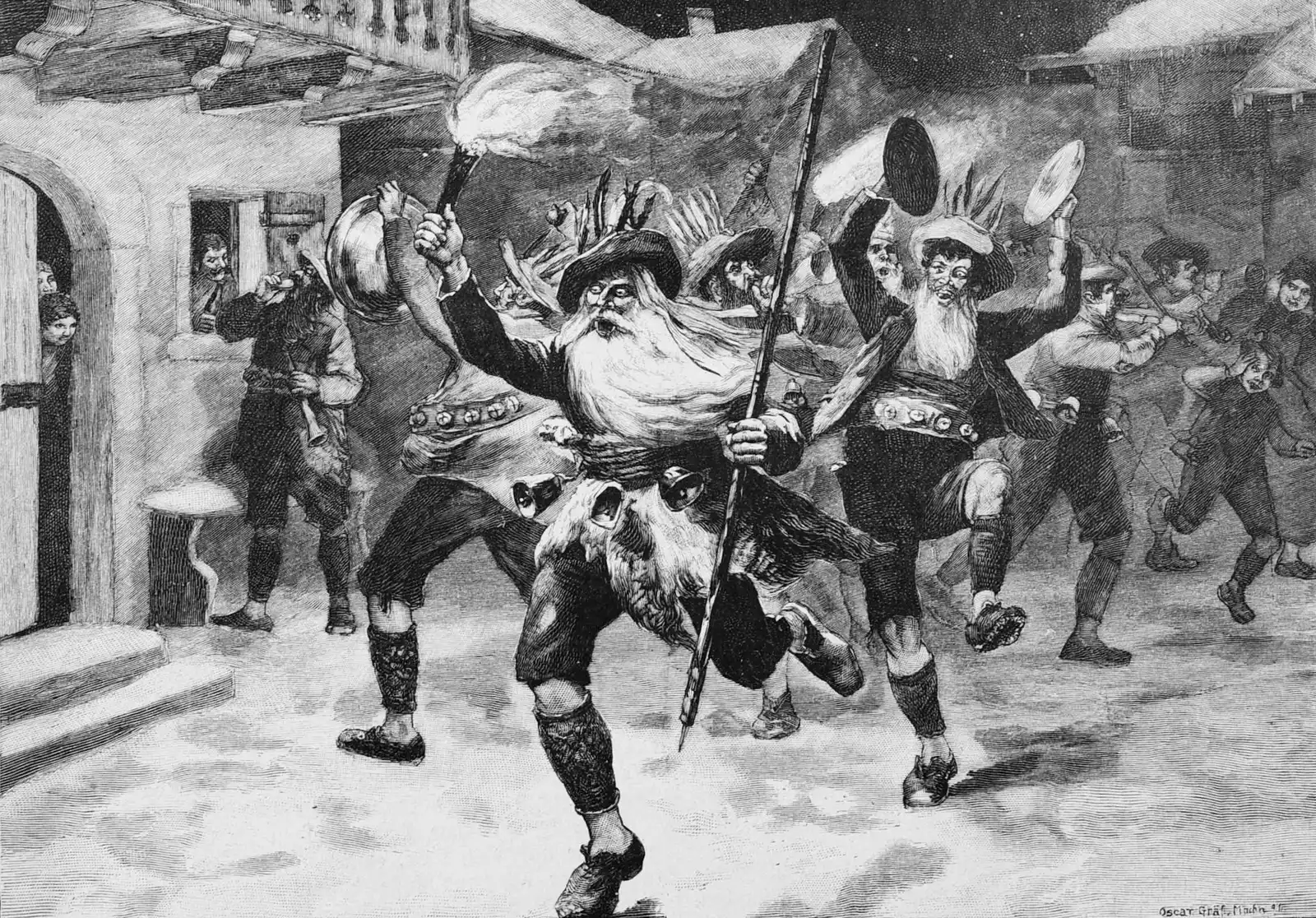
A year later, in 1892, Die Gartenlaube printed Oscar Gräf's drawing of a Perchten run in the Salzburg region with a note on Perchta. In the conception of the ancient Germans, the note says, she was "die Gemahlin Wodans," the wife of Wodan (Translation: Where Tales Began), and took part in his wild hunt.
Source and licence
"Die Gartenlaube (1892) b 841" by Oscar Gräf, for Die Gartenlaube (1892) — https://commons.wikimedia.org/wiki/File:Die_Gartenlaube_(1892)_b_841.jpg — Public domain (artist d. 1912 (Commons category Oscar Gräf, 1861-1912); US: published 1892, before 1931; EU: 70 years after the artist's death; volunteer scan of the printed page)In Christmas in Ritual and Tradition, Christian and Pagan (1912), Clement A. Miles listed the Tyrolean Klaubauf, the Lower Austrian Krampus and the Styrian Bartel. He then judged all three heathen in origin, though he granted that their descent was hard to trace. That judgment carries no footnote, but the sentences on either side cite sources. Miles also reported that Tille, in his 1899 book Yule and Christmas, dated Ruprecht only to the seventeenth century.
Popular claims and the dated record
Each claim below appears in print or online; the right-hand column gives what the sources checked show.
| Popular claim | Where it appears | What the record shows |
|---|---|---|
| Krampus comes from pre-Christian times | German Wikipedia (as of October 19, 2026), citing Forcher and Peterlini (2010), p. 399 | The same article, citing Schuhladen (1983), says there are no sources before the end of the 16th century; English Wikipedia, citing the same page of the same book, says some folklorists and anthropologists have suggested a pre-Christian origin, which historians on the whole doubt |
| Knecht Ruprecht is left over from prehistoric processions of the gods | Tille, Die Gartenlaube, 1891 | In the sentence that introduces those prehistoric performances, Tille wrote that nothing is known of their nature |
| Perchta was the wife of Wodan | Note to Oscar Gräf's picture, Die Gartenlaube, 1892 | German Wikipedia's article on the Perchten says it is unclear where Perchta herself comes from |
| The Perchten's bells drive out the evil spirits of winter | German Wikipedia, which labels it a popular interpretation | The same article calls it disputed how far the Perchten runs go back to pagan customs |
| Austria's government handed out "Krampus Is an Evil Man" pamphlets in the 1950s | English Wikipedia, citing Time (December 7, 1953) | Not verified here; the Time report could not be read for this page |
| The Krampus tradition was banned in 1930s Austria | English Wikipedia, citing The New York Times (December 23, 1934) | Not verified here; the newspaper report was not read for this page |
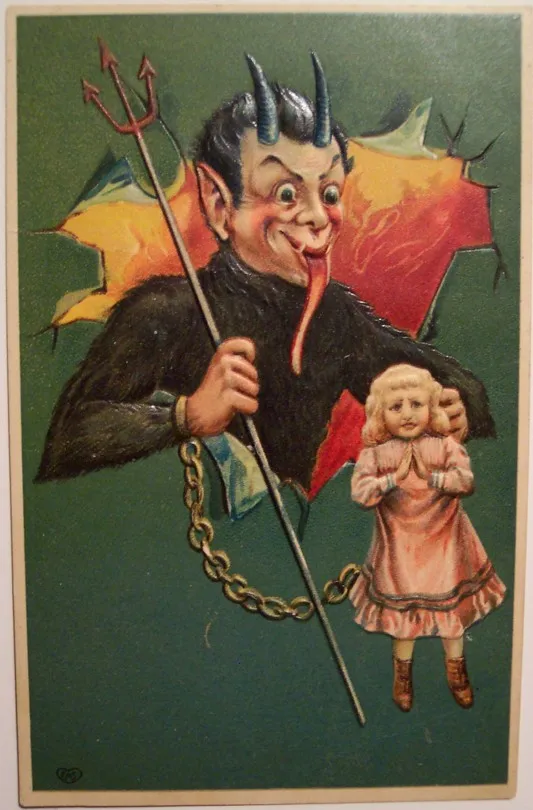
German Wikipedia says Krampus resembles the devil as well as the mythical and animal figures of the Schiachperchten. English Wikipedia reports a reading of his chains as a sign that the Church bound the Devil.
Source and licence
"Krampus 1900s 3" by Unknown artist — https://commons.wikimedia.org/wiki/File:Krampus_1900s_3.jpg — Public domain (anonymous postcard dated to the 1900s on its Commons page; EU: anonymous work, 70 years after it was made public; US: presumed published before 1931; remaining risk: first publication after 1930)Krampus vs. Perchten: what is the difference?
The two share masks, fur and bells, but the sources checked keep them apart. German Wikipedia's Krampus article places Krampus with St. Nicholas and says he belongs only to Advent, while the frightening Schiachperchten run in the Rauhnächte, the rough nights of midwinter. Its article on the Perchten puts them between Christmas Eve and Epiphany and divides them into the good Schönperchten and the bad Schiachperchten.
German Wikipedia connects the Perchten, probably, with Perchta, a figure of legend, and traces the word to Middle High German berchttac, the medieval name for the feast of Epiphany. For Krampus it gives two derivations: Middle High German Krampen, meaning claw, or Bavarian Krampn, something lifeless or withered.
On the ground the line blurs. German Wikipedia says the Krampus figure has become mixed with Perchten customs in many regions, and that some groups around Passau now merge the two into figures modeled on fantasy films. The word percht is older in ink than the name Krampus: the table above puts it in an 11th-century name for Epiphany night.
Source and licence
"Andree-Eysn(1910)-p173-fig141-Schöne-Pinzgauer-Perchten" by Albert von Obermayer, in Marie Andree-Eysn, Volkskundliches aus dem bayrisch-österreichischen Alpengebiet (1910) — https://commons.wikimedia.org/wiki/File:Andree-Eysn(1910)-p173-fig141-Sch%C3%B6ne-Pinzgauer-Perchten.png — Public domain (photographer d. 1915 (Commons category Albert von Obermayer, 1844-1915) and author d. 1929; US: published 1910, before 1931; EU: 70 years after both deaths; faithful scan of the printed plate)Who else walks with St. Nicholas?
Krampus is one of several figures who walk with a gift-bringer; the entry on Christmas traditions follows the St. Nicholas visit into the wider season. A shared job does not prove a shared ancestor, so this table only lines up what each record says.
| Companion | Where, and with whom | Recorded detail | Source |
|---|---|---|---|
| Krampus | Eastern Alps, with St. Nicholas | Usually appears in groups | German Wikipedia |
| Knecht Ruprecht | Northern and western Germany | Usually appears alone | German Wikipedia |
| Schmutzli | Switzerland, with St. Nicholas | Carries a sack and wears a belt of small bells instead of cowbells | German Wikipedia |
| Klaubauf | Tyrol; Munich | Horned and shaggy, with clanking chains (Tyrol); the Munich name for Krampus (1856) | Miles 1912; Wurzbach 1856 |
| Bartel / Bartl | Styria, Carinthia | A short form of Bartholomew | Miles 1912; German Wikipedia |
| Parkelj | Slovenia, with Miklavž | Companion of the Slovenian St. Nicholas | English Wikipedia |
| Hans Trapp | Alsace, with the Christkind | Bearskin, soot-blackened face, a broom-like rod (1891) | Tille 1891 |
| Pelzmärtel | Swabia, with the Christkind | Pea straw, a chain around the body, a basket on the back (1891) | Tille 1891 |
Tille's survey also records a Ruprecht who was three people at once. On the island of Usedom the three went about together under that name: one wrapped in pea straw with a rod and an ash sack, one carrying the Klapperbock, one riding a broom. The Klapperbock was a pole draped in goat hide, with a wooden ram's head, and its lower jaw clacked shut when a string was pulled. It butted children who could not say their prayers.
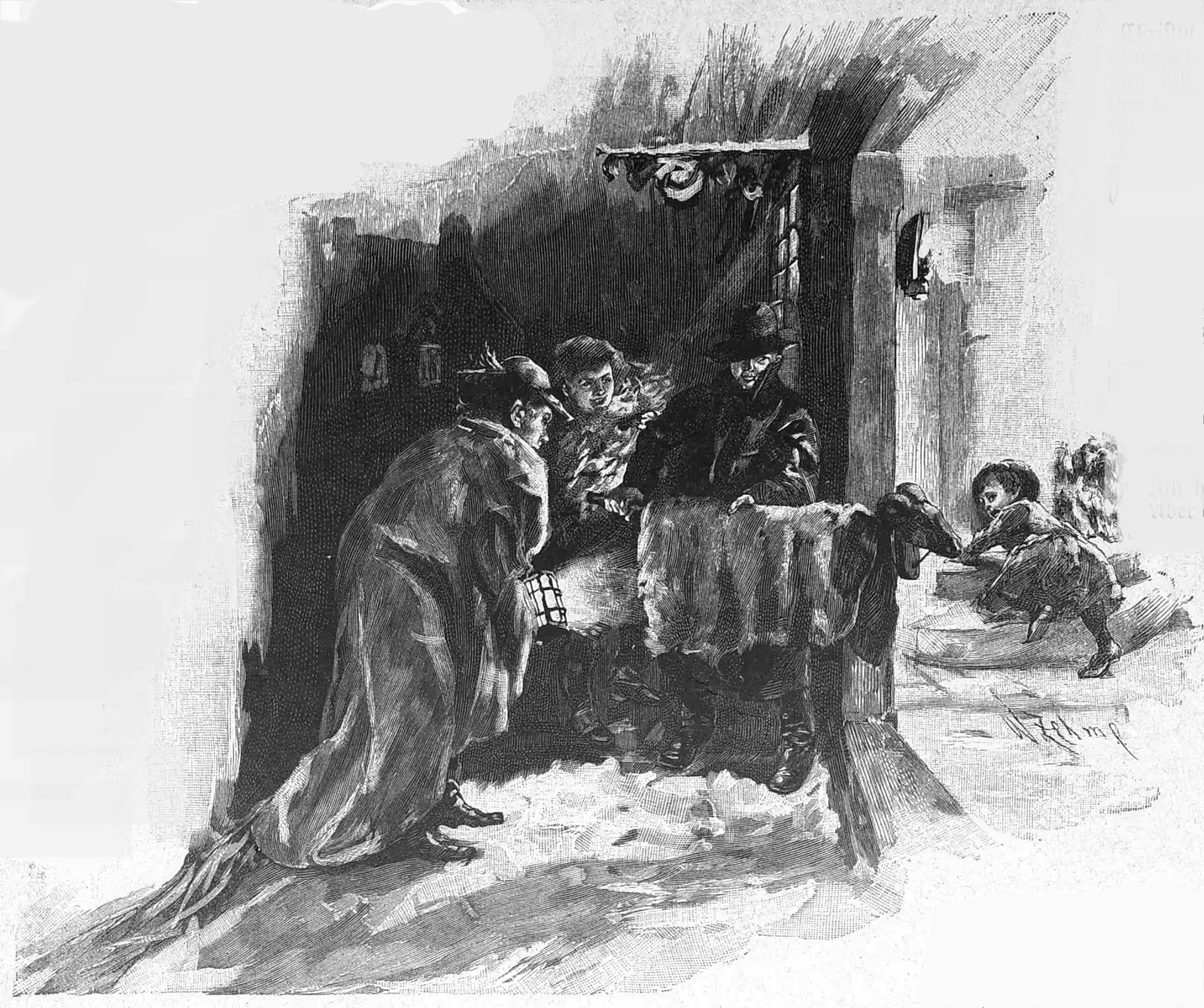
Source and licence
"Die Gartenlaube (1891) b 850 1" by Werner Zehme, for Die Gartenlaube (1891) — https://commons.wikimedia.org/wiki/File:Die_Gartenlaube_(1891)_b_850_1.jpg — Public domain (artist d. 1924 (Commons category Werner Zehme, 1859-1924); US: published 1891, before 1931; EU: 70 years after the artist's death; volunteer scan of the printed page)A figure who threatens children also turns up far from the Alps. "The Baba Yaga" is a tale from Alexander Afanasyev's collection, in W. R. S. Ralston's English version of 1873. In it, Baba Yaga tells her servant to wash a girl who has come to borrow a needle and thread: "I want to breakfast off her." She belongs to tales rather than to a December visit, and the two are set side by side here with no claim that either comes from the other.
Why Krampus counts as an orphan rite
An orphan rite is a custom or ritual that is still carried on but whose early origin cannot be settled within the records an entry studies; the word describes the paper trail, not the people. The records studied here are the ones in the Sources list below, and within them Krampus fits. The table keeps three kinds of evidence apart, so that this site's reading of the records does not replace the practitioners' own.
| Historical origin | What practitioners say | Explanations in circulation |
|---|---|---|
| The records begin late: German Wikipedia, citing Schuhladen (1983), says there are no sources for the custom before the end of the 16th century | English Wikipedia, quoting Honigmann's 1977 study, reports that people in Irdning, a small Styrian town he observed in 1975, saw heathen elements blended with Christian ones in their St. Nicholas customs and believed Krampus came from a pagan spirit absorbed into the Christian devil | A pre-Christian origin: German Wikipedia, citing Forcher and Peterlini (2010); English Wikipedia, citing the same page, says some folklorists and anthropologists have suggested it, while historians on the whole doubt it |
| 1856: the name in print in an Austrian lexicon (Wurzbach) | — | Knecht Ruprecht as a survival of the god Wuotan, with Krampus among his relatives (Tille, 1891); Perchta as the wife of Wodan (Die Gartenlaube, 1892) |
| 1891: Krampus as the saint's enforcer in Lower Austria, counted by Tille among the figures with a Christian coloring | — | A heathen origin for Klaubauf, Krampus and Bartel, judged plain but hard to trace in detail (Miles, 1912) |
| Not found in the records studied: any document tying Krampus to a named pre-Christian god or rite | — | Perchten bells that drive out the evil spirits of winter, labeled a popular interpretation by German Wikipedia |
Marie Andree-Eysn's 1910 study of the Perchten of Salzburg shows the kind of object the masked runs left behind. Her figure 131 is a devil mask from Mittersill, then in the Museum zu Salzburg, carved in wood with its horns to a height of 45 centimeters. It is painted black, with red lips, nostrils and eye rims, gilded in places, and a slit beside the staring eyes let the wearer look out. The caption calls it a devil mask and does not name Krampus.
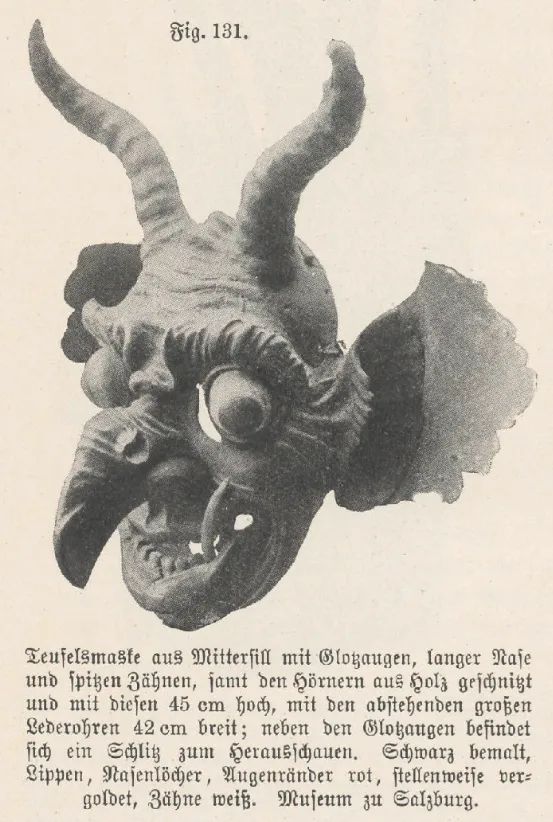
Source and licence
"Andree-Eysn(1910)-p168-fig131-Teufelmaske-aus-Mittersill" by Marie Andree-Eysn, Volkskundliches aus dem bayrisch-österreichischen Alpengebiet (1910) — https://commons.wikimedia.org/wiki/File:Andree-Eysn(1910)-p168-fig131-Teufelmaske-aus-Mittersill.png — Public domain (author d. 1929; US: published 1910, before 1931; EU: 70 years after the author's death; the mask itself is an anonymous carving older than the 1910 book; faithful scan of the printed plate)Why did Krampus come back?
The records checked for this page date Krampus's modern history but do not explain it. A ban in the 1930s and pamphlets titled "Krampus Is an Evil Man" in the 1950s are known here only through English Wikipedia, which cites The New York Times and Time. Neither report could be read, so both are marked unverified in the chart below.
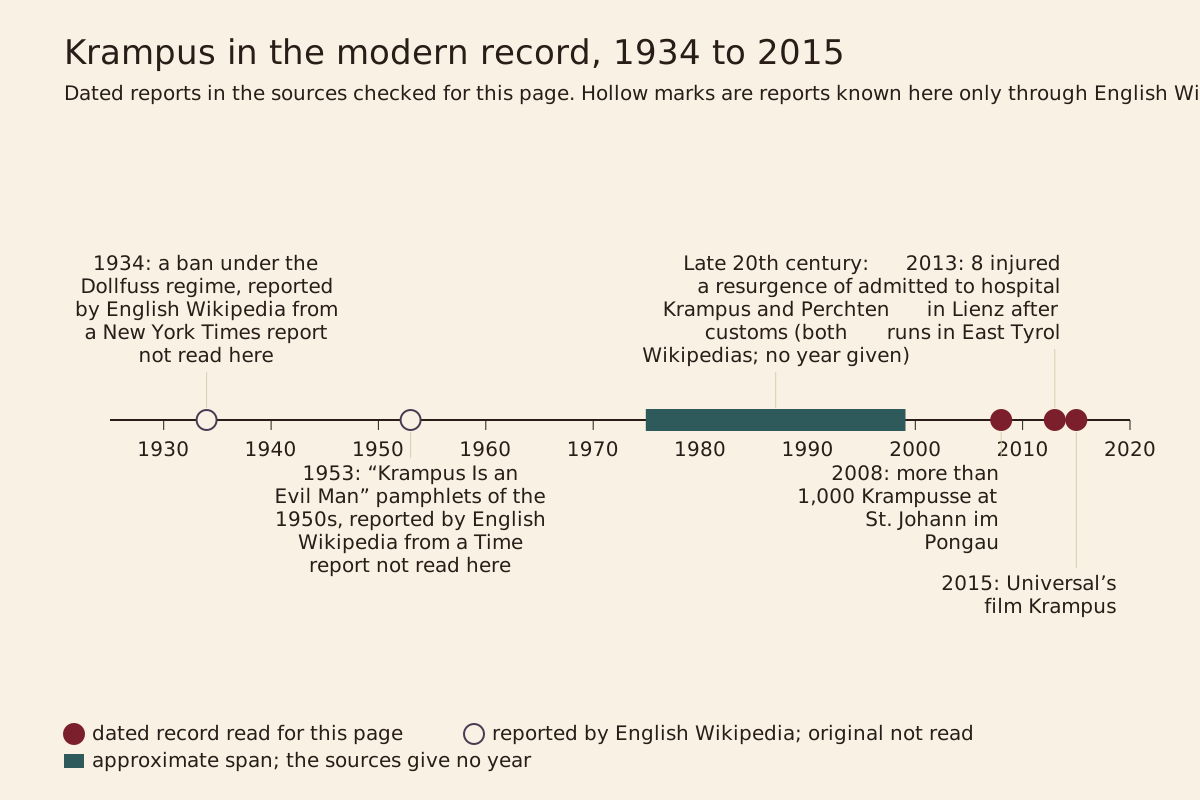
Then the celebrations grew again. English Wikipedia reports a popular resurgence of Krampus celebrations toward the end of the 20th century. German Wikipedia's article on the Perchten ties an earlier revival of those customs to secularization and new attitudes to folk culture in the 19th century. It records another revival toward the end of the 20th.
German Wikipedia counts the run at St. Johann im Pongau, with more than 1,000 Krampusse in 2008, among the largest. After several Krampus runs in East Tyrol in 2013, it reports, eight injured people were admitted to the hospital in Lienz. More than 60 others were treated as outpatients. In 2015 Universal Pictures released a horror comedy called Krampus, and German Wikipedia sets that film's child-killing title figure apart from the Alpine Krampus it describes.
Krampus questions, answered
When is Krampusnacht in 2026?
Krampusnacht is the evening of December 5, the eve of St. Nicholas Day on December 6. In 2026, December 5 falls on a Saturday, by this page's calendar count. German Wikipedia says the pair usually appears that evening and sometimes on December 6; in Austria's Gastein valley, groups called Passen go from house to house on both days. Krampusnacht keeps the same date every year, unlike Easter, whose date has to be calculated.
Is Krampus from Norse mythology?
No source checked for this page ties Krampus by name to Norse mythology. In Snorri Sturluson's Prose Edda, read here in Rasmus B. Anderson's English version (1879; 1901 printing), Hel is the daughter of Loki and the giantess Angerboda. Alfather casts her into Niflheim, where she has a hall called Eljudner, with a man-servant and a maid-servant; the passage names no son and does not mention Krampus. Snorri lived from 1178 to 1241, by Anderson's account.
Is Krampus the same as a Perchte?
Not quite. In German Wikipedia's account Krampus walks with St. Nicholas and belongs only to Advent, while the frightening Schiachperchten run in the Rauhnächte, the rough nights of midwinter, though in many regions the two customs have mixed.
Was Krampus ever banned?
English Wikipedia says the Dollfuss regime prohibited the Krampus tradition after Austria's 1932 election, citing a New York Times report of December 23, 1934. That report was not read for this page, so the ban is unverified here. The same article says Perchten runs were banned by some civil authorities, without giving dates.
Earliest ink
- Krampus, by name: 1856. Constant von Wurzbach, Biographisches Lexikon des Kaiserthums Oesterreich, vol. 1, entry "Bernbrunn, Carl," p. 328 (Wikisource): the earliest dated print use in the sources checked; archives not searched for this page may hold earlier ones.
- Undated lead: the farce Staberl als Krampus, in the Allgemeine Deutsche Biographie entry on Johann Nestroy (vol. 23, 1886) (Wikisource); Wurzbach dates Carl's death to 1854.
- Krampus with St. Nicholas, described: 1891. Alexander Tille, "Mummenschanz der deutschen Weihnacht," Die Gartenlaube, Heft 50, pp. 848–851 (Wikisource).
- The custom: no sources before the end of the 16th century. Hans Schuhladen (1983), as cited by German Wikipedia; the study itself was not read for this page.
- The word percht as a night's name: 11th century. The Mondsee glosses' Giperchtennacht, as dated by German Wikipedia, which reports that Schmeller and Grimm read it as Epiphany.
- How these dates are scoped: first-ink date.
Sources checked through 2026-10-19.
Where the trail goes next
- Follow the season: Christmas Traditions dates the other customs of the season, from a Roman list of 354 to the red suits of 1902.
- Meet another figure who threatens children: Baba Yaga, the witch of Afanasyev's Russian tales, is set against the tale texts in the same way.
- Read the 1891 visit in German: Tille's "Mummenschanz der deutschen Weihnacht" is on Wikisource.
Cite this page
Where Tales Began. “Krampus: A 'Pagan' Christmas Devil With No Pagan Paper Trail.” First published October 20, 2026; last substantive revision October 20, 2026. https://wheretalesbegan.com/festivals/krampus/. Accessed: add the date you read this page.
- Author
- Where Tales Began
- Title
- Krampus: A 'Pagan' Christmas Devil With No Pagan Paper Trail
- Published
- Revised
- Address
- https://wheretalesbegan.com/festivals/krampus/
Sources
- Alexander Tille, "Mummenschanz der deutschen Weihnacht," Die Gartenlaube (1891), Heft 50, pp. 848–851, with drawings by Werner Zehme; Wikisource transcription (read 2026-10-19). de.wikisource.org/wiki/Mummenschanz_der_deutschen_Weihnacht Read: full text, Heft 50, pp. 848–851, with the picture captions
- Constant von Wurzbach, "Bernbrunn, Carl," Biographisches Lexikon des Kaiserthums Oesterreich, vol. 1 (1856), pp. 327–331 (quoted line on p. 328); Wikisource transcription (read 2026-10-19). de.wikisource.org/wiki/BLK%C3%96:Bernbrunn,_Carl Read: full entry, vol. 1 (1856), pp. 327–331
- Richard Maria Werner, "Nestroy, Johann," Allgemeine Deutsche Biographie, vol. 23 (1886), pp. 447–455; Wikisource transcription (read 2026-10-19). de.wikisource.org/wiki/ADB:Nestroy,_Johann Read: full entry; the Staberl titles on p. 449
- "Das Perchtenlaufen," note to Oscar Gräf's picture "Das Perchtenlaufen im Salzburgischen" (p. 841), Die Gartenlaube (1892), p. 869; Wikisource transcription (read 2026-10-19). de.wikisource.org/wiki/Seite:Die_Gartenlaube_(1892)_869.jpg Read: p. 841 (picture caption) and p. 869 (the note's opening)
- Marie Andree-Eysn, "Die Perchten im Salzburgischen," in Volkskundliches aus dem bayrisch-österreichischen Alpengebiet (Braunschweig: Friedrich Vieweg, 1910), pp. 156–184, figs. 131 and 141. commons.wikimedia.org/wiki/File:Andree-Eysn(1910)-p168-fig131-Teufelmaske-aus-Mittersill.png Read: captions to figs. 131 (p. 168) and 141 (p. 173), as printed on the plate scans
- Clement A. Miles, Christmas in Ritual and Tradition, Christian and Pagan (1912), chs. VIII and IX and notes; Project Gutenberg eBook #19098. www.gutenberg.org/ebooks/19098 Read: ch. VIII (pp. 219–220), ch. IX (pp. 231–232) and the notes to both; paraphrased here
- Snorri Sturluson, The Younger Edda (Prose Edda), trans. Rasmus B. Anderson (1879; 1901 printing), "The Fooling of Gylfe" (Gylfaginning), ch. 34, and introduction; Project Gutenberg eBook #18947. www.gutenberg.org/ebooks/18947 Read: ch. 34 and the introduction (1901 printing)
- W. R. S. Ralston, Russian Folk-Tales (1873), "The Baba Yaga" (from Afanasyev, vol. i, no. 3b) and the commentary around it; Project Gutenberg eBook #22373 (Hurst & Co. reprint, Russian Fairy Tales: A Choice Collection of Muscovite Folk-lore). www.gutenberg.org/ebooks/22373 Read: the tale "The Baba Yaga" with its note, and the preface
- German Wikipedia, "Krampus" (read 2026-10-19). de.wikipedia.org/wiki/Krampus Read: full article, revision of March 15, 2026
- German Wikipedia, "Percht" (read 2026-10-19). de.wikipedia.org/wiki/Percht Read: full article, revision of July 9, 2026
- English Wikipedia, "Krampus" (read 2026-10-19). en.wikipedia.org/wiki/Krampus Read: full article, revision of September 27, 2026
- John J. Honigmann, "The Masked Face," Ethos 5, no. 3 (1977): 263–280. doi.org/10.1525/eth.1977.5.3.02a00020 Read: bibliographic record only; summarized here through English Wikipedia

