Deep dive
Date of Easter: The Rule Follows a Table Moon, Not the Sky
- By
- Where Tales Began
- Published
- Last substantive revision
How records are checked: Following the paper trail. Corrections: Fixes to the record. Questions: Contact us.
Fast facts
- Name
- Date of Easter (the computus, or Easter reckoning)
- Classification
- Moveable feast set by church tables: Gregorian in the West, Julian for most Orthodox churches
- When
- Easter Sunday 2027: March 28 (Western), May 2 (Orthodox)
- Earliest ink
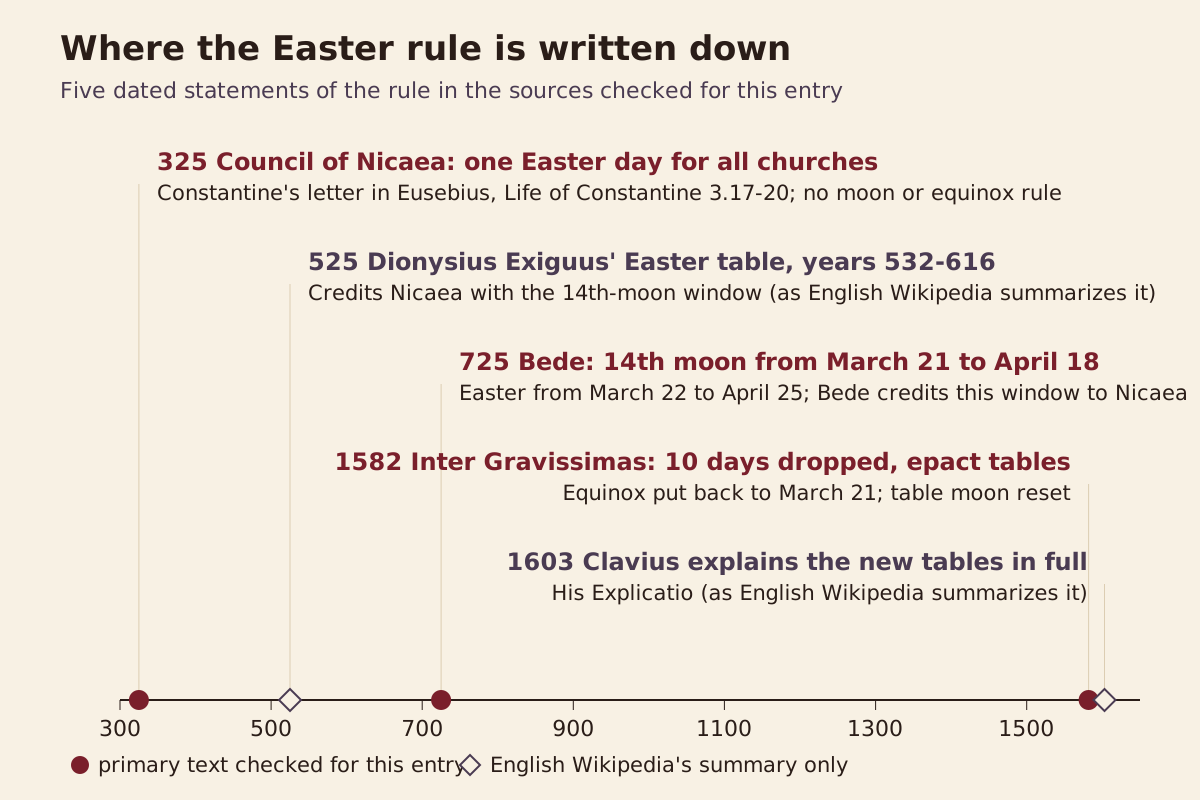
- One day for all churches: Constantine's letter of 325, in Eusebius. Full table rule: Bede, 725 (sources checked)
- Where found
- Western churches use the Gregorian table; most Orthodox churches keep the Julian table
- TL;DR
- Easter is the Sunday after the 14th day of a moon counted in a church table, on or after March 21. The table moon only approximates the sky's full moon, so in some years Easter lands weeks away from a date taken from the sky. In 2027 Western Easter is March 28 and Orthodox Easter is May 2.
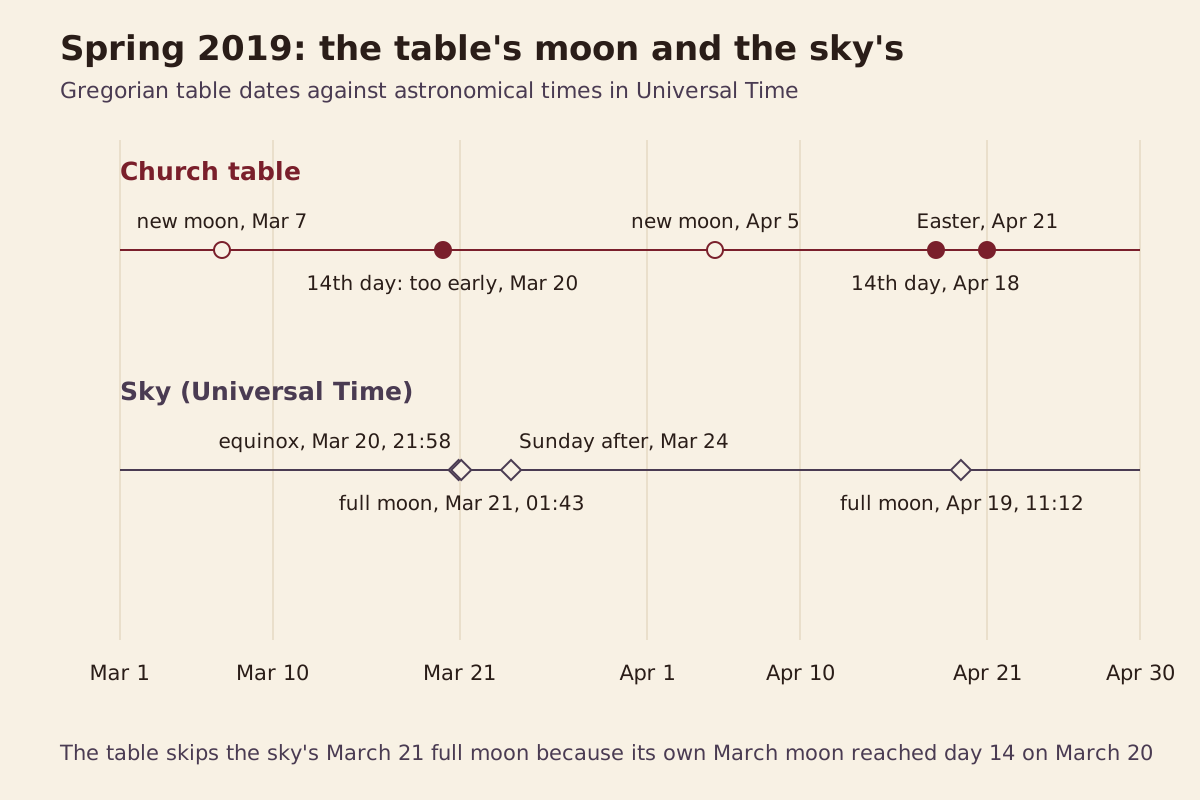
In 2019 a full moon came hours after the March equinox, yet Easter fell a month later. The reason is that Easter follows a moon kept in a church table, not the moon in the sky. For 2027 the table gives Easter Sunday as March 28 in Western churches and May 2 in most Orthodox churches.
The rule itself is short. Easter is the first Sunday after the paschal full moon, which is the 14th day of a table moon falling on or after March 21. The table treats March 21 as the spring equinox. In 2019 the table's March moon reached its 14th day on March 20, one day too early.
So the count moved on to the next table moon. Its 14th day was April 18. Easter fell on April 21. In the sky, the moon had been full at 01:43 Universal Time on March 21, after the equinox at 21:58 on March 20, by this page's recomputation.
The rule, and what Nicaea actually recorded
The Council of Nicaea met in 325. Its Easter decision survives in a letter that the emperor Constantine sent to the churches afterward. Eusebius of Caesarea copied the letter into his Life of Constantine (3.17–20), a book left unfinished at his death in 339, as English Wikipedia's article on the book notes. In Ivar Heikel's 1902 Greek edition the decision reads:
ἔδοξε κοινῇ γνώμῃ καλῶς ἔχειν ἐπὶ μιᾶς ἡμέρας πάντας τοὺς ἁπανταχοῦ (Eusebius, Life of Constantine 3.18, ed. Heikel, 1902)
In English: "it seemed right, by common judgment, for all people everywhere [to keep it] on one day" (Translation: Where Tales Began). Much of the rest of the letter is a polemic against setting the date by the Jewish reckoning. That reckoning, the letter objects, could put the feast twice in one year. It points instead to the practice of Rome, Italy, Africa, Egypt, Spain, Gaul, Britain, Libya, Greece, Asia, Pontus and Cilicia.
The letter names no full moon, no equinox and no rule about Sundays. English Wikipedia's "Computus" article reads the council the same way: Nicaea set no explicit rule for finding the date. Dionysius Exiguus published an Easter table in 525 and presented it as following the fathers of Nicaea, the same article reports.
Bede's full rule, on record by 725
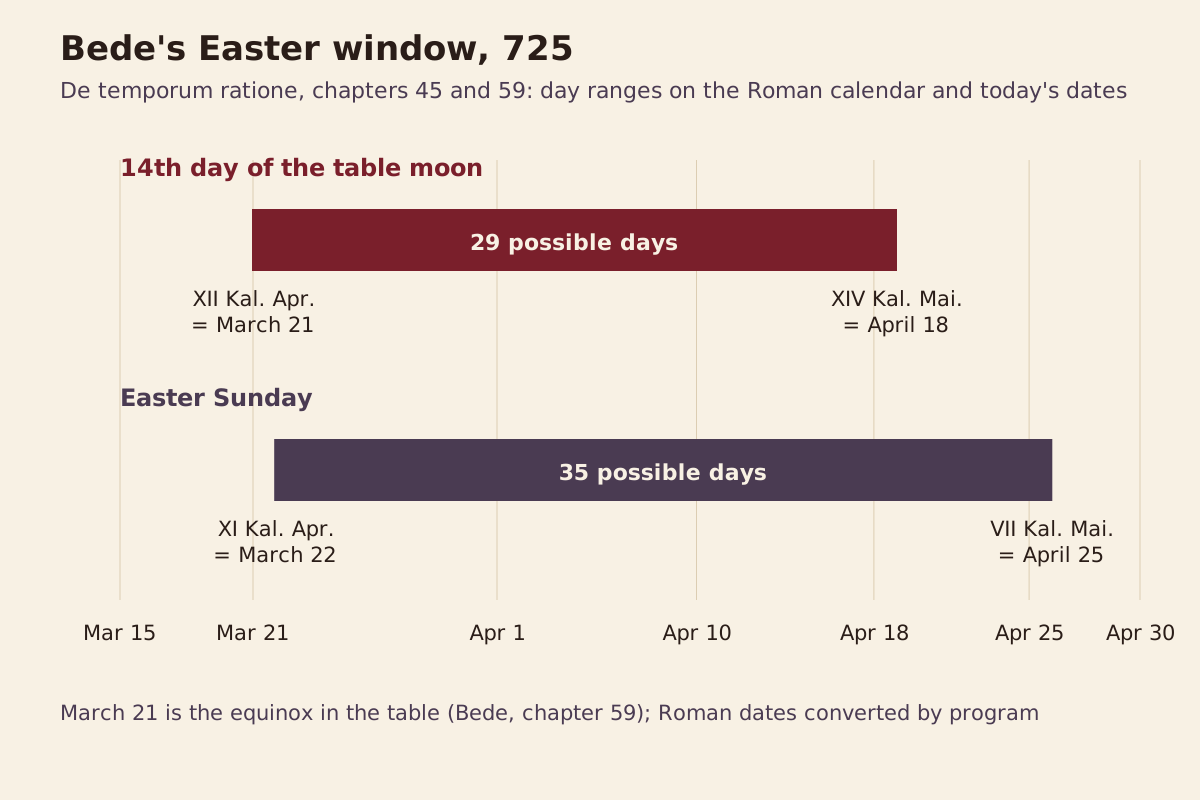
The full rule is on record by 725. Bede gives that year as the current one in a worked example in De temporum ratione (The Reckoning of Time, chapter 49). Chapter 59 places the 14th moon of the first month between March 21 and April 18, just after stating the rule:
quae post XIIII lunam Dominica dies occurrit, ipsa est paschalis dominicae resurrectionis dies (Bede, De temporum ratione 59, ed. Migne, Patrologia Latina 90)
That is, "the Sunday that comes after the 14th moon is the Easter day of the Lord's resurrection" (Translation: Where Tales Began). In chapter 30 Bede ties the Easter window to Nicaea:
regula tenet ecclesiasticae observationis, a Nicaeno confirmata concilio, ut Paschae dies ab XI Calendas Apriles usque in VII Calendas Maias inquiratur (Bede, De temporum ratione 30, ed. Migne)
In English: "the rule of church observance, confirmed by the Council of Nicaea, holds that Easter Day is to be sought from the eleventh day before the Kalends of April to the seventh before the Kalends of May" (Translation: Where Tales Began), that is, from March 22 to April 25. In the sources checked for this page, Bede's is the earliest text that ties this Easter Sunday window to Nicaea. English Wikipedia's "Computus" article reports an earlier claim for the 14th moon: in the letter that introduced his table, Dionysius credited the council with a window of March 21 to April 18. Bede wrote about four centuries after the council.
A table moon, not the sky's
The table's full moon is a count of days, not a sighting. Bede calls it the decima quarta luna, the 14th day of the table's lunar month (chapter 59), and the Gregorian tables of 1582 keep that 14th day. English Wikipedia's "Computus" article calls it the day on which the real full moon is most likely to fall. That leaves room for misses.
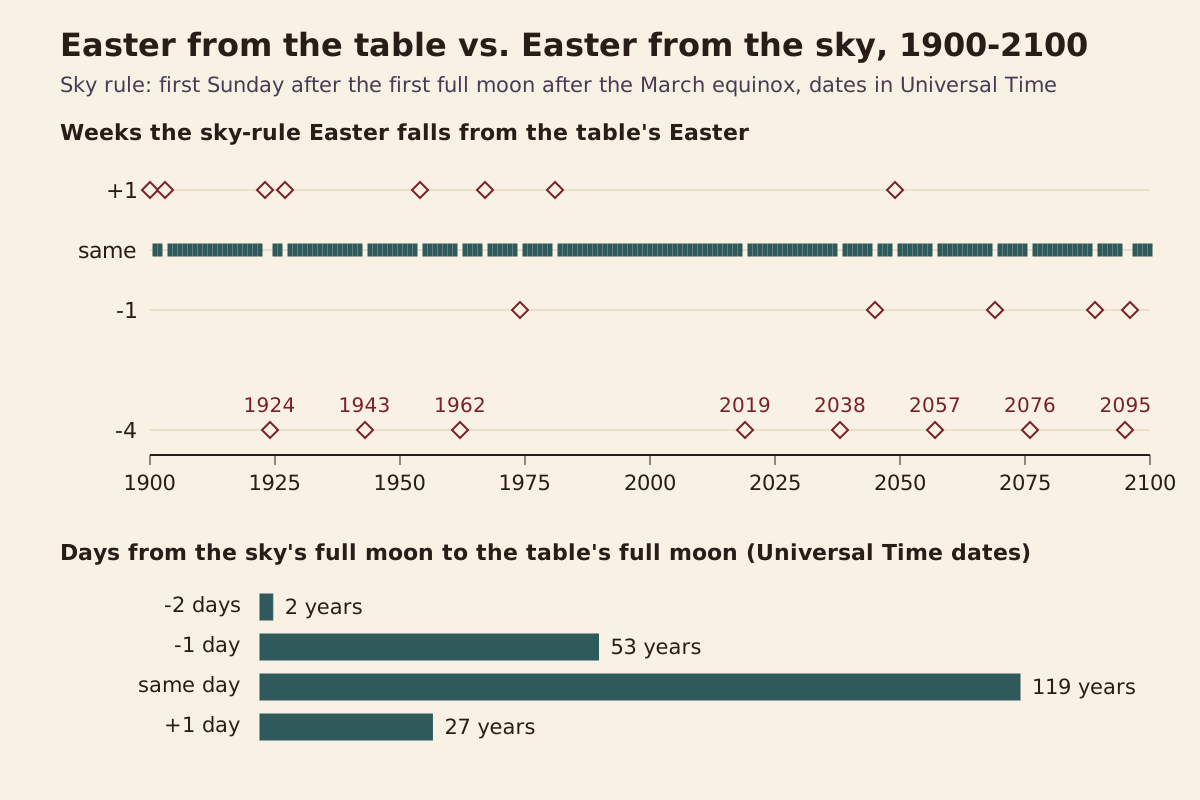
Recomputed for 1900 to 2100, the table's full moon falls on the same Universal Time date as the astronomical full moon in 119 of the 201 years, by this page's count. It falls one day earlier in 53 years, two days earlier in 2 and one day later in 27. The full-moon times agree to within a minute with the moon-phase tables of Fred Espenak at NASA's Goddard Space Flight Center. What a recomputation of this kind proves, and what it does not, is set out in Following the Paper Trail.
What a sky rule would change
A rule taken from the sky gives a different Easter in 21 of the 201 years from 1900 to 2100. Here that rule means the first Sunday after the first full moon after the March equinox, with dates in Universal Time. In 8 of the 21 years the sky's Easter comes four weeks earlier, as in 2019 and 2038, and in the other 13 it moves by one week. The clock chosen matters at the edges: with Jerusalem time instead, 1998 joins the list.
Source and licence
"Easter from the Gregorian table compared with a rule taken from the sky, 1900-2100" by Where Tales Began, https://wheretalesbegan.com/festivals/easter-date/, licensed under CC BY 4.0 (https://creativecommons.org/licenses/by/4.0/)The sky has been tried before. English Wikipedia's "Computus" article records that Denmark and the Protestant states of the Holy Roman Empire took Easter from astronomical tables from 1700 and adopted the Gregorian rules in 1776. It also records a 1997 World Council of Churches consultation in Aleppo that proposed an astronomical Easter at the meridian of Jerusalem, which no church adopted. For 2000 to 2025 that proposal would have moved only the Easter of 2019, the article says, and this page's recomputation agrees.
The year-by-year figures, with equinox and full-moon times, are in easter-date-table-vs-sky.csv. Hesiod's farm calendar, by contrast, reads the sky directly: "When the Pleiades, daughters of Atlas, are rising, begin your harvest, and your ploughing when they are going to set" (Works and Days, H. G. Evelyn-White's 1914 translation). That star cluster has its own entry, the Pleiades.
The calculation, step by step
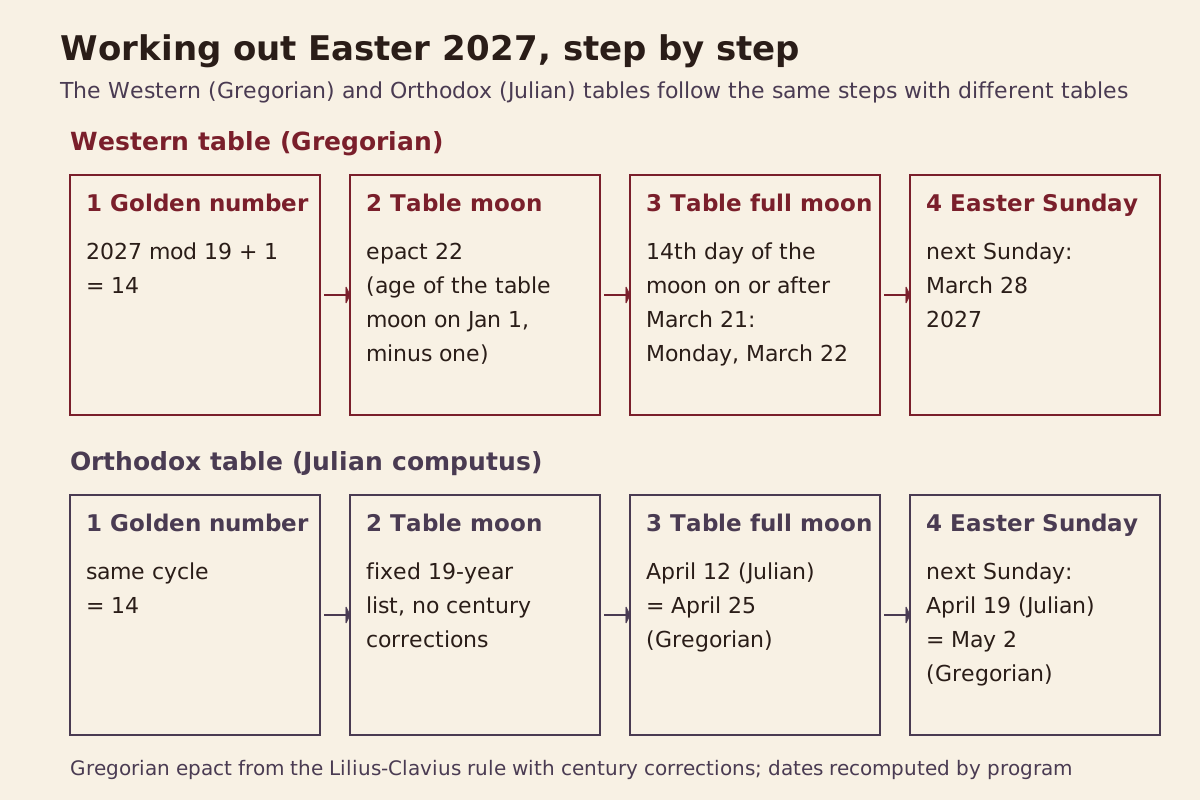
The table can be worked out in four steps. Here is 2027 in the Western, Gregorian reckoning.
- 1. Golden number. Divide the year by 19 and add 1 to the remainder. For 2027 the result is 14. The number places the year in a 19-year cycle in which 235 lunar months come close to 19 solar years, as English Wikipedia's "Computus" article explains.
- 2. Epact. The epact is the age of the table moon on January 1, less one day. Twelve lunar months fall about 11 days short of the calendar year, so the epact grows by about 11 each year. The Gregorian table also adjusts it in some century years. For 2027 the epact is 22.
- 3. Paschal full moon. Find the first 14th day of a table moon on or after March 21. With epact 22, the table's March new moon falls on March 9, so its 14th day is Monday, March 22, 2027.
- 4. Easter. Take the Sunday after that day. If the 14th day is itself a Sunday, wait a week, as Bede's chapter 61 sets out. For 2027 the answer is Sunday, March 28.
The Orthodox reckoning runs the same steps on an older table with no century corrections. For golden number 14, its full moon is April 12 in the Julian calendar. The next Sunday is April 19 in the Julian calendar. In 2027 the Julian calendar runs 13 days behind the Gregorian, so that Sunday is May 2.
A ready-made table in a prayer book
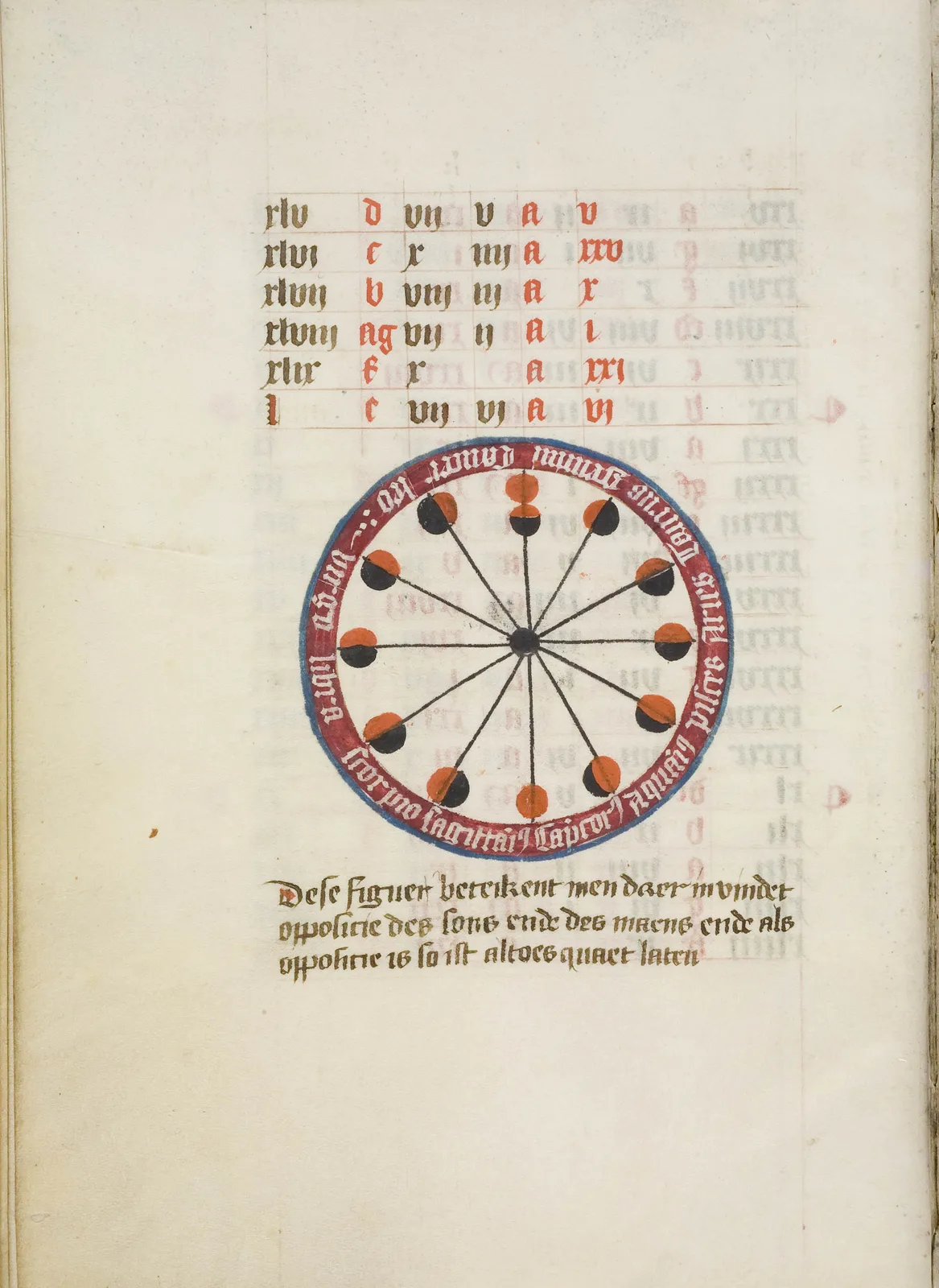
A ready-made table spares the arithmetic. One page of the Bout Psalter-Hours, a Middle Dutch prayer book in the Koninklijke Bibliotheek, the national library of the Netherlands (79 K 11, folio 15v), lists rows numbered xlv to l. Each row gives a Sunday letter and an April date. A Sunday letter is the letter that lands on a year's Sundays when the days from January 1 are lettered A to G in turn, as English Wikipedia's "Computus" article describes.
By this page's count, the six rows match the Julian Easter dates and Sunday letters for 1545 to 1550. They run from April 5 in 1545 to April 6 in 1550, and no other run of years from 1045 to 1749 fits. The page itself does not say which century its row numbers count.
Source and licence
"Bout Psalter-Hours - KB 79 K 11 - folio 015v Computational tables for calculating the day of Easter" by Unknown scribe, Bout Psalter-Hours (Koninklijke Bibliotheek, 79 K 11) — https://commons.wikimedia.org/wiki/File:Bout_Psalter-Hours_-_KB_79_K_11_-_folio_015v_Computational_tables_for_calculating_the_day_of_Easter.jpg — Public domain (anonymous manuscript, dated 1453/1600 on the source page; US: anonymous work created more than 120 years ago; EU: anonymous work made available more than 70 years ago; faithful scan of a flat page)Every Western and Orthodox date from 1583 to 2299 is in easter-date-dates-1583-2299.csv. Each date comes from two independent methods that agree in every year. For 2016 to 2036 the dates also agree with the table in English Wikipedia's "List of dates for Easter."
Why Orthodox Easter is often later
Two things separate the Orthodox date from the Western one, and neither is a different rule.
The first is the calendar. Most Eastern churches, including nearly all Eastern Orthodox churches, still use the older Dionysian and Bedan reckoning on the Julian calendar, English Wikipedia's "Computus" article reports. For every Easter from 1900 to 2099, the Julian calendar runs 13 days behind the Gregorian, by this page's calendar arithmetic. The article names the Finnish Orthodox Church as the one Eastern Orthodox church on the Gregorian table.
The second difference is the moon. The Julian table has no century corrections, so its full moon falls 4, 5 or 34 days after the Western one. By this page's count for 1900 to 2099, the gap is 4 days in 127 years, 5 days in 21 and 34 days in 52.
The result is a fixed set of gaps, and from 1900 to 2099 Orthodox Easter never comes first.
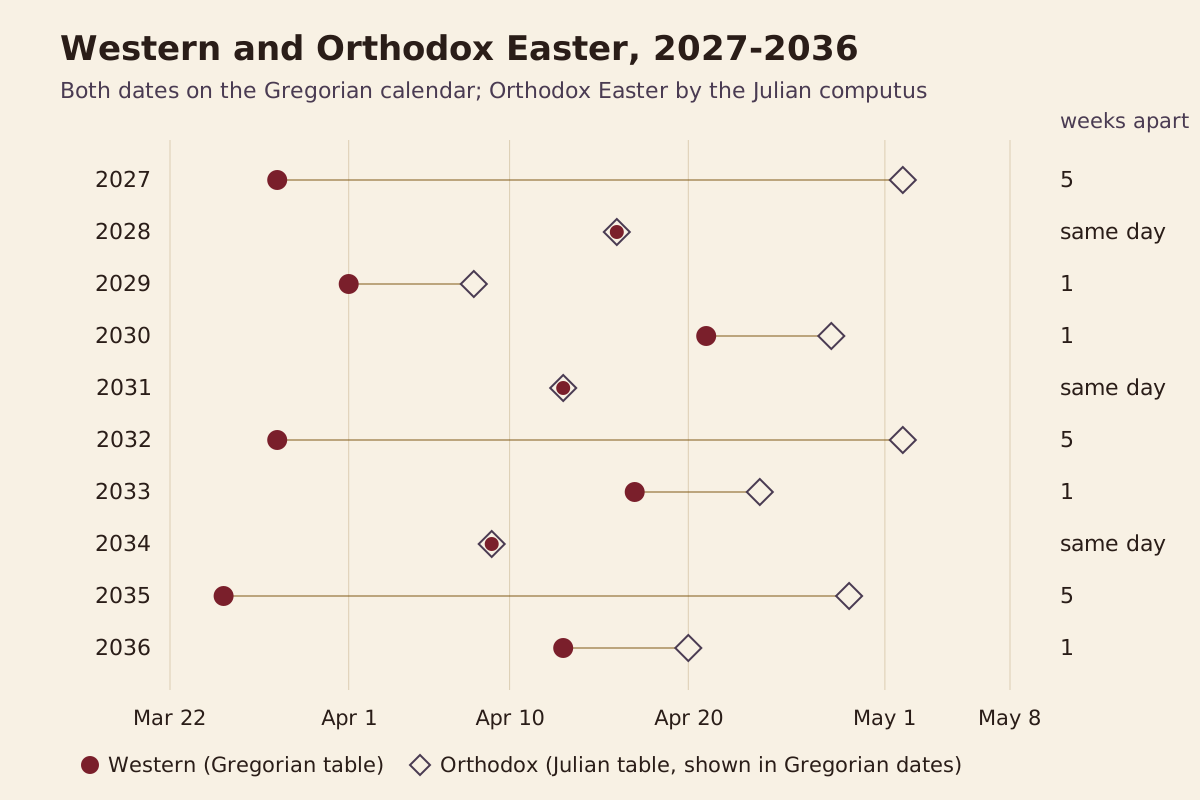
| Orthodox Easter compared with Western Easter | Years, 1900 to 2099 | Share |
|---|---|---|
| Same Sunday | 57 | 28.5% |
| One week later | 91 | 45.5% |
| Four weeks later | 9 | 4.5% |
| Five weeks later | 43 | 21.5% |
The coming decade shows three of those patterns. The two Easters fall on the same Sunday in 2028, 2031 and 2034, one week apart in 2029, 2030, 2033 and 2036, and five weeks apart in 2027, 2032 and 2035. Christmas, by contrast, keeps its date, December 25. On the Julian calendar that day falls on January 7 of the Gregorian calendar, the date followed in the entry on Christmas traditions.
From Dionysius to the 1582 reform
Dionysius's table continued an Alexandrian table that covered 437 to 531, as English Wikipedia's "Computus" article summarizes. Bede records that Dionysius counted the years from the Incarnation rather than from the reign of the emperor Diocletian, and that his first cycle began at 532 (chapter 47). The same article says Bede described the Dionysian reckoning in full in 725, and that it stayed in use in western Europe until the Gregorian reform.
Both the equinox and the table moon drifted. The article notes that Bede had already seen the true equinox moving away from March 21. The table moon drifted as well, it explains, because 19 Julian years run slightly longer than 235 lunar months.
Pope Gregory XIII's bull Inter Gravissimas, dated at Tusculum on 24 February 1582, frames the reform in Easter terms. By its account, the spring equinox had slipped about ten days from March 21, where it says the Council of Nicaea had fixed it. The table's 14th moon was four or more days out of place.
To put the equinox back on March 21, the bull dropped ten days from October 1582. To keep it there, the bull kept 1600 as a leap year but not 1700, 1800 or 1900. It also replaced the golden numbers in the church calendar with a cycle of epacts devised by Aloysius Lilius.
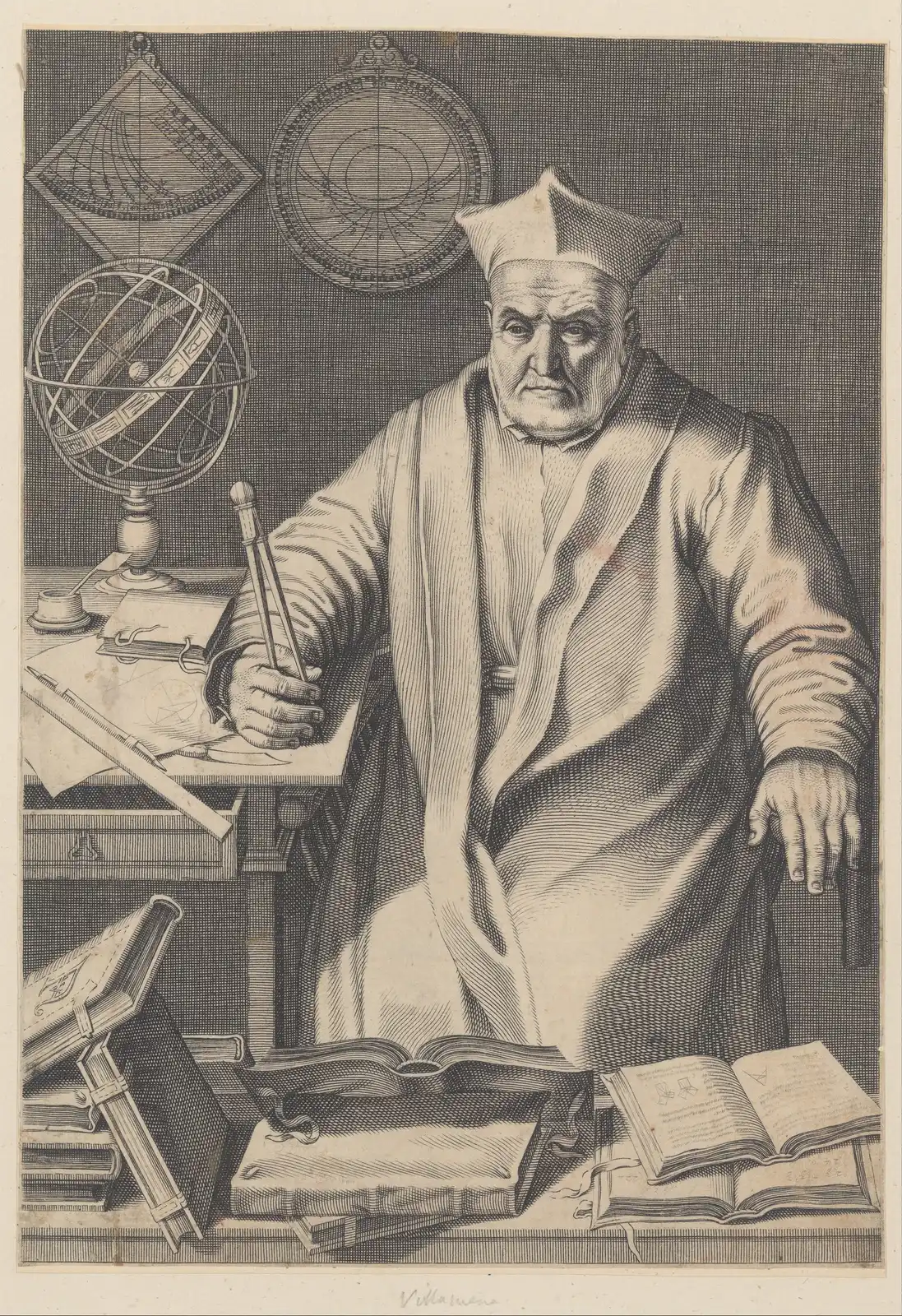
Christopher Clavius, a Jesuit mathematician at the Collegio Romano, sat on the commission that accepted Lilius's scheme, English Wikipedia's article on him reports. He wrote the explanations, the Six Canons in 1582 and a full Explicatio in 1603, according to the computus article. The same article says the Roman Catholic Church has used the Gregorian Easter since 1583, and most Protestant churches adopted it between 1753 and 1869.
Source and licence
"Portrait of Cardinal Christopher Clavius MET DP218205" by Francesco Villamena (The Metropolitan Museum of Art, 51.501.2510) — https://commons.wikimedia.org/wiki/File:Portrait_of_Cardinal_Christopher_Clavius_MET_DP218205.jpg — CC0 1.0 (https://creativecommons.org/publicdomain/zero/1.0/)Every date Easter can fall on
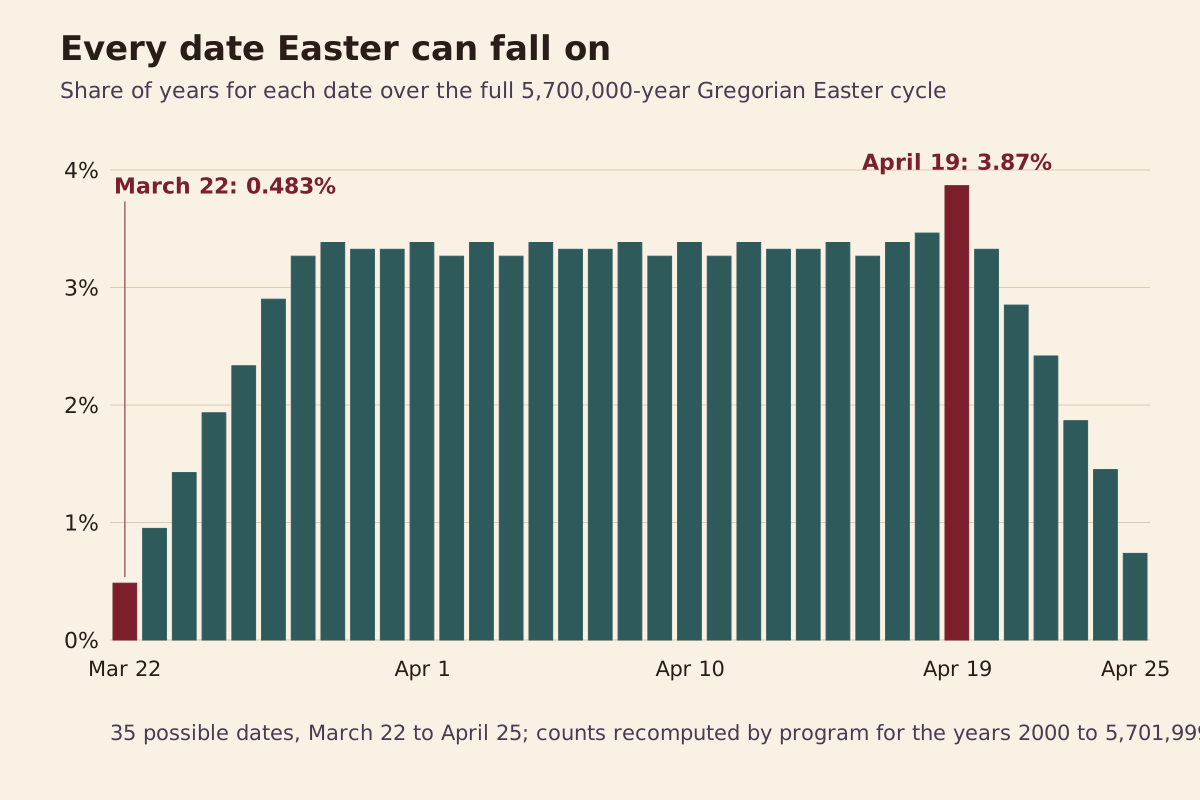
Bede already gives the limits. Easter can fall no earlier than March 22 and no later than April 25 (chapter 45), and the Gregorian tables keep that window. Over the full Gregorian cycle of 5,700,000 years, after which the dates repeat, April 19 is the most frequent Easter, at 3.87% of years. March 22 is the rarest, at 0.483%, by this page's count.
English Wikipedia's "Computus" article explains the cycle's length: the epacts set by the solar and lunar corrections take that long to repeat with the same golden numbers. Within one lifetime the extremes are rare. Western Easter fell on March 22 in 1598, 1693, 1761 and 1818, and next will in 2285, with none from 1900 to 2199. It fell on April 25 in 1666, 1734, 1886 and 1943 and will again in 2038, 2190 and 2258, by this page's count for 1583 to 2299.
In Gregorian dates, Orthodox Easter ranges from April 4 to May 8 in the years 1900 to 2099. Fixed feasts need none of this: Krampusnacht is the evening of December 5 every year.
Easter dates: quick answers
When is Easter in 2027?
Western Easter falls on Sunday, March 28, 2027, and Orthodox Easter on Sunday, May 2, 2027. Both dates come from the church tables described above, recomputed by program with two independent methods for each.
Why does the date of Easter change every year?
Easter is tied to a moon, and 12 lunar months fall about 11 days short of the calendar year. So the table's paschal full moon moves from year to year. Easter is the Sunday after that moon's 14th day on or after March 21, which puts it anywhere from March 22 to April 25.
Why is Orthodox Easter on a different date?
Most Orthodox churches use the older Julian table on the Julian calendar. For every Easter from 1900 to 2099 that calendar runs 13 days behind the Gregorian, and the Julian table's full moon falls 4, 5 or 34 days after the Western one. So Orthodox Easter is the same day or one, four or five weeks later.
What are the earliest and latest possible Easter dates?
Western Easter can fall from March 22 to April 25. The last March 22 Easter was in 1818 and the next is in 2285, and the next April 25 Easter comes in 2038. Orthodox Easter, in Gregorian dates, ranges from April 4 to May 8 between 1900 and 2099.
Earliest ink
- One Easter day for all churches: 325. Constantine's letter after the Council of Nicaea, preserved in Eusebius, Life of Constantine 3.17–20, in Heikel's 1902 Greek edition; the earliest record of the decision in the sources checked, together with the council's own letter of the same year quoted in English Wikipedia's "Computus" article. Neither gives a moon or equinox rule.
- The full table rule: 725. Bede, De temporum ratione, chapters 30, 45, 59 and 61, in the Migne text on Latin Wikisource: the 14th moon from March 21 to April 18 and Easter from March 22 to April 25, the first-ink date for the complete rule in the sources checked for this page.
- The Gregorian tables: 1582. Inter Gravissimas, dated 24 February 1582, in the Latin Wikisource transcription, whose base edition is not stated.
Sources checked through 2026-10-19.
Where the trail goes next
- A feast that keeps its day: Christmas Traditions follows December 25 through the written record, including the churches that keep it on January 7.
- A calendar read from the stars: The Pleiades traces the star cluster whose rising and setting Hesiod gave to farmers as a calendar.
- Bede's own chapters: the Latin text of De temporum ratione on Latin Wikisource, chapters 59 to 65 on the Easter moon and the 532-year cycle.
Cite this page
Where Tales Began. “Date of Easter: The Rule Follows a Table Moon, Not the Sky.” First published October 20, 2026; last substantive revision October 20, 2026. https://wheretalesbegan.com/festivals/easter-date/. Accessed: add the date you read this page.
- Author
- Where Tales Began
- Title
- Date of Easter: The Rule Follows a Table Moon, Not the Sky
- Published
- Revised
- Address
- https://wheretalesbegan.com/festivals/easter-date/
Sources
- Eusebius of Caesarea, Life of Constantine (Vita Constantini) 3.17–20, ed. Ivar A. Heikel, Eusebius Werke, vol. 1 (Leipzig: J. C. Hinrichs, 1902); digital edition urn:cts:greekLit:tlg2018.tlg020.1st1K-grc1, First1KGreek (University of Leipzig), OpenGreekAndLatin/First1KGreek (GitHub, commit c513a29), CC BY-SA 4.0 github.com/OpenGreekAndLatin/First1KGreek/blob/c513a292883788173d419686ce6d5d66d519d012/data/tlg2018/tlg020/tlg2018.tlg020.1st1K-grc1.xml Read: Book 3, chapters 17 to 20 (Greek text) Text licence: CC BY-SA 4.0
- Bede, De temporum ratione (De ratione temporum), chs. 30, 45, 47, 49, 59, 61 and 65, in J.-P. Migne, ed., Patrologia Latina, vol. 90; Latin Wikisource transcription (edition: Migne; source: Corpus Corporum) (read 2026-10-19) la.wikisource.org/wiki/De_ratione_temporum Read: Chapters 30, 45, 47, 49, 59, 61 and 65 (Latin text)
- Gregory XIII, Inter Gravissimas, dated at Tusculum, 1582, sexto kalendas martii; Latin Wikisource transcription by Rodolphe Audette, edition and source not stated (read 2026-10-19) la.wikisource.org/wiki/Inter_Gravissimas Read: Full text, paragraphs 1 to 17; used for checking only, since the base edition is not stated
- Hesiod, Works and Days, lines 383-384, trans. Hugh G. Evelyn-White, in Hesiod, the Homeric Hymns and Homerica (Loeb Classical Library, 1914); digital edition urn:cts:greekLit:tlg0020.tlg002.perseus-eng2, Perseus Digital Library, PerseusDL/canonical-greekLit (GitHub, commit d771ecb), CC BY-SA 4.0 github.com/PerseusDL/canonical-greekLit/blob/d771ecb5448baeb450d3f9822036555655ca65f3/data/tlg0020/tlg002/tlg0020.tlg002.perseus-eng2.xml Read: Lines 383 and 384 (the Pleiades sentence) Text licence: CC BY-SA 4.0
- Fred Espenak, "Six Millennium Catalog of Phases of the Moon," NASA Goddard Space Flight Center Eclipse Web Site, century tables 1801-1900, 1901-2000 and 2001-2100 (read 2026-10-19) eclipse.gsfc.nasa.gov/phase/phasecat.html Read: Full-moon times, 1900 to 2100 (comparison only)
- English Wikipedia, "Computus" (read 2026-10-19). en.wikipedia.org/wiki/Computus Read: Summarized here through English Wikipedia
- English Wikipedia, "Life of Constantine" (read 2026-10-19). en.wikipedia.org/wiki/Life_of_Constantine Read: Summarized here through English Wikipedia
- English Wikipedia, "Christopher Clavius" (read 2026-10-19). en.wikipedia.org/wiki/Christopher_Clavius Read: Summarized here through English Wikipedia
- English Wikipedia, "List of dates for Easter" (read 2026-10-19). en.wikipedia.org/wiki/List_of_dates_for_Easter Read: Table of dates for 2016 to 2036 (comparison only)