Catalogue entry
Baba Yaga: Afanasyev's Witch Is Also the Hero's Helper
- By
- Where Tales Began
- Published
- Last substantive revision
How records are checked: Following the paper trail. Corrections: Fixes to the record. Questions: Contact us.
Fast facts
- Name
- Baba Yaga (Russian baba-yaga)
- Classification
- A tale character, not a tale type: her tales are filed under several types, among them ATU 402, ATU 432 and ATU 552
- Earliest ink
- Name: 1755, Lomonosov's grammar (reported, not checked here). Tale texts read here: Afanasyev's collection, first issued from 1855. In English: Ralston, 1873
- Languages and regions
- Russian tales in Afanasyev's collection, recorded in provinces including Vologda, Voronezh, Kursk and Saratov; related figures in other Slavic traditions
- Core motifs
- Hut on chicken legs; flight in a mortar; tasks set on pain of being eaten
- Surviving texts or data sources
- Afanasyev, Narodnye russkie skazki (Nauka edition, 1984-85); Ralston, Russian Folk-Tales (1873); Magnus, Russian Folk-Tales (1915)
- TL;DR
- Baba Yaga is the forest witch of Russian wonder tales who rides a mortar and lives in a hut on chicken legs. In Afanasyev's collection she threatens to eat Vasilisa yet sends her home with fire, and in other tales she gives heroes gifts and directions. The sources checked here record no worship of her as a goddess.
Source and licence
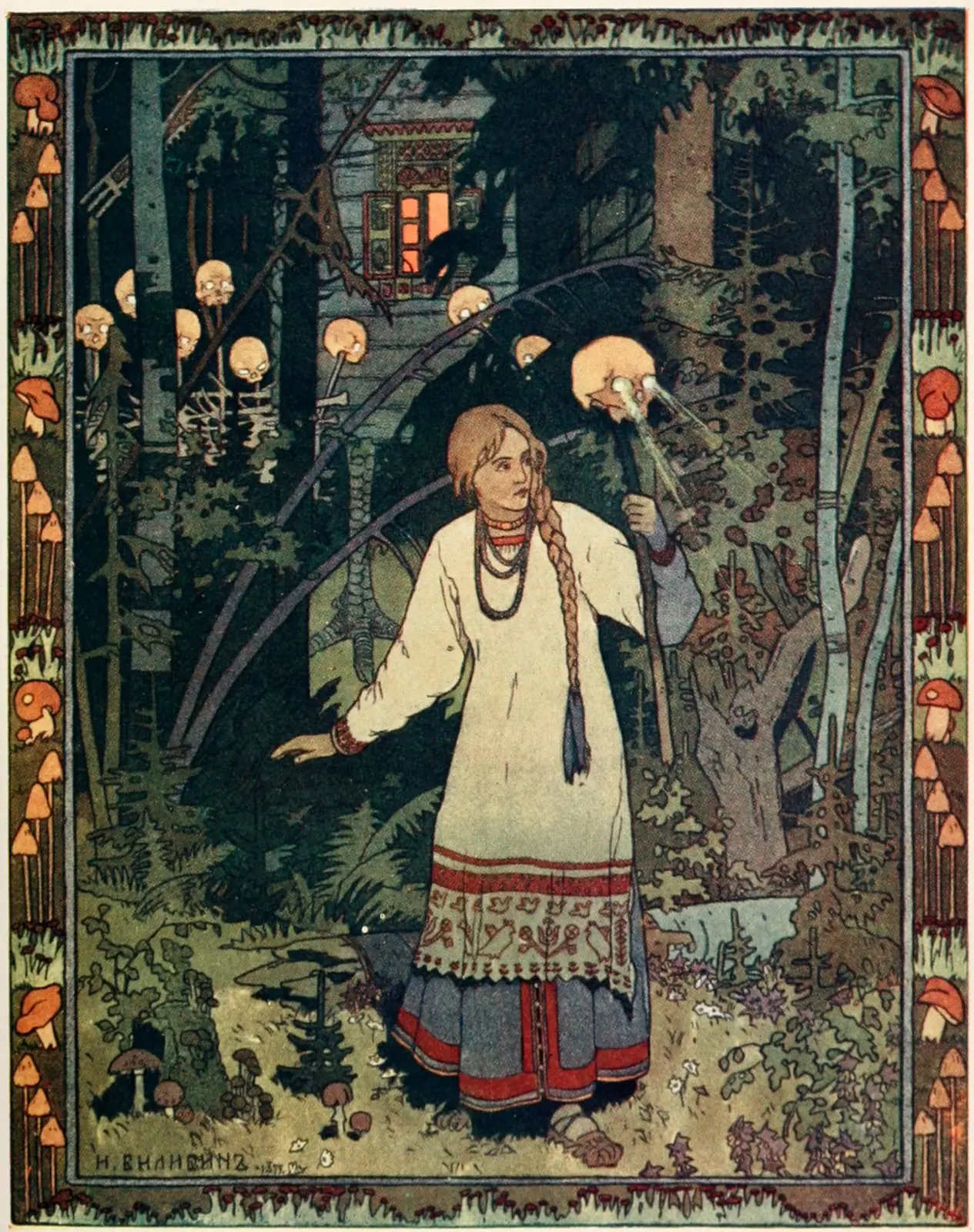
"Russian Wonder Tales 081" by Ivan Bilibin — https://commons.wikimedia.org/wiki/File:Russian_Wonder_Tales_081.jpg — Public domain (artist Ivan Bilibin d. 1942; US: published before 1931 (picture dated 1899, printed in Post Wheeler's Russian Wonder Tales, New York, 1912); EU: 70 years after the artist's death)Baba Yaga sends Vasilisa home with a burning-eyed skull on a stick, the fire she came for. The same witch had promised to eat the girl if her chores were left undone. In the Russian folktales that Alexander Afanasyev began publishing in 1855, Baba Yaga is an old woman of the forest who rides in a mortar and lives in a hut on chicken legs. She eats people in some tales, sets tests in others, and in still others hands the hero a gift or the road to follow.
This entry sets seven of those tales side by side, read in the 1984–85 Nauka edition of Afanasyev and in the English translations of W. R. S. Ralston (1873) and Leonard A. Magnus (1915). The sources checked for it record no cult of Baba Yaga as a goddess. The site's rules for dating a record are set out in Following the Paper Trail.
Where the name first turns up
A first-ink date is the date of the earliest written record of a name or story that can be checked. It marks where the paper evidence starts, not where the figure began, and for Baba Yaga it is harder to fix than her fame suggests. English Wikipedia, citing Andreas Johns's 2004 study, places the first clear reference in Mikhail Lomonosov's Russian Grammar of 1755, where "Iaga baba" appears near a list of Slavic gods paired with Roman ones. Russian Wikisource dates the grammar to 1755 and its printing to 1757, but a search of its transcription of the 1952 edition did not turn up the name, so the 1755 record is reported here, not checked.
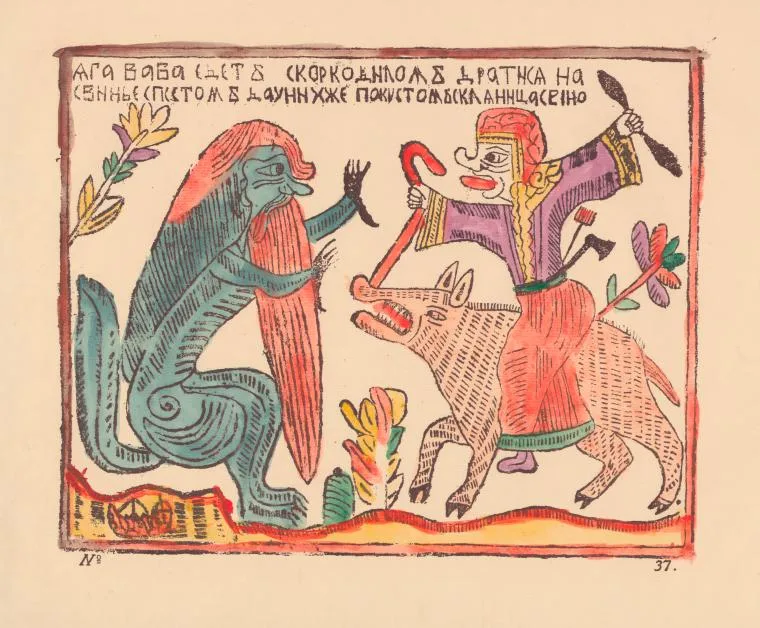
Lubki, popular Russian woodblock prints, carry the name too. The caption on the one below names "Iaga baba" and has her ride a pig, pestle in hand, to fight a crocodile.
Source and licence
"Babayaga lubok" by Unknown author — https://commons.wikimedia.org/wiki/File:Babayaga_lubok.jpg — Public domain (anonymous Russian lubok woodcut, dated by Commons to the early 17th century (English Wikipedia places such prints in the late 17th and early 18th centuries), reproduced in a 1972 Moscow album; US: published before 1931; EU: anonymous work made public more than 70 years ago)Wikimedia Commons dates this print to the early 17th century, while English Wikipedia places prints of this kind in the late 17th and early 18th centuries and reports Dmitry Rovinsky's reading of the scene as a parody aimed at Peter the Great. With its date unsettled, the print is not used here as a first-ink date.
Villain, tester, giver
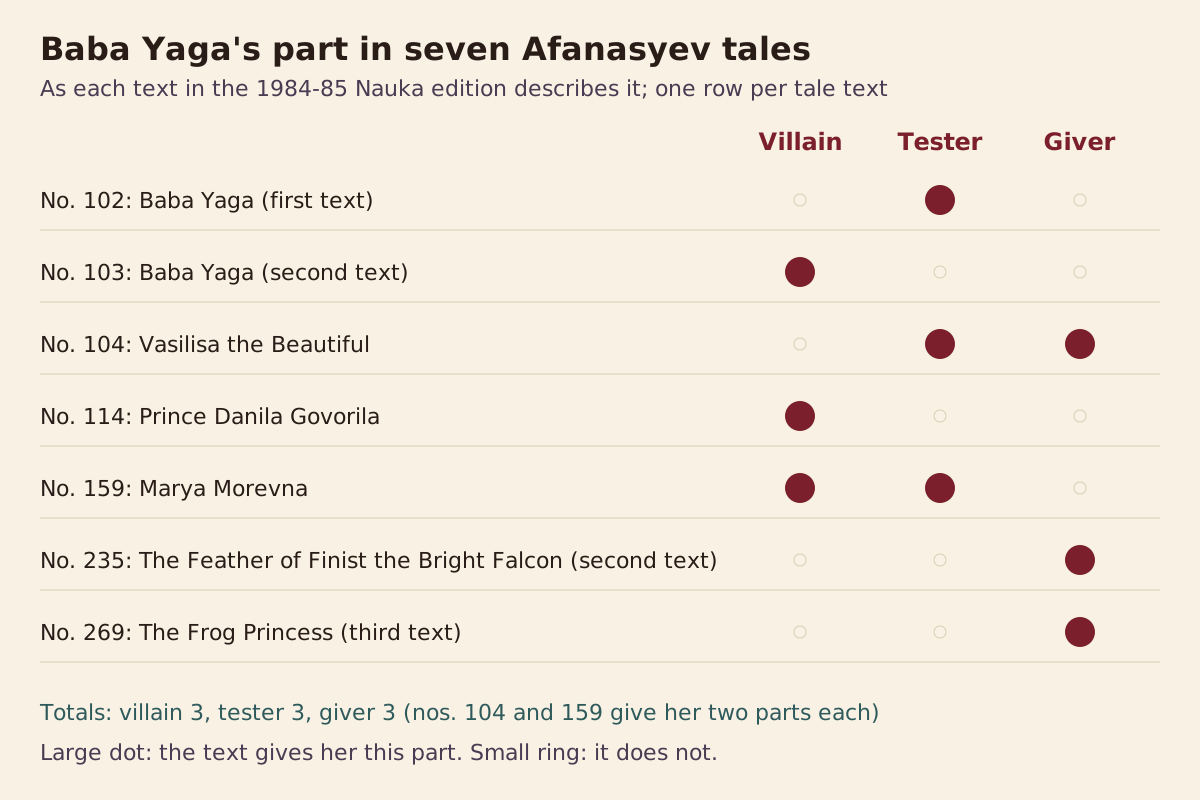
In Afanasyev's collection Baba Yaga is a character, not a plot. She turns up in tales that folklorists file under different types, and the table sets seven texts side by side with her part in each as the text describes it. Here a villain tries to kill or eat the hero, a tester sets tasks and rewards or punishes the result, and a giver hands over what the quest needs.
| Tale (Afanasyev no.) | What Baba Yaga does | How it ends for her |
|---|---|---|
| "Baba Yaga" (102) | Sets a stepdaughter to spin and heat the stove, rewards her with fine clothes, and breaks the bones of the stepmother's own daughter | Unharmed |
| "Baba Yaga" (103) | Plans to eat the girl sent to borrow a needle and thread | The girl escapes with a towel and a comb; Baba Yaga turns back |
| "Vasilisa the Beautiful" (104) | Sets tasks on pain of being eaten, then gives the skull lamp | Unharmed |
| "Prince Danila Govorila" (114) | Tries to slide a girl into the oven on a bread shovel | Breaks out of the oven, gives chase and burns in a sea of fire |
| "Marya Morevna" (159) | Sets Ivan to herd her mares for three days, his head on a pole the price of failure | Falls into the river of fire and dies |
| "The Feather of Finist the Bright Falcon" (235) | Three Baba Yagas in turn give the heroine gold and diamond gifts and a fast horse | Unharmed |
| "The Frog Princess" (269) | Feeds Ivan and tells him where the death of Koschei the Deathless is hidden | Unharmed |
Table data: baba-yaga-roles.csv, with the tale type as reported and the source link for every row.
Is Baba Yaga good or evil? The texts give both answers. Of the seven Afanasyev tales in the table, three make Baba Yaga a villain and three a giver, and in Vasilisa's tale she both threatens and gives.
A 2005 review in Folklorica reports a similar three-way split in Andreas Johns's 2004 book on the Russian tales: a donor Baba Yaga, an ambiguous one and an evil witch. In that summary, Johns ties the difference to the hero who meets her. With children, boys meet a threat and girls a figure who rewards or punishes their behavior; the donor appears almost only in tales of grown men looking for brides.
The oven scene in no. 114 sits close to the Grimms' "Hansel and Grethel." In Magnus's translation, Baba Yaga loses patience with the girl on the shovel, says "Just look at me and see how it is done," sits on it herself and is shut in. In Margaret Hunt's 1884 translation of the Grimms' 1857 text, the witch shows Grethel how to climb in, and "Grethel gave her a push that drove her far into it." English Wikipedia notes that this "show me how" trick marks type ATU 327A but also turns up in other subtypes of ATU 327; the two scenes are set side by side here, with no claim that one comes from the other.
Vasilisa and the doll
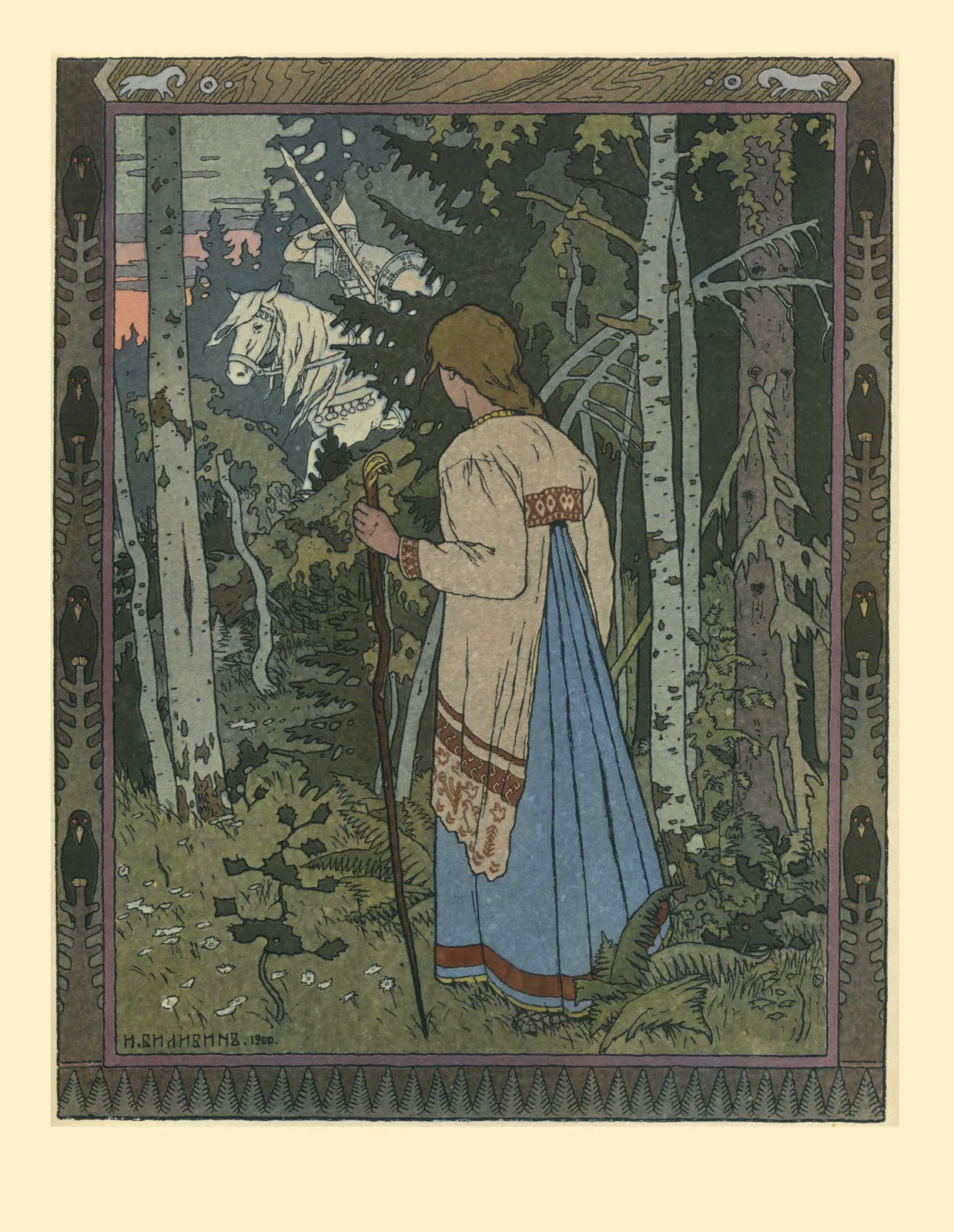
Vasilisa's help comes from her mother. In Ralston's 1873 translation the dying mother says, "together with my parental blessing, I bequeath to you this doll," and the doll does the work Baba Yaga sets, from clearing the wheat to cleaning the poppy seed. When the witch asks how the work gets done, Vasilisa answers, "My mother's blessing assists me." Baba Yaga throws her out ("I don't want bless'd people") but still hands her the skull, whose eyes burn the stepmother and stepsisters "to cinders" by morning.
Source and licence
"Билибин img602" by Ivan Bilibin — https://commons.wikimedia.org/wiki/File:%D0%91%D0%B8%D0%BB%D0%B8%D0%B1%D0%B8%D0%BD_img602.jpg — Public domain (artist Ivan Bilibin d. 1942; US: published before 1931 (plate signed and dated 1900, from his illustrated Vasilisa the Beautiful, which Commons dates 1899-1902); EU: 70 years after the artist's death)Help from a dead mother links this tale to Cinderella. In the same Grimm edition, as Hunt translated it, the heroine plants a hazel twig on her mother's grave and waters it with tears, and a white bird in the grown tree throws down whatever she wishes for. Cinderella Around the World dates that tale and its relatives, and it sets the doll and the grave tree side by side as matching motifs only.
Vasilisa's tale also has its own number. English Wikipedia reports that the East Slavic tale catalogue files it as SUS 480В* (with a Cyrillic В), "Stepmother and Step-daughter," and that Jack Haney numbers it AT 480B*. How such numbers are assigned, and why one label can mean different things in different catalogues, is the subject of the Aarne–Thompson–Uther index entry.
The hut on chicken legs
Afanasyev's texts describe the hut more than they explain it. In no. 102 a peasant comes on "избушка на курьих ножках," a little hut on chicken legs, and turns it to face him: "Избушка, избушка! Стань к лесу задом, а ко мне передом," "Little hut, little hut! Stand with your back to the forest and your front to me" (Translation: Where Tales Began). In no. 235, a Finist tale, the hut is cast iron and never stops turning, and in no. 269 it stands on chicken feet. Ralston in 1873 described the hut as supported "by fowl's legs," and Magnus in 1915 wrote that the forest witch "lives in a hut on cocks' legs."
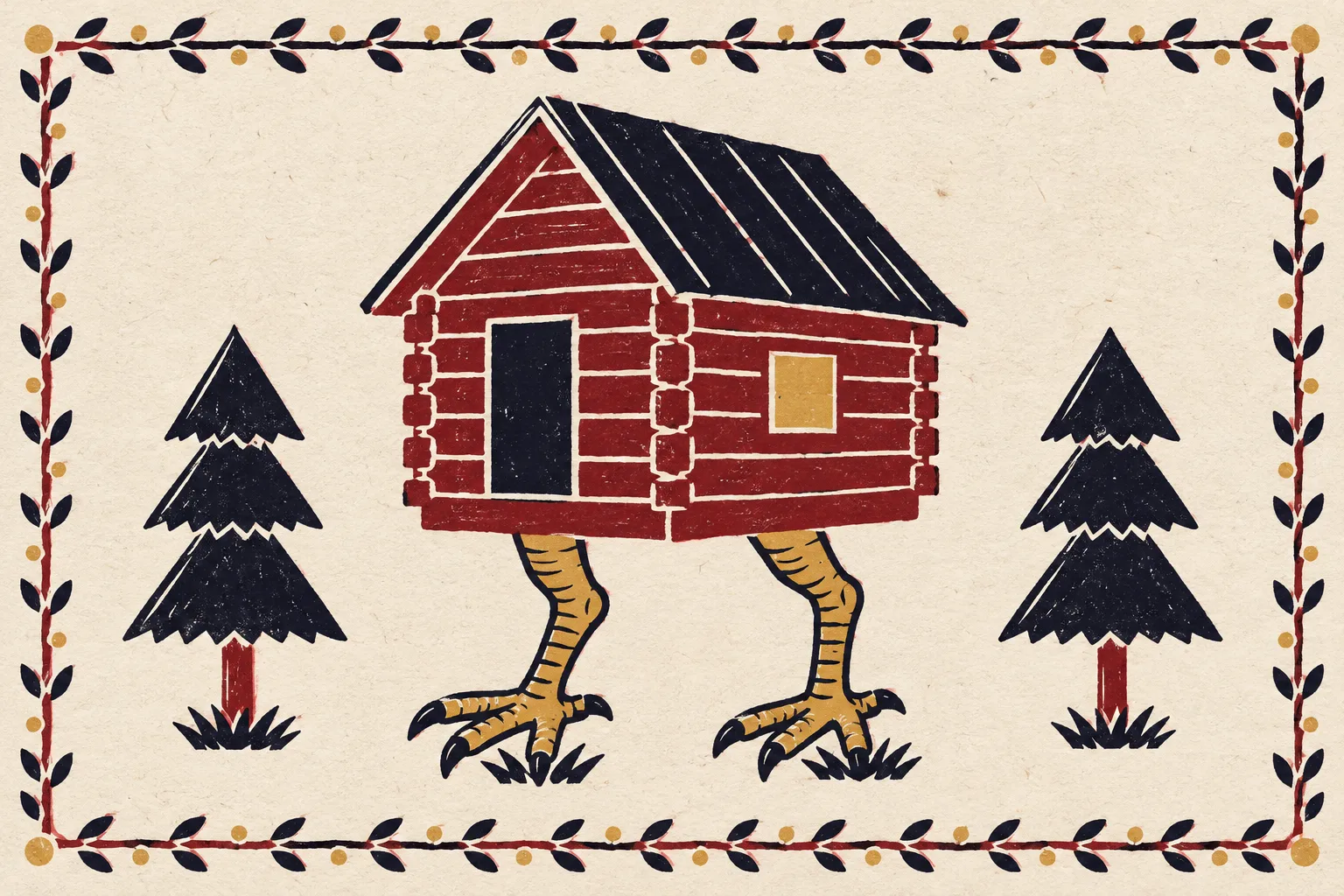
No Afanasyev text read here explains the chicken legs. English Wikipedia, citing Johns's book, reports a proposal that the hut resembles storehouses raised on tree stumps among Finno-Ugric peoples; it is a comparison, not a record of where the picture came from.
The detail may be older in print than Afanasyev. English Wikipedia, citing Jack Haney, reports a Finist tale printed in 1795 in which the heroine passes three Baba Yagas whose huts spin on chicken legs. That text was not read for this page, so the chart below marks 1795 as reported.
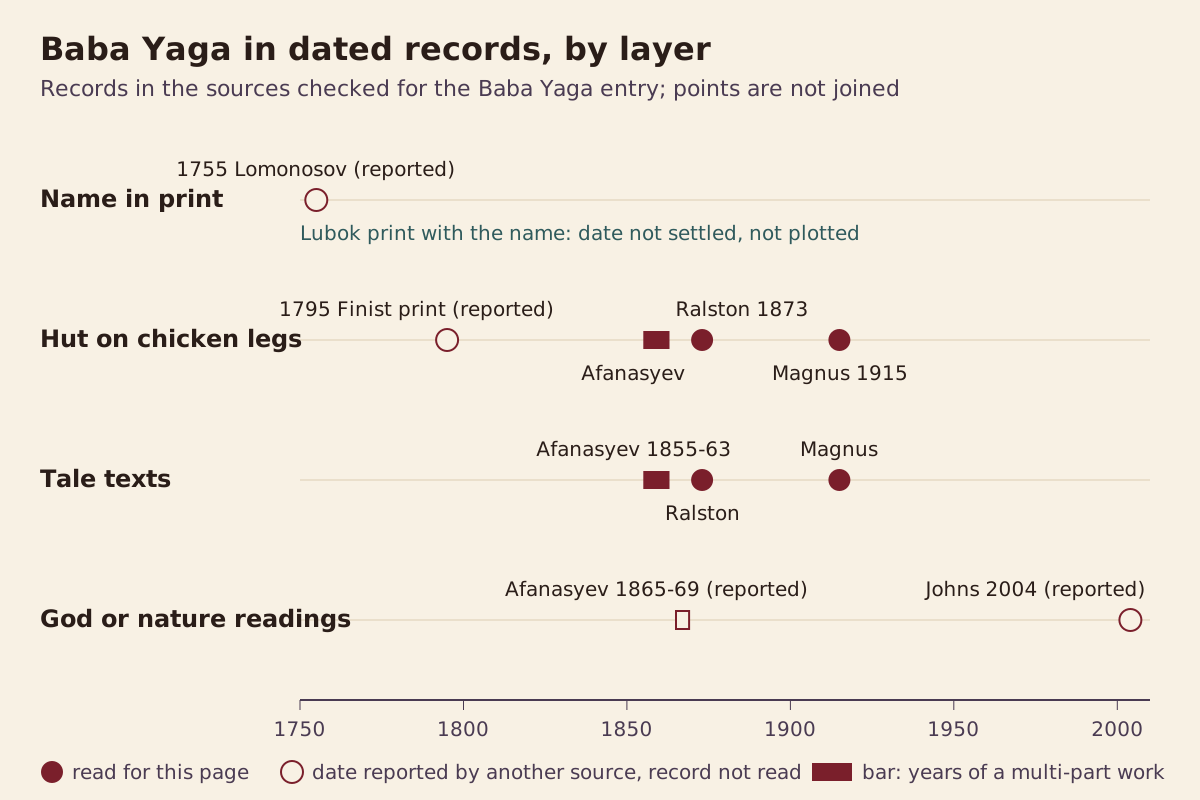
Chart data: baba-yaga-record-layers.csv, with the source and link for every row.
Goddess, ogress or tale figure?
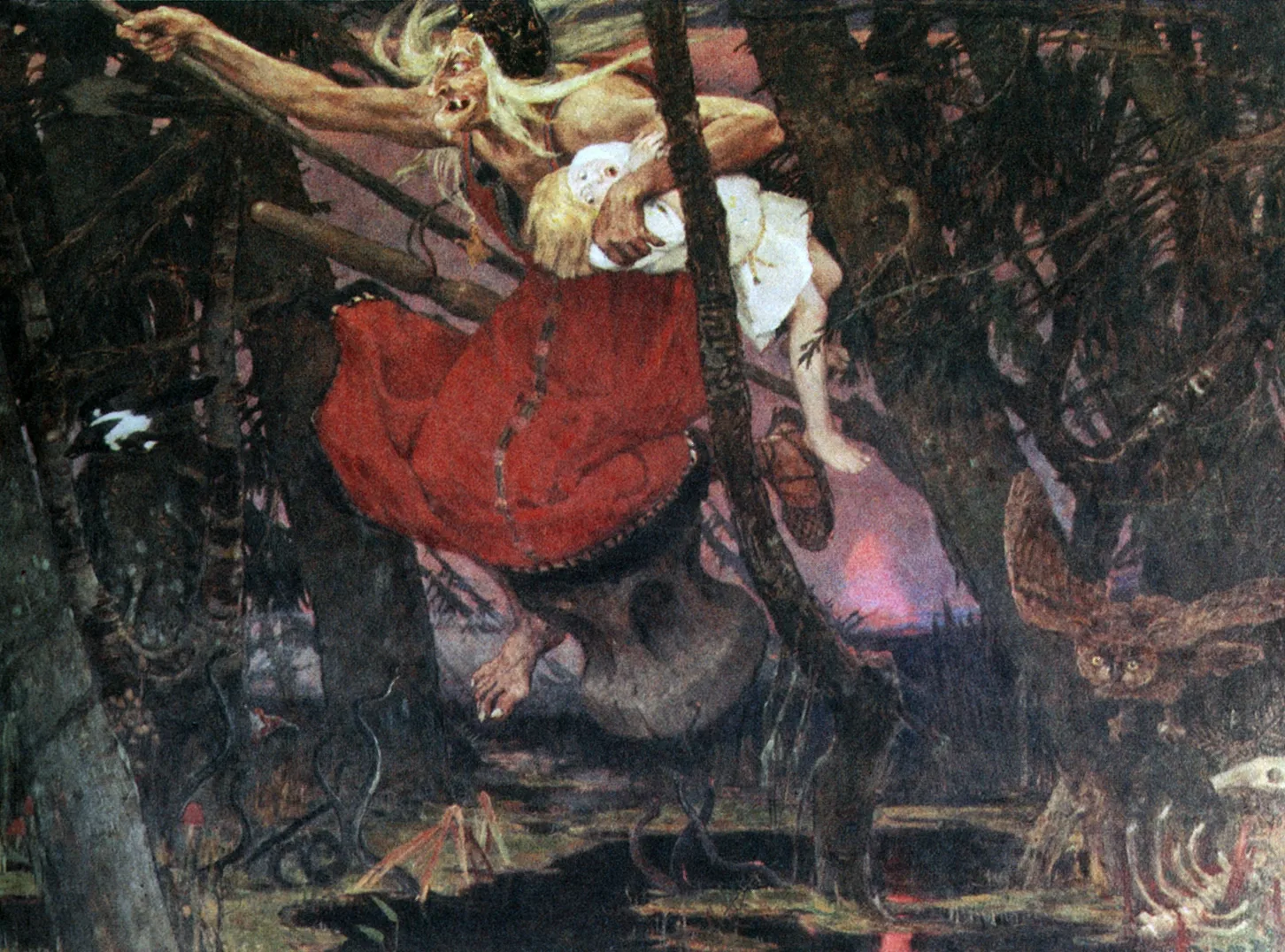
Was Baba Yaga a Slavic goddess? No source checked for this page records a shrine, an offering or a prayer to her. In every text read here she is a character in a tale, and Ralston's summary of those tales puts it plainly: "The Baba Yaga generally kills people in order to eat them." In the sources checked here, the goddess idea appears only as a later reading of the tales, and it has plenty of company.
| Reading | Put forward by (as reported) | What the records checked here show |
|---|---|---|
| A figure listed with the gods | Lomonosov's grammar, 1755, per English Wikipedia citing Johns | She appears near Slavic gods given Roman equivalents but gets no equivalent herself; the passage was not read here |
| A nature myth: storm, cloud, snake | Afanasyev: Poetic Views of the Slavs on Nature (1865–69), as quoted by Ralston; his reading of Vasilisa's tale, as summarized by English Wikipedia | In Poetic Views Afanasyev derived yaga from Sanskrit ahi, "snake," and English Wikipedia reports that he read Vasilisa's tale as sunlight against storm and dark clouds; these are the collector's interpretations, not older records |
| A goddess, among many readings | Researchers surveyed by Johns, per English Wikipedia | Johns lists readings of her as a cloud, the moon, death, winter, a snake, a bird and an earth goddess, among others; no record of worship appears in the sources checked |
| A mother or mother-in-law figure | Johns 2004, per the 2005 Folklorica review | Argued from tale texts, village ethnography and psychology, not from cult records |
Source and licence
"Баба Яга" by Viktor Vasnetsov — https://commons.wikimedia.org/wiki/File:%D0%91%D0%B0%D0%B1%D0%B0_%D0%AF%D0%B3%D0%B0.jpg — Public domain (painter Viktor Vasnetsov d. 1926; EU: 70 years after the painter's death; US: presumed public domain, not tied to a dated publication (painted 1917; if never published, US protection for unpublished works of an author who died in 1926 ended after 2002; if first published abroad after 1930, it was already public domain in Russia on 1 January 1996 and so was not restored))The Alpine Krampus makes a useful comparison. English Wikipedia describes him as a horned figure who comes with Saint Nicholas on the night of December 5 and punishes badly behaved children, and Baba Yaga plays the threat in some tales too: she plans to eat the girl in no. 103, and a "yagaya-baba" orders the boy Lutonya roasted in no. 111. Both have been read as pre-Christian survivals, and the Krampus entry tests that claim against dated records as this one does for Baba Yaga. The two are set side by side as figures with a similar job, with no claim that either comes from the other.
Earliest ink
- Baba Yaga's name: 1755 (reported). Lomonosov's Russian Grammar, as dated by English Wikipedia citing Johns 2004, p. 12; the name was not found in the 1952 edition's text on Russian Wikisource, so the date is not checked here.
- The hut on chicken legs: 1795 (reported). A printed Finist tale cited by Jack Haney, per English Wikipedia; not read here.
- Dated tale texts read for this page: from 1855. Afanasyev's Narodnye russkie skazki, first edition 1855–63 per English Wikipedia, which also gives 1855–67 in the same article; the tales are read in the 1984–85 Nauka edition on Russian Wikisource.
- In English: 1873. W. R. S. Ralston's 1873 collection, read in a New York reprint titled Russian Fairy Tales, gives the hut "by fowl's legs" and "Vasilissa the Fair," translated in full up to the burning of the stepmother and summarized after that; it is the earliest dated English description of her read for this page (Project Gutenberg).
Sources checked through 2026-10-19.
Where the trail goes next
- Follow the doll to the grave tree: Cinderella Around the World dates the Grimms' hazel tree and the other versions Vasilisa's tale is compared with.
- See how tale numbers work: The Aarne–Thompson–Uther index explains why a shared number marks a shared plot, not a shared ancestor.
- Another menace to children: Krampus tests the same "pagan god" claim against the dated records.
Cite this page
Where Tales Began. “Baba Yaga: Afanasyev's Witch Is Also the Hero's Helper.” First published October 20, 2026; last substantive revision October 20, 2026. https://wheretalesbegan.com/tales/baba-yaga/. Accessed: add the date you read this page.
- Author
- Where Tales Began
- Title
- Baba Yaga: Afanasyev's Witch Is Also the Hero's Helper
- Published
- Revised
- Address
- https://wheretalesbegan.com/tales/baba-yaga/
Sources
- A. N. Afanasyev, "Baba-iaga" (Баба-яга), nos. 102-103, in Narodnye russkie skazki A. N. Afanaseva, 3 vols., Literaturnye pamiatniki (Moscow: Nauka, 1984-85); Russian Wikisource transcription (read 2026-10-19) ru.wikisource.org/wiki/%D0%9D%D0%B0%D1%80%D0%BE%D0%B4%D0%BD%D1%8B%D0%B5_%D1%80%D1%83%D1%81%D1%81%D0%BA%D0%B8%D0%B5_%D1%81%D0%BA%D0%B0%D0%B7%D0%BA%D0%B8_(%D0%90%D1%84%D0%B0%D0%BD%D0%B0%D1%81%D1%8C%D0%B5%D0%B2)/%D0%91%D0%B0%D0%B1%D0%B0-%D1%8F%D0%B3%D0%B0 Read: nos. 102 and 103, full text with the edition notes on where each was recorded
- A. N. Afanasyev, "Vasilisa Prekrasnaia" (Василиса Прекрасная), no. 104, in Narodnye russkie skazki A. N. Afanaseva, 3 vols., Literaturnye pamiatniki (Moscow: Nauka, 1984-85); Russian Wikisource transcription (read 2026-10-19) ru.wikisource.org/wiki/%D0%9D%D0%B0%D1%80%D0%BE%D0%B4%D0%BD%D1%8B%D0%B5_%D1%80%D1%83%D1%81%D1%81%D0%BA%D0%B8%D0%B5_%D1%81%D0%BA%D0%B0%D0%B7%D0%BA%D0%B8_(%D0%90%D1%84%D0%B0%D0%BD%D0%B0%D1%81%D1%8C%D0%B5%D0%B2)/%D0%92%D0%B0%D1%81%D0%B8%D0%BB%D0%B8%D1%81%D0%B0_%D0%9F%D1%80%D0%B5%D0%BA%D1%80%D0%B0%D1%81%D0%BD%D0%B0%D1%8F Read: no. 104, full text
- A. N. Afanasyev, "Ivashko i ved'ma" (Ивашко и ведьма), nos. 108-111, in Narodnye russkie skazki A. N. Afanaseva, 3 vols., Literaturnye pamiatniki (Moscow: Nauka, 1984-85); Russian Wikisource transcription (read 2026-10-19) ru.wikisource.org/wiki/%D0%9D%D0%B0%D1%80%D0%BE%D0%B4%D0%BD%D1%8B%D0%B5_%D1%80%D1%83%D1%81%D1%81%D0%BA%D0%B8%D0%B5_%D1%81%D0%BA%D0%B0%D0%B7%D0%BA%D0%B8_(%D0%90%D1%84%D0%B0%D0%BD%D0%B0%D1%81%D1%8C%D0%B5%D0%B2)/%D0%98%D0%B2%D0%B0%D1%88%D0%BA%D0%BE_%D0%B8_%D0%B2%D0%B5%D0%B4%D1%8C%D0%BC%D0%B0 Read: no. 111 (Lutonya and the yagaya-baba), full text
- A. N. Afanasyev, "Kniaz Danila-Govorila" (Князь Данила-Говорила), no. 114, in Narodnye russkie skazki A. N. Afanaseva, 3 vols., Literaturnye pamiatniki (Moscow: Nauka, 1984-85); Russian Wikisource transcription (read 2026-10-19) ru.wikisource.org/wiki/%D0%9D%D0%B0%D1%80%D0%BE%D0%B4%D0%BD%D1%8B%D0%B5_%D1%80%D1%83%D1%81%D1%81%D0%BA%D0%B8%D0%B5_%D1%81%D0%BA%D0%B0%D0%B7%D0%BA%D0%B8_(%D0%90%D1%84%D0%B0%D0%BD%D0%B0%D1%81%D1%8C%D0%B5%D0%B2)/%D0%9A%D0%BD%D1%8F%D0%B7%D1%8C_%D0%94%D0%B0%D0%BD%D0%B8%D0%BB%D0%B0-%D0%93%D0%BE%D0%B2%D0%BE%D1%80%D0%B8%D0%BB%D0%B0 Read: no. 114, full text
- A. N. Afanasyev, "Mar'ia Morevna" (Марья Моревна), no. 159, in Narodnye russkie skazki A. N. Afanaseva, 3 vols., Literaturnye pamiatniki (Moscow: Nauka, 1984-85); Russian Wikisource transcription (read 2026-10-19) ru.wikisource.org/wiki/%D0%9D%D0%B0%D1%80%D0%BE%D0%B4%D0%BD%D1%8B%D0%B5_%D1%80%D1%83%D1%81%D1%81%D0%BA%D0%B8%D0%B5_%D1%81%D0%BA%D0%B0%D0%B7%D0%BA%D0%B8_(%D0%90%D1%84%D0%B0%D0%BD%D0%B0%D1%81%D1%8C%D0%B5%D0%B2)/%D0%9C%D0%B0%D1%80%D1%8C%D1%8F_%D0%9C%D0%BE%D1%80%D0%B5%D0%B2%D0%BD%D0%B0 Read: no. 159, full text
- A. N. Afanasyev, "Pioryshko Finista iasna sokola" (Пёрышко Финиста ясна сокола), nos. 234-235, in Narodnye russkie skazki A. N. Afanaseva, 3 vols., Literaturnye pamiatniki (Moscow: Nauka, 1984-85); Russian Wikisource transcription (read 2026-10-19) ru.wikisource.org/wiki/%D0%9D%D0%B0%D1%80%D0%BE%D0%B4%D0%BD%D1%8B%D0%B5_%D1%80%D1%83%D1%81%D1%81%D0%BA%D0%B8%D0%B5_%D1%81%D0%BA%D0%B0%D0%B7%D0%BA%D0%B8_(%D0%90%D1%84%D0%B0%D0%BD%D0%B0%D1%81%D1%8C%D0%B5%D0%B2)/%D0%9F%D1%91%D1%80%D1%8B%D1%88%D0%BA%D0%BE_%D0%A4%D0%B8%D0%BD%D0%B8%D1%81%D1%82%D0%B0_%D1%8F%D1%81%D0%BD%D0%B0_%D1%81%D0%BE%D0%BA%D0%BE%D0%BB%D0%B0 Read: nos. 234 and 235, full text with the edition notes (the three Baba Yagas are in no. 235, recorded in Vologda province)
- A. N. Afanasyev, "Tsarevna-liagushka" (Царевна-лягушка), nos. 267-269, in Narodnye russkie skazki A. N. Afanaseva, 3 vols., Literaturnye pamiatniki (Moscow: Nauka, 1984-85); Russian Wikisource transcription (read 2026-10-19) ru.wikisource.org/wiki/%D0%9D%D0%B0%D1%80%D0%BE%D0%B4%D0%BD%D1%8B%D0%B5_%D1%80%D1%83%D1%81%D1%81%D0%BA%D0%B8%D0%B5_%D1%81%D0%BA%D0%B0%D0%B7%D0%BA%D0%B8_(%D0%90%D1%84%D0%B0%D0%BD%D0%B0%D1%81%D1%8C%D0%B5%D0%B2)/%D0%A6%D0%B0%D1%80%D0%B5%D0%B2%D0%BD%D0%B0-%D0%BB%D1%8F%D0%B3%D1%83%D1%88%D0%BA%D0%B0 Read: nos. 267-269, full text (Baba Yaga named in no. 269)
- W. R. S. Ralston, Russian Folk-Tales (London, 1873), read in the Hurst & Co. New York reprint titled Russian Fairy Tales: A Choice Collection of Muscovite Folk-lore; Project Gutenberg eBook 22373 www.gutenberg.org/ebooks/22373 Read: preface; chapter on the Baba Yaga with "The Baba Yaga" and "Vasilissa the Fair"; notes 160-193
- Leonard A. Magnus, trans., Russian Folk-Tales (London: Kegan Paul, Trench, Trubner, 1915; second impression 1916); Project Gutenberg eBook 62509 www.gutenberg.org/ebooks/62509 Read: introduction; "By Command of the Prince Daniel"; "Vasilisa the Fair"; contents and glossary
- Jacob and Wilhelm Grimm, Household Tales, trans. Margaret Hunt (London, 1884), from the 1857 edition; Project Gutenberg eBook 5314 www.gutenberg.org/ebooks/5314 Read: no. 15 "Hansel and Grethel"; no. 21 "Cinderella" (Aschenputtel)
- Mikhail Lomonosov, Rossiiskaia grammatika (dated 1755, printed 1757); Russian Wikisource transcriptions of the 1757 first edition and of the 1952 edition (read 2026-10-19) ru.wikisource.org/wiki/%D0%A0%D0%BE%D1%81%D1%81%D0%B8%D0%B9%D1%81%D0%BA%D0%B0%D1%8F_%D0%B3%D1%80%D0%B0%D0%BC%D0%BC%D0%B0%D1%82%D0%B8%D0%BA%D0%B0_(%D0%9B%D0%BE%D0%BC%D0%BE%D0%BD%D0%BE%D1%81%D0%BE%D0%B2) Read: edition list with the dates; 1952 edition, full text searched for the name; 1757 edition, dedication and part 3
- Jeanmarie Rouhier-Willoughby, review of Andreas Johns, Baba Yaga: The Ambiguous Mother and Witch of the Russian Folktale (New York: Peter Lang, 2004), Folklorica 10, no. 1 (2005): 54-56 (CC BY-ND) doi.org/10.17161/folklorica.v10i1.3759 Read: full text, pp. 54-56
- Wikimedia Commons, File:Babayaga lubok.jpg, file description (read 2026-10-19) commons.wikimedia.org/wiki/File:Babayaga_lubok.jpg Read: file description: date, source album and description
- English Wikipedia, "Baba Yaga" (read 2026-10-19). en.wikipedia.org/wiki/Baba_Yaga Read: Attestations (Lomonosov 1755, citing Johns 2004), lubki section, related figures, the Finno-Ugric storehouse proposal, Johns's list of readings; summarized here, not quoted
- English Wikipedia, "Vasilisa the Beautiful" (read 2026-10-19). en.wikipedia.org/wiki/Vasilisa_the_Beautiful Read: Tale type and Interpretations sections; summarized here, not quoted
- English Wikipedia, "Alexander Afanasyev" (read 2026-10-19). en.wikipedia.org/wiki/Alexander_Afanasyev Read: lead, the biography (Poetic Views, 1865-1869) and the section on the collection; summarized here, not quoted
- English Wikipedia, "The Feather of Finist the Falcon" (read 2026-10-19). en.wikipedia.org/wiki/The_Feather_of_Finist_the_Falcon Read: Tale type section and the note on the 1795 printed version (citing Jack Haney); summarized here, not quoted
- English Wikipedia, "Marya Morevna" (read 2026-10-19). en.wikipedia.org/wiki/Marya_Morevna Read: Tale types section; summarized here, not quoted
- English Wikipedia, "The Frog Princess" (read 2026-10-19). en.wikipedia.org/wiki/The_Frog_Princess Read: Tale type section; summarized here, not quoted
- English Wikipedia, "Hansel and Gretel" (read 2026-10-19). en.wikipedia.org/wiki/Hansel_and_Gretel Read: ATU 327A tales section; summarized here, not quoted
- English Wikipedia, "Krampus" (read 2026-10-19). en.wikipedia.org/wiki/Krampus Read: lead section; summarized here, not quoted
