Deep dive
Aarne–Thompson–Uther Index: Same Number, Not Same Ancestor
- By
- Where Tales Began
- Published
- Last substantive revision
How records are checked: Following the paper trail. Corrections: Fixes to the record. Questions: Contact us.
Fast facts
- Name
- Aarne–Thompson–Uther index (ATU), a numbered catalogue of folktale types
- Classification
- Reference catalogue used in folklore studies, with Stith Thompson's Motif-Index of Folk-Literature as its companion
- Earliest ink
- 1910: Antti Aarne, Verzeichnis der Märchentypen (FF Communications 3), the earliest edition of this numbering in the sources checked
- Where found
- Built in 1910 on Finnish, Danish and German collections; Hans-Jörg Uther's 2004 revision added more tales from eastern and southern Europe
- TL;DR
- The ATU index numbers folktale plots: Antti Aarne drew up the list in 1910, Stith Thompson enlarged it in 1928 and 1961, and Hans-Jörg Uther revised it in 2004. Ye Xian, written down in China before 863, and Perrault's Cendrillon of 1697 share the number 510A. A shared number marks a shared plot, not a proven common ancestor.
Download these facts (CSV, aarne-thompson-uther-index-fast-facts.csv)
In the Aarne–Thompson–Uther index, Ye Xian (written down before 863) and Perrault's "Cendrillon" (1697) share one number: 510A. The number says that the two tales follow the same plot. It does not say that one descends from the other. The index is a numbered list of tale types, the plots that folklorists treat as whole stories.
ATU stands for Aarne–Thompson–Uther, the three folklorists who built the list. Antti Aarne published it in German in 1910. Stith Thompson translated and enlarged it in 1928 and revised it in 1961, and Hans-Jörg Uther revised it in 2004. English Wikipedia's entry on the index calls it an essential tool for folklorists.
The numbers sort plots. They carry no information about where any story began.
What does a tale-type number say?
Stith Thompson defined a tale type as a traditional tale with a life of its own. It can be told as a complete story and does not need another tale to make sense, as English Wikipedia quotes his 1946 book The Folktale. Each type gets a number. The number places it in a block of related plots.
Take ATU 510A. The 510 sits in the run 500–559, which Aarne set aside in 1910 for tales with a supernatural helper. That run lies inside the tales of magic, numbers 300–749.
The letter marks one form of a type. Aarne's 1910 preface says that letters after a number mark "variierende Formen desselben Typs", that is, "varying forms of the same type" (Translation: Where Tales Began). His list already gives 510 A and 510 B.
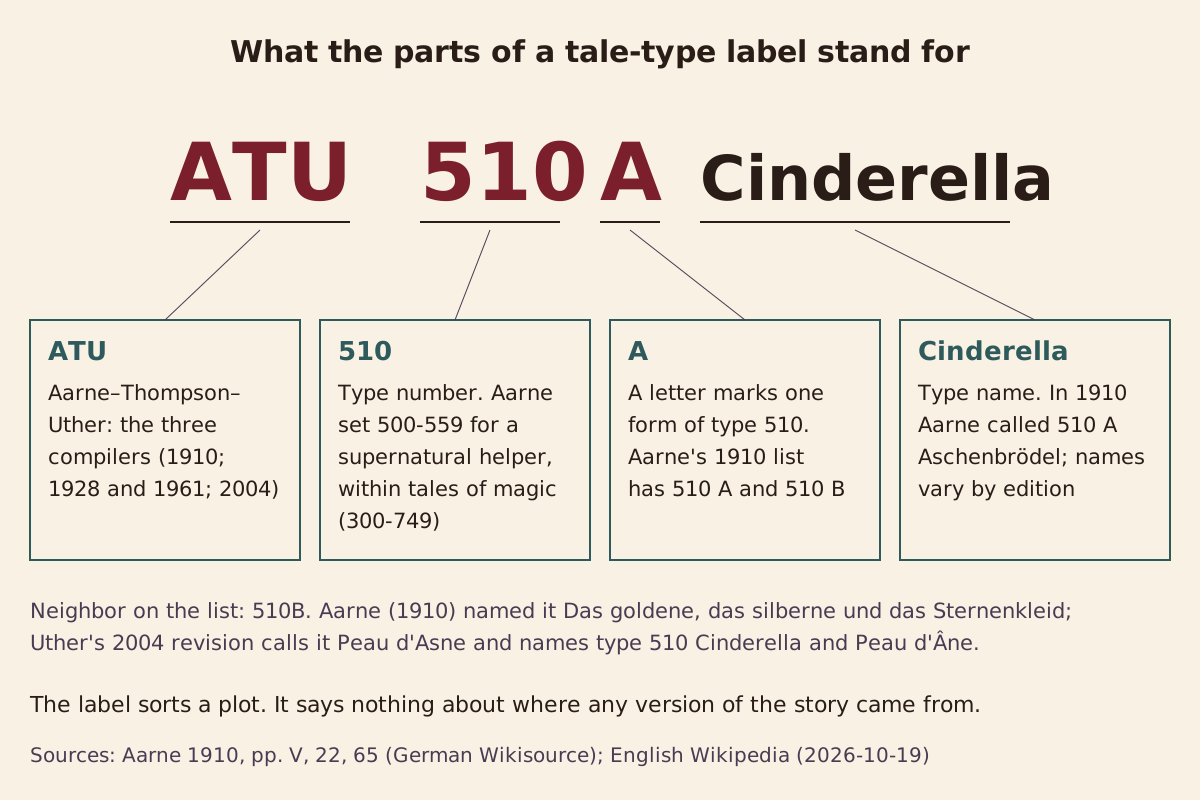
The name after the number is a label, not a fixed title. Aarne called 510 A "Aschenbrödel". Uther's 2004 revision calls it Cinderella and renames type 510 as a whole Cinderella and Peau d'Âne, according to English Wikipedia's entry on the index. It also renames 510B, called Catskin in the earlier editions, as Peau d'Asne.
The same entry notes that the names are typical rather than literal. Aarne's 1910 list already shows this: it calls type 545 B "Der gestiefelte Kater (oder der Fuchs als Fürsprecher)", that is, "Puss in Boots (or the fox as advocate)" (Translation: Where Tales Began), so the type also covers tales in which a fox, not a cat, speaks for the hero.
From Aarne's 1910 list to Uther's 2004 catalogue
Sorting tales by plot did not begin with Aarne. English Wikipedia's index entry lists several attempts made before his. Johann Georg von Hahn analyzed some 40 tale "formulae" in 1864, and Sabine Baring-Gould listed 52 "story radicals" in 1866. Svend Grundtvig's Danish system of 134 types was translated by Astrid Lunding in 1910.
Aarne's Verzeichnis der Märchentypen appeared in Helsinki in 1910, as number 3 of the series FF Communications. In its preface, Aarne writes that the list rests on three bodies of tales: Finnish manuscript collections, Grundtvig's Danish collections and the Grimms' Kinder- und Hausmärchen. He adds that it makes no claim to be complete.
Stith Thompson's English version, The Types of the Folk-Tale (FF Communications 74), translated and enlarged the list and created what became known as the AT, or AaTh, number system. English Wikipedia's index entry dates it 1928, while its entry on Aarne and German Wikipedia give 1927. Thompson's second revision, The Types of the Folktale (FF Communications 184), followed in 1961.
Thompson also listed motifs, the small story elements that recur in many plots, such as a helpful animal. His Motif-Index of Folk-Literature appeared in 1932–1936 and again, revised, in 1955–1958.
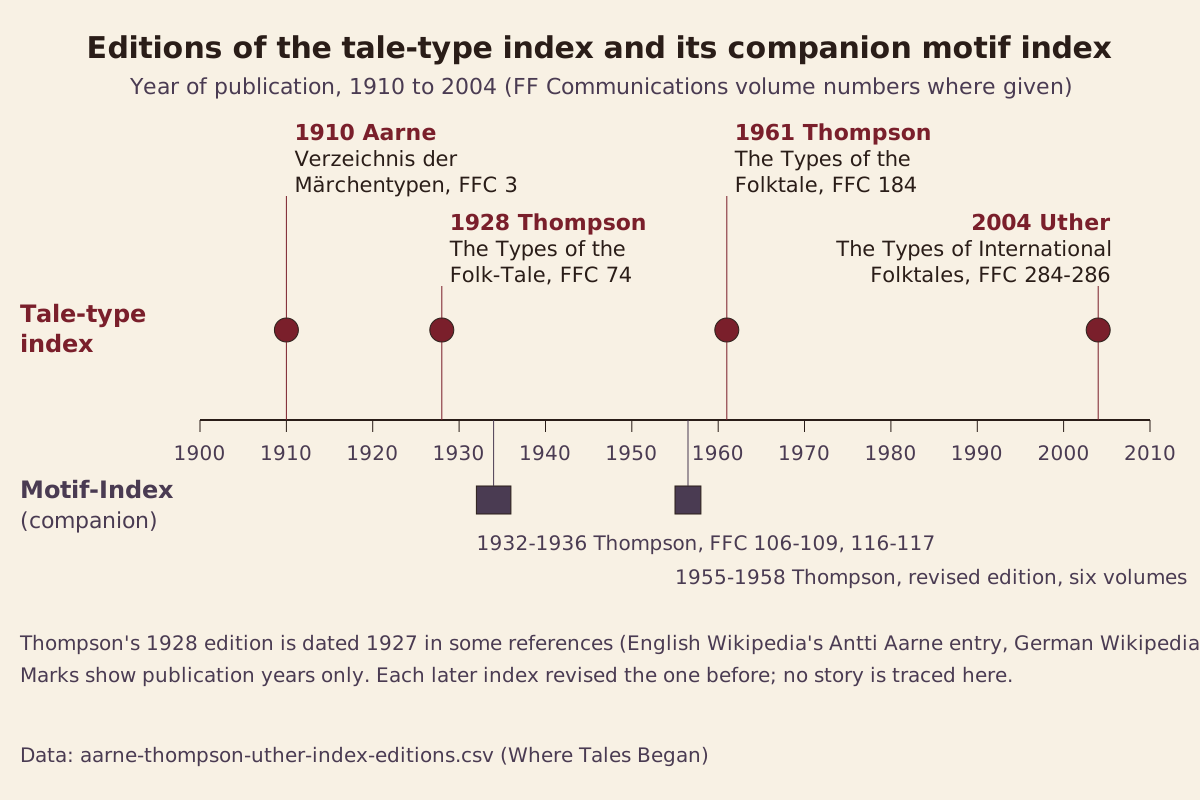
Hans-Jörg Uther's The Types of International Folktales came out in 2004, in three volumes (FF Communications 284–286). It gave the system the name Aarne–Thompson–Uther. As English Wikipedia summarizes his aims, Uther found many earlier descriptions cursory and often imprecise. He added more tales from eastern and southern Europe and dropped examples recorded in only one ethnic group.
The editions behind the timeline can be downloaded as a CSV file, with a source and link for every row.
How are the numbers grouped?
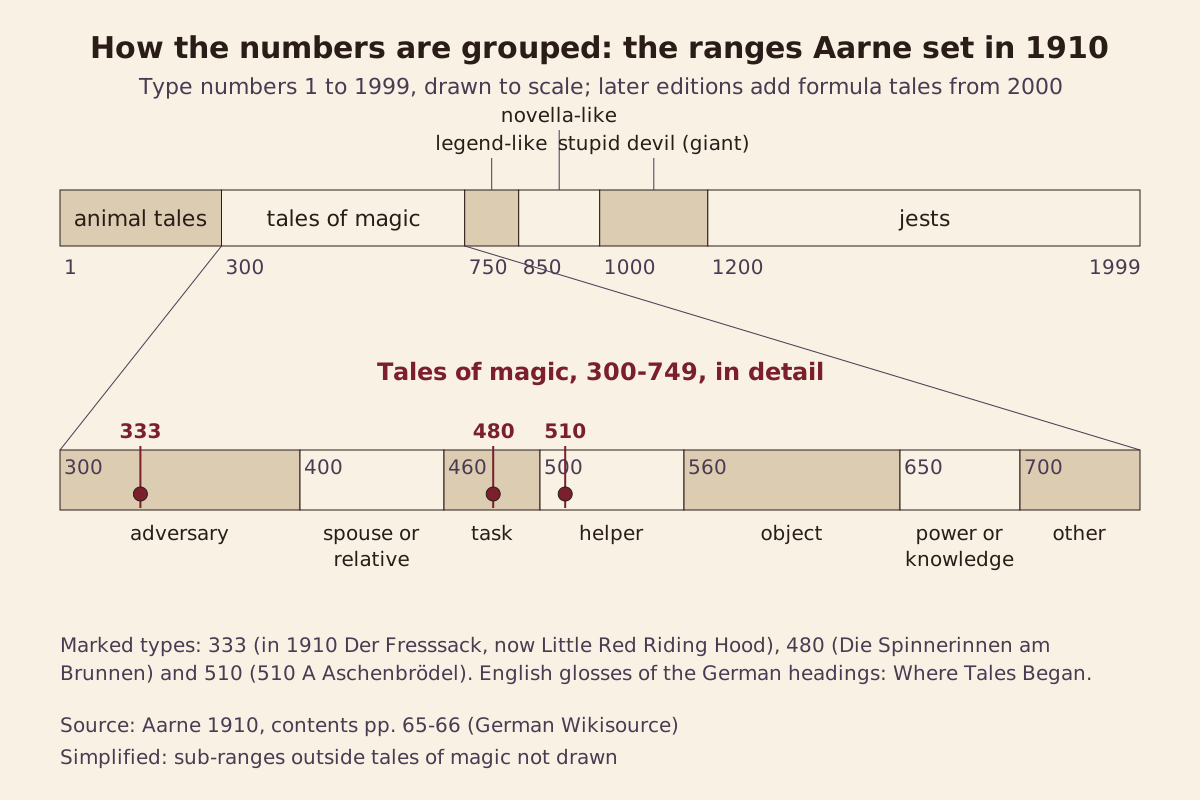
Aarne split the list into three main groups: Tiermärchen, eigentliche Märchen and Schwänke, or animal tales, tales proper and jests (Translation: Where Tales Began). He numbered the whole list in one continuous run. Starting again in each group, he wrote, would have made the labels too complicated. The contents pages of his 1910 list give these ranges.
| Numbers | Aarne's heading (1910) | In English (Translation: Where Tales Began) |
|---|---|---|
| 1–299 | Tiermärchen | animal tales |
| 300–749 | Zaubermärchen | tales of magic |
| 750–849 | Legendenartige Märchen | legend-like tales |
| 850–999 | Novellenartige Märchen | novella-like tales |
| 1000–1199 | Märchen vom dummen Teufel (Riesen) | tales of the stupid devil (giant) |
| 1200–1999 | Schwänke | jests |
German Wikipedia's summary of the current index gives the same blocks, with Aarne's German headings beside the English ones, and adds formula tales from number 2000, a group that Aarne's list did not have. Inside the tales of magic, Aarne sorted plots by the kind of supernatural element that drives them. So Little Red Riding Hood's number, 333, sits among supernatural adversaries, and Cinderella's 510 among supernatural helpers.
Type versus motif
A tale type is a whole plot that can be told on its own. A motif is one element inside a plot. The same motif can turn up in many types. Thompson, as English Wikipedia reports, called a motif the smallest element of a tale that has the power to persist in tradition, and in his view that power needed something unusual and striking.
His Motif-Index sorts motifs under letters, from A for mythological motifs to Z for miscellaneous groups. Within each letter, the motifs are numbered.
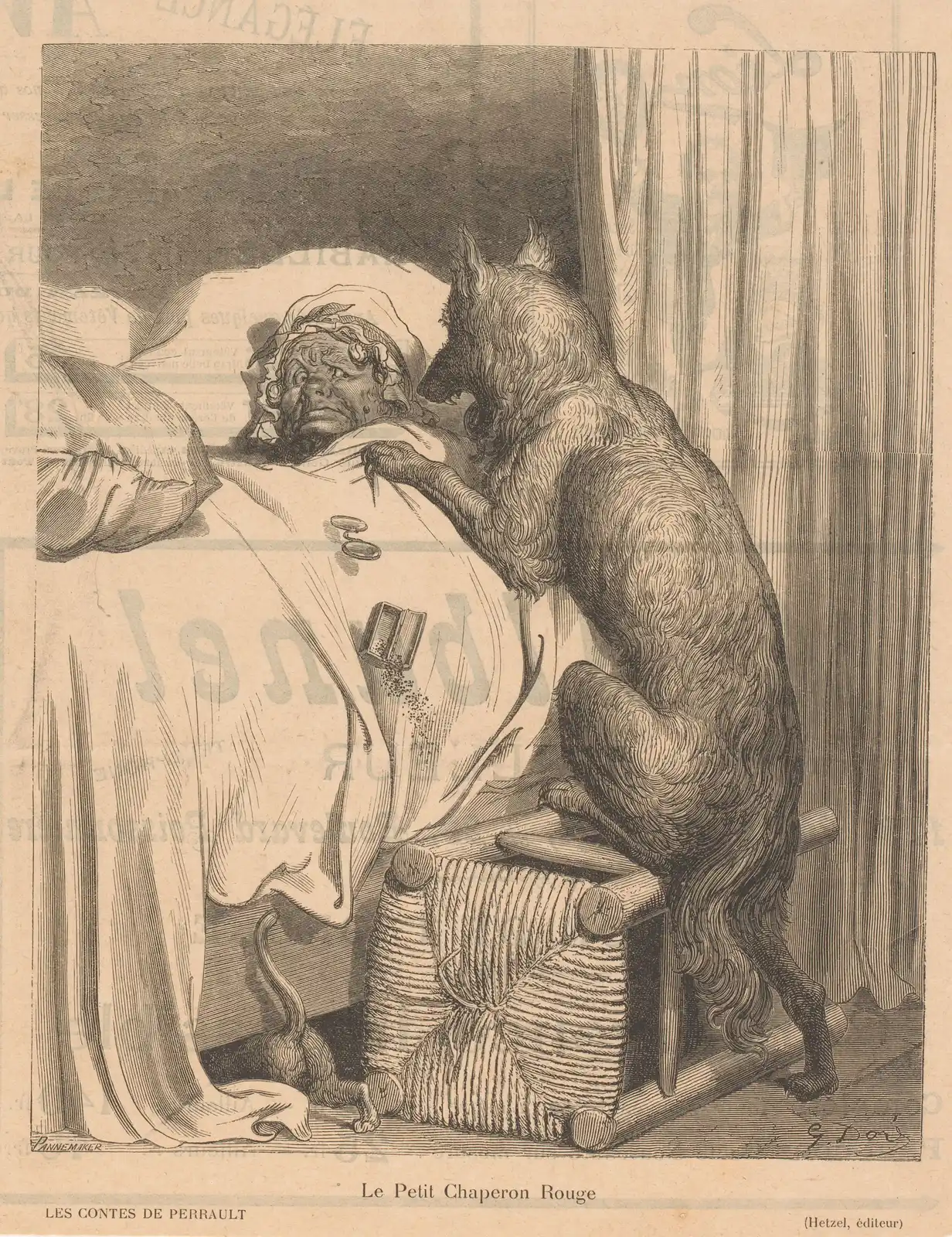
Aarne's own list shows the difference. He named type 333 "Der Fresssack", or "the glutton" (Translation: Where Tales Began). In it a wolf or another monster swallows people and animals, until all of them are rescued alive from its belly. Aarne sent the reader on to type 123, the wolf and the young goats, where the mother goat cuts open the wolf's stomach.
The rescue from the belly is one element in two plots. Type 333 is listed today as Little Red Riding Hood: English Wikipedia, D. L. Ashliman's online collection of folktexts and German Wikipedia's list all give the tale that number.
Source and licence
"Le Petit Chaperon Rouge, RP-P-OB-33.985" by Gustave Doré and Adolphe François Pannemaker; Rijksmuseum, Amsterdam, RP-P-OB-33.985 (CC0) — https://commons.wikimedia.org/wiki/File:Le_Petit_Chaperon_Rouge,_RP-P-OB-33.985.jpg — CC0 1.0 (https://creativecommons.org/publicdomain/zero/1.0/)Some elements turn up far outside any one plot. The texts set side by side in the flood myths comparison run from Mesopotamian clay tablets to Ovid, Apollodorus, the Satapatha-Brahmana and Mencius. They share an episode, a great flood, without telling one story from start to finish, so that entry compares them episode by episode. Thompson's 1955 Motif-Index gives the destruction of the world its own block among mythological motifs: A1000–A1099, world calamities and renewals.
What a shared number doesn't prove
The Cinderella entry on this site lines up seven dated versions of ATU 510A. Three of them show how far texts under one number can differ at the same point in the plot. Duan Chengshi's Ye Xian, written down before his death in 863, leaves one gold shoe behind and is helped by the bones of a fish. Perrault's heroine of 1697 loses a glass slipper and is helped by a fairy godmother.
The Grimms' Aschenputtel of 1857 loses her left golden slipper on a stairway smeared with pitch. Her help comes from a hazel twig that she plants on her mother's grave.
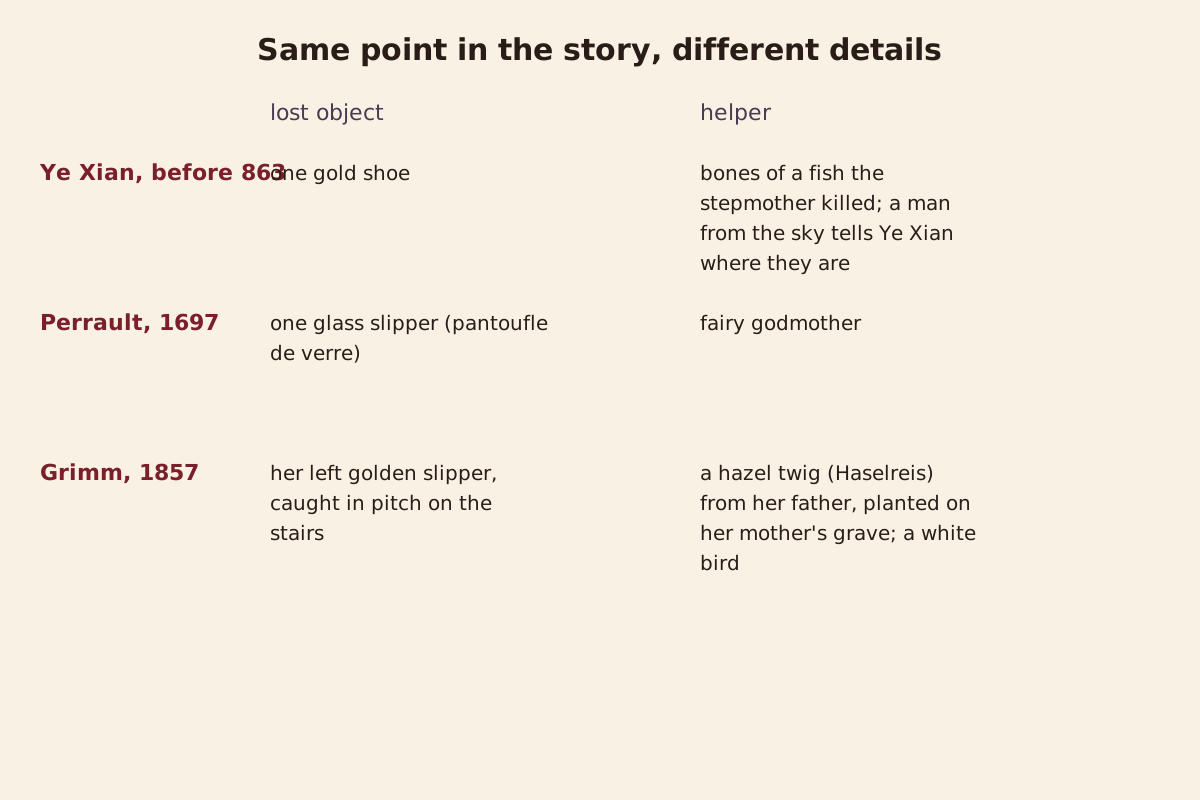
Where Tales Began calls a difference of this kind motif drift: a difference between recorded versions of the same tale type at the same point in the story. The term describes difference only. It does not claim that the glass slipper came from the golden shoe, or that Perrault knew the Chinese story. Nor does it say that either version is closer to a first telling.
The site uses the same term for recorded versions of a single myth, which have no type number.
A shared ATU number means that the texts were judged to follow the same plot. On its own, the number does not show that one text descends from another or that the two share an ancestor, and it does not rule either out. This site marks a direction between two versions only when published research supports a textual relation between them; otherwise the versions stand side by side, as Following the Paper Trail explains. The motif drift table in the Cinderella entry draws no arrows between Ye Xian, Perrault and the Grimms.
Why do folklorists still argue about the index?
The index grew out of a school that did look for origins. As English Wikipedia's entry on Julius Krohn summarizes it, the historic-geographic method compared variant texts to identify an "original" version and its origin. Aarne developed that method further. His 1910 preface says that folktales "wandern ganz besonders leicht", that is, "wander especially easily" (Translation: Where Tales Began), from region to region and from people to people.
Joseph Jacobs, according to English Wikipedia's Cinderella entry, tried to rebuild the tale's original as "The Cinder Maid." He compared features common to hundreds of European variants. These were claims about where tales began and how they spread, made by the index's builders and their contemporaries. A tale keeps its number whether or not anyone accepts them.
Criticism of the index itself has come from several sides, as English Wikipedia's index entry summarizes it. Vladimir Propp, of the Russian Formalist school of the 1920s, objected that the index ignores what each element does in the story. Tales that share elements can then be split apart, while very different tales can end up in one type.
In the same entry's account, Uther wrote in 2009 that Thompson's focus on oral tradition sometimes neglected older written versions. He also found eastern and southern Europe under-represented. Thompson himself had said that the catalogue might well be called one of the tales of Europe, West Asia and the lands settled by their peoples.
Source and licence
"Cinderella-Rackham-046" by Arthur Rackham, illustration for C. S. Evans, Cinderella (1919); scan: Maastricht University Library, MU KPB 022 — https://commons.wikimedia.org/wiki/File:Cinderella-Rackham-046.jpg — Public domain (illustrator Arthur Rackham d. 1939 and author C. S. Evans d. 1944 (Commons file page); US: published 1919, before 1931; EU: more than 70 years after both deaths)Alan Dundes, an outspoken critic, still counted the type and motif indexes among a folklorist's most valuable tools, as English Wikipedia reports his 1997 critique.
Do regional catalogues use the same numbers?
Tales left out of the international list can still have numbers in regional or national catalogues, as English Wikipedia's index entry notes. Its Motif-Index entry lists motif and tale-type indexes for regions that Thompson covered thinly or not at all, from Ernest Baughman's 1966 index of the folktales of England and North America to Hasan El-Shamy's 1995 guide for the Arab world. Nai-tung Ting's 1978 index of Chinese folktales, according to English Wikipedia's Ye Xian entry, has a type 510A, Cinderella, in which the heroine's helper is a fish.
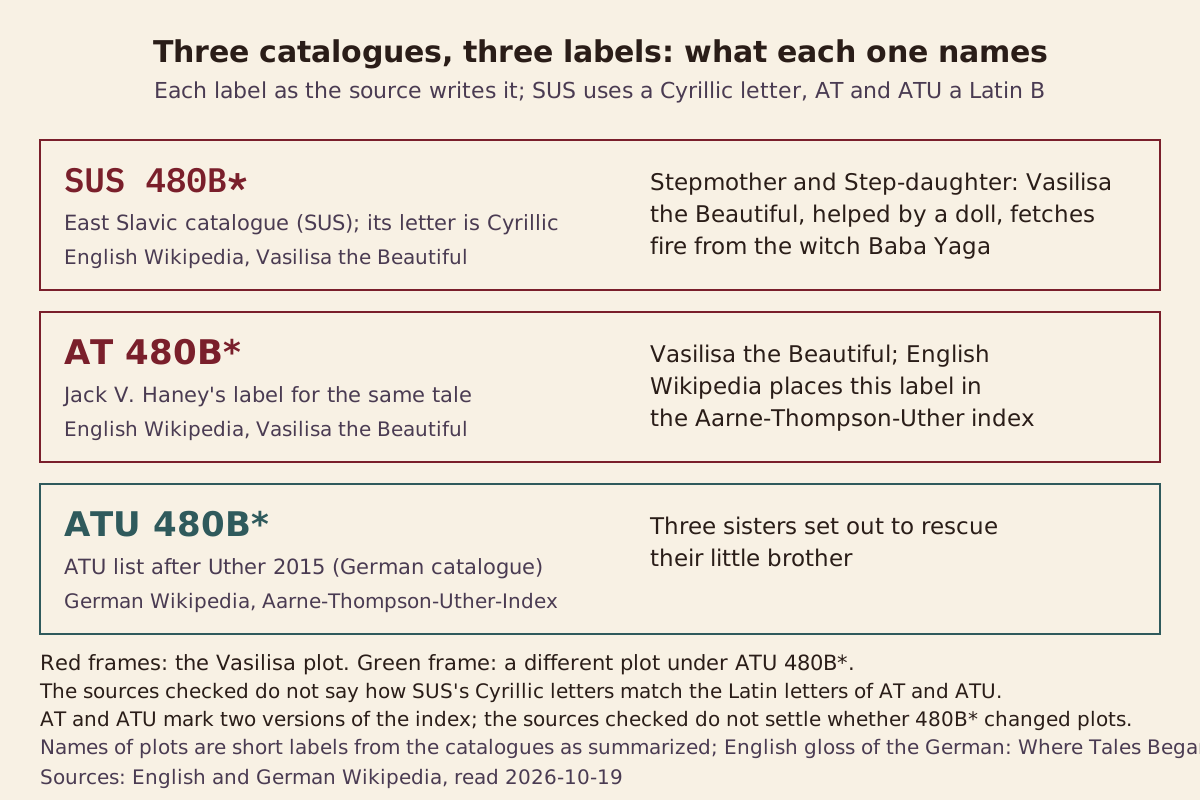
A label means what its catalogue says it means. English Wikipedia's entry on Vasilisa the Beautiful reports that Russian scholarship files the tale as SUS 480В*, Stepmother and Step-daughter, in the East Slavic catalogue. The SUS label uses the Cyrillic letter В, and the sources checked for this page do not say how SUS letters correspond to the Latin letters of AT and ATU. In that tale a doll from the heroine's dead mother helps her through the tasks set by the witch Baba Yaga.
The same entry says that Jack V. Haney classified the tale as AT 480B* in the Aarne–Thompson–Uther index. The ATU list excerpted on German Wikipedia, which follows Uther's 2015 German catalogue, gives 480B* to a different plot: three sisters set out to rescue their little brother. The two encyclopedias therefore give 480B* under two prefixes, AT and ATU, which mark two versions of the international index. The sources checked for this page do not settle whether the label changed plots between them.
Source and licence
"Three catalogues, three labels: SUS 480В*, AT 480B*, ATU 480B*" by Where Tales Began, https://wheretalesbegan.com/tales/aarne-thompson-uther-index/, licensed under CC BY 4.0 (https://creativecommons.org/licenses/by/4.0/)Earliest ink
- The numbered tale-type list: 1910. Antti Aarne, Verzeichnis der Märchentypen, FF Communications 3 (Helsinki, 1910), German Wikisource transcription. The earliest edition of this numbering in the sources checked; English Wikipedia lists earlier plot lists by von Hahn (1864) and Baring-Gould (1866) that did not use it.
- 510 A for Cinderella: 1910. The same list, p. 22, already numbers "Aschenbrödel" 510 A, with 510 B beside it. For the earliest dated text of the tale type itself, see the Cinderella entry.
- The name Aarne–Thompson–Uther: 2004. Hans-Jörg Uther, The Types of International Folktales, FF Communications 284–286 (Helsinki, 2004), as recorded in English Wikipedia's entry on the index; German Wikipedia also dates the ATU name to this revision.
Sources checked through 2026-10-19.
Where the trail goes next
- See one number at work: Cinderella Around the World sets seven dated versions of ATU 510A side by side, motif by motif.
- Follow the witch from another number: Baba Yaga follows the witch Vasilisa meets, through the tales Alexander Afanasyev collected.
- Read the 1910 list itself: Aarne's Verzeichnis der Märchentypen gives each type in a line or two of German.
Cite this page
Where Tales Began. “Aarne–Thompson–Uther Index: Same Number, Not Same Ancestor.” First published October 20, 2026; last substantive revision October 20, 2026. https://wheretalesbegan.com/tales/aarne-thompson-uther-index/. Accessed: add the date you read this page.
- Author
- Where Tales Began
- Title
- Aarne–Thompson–Uther Index: Same Number, Not Same Ancestor
- Published
- Revised
- Address
- https://wheretalesbegan.com/tales/aarne-thompson-uther-index/
Sources
- Antti Aarne, Verzeichnis der Märchentypen, mit Hülfe von Fachgenossen ausgearbeitet, FF Communications 3 (Helsinki: Suomalaisen Tiedeakatemian Toimituksia, 1910); German Wikisource transcription (read 2026-10-19) de.wikisource.org/wiki/Verzeichnis_der_M%C3%A4rchentypen Read: preface pp. II and IV–VIII; types 123, 333, 480, 510 and 545 (pp. 7, 15, 21–23); contents pp. 65–66
- Duan Chengshi, Youyang zazu, sequel, chapter 1 (the Ye Xian passage), Chinese Wikisource transcription, base edition not named on the page (read 2026-10-19) zh.wikisource.org/wiki/%E9%85%89%E9%99%BD%E9%9B%9C%E4%BF%8E/%E7%BA%8C%E9%9B%86/%E5%8D%B7%E4%B8%80 Read: the Ye Xian passage
- Charles Perrault, "Cendrillon, ou la petite pantoufle de verre," in Histoires ou contes du temps passé (Paris: Claude Barbin, 1697), pp. 117–148; French Wikisource transcription (read 2026-10-19) fr.wikisource.org/wiki/Histoires_ou_Contes_du_temps_pass%C3%A9_(1697)/Original/Cendrillon Read: full text
- Jacob and Wilhelm Grimm, "Aschenputtel," Kinder- und Hausmärchen, vol. 1, 7th ed. (Göttingen: Dieterich, 1857), no. 21, pp. 119–126; German Wikisource transcription (read 2026-10-19) de.wikisource.org/wiki/Aschenputtel_(1857) Read: full text
- Stith Thompson, Motif-Index of Folk-Literature, revised and enlarged ed., vol. 1 (Bloomington: Indiana University Press, 1955), section A1000–A1099, World calamities and renewals; English Wikisource transcription (read 2026-10-19) en.wikisource.org/wiki/Motif-Index_of_Folk-Literature/Volume_1/A/1000 Read: section heading and motifs A1000–A1002.2.3 (the rest of the section is not yet transcribed); consulted for checking, not quoted
- English Wikipedia, "Aarne–Thompson–Uther Index" (read 2026-10-19) en.wikipedia.org/wiki/Aarne%E2%80%93Thompson%E2%80%93Uther_Index Read: full article, used as a secondary summary
- German Wikipedia, "Aarne-Thompson-Uther-Index" (read 2026-10-19) de.wikipedia.org/wiki/Aarne-Thompson-Uther-Index Read: full article, used as a secondary summary
- English Wikipedia, "Motif-Index of Folk-Literature" (read 2026-10-19) en.wikipedia.org/wiki/Motif-Index_of_Folk-Literature Read: full article, used as a secondary summary
- English Wikipedia, "Antti Aarne" (read 2026-10-19) en.wikipedia.org/wiki/Antti_Aarne Read: full article
- English Wikipedia, "Julius Krohn" (read 2026-10-19) en.wikipedia.org/wiki/Julius_Krohn Read: full article
- English Wikipedia, "Little Red Riding Hood" (read 2026-10-19) en.wikipedia.org/wiki/Little_Red_Riding_Hood Read: infobox and introduction
- D. L. Ashliman, "Little Red Riding Hood and other tales of Aarne-Thompson-Uther type 333," Folklore and Mythology Electronic Texts, University of Pittsburgh (read 2026-10-19) sites.pitt.edu/~dash/type0333.html Read: page title and type number only
- English Wikipedia, "Cinderella" (read 2026-10-19) en.wikipedia.org/wiki/Cinderella Read: sections on the tale type and on Joseph Jacobs
- English Wikipedia, "Ye Xian" (read 2026-10-19) en.wikipedia.org/wiki/Ye_Xian Read: full article and notes
- English Wikipedia, "Vasilisa the Beautiful" (read 2026-10-19) en.wikipedia.org/wiki/Vasilisa_the_Beautiful Read: plot and tale type sections