Deep dive
Cinderella Around the World: 7 Dated Versions of ATU 510A
- By
- Where Tales Began
- Published
- Last substantive revision
How records are checked: Following the paper trail. Corrections: Fixes to the record. Questions: Contact us.
Fast facts
- Name
- Cinderella (folktale type ATU 510A)
- Classification
- ATU 510A, Cinderella, in the Aarne-Thompson-Uther index (Uther revision, 2004)
- Earliest ink
- Before 863: Ye Xian in Duan Chengshi's Youyang zazu, the earliest of the 7 dated ATU 510A versions checked here
- Where found
- Versions checked here: southern China (before 863), Naples (1634), Paris (1697), German lands (1812, 1857), Norway (English text 1859), Ireland (1890)
- TL;DR
- Of the 7 dated ATU 510A versions checked here, the earliest is Ye Xian, written down by Duan Chengshi before his death in 863. Her helper is a fish's bones and her lost shoe is gold, not glass. A shared type number marks a shared plot, not a proven common ancestor.
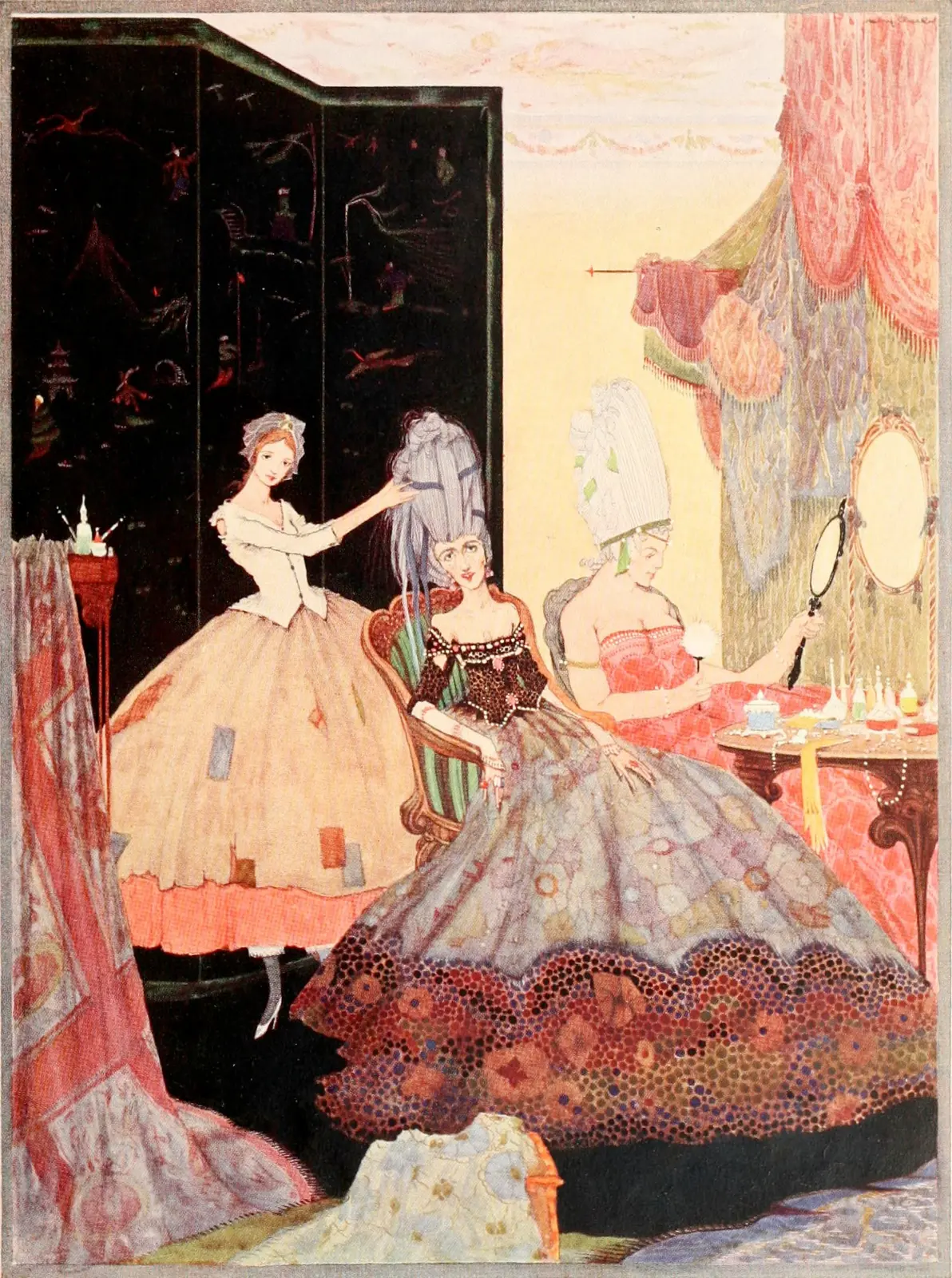
Source and licence
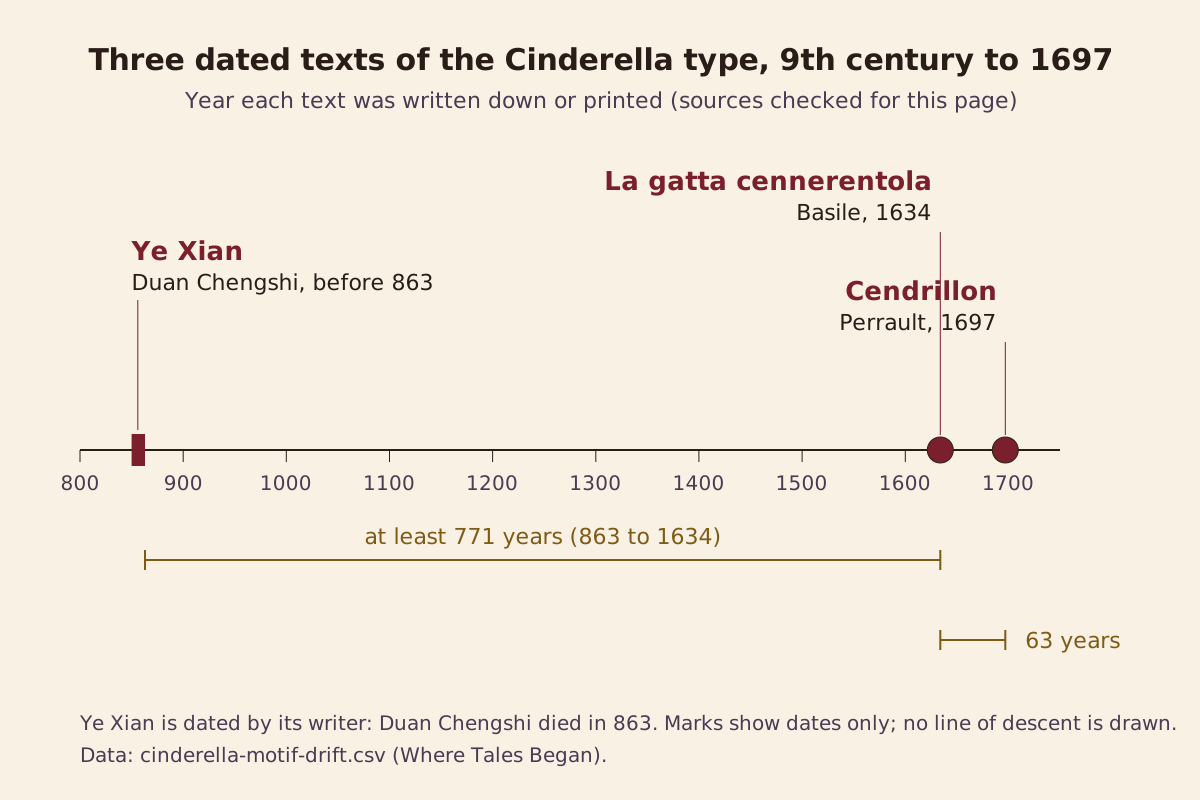
"Page facing 80 illustration from Fairy tales of Charles Perrault (Clarke, 1922)" by Charles Perrault, Harry Clarke (ill.) — https://commons.wikimedia.org/wiki/File:Page_facing_80_illustration_from_Fairy_tales_of_Charles_Perrault_(Clarke,_1922).jpg — Public domain (illustrator Harry Clarke d. 1931 (the file description gives Clarke, Harry, 1889-1931); US: published 1922 in London by Harrap, before 1931; EU: 70 years after the artist's death)A fish's bones, not a fairy godmother, dress the earliest dated Cinderella in the sources checked here. Her name is Ye Xian, and Duan Chengshi wrote her story into his miscellany Youyang zazu before he died in 863, at least 834 years before Charles Perrault's "Cendrillon" was printed in Paris in 1697. Of the seven dated texts compared on this page, all filed under ATU 510A, the Cinderella type in the standard index of folktale types, hers is the earliest. Strabo's story of Rhodopis is older, but it has no stepmother and no sisters, so it sits outside the type.
The seven texts give no single original to find. Instead, they give a first-ink date for the type: the date of the earliest written record that can be checked, which marks where the paper evidence starts, not where the story began. Each version below is quoted from the edition named with it, and how the site dates records sets out the rules used for every date on the page.
A gold shoe in ninth-century China
Duan sets the story before the Qin and Han dynasties. A cave chief named Wu has two wives, and one dies, leaving a clever daughter, Ye Xian. When Wu dies too, the stepmother sends Ye Xian to cut wood on steep slopes and draw water from deep wells. Ye Xian raises a small fish in a pond, until the stepmother puts on the girl's clothes, calls the fish, kills it, eats it and hides the bones under the dung heap.
A man with loose hair and rough clothes comes down from the sky. He tells her to pray to the bones for whatever she needs. At the cave festival she wears a kingfisher-green jacket and gold shoes. When her stepsister seems to know her, she runs home and leaves one shoe behind.
躡金履……遂遺一隻履
"She wore shoes of gold … and so she left one shoe behind." (Translation: Where Tales Began)
The shoe is sold to Tuohan, an island kingdom, and its king has the women of his country try it on. Duan says it was an inch shorter than the smallest foot, and so light that it made no sound on stone. The king finds Ye Xian, the shoe fits, and he makes her his chief wife. The stepmother and her daughter are killed by flying stones.
Duan ends by naming his source: Li Shiyuan, a former servant of his household from the cave settlements of Yongzhou, who knew many strange tales of the south. English Wikipedia's Youyang Zazu entry calls Li a native of present-day Nanning, and its entries date the book to around 850 (Ye Xian) and 853 (Duan Chengshi). The Chinese Wikisource author page gives Duan's dates as 803 to 863, so this page dates the text only as "before 863."
The Wikisource transcription quoted here does not name the printed edition it follows. In English, Arthur Waley's article "The Chinese Cinderella Story" appeared in Folklore in 1947.
What makes a story ATU 510A?
Folklorists sort tales with the Aarne–Thompson–Uther index, a numbered catalogue of folktale types. As English Wikipedia's entry on the index summarizes it, Antti Aarne published it in 1910, Stith Thompson revised it in 1928 (1927 in some accounts) and 1961, and Hans-Jörg Uther revised it again in 2004. Type 510A is the one called Cinderella. English Wikipedia's Cinderella entry gives a female persecutor as the type's defining trait.
That rule leaves Rhodopis outside. Strabo's Geography (17.1.33), written between 7 BC and AD 23 by English Wikipedia's dating, reports the story as a tale people tell: "an eagle snatched one of her sandals from the hands of her female attendant and carried it to Memphis," in Hans Claude Hamilton and William Falconer's 1854–57 translation. The king searches the country for the sandal's owner and marries her, but no stepmother or sister appears. D. L. Ashliman's ATU 510A index, which opens with Rhodopis, notes the same gap.
Marie-Catherine d'Aulnoy's "Finette Cendron," listed as "Finette" in the contents of the 1698 Paris printing of her Contes des fées, is also left out of the count. English Wikipedia classes it as a mix of ATU 327A and 510A, and as of 2026-10-18 the 1698 pages are not transcribed on French Wikisource, so the tale could not be quoted from that printing.
Inside the type, the seven texts differ at the same points in the plot. This page calls each such difference a motif drift: a difference between recorded versions of the same tale type at the same point in the story, with no claim that one version turned into another. The grid marks six of those points.
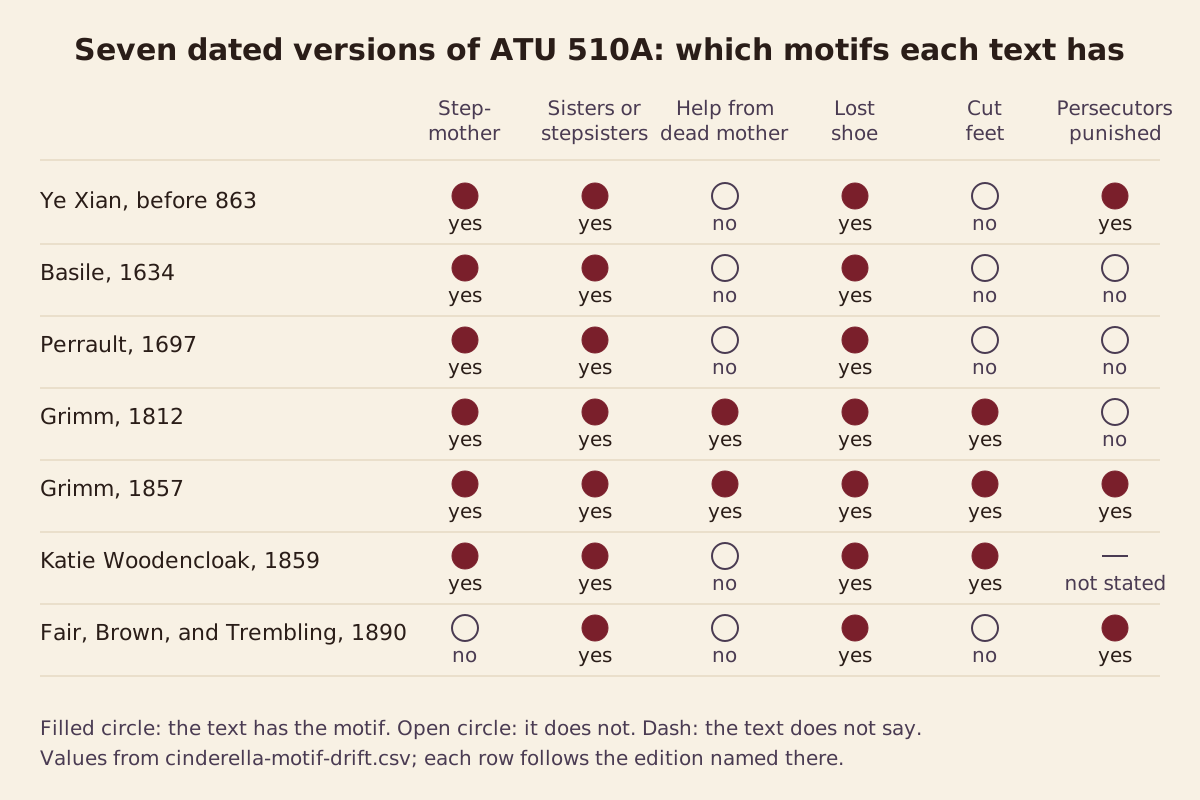
| Version and date | Helper | Where she goes | The lost shoe | What happens to the persecutors |
|---|---|---|---|---|
| Ye Xian, before 863 | a fish's bones | the cave festival | one gold shoe | killed by flying stones |
| Basile, 1634 | a date tree from the fairies of Sardinia | three feasts | a chianiello, a slipper | go home to their mother |
| Perrault, 1697 | a fairy godmother | two balls | one glass slipper | forgiven and married to two lords |
| Grimm, 1812 | a tree on her mother's grave, and doves | a ball lasting three days | a golden slipper caught in pitch | no punishment in the text |
| Grimm, 1857 | a hazel tree on the grave, a white bird and doves | a festival lasting three days | her left golden slipper, caught in pitch | doves peck out their eyes |
| Katie Woodencloak, 1859 | a dun bull | church, three times | a gold shoe caught in pitch | not stated |
| Fair, Brown, and Trembling, 1890 | the henwife | Mass, three Sundays | one shoe, pulled from her foot | the eldest sister is later set adrift |
Table data: cinderella-motif-drift.csv, with the edition, source and link for every row.
Basile's cat Cinderella, 1634
The earliest dated European text among the seven is Giambattista Basile's "La gatta cennerentola," the sixth tale of the first day of his Neapolitan Lo cunto de li cunti, printed after his death in 1634, as English Wikipedia notes. Its heroine, Zezolla, is no simple innocent. Her governess teaches her to kill her stepmother with the falling lid of a clothes chest, then has Zezolla talk her father into marrying the governess. The new stepmother brings out six daughters of her own, and Zezolla is sent to the kitchen as Gatta cennerentola, "the cinder cat" (Translation: Where Tales Began).
Her help comes from the fairies of Sardinia, not from a dead mother. When her father sails there, she asks only to be remembered to the fairies' dove; he forgets, his ship cannot leave port, and he goes to the fairies' grotto. A fairy sends her a date to plant, a golden hoe, a golden bucket and a silk towel. In four days the plant grows as tall as a woman, and a fairy steps out with a rhyme that dresses and undresses her.
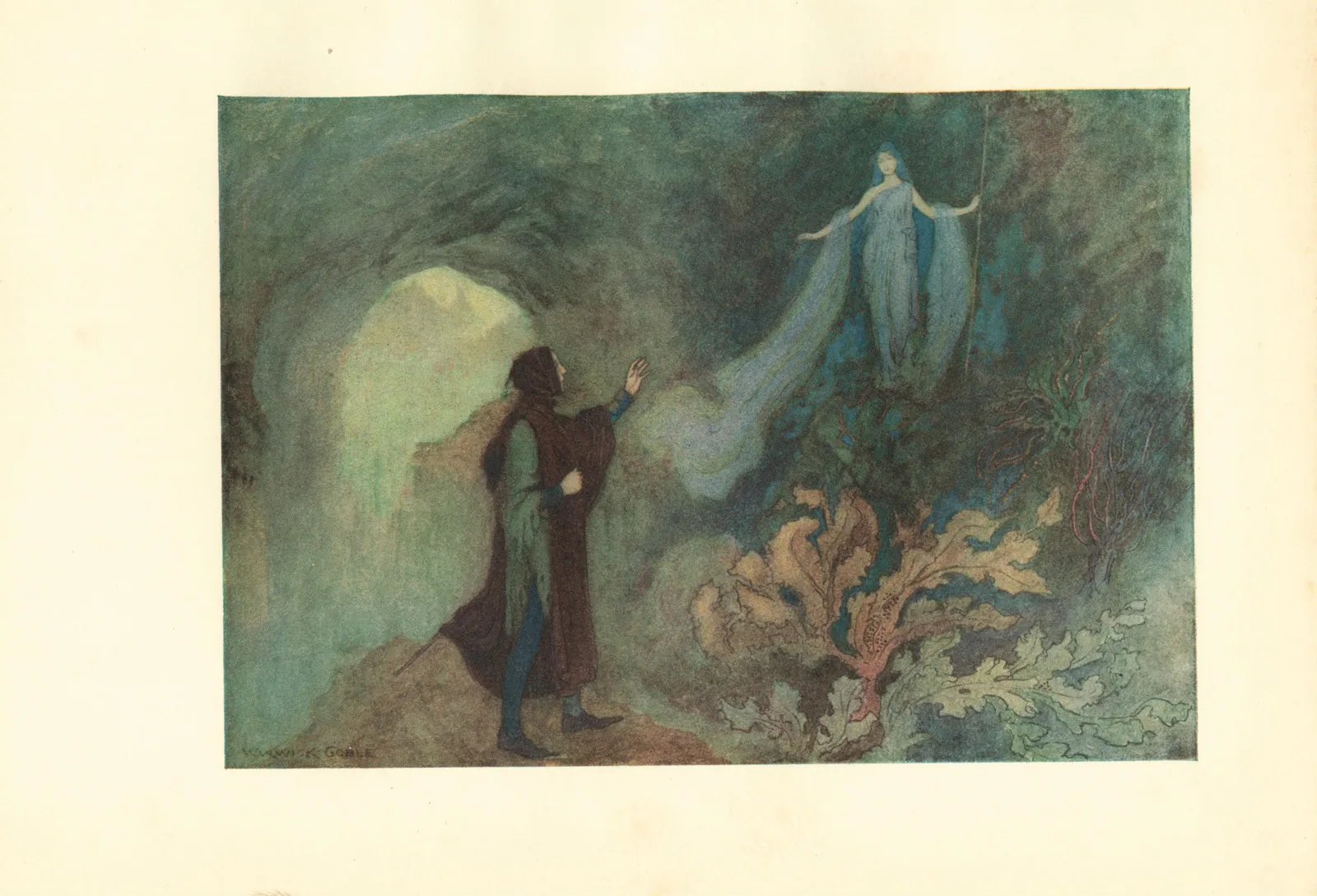
Source and licence
"Stories from the Pentamerone-0088" by Warwick Goble (ill.); Giambattista Basile, E. F. Strange — https://commons.wikimedia.org/wiki/File:Stories_from_the_Pentamerone-0088.jpg — Public domain (illustrator Warwick Goble d. 1943 (Commons category Warwick Goble: 1862-1943); US: published 1911 by Macmillan, before 1931; EU: 70 years after the artist's death)At three feasts the king sees her. Twice she escapes his servant by throwing down gold coins and then pearls and jewels; the third time, as her coach races off, she loses a chianiello, which Benedetto Croce's 1891 notes explain as a pianella, a slipper.
The king holds a banquet for all the women of the land, and the slipper leaps onto Zezolla's foot "comme lo fierro corre a la calamita," as iron runs to a magnet (Translation: Where Tales Began). The stepsisters slip home to their mother. The tale closes on a proverb: "Ca pazzo è chi contrasta co le stelle," he is mad who fights the stars (Translation: Where Tales Began).
Perrault's glass slipper, 1697
Perrault's "Cendrillon, ou la petite pantoufle de verre" fills pages 117 to 148 of Histoires ou contes du temps passé, printed in Paris by Claude Barbin in 1697, 63 years after Basile's tale. Here the helper is a godmother who is a fairy, "sa Maraine, qui estoit Fée." She turns a pumpkin into a gilded coach, six mice into horses, a rat into a coachman and six lizards into footmen. She sends Cinderella to two balls with a warning to leave before midnight, and on the second night Cinderella forgets the hour and drops one of her slippers as she runs.
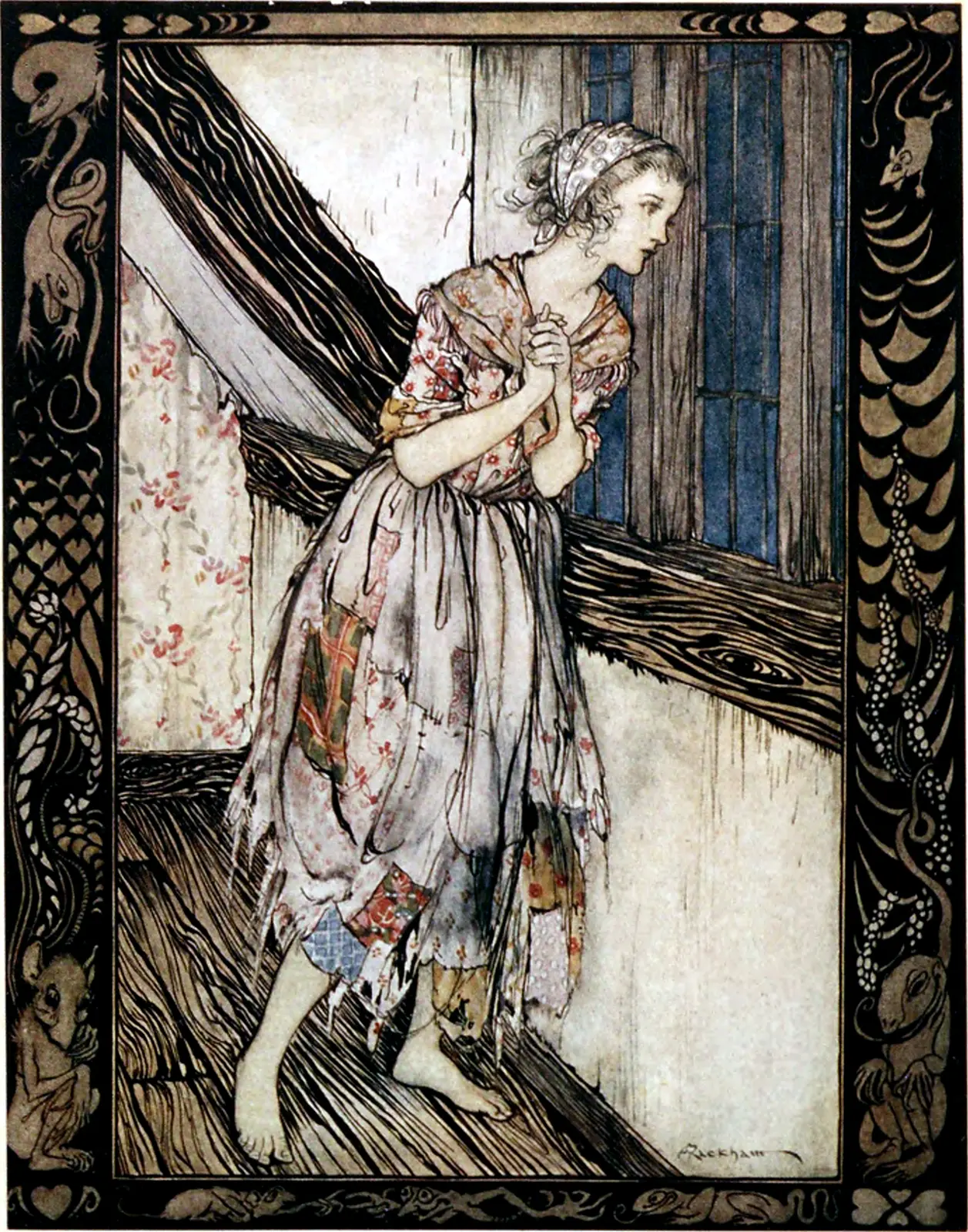
In the English text of Andrew Lang's The Blue Fairy Book (1889), the godmother "gave her a pair of glass slippers, the prettiest in the whole world." The slipper is tried on princesses, then duchesses, then the whole court, and Cinderella fits it and takes the other one from her pocket. Her stepsisters beg her pardon. She forgives them, lodges them in the palace and marries them that same day to two great lords of the court.
Source and licence
"Cinderella-Rackham-008p" by Arthur Rackham (ill.); C. S. Evans — https://commons.wikimedia.org/wiki/File:Cinderella-Rackham-008p.jpg — Public domain (illustrator Arthur Rackham d. 1939 (Commons creator data: 1867-1939); US: published 1919, before 1931; EU: 70 years after the artist's death)Was the slipper glass or fur? Perrault's printed text says glass. In the 1697 text the slipper's material is named four times, counting the title, and each time it is verre, by this page's count; vair, a fur, does not appear.
The fur reading is argued in Honoré de Balzac's Sur Catherine de Médicis (1841, by English Wikipedia's dating): in Katharine Prescott Wormeley's English translation, "Cinderella's slipper, which was no doubt of vair (the fur), is said to have been made of verre (glass)." Balzac names no earlier text that reads vair, and English Wikipedia's Cinderella entry reports a scholarly view that the glass was Perrault's own deliberate invention.
The Grimms' hazel tree, 1812 and 1857
Jacob and Wilhelm Grimm printed "Aschenputtel" as no. 21 of their Kinder- und Haus-Märchen in 1812 and kept revising it. The seventh edition of 1857, which German Wikisource labels the brothers' final edition, prints it under the title "Aschenbuttel." The two texts follow the same plot but differ at many points, so this page counts them as two dated versions.
| Point in the story | 1812 (first edition, Berlin) | 1857 (seventh edition, Göttingen) |
|---|---|---|
| Help at the grave | the dying mother: "pflanz ein Bäumlein auf mein Grab," "plant a little tree on my grave" (Translation: Where Tales Began) | a hazel twig, "ein Haselreis," that knocks off the father's hat on his way home from a fair |
| The first night | she watches the ball from the dovecote | she dances with the prince, then hides in the dovecote |
| Slippers | silver, then golden | stitched with silk and silver, then all gold |
| The cut feet | the elder cuts her heel, the younger her toes | the elder cuts off her toe, the second part of her heel |
| The ending | the prince takes the true bride home | doves peck out the stepsisters' eyes at the wedding |
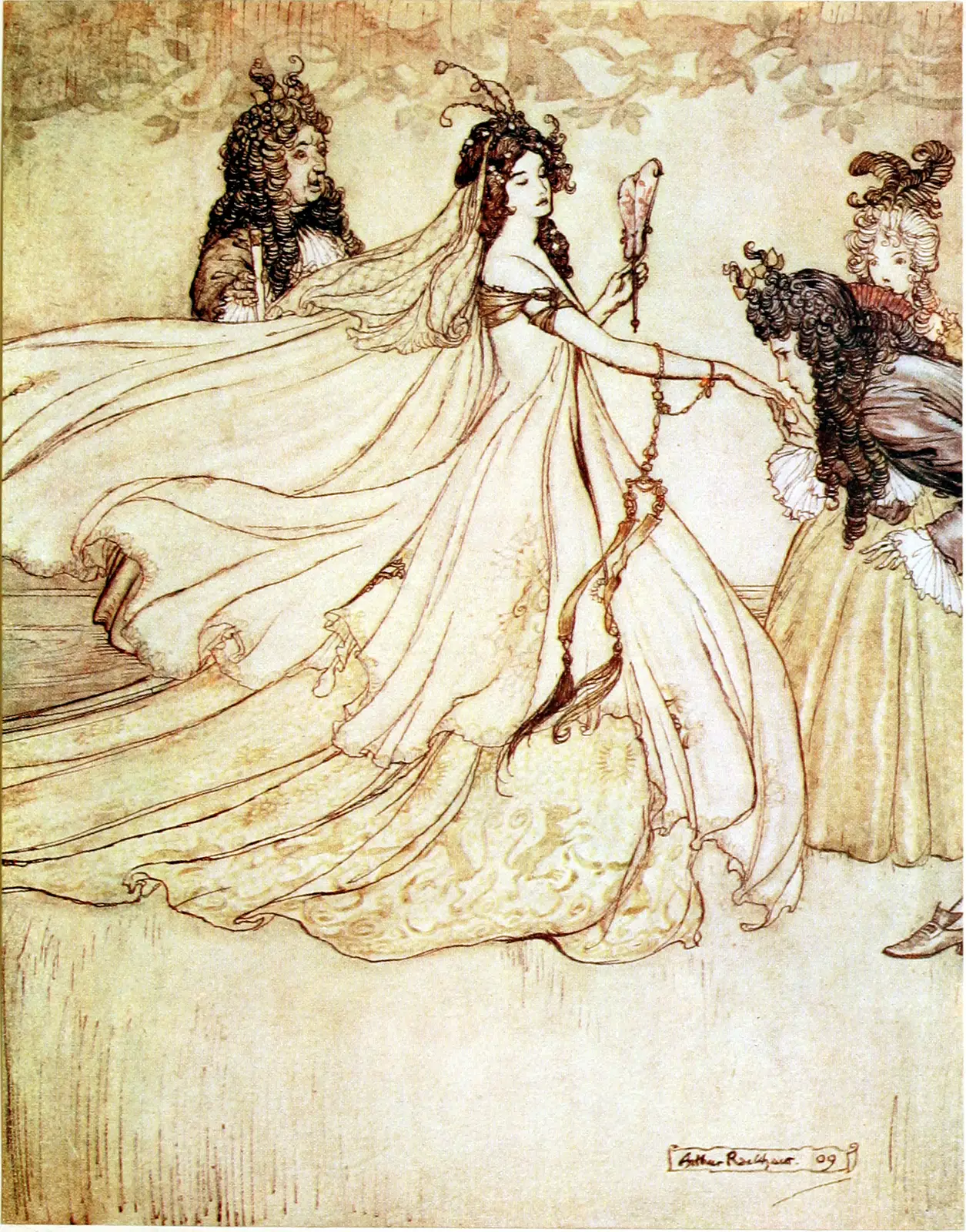
Do the stepsisters lose their eyes in every version? Not among the seven dated texts here. The 1812 text ends with the prince taking the true bride home, while in Margaret Hunt's 1884 English translation of the 1857 text "the pigeons pecked out one eye of each of them" on the way into church and the other eye on the way out.
The second edition of 1819 already has both the hazel twig and the blinding. Perrault's stepsisters are forgiven, Basile's go home, and Ye Xian's stepmother and stepsister are killed by flying stones.
Source and licence
"Snowdrop-Rackham-053" by Arthur Rackham (ill.); Brothers Grimm — https://commons.wikimedia.org/wiki/File:Snowdrop-Rackham-053.jpg — Public domain (illustrator Arthur Rackham d. 1939 (Commons creator data: 1867-1939); US: published before 1931 (the plate is signed and dated 1909, and the file page gives a 1909 New York edition); EU: 70 years after the artist's death)The Grimms knew both earlier European texts compared here. Their 1812 notes to no. 21 name Perrault's "Cendrillon," Madame d'Aulnoy's "Finnette Cendron" and Basile's "Cennerentola" (Pentamerone 1, 6), which they call unvergleichbar schöneren, "incomparably more beautiful" (Translation: Where Tales Began).
Help from a dead mother has a close match outside the type. In "Vasilisa the Beautiful," no. 104 in Alexander Afanasyev's Russian folktales as printed in the 1984–85 Nauka edition, the dying mother gives her daughter a doll ("оставляю тебе вот эту куклу"); in Leonard A. Magnus's 1915 English translation she says, "I will leave you my mother's blessing and this doll." English Wikipedia reports that Russian scholarship files that tale under SUS 480В* (with a Cyrillic В) and Jack Haney under AT 480B*, not 510A. The doll and the grave tree are set side by side here as matching motifs only; the Baba Yaga entry follows Vasilisa to the witch's hut.
Versions recorded elsewhere
Two dated 19th-century texts from the north and west of Europe also turn on a lost shoe. "Katie Woodencloak," a Norwegian tale from Peter Christen Asbjørnsen and Jørgen Moe's collection, is quoted here from George Webbe Dasent's English translation, Popular Tales from the Norse, in the second edition, dated 1859 in D. L. Ashliman's bibliography. Its helper is a dun bull with a food-giving cloth in its ear. Katie goes to church three times, and the third time the prince has pitch poured in the porch and keeps one of her gold shoes.
The shoe seems to fit Katie's stepsister until a bird sings:
A bit off her heel, And a bit off her toe; Katie Woodencloak's tiny shoe Is full of blood—that's all I know.
"Fair, Brown, and Trembling," printed by Jeremiah Curtin in Myths and Folk-lore of Ireland (1890), has no stepmother at all. Trembling is kept in the kitchen by her own older sisters, Fair and Brown, because she is the most beautiful of the three. An old henwife dresses her for Mass on three Sundays, and on the third Trembling asks for "shoes for my feet with the toes red, the middle white, and the backs and heels green." The prince of Omanya grabs her foot as she rides off and keeps the shoe; English Wikipedia classes this first part as ATU 510A and the rest of the tale as ATU 403.
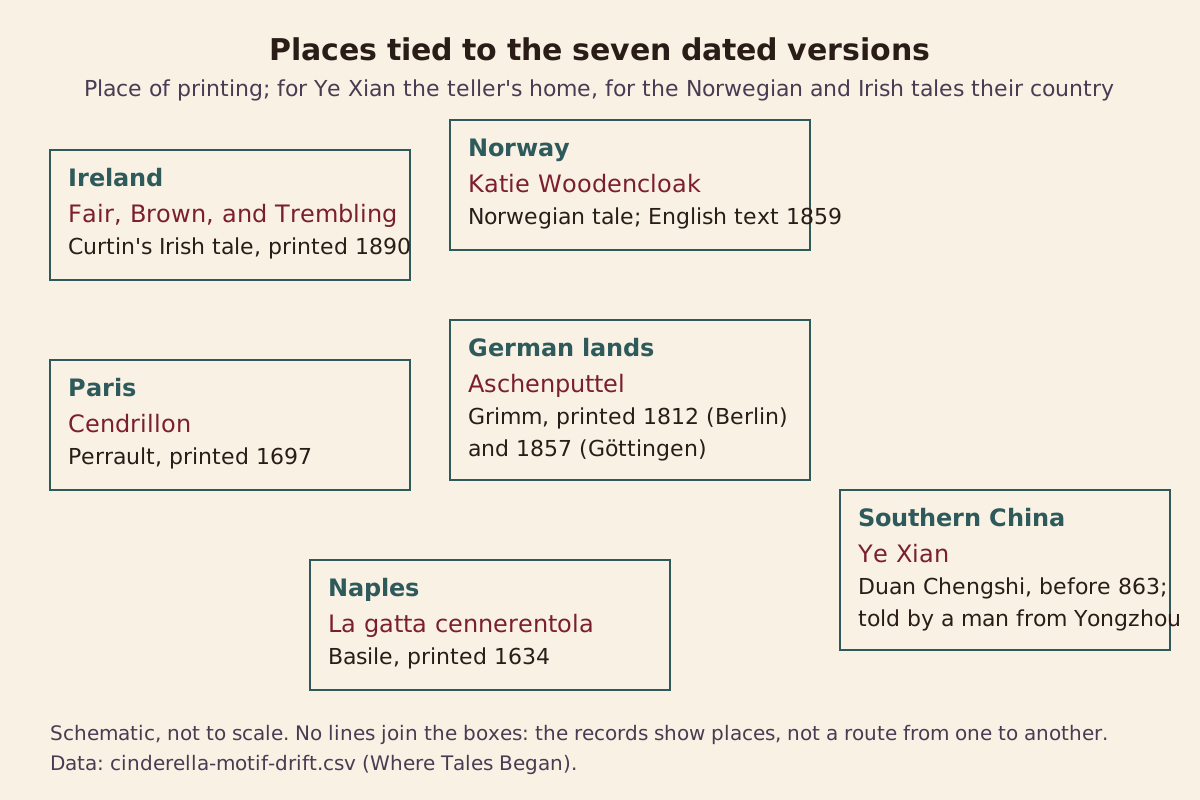
A version written down before 863 by a man who heard it from a teller from Yongzhou, and another printed in Paris in 1697, are two separate records. None of the sources read for this page traces a written route from one to the other, so the map shows places only.
One number, 345 variants, and what neither proves
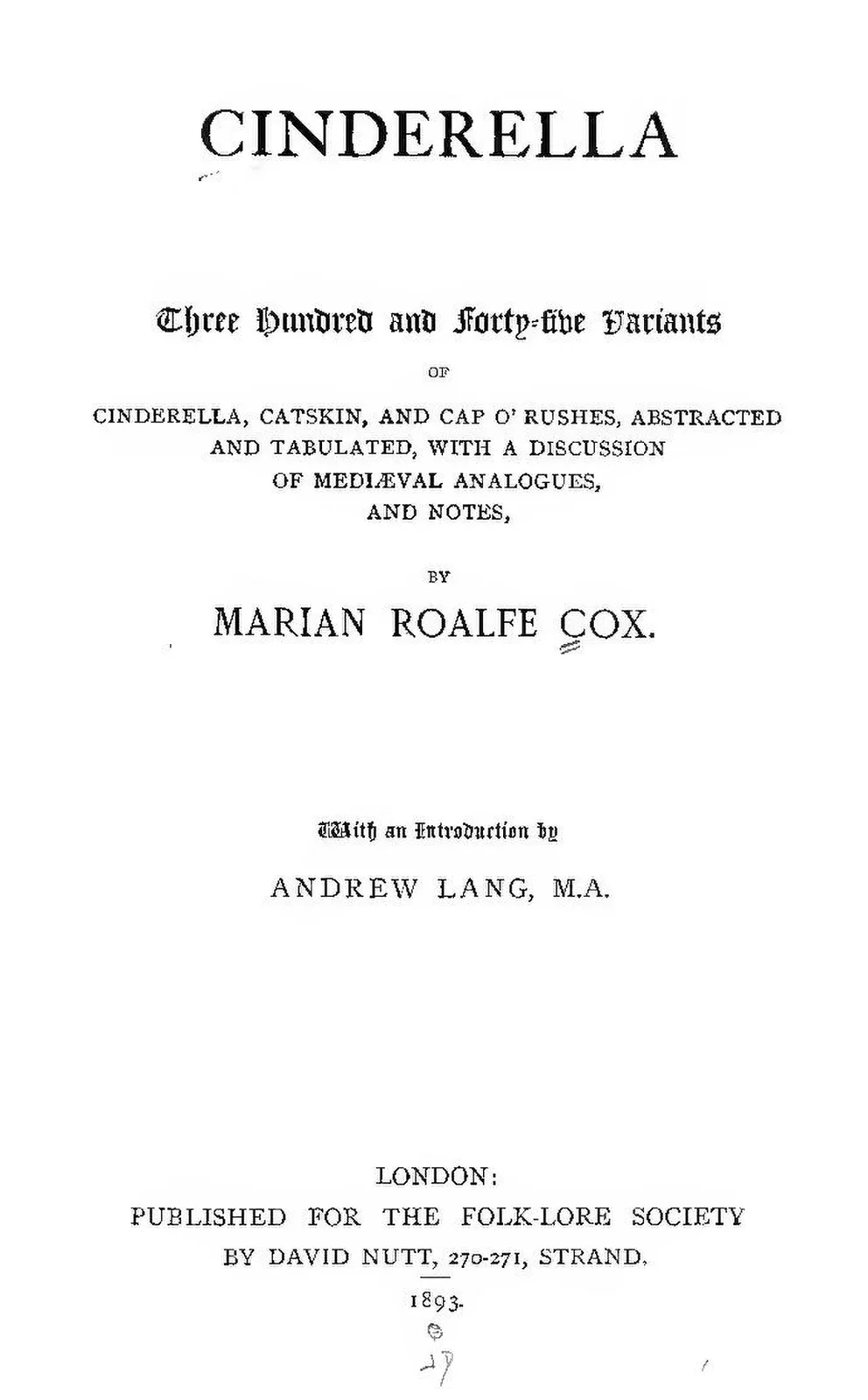
A much larger count comes from Marian Roalfe Cox's Cinderella: Three Hundred and Forty-five Variants of Cinderella, Catskin, and Cap o' Rushes, published for the Folk-Lore Society in London in 1893. The 345 variants in her title cover more than one story. Her preface (pp. xxv–xxvi) sorts them into Cinderella, marked by an ill-treated heroine and recognition by a shoe; Catskin, marked by an unnatural father and the heroine's flight; Cap o' Rushes, marked by a King Lear judgment; and two further groups of indeterminate stories and hero tales. Her table of contents starts the Cinderella abstracts on page 1 and the Catskin abstracts on page 53.
Source and licence
"Cinderella; three hundred and forty-five variants of Cinderella, Catskin, and Cap o'Rushes (IA cu31924007918299)" by Marian Roalfe Cox — https://commons.wikimedia.org/wiki/File:Cinderella%3B_three_hundred_and_forty-five_variants_of_Cinderella,_Catskin,_and_Cap_o'Rushes_(IA_cu31924007918299).pdf — Public domain (author Marian Roalfe Cox d. 1916 (Commons creator data: 1860-1916); US: published 1893 in London, before 1931; EU: 70 years after the author's death); modified: title page only (page 9 of the PDF), as rendered by Wikimedia Commons at 1,280 px wideThe records hold no original Cinderella story. They hold an earliest dated text among those that can be read and classed, and here that is Duan Chengshi's Ye Xian, written before 863. Rhodopis is older but outside the type. The sources checked for this page hold no earlier text of the type.
Andrew Lang's introduction to Cox's volume (p. viii) is cautious about shared incidents. He judged that so many combinations of incidents can make a story that looks like Cinderella that he would treat stories as borrowed only when the order of incidents keeps close to one model, such as Perrault's. The ATU number makes no such test. It groups tales by a shared plot, and a shared number is not by itself evidence of a shared ancestor, as the Aarne–Thompson–Uther index entry explains.
Earliest ink
- Cinderella (ATU 510A): before 863. Duan Chengshi, Youyang zazu, sequel, chapter 1, the story of Ye Xian (Chinese Wikisource); the earliest dated text among the seven ATU 510A versions compared here, and the first-ink date for the type in the sources checked for this page.
- A shoe test outside the type: between 7 BC and AD 23. Strabo, Geography 17.1.33, the story of Rhodopis (Perseus Digital Library text); no stepmother or sisters, so not counted as ATU 510A.
- The glass slipper: 1697. Charles Perrault, "Cendrillon, ou la petite pantoufle de verre," Claude Barbin printing, pp. 117–148 (French Wikisource); the only glass slipper among the seven texts compared here.
Sources checked through 2026-10-18.
Where the trail goes next
- Follow the doll instead of the shoe: Baba Yaga sets Vasilisa's doll, her dying mother's gift, beside the tree on Aschenputtel's mother's grave.
- See how tale-type numbers work: Aarne–Thompson–Uther Index explains why a shared number such as 510A marks a shared plot, not a shared ancestor.
- Read Ye Xian in Chinese: Duan Chengshi's text is on Chinese Wikisource, in the transcription quoted above.
Cite this page
Where Tales Began. “Cinderella Around the World: 7 Dated Versions of ATU 510A.” First published October 20, 2026; last substantive revision October 20, 2026. https://wheretalesbegan.com/tales/cinderella/. Accessed: add the date you read this page.
- Author
- Where Tales Began
- Title
- Cinderella Around the World: 7 Dated Versions of ATU 510A
- Published
- Revised
- Address
- https://wheretalesbegan.com/tales/cinderella/
Sources
- Duan Chengshi, Youyang zazu (Miscellaneous Morsels from Youyang), sequel, chapter 1, "Zhinuogao, part 1": the story of Ye Xian. Chinese Wikisource transcription; the page does not name its base edition (read 2026-10-18). zh.wikisource.org/wiki/%E9%85%89%E9%99%BD%E9%9B%9C%E4%BF%8E/%E7%BA%8C%E9%9B%86/%E5%8D%B7%E4%B8%80 Read: sequel, chapter 1, the Ye Xian story and its closing note on the teller (full text of the chapter)
- Chinese Wikisource, author page "Duan Chengshi" (803–863) (read 2026-10-18). zh.wikisource.org/wiki/Author:%E6%AE%B5%E6%88%90%E5%BC%8F Read: author dates and list of works
- Giambattista Basile, "La gatta cennerentola," Lo cunto de li cunti, day 1, tale 6 (first printed 1634); text and notes in Lo cunto de li cunti, ed. Benedetto Croce, vol. 1 (Naples, 1891), pp. 77–86. Italian Wikisource transcription (read 2026-10-18). it.wikisource.org/wiki/Lo_cunto_de_li_cunti/Lo_Cunto_de_li_Cunti/Jornata_primma/VI Read: pp. 77–86, the whole tale with Croce's notes; title page of vol. 1
- Charles Perrault, "Cendrillon, ou la petite pantoufle de verre," in Histoires ou contes du temps passé (Paris: Claude Barbin, 1697), pp. 117–148. French Wikisource transcription, listed as validated (read 2026-10-18). fr.wikisource.org/wiki/Histoires_ou_Contes_du_temps_pass%C3%A9_(1697)/Original/Cendrillon Read: pp. 117–148, the whole tale and both morals; contents page of the volume
- Andrew Lang, ed., The Blue Fairy Book (London: Longmans, Green, 1889), "Cinderella, or the Little Glass Slipper." Project Gutenberg eBook no. 503. www.gutenberg.org/ebooks/503 Read: "Cinderella, or the Little Glass Slipper" (full text of the tale)
- Jacob and Wilhelm Grimm, Kinder- und Haus-Märchen, vol. 1 (Berlin: Realschulbuchhandlung, 1812), no. 21, "Aschenputtel," pp. 88–101, and notes, pp. XV–XVI. German Wikisource transcription (read 2026-10-18). de.wikisource.org/wiki/Aschenputtel_(1812) Read: pp. 88–101 (whole tale) and the notes to no. 21
- Jacob and Wilhelm Grimm, Kinder- und Haus-Märchen, vol. 1, 2nd ed. (Berlin: G. Reimer, 1819), no. 21, "Aschenputtel," pp. 114–123. German Wikisource transcription (read 2026-10-18). de.wikisource.org/wiki/Aschenputtel_(1819) Read: pp. 114–123 (whole tale)
- Jacob and Wilhelm Grimm, Kinder- und Haus-Märchen, vol. 1, 7th ed. (Göttingen: Dieterich, 1857), no. 21, "Aschenbuttel," pp. 119–126. German Wikisource transcription (read 2026-10-18). de.wikisource.org/wiki/Aschenputtel_(1857) Read: pp. 119–126 (whole tale)
- Margaret Hunt, trans., Grimm's Household Tales (London, 1884), no. 21, "Cinderella (Aschenputtel)," translated from the 1857 text. Project Gutenberg eBook no. 5314. www.gutenberg.org/ebooks/5314 Read: no. 21, "Cinderella (Aschenputtel)" (full text of the tale)
- Peter Christen Asbjørnsen and Jørgen Moe, Popular Tales from the Norse, trans. George Webbe Dasent, 2nd ed. (Edinburgh: Edmonston and Douglas, 1859), "Katie Woodencloak." Project Gutenberg eBook no. 8933. www.gutenberg.org/ebooks/8933 Read: "Katie Woodencloak" (full text of the tale) and the notices to the first and second editions
- Jeremiah Curtin, Myths and Folk-lore of Ireland (Boston: Little, Brown, 1890), "Fair, Brown, and Trembling." Project Gutenberg eBook no. 36540, from the unabridged 1975 reprint. www.gutenberg.org/ebooks/36540 Read: "Fair, Brown, and Trembling" (full text of the tale) and the transcriber's note on the edition
- Strabo, Geography 17.1.33, trans. H. C. Hamilton and W. Falconer, The Geography of Strabo (London, 1854–1857); Greek text ed. Meineke; digital editions urn:cts:greekLit:tlg0099.tlg001.perseus-eng4 and perseus-grc2, Perseus Digital Library, PerseusDL/canonical-greekLit (commit 0189b9c8d8d1), CC BY-SA 4.0. github.com/PerseusDL/canonical-greekLit/blob/0189b9c8d8d1f148133f2f0af309b4ee90ea4332/data/tlg0099/tlg001/tlg0099.tlg001.perseus-eng4.xml Read: 17.1.33, the Rhodopis passage, in English and Greek Text licence: CC BY-SA 4.0
- Alexander Afanasyev, Narodnye russkie skazki, no. 104, "Vasilisa Prekrasnaya" (Vasilisa the Beautiful), as printed in Narodnye russkie skazki A. N. Afanasyeva, 3 vols. (Moscow: Nauka, 1984–1985). Russian Wikisource transcription (read 2026-10-18). ru.wikisource.org/wiki/%D0%92%D0%B0%D1%81%D0%B8%D0%BB%D0%B8%D1%81%D0%B0_%D0%9F%D1%80%D0%B5%D0%BA%D1%80%D0%B0%D1%81%D0%BD%D0%B0%D1%8F Read: no. 104, the opening (the dying mother's doll) and the whole tale
- Leonard A. Magnus, trans., Russian Folk-Tales (London: Kegan Paul, Trench, Trubner; New York: E. P. Dutton, 1915), "Vasilisa the Fair." Project Gutenberg eBook no. 62509. www.gutenberg.org/ebooks/62509 Read: "Vasilisa the Fair," opening paragraph (the dying mother and the doll)
- Marie-Catherine d'Aulnoy, Les Contes des fées, vols. 3–4 (Paris: Claude Barbin, 1698), table of contents listing "Finette," p. 113. French Wikisource book index (read 2026-10-18). fr.wikisource.org/wiki/Livre:Aulnoy_-_Contes_des_f%C3%A9es,_1698,_tomes_3_et_4.pdf Read: book index page and table of contents only; the tale pages are not transcribed as of 2026-10-18
- Honoré de Balzac, Sur Catherine de Médicis, part 1, "Le Martyr calviniste," in Œuvres complètes de H. de Balzac, vol. 15 (Paris: A. Houssiaux, 1855), pp. 503–662. French Wikisource transcription (read 2026-10-18). fr.wikisource.org/wiki/Sur_Catherine_de_M%C3%A9dicis/Premi%C3%A8re_partie Read: the passage on vair and Cinderella's slipper
- Honoré de Balzac, Catherine de' Medici, trans. Katharine Prescott Wormeley, part 1, "The Calvinist Martyr." Project Gutenberg eBook no. 1854. www.gutenberg.org/ebooks/1854 Read: the passage on vair and Cinderella's slipper
- Marian Roalfe Cox, Cinderella: Three Hundred and Forty-five Variants of Cinderella, Catskin, and Cap o' Rushes, Abstracted and Tabulated, with an introduction by Andrew Lang (London: Folk-Lore Society, 1893). Cornell University Library copy. archive.org/details/cu31924007918299 Read: title page, table of contents, Lang's introduction p. viii, preface pp. xxv–xxvi (used as a check only)
- D. L. Ashliman, "Cinderella: Aarne-Thompson-Uther folktale type 510A and related stories of persecuted heroines," University of Pittsburgh, 1998–2024, revised July 19, 2024. sites.pitt.edu/~dash/type0510a.html Read: contents list, the Rhodopis note and the source notes (used as a check only; no translations reproduced)
- Arthur Waley, "The Chinese Cinderella Story," Folklore 58, no. 1 (1947): 226–238. doi.org/10.1080/0015587x.1947.9717844 Read: bibliographic record only
- English Wikipedia, "Ye Xian" (read 2026-10-18). en.wikipedia.org/wiki/Ye_Xian Read: lead, motifs section and references (summarized here through English Wikipedia)
- English Wikipedia, "Duan Chengshi" (read 2026-10-18). en.wikipedia.org/wiki/Duan_Chengshi Read: lead (summarized here through English Wikipedia)
- English Wikipedia, "Youyang Zazu" (read 2026-10-18). en.wikipedia.org/wiki/Youyang_Zazu Read: lead (summarized here through English Wikipedia)
- English Wikipedia, "Cinderella" (read 2026-10-18). en.wikipedia.org/wiki/Cinderella Read: lead, sections on Rhodopis, Basile, Perrault, tale type and the glass slipper (summarized here through English Wikipedia)
- English Wikipedia, "Aarne–Thompson–Uther Index" (read 2026-10-18). en.wikipedia.org/wiki/Aarne%E2%80%93Thompson%E2%80%93Uther_Index Read: lead (summarized here through English Wikipedia)
- English Wikipedia, "Antti Aarne" (read 2026-10-19). en.wikipedia.org/wiki/Antti_Aarne Read: lead (summarized here through English Wikipedia)
- English Wikipedia, "Fair, Brown and Trembling" (read 2026-10-18). en.wikipedia.org/wiki/Fair,_Brown_and_Trembling Read: lead and tale-type section (summarized here through English Wikipedia)
- English Wikipedia, "Katie Woodencloak" (read 2026-10-18). en.wikipedia.org/wiki/Katie_Woodencloak Read: lead (summarized here through English Wikipedia)
- English Wikipedia, "Vasilisa the Beautiful" (read 2026-10-18). en.wikipedia.org/wiki/Vasilisa_the_Beautiful Read: lead and tale-type section (summarized here through English Wikipedia)
- English Wikipedia, "Finette Cendron" (read 2026-10-18). en.wikipedia.org/wiki/Finette_Cendron Read: lead (summarized here through English Wikipedia)